
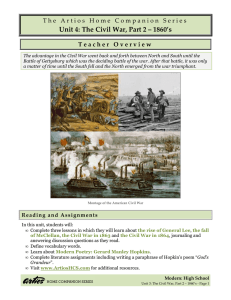
Unit 4: The Civil War, Part 2 – 1860`s
... 4. Up until the Battle of Antietam the war had been a war for what cause? 5. After the Battle of Antietam, what statement did Lincoln issue that was really a “measure of war?” 6. The Emancipation was a warning to the South and gave them a deadline to do what? 7. If the South did not heed the warning ...
... 4. Up until the Battle of Antietam the war had been a war for what cause? 5. After the Battle of Antietam, what statement did Lincoln issue that was really a “measure of war?” 6. The Emancipation was a warning to the South and gave them a deadline to do what? 7. If the South did not heed the warning ...
1 Standard 8.80 Lesson
... Eye witness account to the First Battle of Bull Run http://www.eyewitnesstohistory.com/bullrun.htm When the war began in April 1861, most Americans expected the conflict to be brief. When President Lincoln called upon the governors and states of the Union to furnish him with 75,000 soldiers, he aske ...
... Eye witness account to the First Battle of Bull Run http://www.eyewitnesstohistory.com/bullrun.htm When the war began in April 1861, most Americans expected the conflict to be brief. When President Lincoln called upon the governors and states of the Union to furnish him with 75,000 soldiers, he aske ...

Problems at Home in the South
... the War • Free African Americans and escaped slaves enlisted in the Union army. • At first black troops served only as laborers, building roads and guarding supplies. • By 1863, African American troops were fighting in major battles. One of the most famous African American units was the 54th Massach ...
... the War • Free African Americans and escaped slaves enlisted in the Union army. • At first black troops served only as laborers, building roads and guarding supplies. • By 1863, African American troops were fighting in major battles. One of the most famous African American units was the 54th Massach ...

Roads to Gettysburg - Carroll County Tourism
... attention of the citizens intrigued by the guns, tents, and battle stories of these weary veterans. Miss Maggie Mehring, just thirteen years old at the time, records in her wartime journal that she and some of her friends at the Kleesich School for Girls in New Windsor stayed up all night taking tur ...
... attention of the citizens intrigued by the guns, tents, and battle stories of these weary veterans. Miss Maggie Mehring, just thirteen years old at the time, records in her wartime journal that she and some of her friends at the Kleesich School for Girls in New Windsor stayed up all night taking tur ...
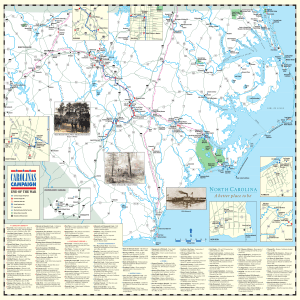
NC Map Side - NC Historic Sites
... Goldsboro bridge in Dec. 1862, encountered Confederates near Kinston. Confederate Line of Defense – Confederate Gen. Nathan G. Evans saw his left flank crumble here. Confederate Retreat – Evans’ troops retreated across a burning bridge, and Federals occupied Kinston. ...
... Goldsboro bridge in Dec. 1862, encountered Confederates near Kinston. Confederate Line of Defense – Confederate Gen. Nathan G. Evans saw his left flank crumble here. Confederate Retreat – Evans’ troops retreated across a burning bridge, and Federals occupied Kinston. ...

Civil War Quiz
... Explanation: Lincoln's Cabinet was comprised of several men who thought they were better suited to be president than he was. Secretary of War Edwin Stanton wrote former President James Buchanan in 1861: "The imbecility of this Administration, culminated in that catastrophe (Bull Run), and irretrieva ...
... Explanation: Lincoln's Cabinet was comprised of several men who thought they were better suited to be president than he was. Secretary of War Edwin Stanton wrote former President James Buchanan in 1861: "The imbecility of this Administration, culminated in that catastrophe (Bull Run), and irretrieva ...
A Talk Delivered by James J. Geary Before the Harrisonburg
... with the idea that a talk on Appomattox would be appropriate for this Sunday. She mentioned it to my wife Pat, also a member of the committee. Pat suggested I could do the talk; but didn’t think I would want to. By the time I decided I wanted to get up here again, Bernie was already working on a ser ...
... with the idea that a talk on Appomattox would be appropriate for this Sunday. She mentioned it to my wife Pat, also a member of the committee. Pat suggested I could do the talk; but didn’t think I would want to. By the time I decided I wanted to get up here again, Bernie was already working on a ser ...
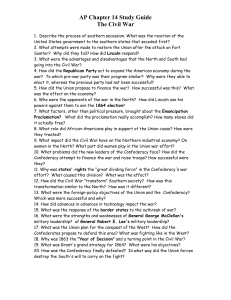
AP Chapter 14 Study Guide
... 3. What were the advantages and disadvantages that the North and South had going into the Civil War? 4. How did the Republican Party act to expand the American economy during the war? To which pre-war party was their program similar? Why were they able to enact it, whereas the previous party had not ...
... 3. What were the advantages and disadvantages that the North and South had going into the Civil War? 4. How did the Republican Party act to expand the American economy during the war? To which pre-war party was their program similar? Why were they able to enact it, whereas the previous party had not ...
Civil War - Saylor Academy
... McClellan's to create a powerful force. Stonewall Jackson attempted to prevent this danger by surrounding Pope's Army in Manassas. Both sides fought on August 29, and the Confederates won against a much larger Union force. Pope's battered Army did eventually combine with McClellan's. But the Second ...
... McClellan's to create a powerful force. Stonewall Jackson attempted to prevent this danger by surrounding Pope's Army in Manassas. Both sides fought on August 29, and the Confederates won against a much larger Union force. Pope's battered Army did eventually combine with McClellan's. But the Second ...
The Civil War – Create A “Living” Timeline - Database of K
... Union General McClellan defeated Confederate General Lee at South Mountain and Crampton’s Gap in September, but did not move quickly enough to save Harper’s Ferry, which fell to Confederate General Jackson on September 15, along with a great number of men and a large body of supplies. September 18 ...
... Union General McClellan defeated Confederate General Lee at South Mountain and Crampton’s Gap in September, but did not move quickly enough to save Harper’s Ferry, which fell to Confederate General Jackson on September 15, along with a great number of men and a large body of supplies. September 18 ...
Identifying political and military turning points of the
... Several union generals played important roles on the Union’s battles. President Lincoln had to fire several of them for lack of success in battles. McClellan, Burnside and Hooker were all fired by Lincoln for losing too many men or bad decisions. General Sherman was most well known for being aggress ...
... Several union generals played important roles on the Union’s battles. President Lincoln had to fire several of them for lack of success in battles. McClellan, Burnside and Hooker were all fired by Lincoln for losing too many men or bad decisions. General Sherman was most well known for being aggress ...
The Civil War - Riverside Preparatory High School
... In an effort to placate the slave-holding border states, Lincoln resisted the demands of radical Republicans for complete abolition. Yet some Union generals, such as General B. F. Butler, declared slaves escaping to their lines "contraband of war," not to be returned to their masters. Other genera ...
... In an effort to placate the slave-holding border states, Lincoln resisted the demands of radical Republicans for complete abolition. Yet some Union generals, such as General B. F. Butler, declared slaves escaping to their lines "contraband of war," not to be returned to their masters. Other genera ...
Chapter 4 PP
... About 18,000 northern blacks enlist in the army Many white soldiers are reluctant to serve with blacks Blacks earn the respect of white soldiers with their bravery and skills on the battlefields About 70,000 blacks lose their lives in the war ...
... About 18,000 northern blacks enlist in the army Many white soldiers are reluctant to serve with blacks Blacks earn the respect of white soldiers with their bravery and skills on the battlefields About 70,000 blacks lose their lives in the war ...

smith Civil War ppt 2008
... •Became effective on Jan. 1, 1863, in those states still in rebellion. •Emancipation Proclamation did not end slavery in US •Lincoln’s “first” step towards ending slavery. ...
... •Became effective on Jan. 1, 1863, in those states still in rebellion. •Emancipation Proclamation did not end slavery in US •Lincoln’s “first” step towards ending slavery. ...
US History/Civil War
... McClellan's to create a powerful force. Stonewall Jackson attempted to prevent this danger by surrounding Pope's Army in Manassas. Both sides fought on August 29, and the Confederates won against a much larger Union force. Pope's battered Army did eventually combine with McClellan's. But the Second ...
... McClellan's to create a powerful force. Stonewall Jackson attempted to prevent this danger by surrounding Pope's Army in Manassas. Both sides fought on August 29, and the Confederates won against a much larger Union force. Pope's battered Army did eventually combine with McClellan's. But the Second ...

The Civil War - Cloudfront.net
... • January 1863 The Emancipation Proclamation goes into effect *Freeing Southern slaves weakened the Confederacy. Lincoln’s action could be seen as a military action. ...
... • January 1863 The Emancipation Proclamation goes into effect *Freeing Southern slaves weakened the Confederacy. Lincoln’s action could be seen as a military action. ...

The Civil War Review
... ___________ _____________ was the Republican candidate for president in 1860. Because the _____________ Party split over the issue of slavery, Lincoln easily won a majority of ______________ votes and became the sixteenth ____________ of the United States. However, several ____________ states refuse ...
... ___________ _____________ was the Republican candidate for president in 1860. Because the _____________ Party split over the issue of slavery, Lincoln easily won a majority of ______________ votes and became the sixteenth ____________ of the United States. However, several ____________ states refuse ...
The Civil War – Create A Living Timeline Overview Students will
... General Grant, promoted to commander of the Union armies, planned to engage Lee’s forces in Virginia until they were destroyed. North and South met and fought in an inconclusive three‐day battle in the Wilderness. Lee inflicted more casualties on the Union forces than his own army incurred, but ...
... General Grant, promoted to commander of the Union armies, planned to engage Lee’s forces in Virginia until they were destroyed. North and South met and fought in an inconclusive three‐day battle in the Wilderness. Lee inflicted more casualties on the Union forces than his own army incurred, but ...
Lecture S15 -- The Confederacy and the United States
... Suspension of Habeas Corpus: Congress frequently allowed Davis to impose martial law and/or suspend the right of Habeas Corpus, thus allowing for arbitrary arrest. Davis was not the type to abuse this too heavily, though. The Draft: The Confederacy imposed the first draft in American history; eventu ...
... Suspension of Habeas Corpus: Congress frequently allowed Davis to impose martial law and/or suspend the right of Habeas Corpus, thus allowing for arbitrary arrest. Davis was not the type to abuse this too heavily, though. The Draft: The Confederacy imposed the first draft in American history; eventu ...
Second Battle of Drewry`s Bluff
... House, carrying one defensive line after stiff fighting. Beauregard fell back to another line of prepared defenses, and the tenacious Confederate defense showed their growing strength. Despite success Butler remained cautious and Beauregard had more time to concentrate troops. He was helped by lefto ...
... House, carrying one defensive line after stiff fighting. Beauregard fell back to another line of prepared defenses, and the tenacious Confederate defense showed their growing strength. Despite success Butler remained cautious and Beauregard had more time to concentrate troops. He was helped by lefto ...

President`s Message, March 30, 2017 Dear Civil War Enthusiasts, I
... in the Second Virginia Infantry, part of the Stonewall Brigade. The family moved to Martinsburg when Belle was ten along with their six slaves, one of whom, Eliza Corsey, became Belle's close friend and helped in her espionage adventures. By candlelight, Belle defied the law and taught Eliza to read ...
... in the Second Virginia Infantry, part of the Stonewall Brigade. The family moved to Martinsburg when Belle was ten along with their six slaves, one of whom, Eliza Corsey, became Belle's close friend and helped in her espionage adventures. By candlelight, Belle defied the law and taught Eliza to read ...
Waynesboro Driving Tour
... Riding through sleet on March 2, 1865, Union cavalry divisions under Gen. George A. Custer and Gen. Thomas Devin advanced east from Staunton, arriving near Waynesboro in the early afternoon. There, they found Early’s small army, consisting of a remnant of Gen. Gabriel C. Wharton’s division and some ...
... Riding through sleet on March 2, 1865, Union cavalry divisions under Gen. George A. Custer and Gen. Thomas Devin advanced east from Staunton, arriving near Waynesboro in the early afternoon. There, they found Early’s small army, consisting of a remnant of Gen. Gabriel C. Wharton’s division and some ...

File
... Gettysburg 5 razones que Lee invadio a Pennsylvania : 1. to disrupt the Union’s ability to attack the Confederate capital at Richmond, Virginia 2. to draw the United States Army away from the safety of the defenses of Washington, D.C. and fight them in the “open” ...
... Gettysburg 5 razones que Lee invadio a Pennsylvania : 1. to disrupt the Union’s ability to attack the Confederate capital at Richmond, Virginia 2. to draw the United States Army away from the safety of the defenses of Washington, D.C. and fight them in the “open” ...
Battle of Antietam

The Battle of Antietam /ænˈtiːtəm/, also known as the Battle of Sharpsburg, particularly in the South, fought on September 17, 1862, near Sharpsburg, Maryland, and Antietam Creek as part of the Maryland Campaign, was the first major battle in the American Civil War to take place on Union soil. It is the bloodiest single-day battle in American history, with a combined tally of dead, wounded, and missing at 22,717.After pursuing Confederate General Robert E. Lee into Maryland, Union Army Maj. Gen. George B. McClellan launched attacks against Lee's army, in defensive positions behind Antietam Creek. At dawn on September 17, Maj. Gen. Joseph Hooker's corps mounted a powerful assault on Lee's left flank. Attacks and counterattacks swept across Miller's Cornfield and fighting swirled around the Dunker Church. Union assaults against the Sunken Road eventually pierced the Confederate center, but the Federal advantage was not followed up. In the afternoon, Union Maj. Gen. Ambrose Burnside's corps entered the action, capturing a stone bridge over Antietam Creek and advancing against the Confederate right. At a crucial moment, Confederate Maj. Gen. A. P. Hill's division arrived from Harpers Ferry and launched a surprise counterattack, driving back Burnside and ending the battle. Although outnumbered two-to-one, Lee committed his entire force, while McClellan sent in less than three-quarters of his army, enabling Lee to fight the Federals to a standstill. During the night, both armies consolidated their lines. In spite of crippling casualties, Lee continued to skirmish with McClellan throughout September 18, while removing his battered army south of the Potomac River.Despite having superiority of numbers, McClellan's attacks failed to achieve force concentration, allowing Lee to counter by shifting forces and moving interior lines to meet each challenge. Despite ample reserve forces that could have been deployed to exploit localized successes, McClellan failed to destroy Lee's army. McClellan had halted Lee's invasion of Maryland, but Lee was able to withdraw his army back to Virginia without interference from the cautious McClellan. Although the battle was tactically inconclusive, the Confederate troops had withdrawn first from the battlefield, making it, in military terms, a Union victory. It had significance as enough of a victory to give President Abraham Lincoln the confidence to announce his Emancipation Proclamation, which discouraged the British and French governments from potential plans for recognition of the Confederacy.