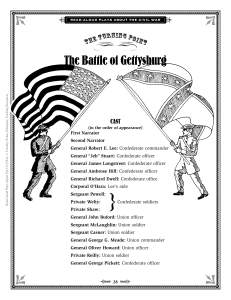
The Battle of Gettysburg - Crest Ridge R-VII
... troops’ morale was high but supplies were low, decided to take the bold move of invading Pennsylvania in the hopes of bringing the war to a quick end and suing for a peace that would be satisfactory to the South. He calculated that he could overcome his disadvantages in numbers by surprising the Uni ...
... troops’ morale was high but supplies were low, decided to take the bold move of invading Pennsylvania in the hopes of bringing the war to a quick end and suing for a peace that would be satisfactory to the South. He calculated that he could overcome his disadvantages in numbers by surprising the Uni ...
THE CIVIL WAR IN WEST VIRGINIA 1861 The Civil War began
... Washington, D.C. After a series of victories in the Shenandoah Valley, Jubal Early's Confederate troops attacked Union positions on Bolivar Heights near Harpers Ferry on July 4. The northern troops were forced to abandon Harpers Ferry for the first ...
... Washington, D.C. After a series of victories in the Shenandoah Valley, Jubal Early's Confederate troops attacked Union positions on Bolivar Heights near Harpers Ferry on July 4. The northern troops were forced to abandon Harpers Ferry for the first ...
Jackson Valley Campaign - Charlottesville Civil War Roundtable
... withdraw towards Harper's Ferry and continue his flight into Maryland. Although outnumbered and facing two Union armies, Jackson had cleared the Shenandoah Valley of all Federal troops in just over two weeks. These battles also completed his primary objective of diverting Federal forces away from th ...
... withdraw towards Harper's Ferry and continue his flight into Maryland. Although outnumbered and facing two Union armies, Jackson had cleared the Shenandoah Valley of all Federal troops in just over two weeks. These battles also completed his primary objective of diverting Federal forces away from th ...
Appomattox Court House
... Appomattox Court House, an obscure Virginia village when Gen. Robert E. Lee surrendered the Army of Northern Virginia, was typical of hundreds of hamlets t h r o u g h o u t the South. A federal soldier noted at the time that it consisted of only a handful of dwellings, a tavern, and a c o u r t h o ...
... Appomattox Court House, an obscure Virginia village when Gen. Robert E. Lee surrendered the Army of Northern Virginia, was typical of hundreds of hamlets t h r o u g h o u t the South. A federal soldier noted at the time that it consisted of only a handful of dwellings, a tavern, and a c o u r t h o ...

Causes of the American Civil War!
... Lincoln won the North, Breckinridge won the South • North had more electoral college votes so Lincoln won the Election of ...
... Lincoln won the North, Breckinridge won the South • North had more electoral college votes so Lincoln won the Election of ...

Unit 4: Civil War and Reconstruction
... C. Nearly 25,000 died - more than Revolutionary War, War of 1812 and Mexican War combined! D. Shiloh opened the way for Union forces to split the Confederacy in half and gain control of Miss. River VII. Battle of Antietam – September 17, 1862 A. First engagement in the North – Sharpsburg, MD B. Unio ...
... C. Nearly 25,000 died - more than Revolutionary War, War of 1812 and Mexican War combined! D. Shiloh opened the way for Union forces to split the Confederacy in half and gain control of Miss. River VII. Battle of Antietam – September 17, 1862 A. First engagement in the North – Sharpsburg, MD B. Unio ...
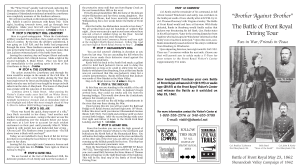
The Battle of Front Royal Driving Tour
... miles. Yet for the very reason that it succeeded brilliantly without costly battles, the Valley Campaign enshrined Jackson as one of history’s great military commanders. It demonstrated dramatically the powerful strategic influence that small armies, operating on the enemy’s flank and threatening hi ...
... miles. Yet for the very reason that it succeeded brilliantly without costly battles, the Valley Campaign enshrined Jackson as one of history’s great military commanders. It demonstrated dramatically the powerful strategic influence that small armies, operating on the enemy’s flank and threatening hi ...

of the Blue and Gray - Frederick County Civil War Roundtable
... were known. The regiments nickname was derived from the fact that it was made up of men with English and Scottish ancestry, ancestors who had supported the Parliament in the English Civil War, the “Roundheads” who fought against King Charles I supporters, the “Cavaliers”. It was very interesting to ...
... were known. The regiments nickname was derived from the fact that it was made up of men with English and Scottish ancestry, ancestors who had supported the Parliament in the English Civil War, the “Roundheads” who fought against King Charles I supporters, the “Cavaliers”. It was very interesting to ...
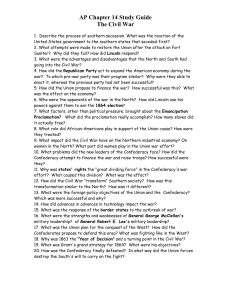
AP Chapter 14 Study Guide
... 3. What were the advantages and disadvantages that the North and South had going into the Civil War? 4. How did the Republican Party act to expand the American economy during the war? To which pre-war party was their program similar? Why were they able to enact it, whereas the previous party had not ...
... 3. What were the advantages and disadvantages that the North and South had going into the Civil War? 4. How did the Republican Party act to expand the American economy during the war? To which pre-war party was their program similar? Why were they able to enact it, whereas the previous party had not ...
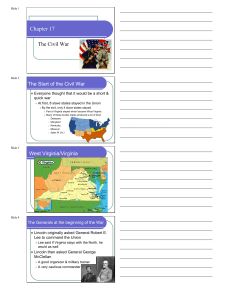

Chapter 19: The Civil War
... Battles Lee forced McClellan and the Union troops to retreat again. Casualty numbers were high for both sides. Lincoln then ordered General John Pope to attack Richmond. Again Lee and the Rebels forced the Union troops to retreat at the Second Battle of Bull Run. By August of 1862 nearly all Union t ...
... Battles Lee forced McClellan and the Union troops to retreat again. Casualty numbers were high for both sides. Lincoln then ordered General John Pope to attack Richmond. Again Lee and the Rebels forced the Union troops to retreat at the Second Battle of Bull Run. By August of 1862 nearly all Union t ...
Civil War Pictures Questions
... Hydrogen-filled balloons were becoming more predictable in the mid-1800s, and several men proposed using them for scientific experiments and for observation missions in the Civil War. Two men, Thaddeus Lowe and John LaMountain, competed for the right to have a Union army contract. Lowe won the endor ...
... Hydrogen-filled balloons were becoming more predictable in the mid-1800s, and several men proposed using them for scientific experiments and for observation missions in the Civil War. Two men, Thaddeus Lowe and John LaMountain, competed for the right to have a Union army contract. Lowe won the endor ...

chapter21questions
... 1. How long did Lincoln envision the war to last after he called up the 75,000 militia men? (p. 453) 2. Why did Lincoln decide to attack at Bull Run and what was the ultimate goal? Who accompanied the soldiers as they went to Bull Run to fight? Who won his well-deserved nickname at this battle? Who ...
... 1. How long did Lincoln envision the war to last after he called up the 75,000 militia men? (p. 453) 2. Why did Lincoln decide to attack at Bull Run and what was the ultimate goal? Who accompanied the soldiers as they went to Bull Run to fight? Who won his well-deserved nickname at this battle? Who ...
AP Chapter 14 Study Guide
... 3. What were the advantages and disadvantages that the North and South had going into the Civil War? 4. How did the Republican Party act to expand the American economy during the war? To which pre-war party was their program similar? Why were they able to enact it, whereas the previous party had not ...
... 3. What were the advantages and disadvantages that the North and South had going into the Civil War? 4. How did the Republican Party act to expand the American economy during the war? To which pre-war party was their program similar? Why were they able to enact it, whereas the previous party had not ...
The American Civil War
... planned to kidnap Abraham Lincoln, subsequently deciding to assassinate ...
... planned to kidnap Abraham Lincoln, subsequently deciding to assassinate ...

Union
... • Major General John Pope, a Union troop leader in northern Virginia attacked approaching Confederate troops lead by Stonewall Jackson on August 29,1862. • This started the Second Battle of Bull Run. • Confederates WIN this battle • Lee and his men were only 20 miles from Washington D.C. ...
... • Major General John Pope, a Union troop leader in northern Virginia attacked approaching Confederate troops lead by Stonewall Jackson on August 29,1862. • This started the Second Battle of Bull Run. • Confederates WIN this battle • Lee and his men were only 20 miles from Washington D.C. ...

THE GETTYSBURG ADDRESS: MARKING THE TURNING POINT
... seem best for our interest.” After the long march north, Confederate troops were spread from Chambersburg, through Carlisle, and into York. Towns across southern Pennsylvania were being “explored” for much needed supplies to continue the Southern offensive. While looking in Gettysburg, Pettigrew’s b ...
... seem best for our interest.” After the long march north, Confederate troops were spread from Chambersburg, through Carlisle, and into York. Towns across southern Pennsylvania were being “explored” for much needed supplies to continue the Southern offensive. While looking in Gettysburg, Pettigrew’s b ...
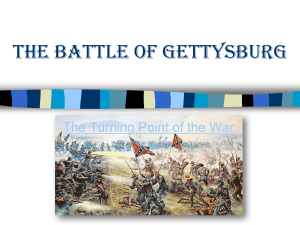
The Battle of Gettysburg - Reeths
... It is rather for us to be here dedicated to the great task remaining before us--that from these honored dead we take increased devotion to that cause for which they gave the last full measure of devotion--that we here highly resolve that these dead shall not have died in vain, that this nation under ...
... It is rather for us to be here dedicated to the great task remaining before us--that from these honored dead we take increased devotion to that cause for which they gave the last full measure of devotion--that we here highly resolve that these dead shall not have died in vain, that this nation under ...
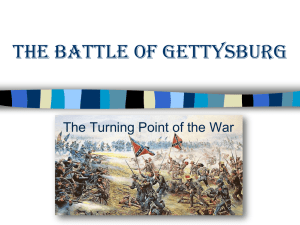
Battle of Gettysburg PPT
... On the 3rd day of battle, Lee orders an all-out attack on the center of the Union line. George Pickett leads 15,000 Confederate soldiers in a charge across the low ground separating the two forces “High Tide of the Confederacy” – Northern-most point reached by Confederate army – Closest and last cha ...
... On the 3rd day of battle, Lee orders an all-out attack on the center of the Union line. George Pickett leads 15,000 Confederate soldiers in a charge across the low ground separating the two forces “High Tide of the Confederacy” – Northern-most point reached by Confederate army – Closest and last cha ...
And So the Murderous Work Went On
... battery and the silence of the artillery reserves, the Confederates never had more than eight guns in action at any one time during the barrage.8 Within a short time it was evident that the Confederate bombardment was not weakening the Union position on Malvern Hill. Doubting the effectiveness of a ...
... battery and the silence of the artillery reserves, the Confederates never had more than eight guns in action at any one time during the barrage.8 Within a short time it was evident that the Confederate bombardment was not weakening the Union position on Malvern Hill. Doubting the effectiveness of a ...
Rappahannock Valley Civil War Round Table Newsletter
... Vicksburg and a July 30, 1864 explosion at Petersburg. In both instances the mines were dug by infantrymen, some with pre-war mining experience, and in both instances the attacks following the detonation of the mine failed. Al also pointed out that the U.S. Military Railroad system constructed bridg ...
... Vicksburg and a July 30, 1864 explosion at Petersburg. In both instances the mines were dug by infantrymen, some with pre-war mining experience, and in both instances the attacks following the detonation of the mine failed. Al also pointed out that the U.S. Military Railroad system constructed bridg ...
Supporting Robert E. Lee`s Decisions at Gettysburg By Michael
... band of Union cavalry totaling about three thousand men). Buford soon received infantry support from the Union 1st Corps., under John Reynolds (See maps 2 and 3). According to Michael Shaara, the skirmish escalated into a large-scale battle in which Heth's division was pushed back and suffered heavy ...
... band of Union cavalry totaling about three thousand men). Buford soon received infantry support from the Union 1st Corps., under John Reynolds (See maps 2 and 3). According to Michael Shaara, the skirmish escalated into a large-scale battle in which Heth's division was pushed back and suffered heavy ...

15 Crucible of Freedom: Civil War 1861 – 1865
... southern coastline, capture the Mississippi River, then wait for Southern __________ to seize control of the CSA. ...
... southern coastline, capture the Mississippi River, then wait for Southern __________ to seize control of the CSA. ...

Battle of Antietam

The Battle of Antietam /ænˈtiːtəm/, also known as the Battle of Sharpsburg, particularly in the South, fought on September 17, 1862, near Sharpsburg, Maryland, and Antietam Creek as part of the Maryland Campaign, was the first major battle in the American Civil War to take place on Union soil. It is the bloodiest single-day battle in American history, with a combined tally of dead, wounded, and missing at 22,717.After pursuing Confederate General Robert E. Lee into Maryland, Union Army Maj. Gen. George B. McClellan launched attacks against Lee's army, in defensive positions behind Antietam Creek. At dawn on September 17, Maj. Gen. Joseph Hooker's corps mounted a powerful assault on Lee's left flank. Attacks and counterattacks swept across Miller's Cornfield and fighting swirled around the Dunker Church. Union assaults against the Sunken Road eventually pierced the Confederate center, but the Federal advantage was not followed up. In the afternoon, Union Maj. Gen. Ambrose Burnside's corps entered the action, capturing a stone bridge over Antietam Creek and advancing against the Confederate right. At a crucial moment, Confederate Maj. Gen. A. P. Hill's division arrived from Harpers Ferry and launched a surprise counterattack, driving back Burnside and ending the battle. Although outnumbered two-to-one, Lee committed his entire force, while McClellan sent in less than three-quarters of his army, enabling Lee to fight the Federals to a standstill. During the night, both armies consolidated their lines. In spite of crippling casualties, Lee continued to skirmish with McClellan throughout September 18, while removing his battered army south of the Potomac River.Despite having superiority of numbers, McClellan's attacks failed to achieve force concentration, allowing Lee to counter by shifting forces and moving interior lines to meet each challenge. Despite ample reserve forces that could have been deployed to exploit localized successes, McClellan failed to destroy Lee's army. McClellan had halted Lee's invasion of Maryland, but Lee was able to withdraw his army back to Virginia without interference from the cautious McClellan. Although the battle was tactically inconclusive, the Confederate troops had withdrawn first from the battlefield, making it, in military terms, a Union victory. It had significance as enough of a victory to give President Abraham Lincoln the confidence to announce his Emancipation Proclamation, which discouraged the British and French governments from potential plans for recognition of the Confederacy.