
LAG-25 Gettysburg
... by Northerners for his prowess as a general. But there is another less positive view of General Lee. Lee had been a brilliant officer in the Union Army. He disliked slavery and did not agree with secession. Just before the war, when secession was imminent, President Lincoln offered Lee the command o ...
... by Northerners for his prowess as a general. But there is another less positive view of General Lee. Lee had been a brilliant officer in the Union Army. He disliked slavery and did not agree with secession. Just before the war, when secession was imminent, President Lincoln offered Lee the command o ...
vocab units 13 n 14
... September 16, 1862, the Confederate and Union armies were in position for what would be the fiercest battle in the Civil War. On the morning of September 17th, Union artillery initiated the fighting by firing at Confederate troops near a church. Unlike numerous previous battles in which the Confeder ...
... September 16, 1862, the Confederate and Union armies were in position for what would be the fiercest battle in the Civil War. On the morning of September 17th, Union artillery initiated the fighting by firing at Confederate troops near a church. Unlike numerous previous battles in which the Confeder ...
The Great Healing: Reconciliation After the Civil War
... many of them did continue their barbarities in both government service and private practice, often in the same way as the atrocities were committed during the war. Confederate General Nathan Bedford Forrest’s troops had massacred hundreds of black soldiers who had already surrendered at Ft. Pillow i ...
... many of them did continue their barbarities in both government service and private practice, often in the same way as the atrocities were committed during the war. Confederate General Nathan Bedford Forrest’s troops had massacred hundreds of black soldiers who had already surrendered at Ft. Pillow i ...

vol. xxxvii, no. 2 november 1996
... Secretary of the Navy Gideon Welles stated that Halleck “originates nothing, anticipates nothing….takes no responsibility, plans nothing, suggests nothing, is good for nothing.” George McClellan proclaimed, “Of all men whom I encountered in high position, Halleck was the most hopelessly stupid. It w ...
... Secretary of the Navy Gideon Welles stated that Halleck “originates nothing, anticipates nothing….takes no responsibility, plans nothing, suggests nothing, is good for nothing.” George McClellan proclaimed, “Of all men whom I encountered in high position, Halleck was the most hopelessly stupid. It w ...

CH 11_AM HISTORY III
... Days’ Battle - South lost more men but forced north to retreat Lee’ determination and unorthodox tactics caused McClellan leave Richmond Lee decided to invade the north - Hoped a victory in the north would convince Lincoln to talk peace - Hoped a victory would also persuade Europe to side with the s ...
... Days’ Battle - South lost more men but forced north to retreat Lee’ determination and unorthodox tactics caused McClellan leave Richmond Lee decided to invade the north - Hoped a victory in the north would convince Lincoln to talk peace - Hoped a victory would also persuade Europe to side with the s ...
The Battle of Lewis`s Farm
... Chamberlain - By this point in the war, Joshua L. Chamberlain was well known, almost legendary figure amongst the men of the V Corps. His stand (with the 20th ME) on Little Round Top at Gettysburg, and his multiple battle wounds had earned him a hero’s reputation amongst the ranks. Though relativel ...
... Chamberlain - By this point in the war, Joshua L. Chamberlain was well known, almost legendary figure amongst the men of the V Corps. His stand (with the 20th ME) on Little Round Top at Gettysburg, and his multiple battle wounds had earned him a hero’s reputation amongst the ranks. Though relativel ...
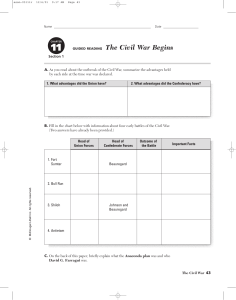
CHAPTER 11 GUIDED READING The Civil War Begins
... Farragut saw action with Porter in the War of 1812. When their ship defeated the British in battle, Farragut—only 12—was allowed to sail one of the captured ships to port. The next year, Porter’s ship was taken, but Farragut’s daring and coolness in battle impressed him. For the next four-and-a-half ...
... Farragut saw action with Porter in the War of 1812. When their ship defeated the British in battle, Farragut—only 12—was allowed to sail one of the captured ships to port. The next year, Porter’s ship was taken, but Farragut’s daring and coolness in battle impressed him. For the next four-and-a-half ...
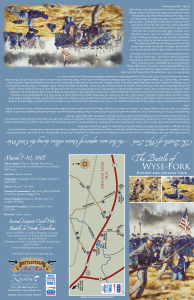
Battle of Wyse Fork
... Hoke’s assault on the Union’s left flank cut the 15th Conn. & 27th Mass. off from their support two miles away at Wyse Fork. The outnumbered and surprised Union soldiers turned about face and fired at Hoke’s attacking infantry three times. Each time the Confederates enveloped them and forced them in ...
... Hoke’s assault on the Union’s left flank cut the 15th Conn. & 27th Mass. off from their support two miles away at Wyse Fork. The outnumbered and surprised Union soldiers turned about face and fired at Hoke’s attacking infantry three times. Each time the Confederates enveloped them and forced them in ...

The American Civil War
... Electors from South Carolina were appointed by the State Legislature not elected by ...
... Electors from South Carolina were appointed by the State Legislature not elected by ...

Dealing w/ Dissent in the S
... • McC out of the picture, Lee & Stonewall Jackson boldly struck north • 2nd Bull Run: Conf. routed Union under John Pope • Lee, bolder now, crossed Potomac & attacked w. MD, to relieve pressure fr. Richmond, hoping Fr. & Br. to recognize Conf. – But McC met him at battle of Antietam (Sharpsburg) & v ...
... • McC out of the picture, Lee & Stonewall Jackson boldly struck north • 2nd Bull Run: Conf. routed Union under John Pope • Lee, bolder now, crossed Potomac & attacked w. MD, to relieve pressure fr. Richmond, hoping Fr. & Br. to recognize Conf. – But McC met him at battle of Antietam (Sharpsburg) & v ...
November - Old Baldy Civil War Round Table
... This was Election Day, one of the few you can call "one of the most important elections in the history of the United States of America" without fear of exaggeration. The contestants were the Republican incumbent Abraham Lincoln, who had replaced his somewhat lackluster vice president Hannibal Hamlin ...
... This was Election Day, one of the few you can call "one of the most important elections in the history of the United States of America" without fear of exaggeration. The contestants were the Republican incumbent Abraham Lincoln, who had replaced his somewhat lackluster vice president Hannibal Hamlin ...
William C - Essential Civil War Curriculum
... As the spring of 1864 approached, President Abraham Lincoln questioned whether voters would award him a second term. Spurred by the need for military successes, Lincoln summoned Ulysses S. Grant to Washington, arranged for his promotion to lieutenant general, and placed him in charge of the nation’s ...
... As the spring of 1864 approached, President Abraham Lincoln questioned whether voters would award him a second term. Spurred by the need for military successes, Lincoln summoned Ulysses S. Grant to Washington, arranged for his promotion to lieutenant general, and placed him in charge of the nation’s ...

textbook pages 175-183. - San Leandro Unified School District
... fought to take Vicksburg, one of the two remaining Confederate strongholds on the Mississippi River. Vicksburg itself was particularly important because it rested on bluffs above the river from which guns could control all water traffic. In the winter of 1862–1863, Grant tried several schemes to rea ...
... fought to take Vicksburg, one of the two remaining Confederate strongholds on the Mississippi River. Vicksburg itself was particularly important because it rested on bluffs above the river from which guns could control all water traffic. In the winter of 1862–1863, Grant tried several schemes to rea ...

Civil War - Dover High School
... the region was unpleasant, dealing with the bickering of his subordinates-William W. Loring, John B. Floyd, and Henry A. Wise. After this he became known throughout the South as "Granny Lee. " His debut in field command had not been promising, but Jefferson Davis appointed him to command along the S ...
... the region was unpleasant, dealing with the bickering of his subordinates-William W. Loring, John B. Floyd, and Henry A. Wise. After this he became known throughout the South as "Granny Lee. " His debut in field command had not been promising, but Jefferson Davis appointed him to command along the S ...


The Furnace of Civil War, 1861-1865
... Lee family of Virginia. When Robert was still a boy, his father sank into debtor’s prison and disgrace, and eventually left the family. An 1829 graduate of West Point, where he was a distinguished student, the younger Lee married Mary Custis, a great-granddaughter of Martha Washington, and became ma ...
... Lee family of Virginia. When Robert was still a boy, his father sank into debtor’s prison and disgrace, and eventually left the family. An 1829 graduate of West Point, where he was a distinguished student, the younger Lee married Mary Custis, a great-granddaughter of Martha Washington, and became ma ...
Document
... held together by force • After the war, Lee encouraged Southerners to accept defeat and unite as Americans again ...
... held together by force • After the war, Lee encouraged Southerners to accept defeat and unite as Americans again ...
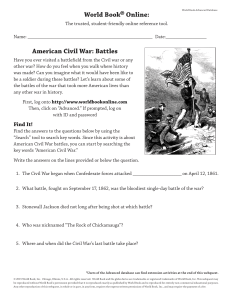
World Book® Online: American Civil War: Battles
... Heights get slaughtered. At the Battle of Fredericksburg, the Union army suffered approxi mately 13,000 casualties, mostly in front of Marye’s Heights. 26. In the middle of June, despite having a much larger force, Smith was reluctant to order a direct assault against the Confederates. ...
... Heights get slaughtered. At the Battle of Fredericksburg, the Union army suffered approxi mately 13,000 casualties, mostly in front of Marye’s Heights. 26. In the middle of June, despite having a much larger force, Smith was reluctant to order a direct assault against the Confederates. ...
Chapter 14 Fight to Gain a Country: The Civil War
... II. The Course of the War, 1862-1864 A. The Republicans’ War On April 27, 1861, Lincoln gave General Winfield Scott the power to suspend the writ of habeas corpus in Baltimore. By the end of the year, this measure, which was designed to target Southern sympathizers, was applied to most of the North ...
... II. The Course of the War, 1862-1864 A. The Republicans’ War On April 27, 1861, Lincoln gave General Winfield Scott the power to suspend the writ of habeas corpus in Baltimore. By the end of the year, this measure, which was designed to target Southern sympathizers, was applied to most of the North ...
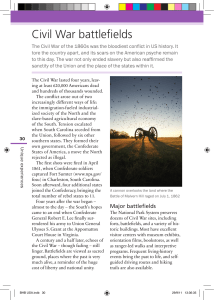
Civil War battlefields
... exhibitions are planned throughout the country through 2015. See www. civilwar150.org and www.nps.gov/ civilwar150 for details. The Battle of Gettysburg is re- enacted each year from July 1–3 on the Pennsylvania site on which the 1993 movie Gettysburg was filmed ...
... exhibitions are planned throughout the country through 2015. See www. civilwar150.org and www.nps.gov/ civilwar150 for details. The Battle of Gettysburg is re- enacted each year from July 1–3 on the Pennsylvania site on which the 1993 movie Gettysburg was filmed ...
The Civil War – Create A Living Timeline Overview Students will
... General Grant, promoted to commander of the Union armies, planned to engage Lee’s forces in Virginia until they were destroyed. North and South met and fought in an inconclusive three‐day battle in the Wilderness. Lee inflicted more casualties on the Union forces than his own army incurred, but ...
... General Grant, promoted to commander of the Union armies, planned to engage Lee’s forces in Virginia until they were destroyed. North and South met and fought in an inconclusive three‐day battle in the Wilderness. Lee inflicted more casualties on the Union forces than his own army incurred, but ...
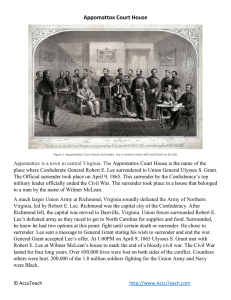
Surrender at Appomattox Court House
... him. This was contrasted by the mud stained uniform worn by Ulysses S. Grant. Grant and Lee had previously fought side-by side in the Mexican-American War. Grant offered generous terms to Robert E. Lee as a part of the surrender. General Grant allowed Lee and his men to keep their side arms and hors ...
... him. This was contrasted by the mud stained uniform worn by Ulysses S. Grant. Grant and Lee had previously fought side-by side in the Mexican-American War. Grant offered generous terms to Robert E. Lee as a part of the surrender. General Grant allowed Lee and his men to keep their side arms and hors ...
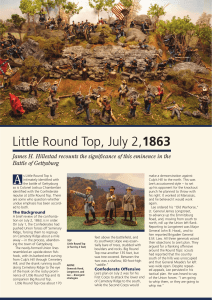
Little Round Top - A Sound Strategy, Inc.
... have enfiladed Meade’s position and made it too unhealthy for him to remain there. This however is countered by the shape and narrowness of the hill’s crest, which faced west. The guns would have to be placed one behind the other to engage the Union lines to the north on Cemetery Ridge -- thus dra ...
... have enfiladed Meade’s position and made it too unhealthy for him to remain there. This however is countered by the shape and narrowness of the hill’s crest, which faced west. The guns would have to be placed one behind the other to engage the Union lines to the north on Cemetery Ridge -- thus dra ...
US History I Ch. 16 Notes
... 3. Blockade the Southern coastline to keep goods from going into and out of the Confederacy b. A Confederate victory i. Southern Army led by General P.G.T. Beauregard at Manassas Junction in Virginia 1. Major railroad center near Washington, D.C. ii. Northern Army led by General Irvin McDowell 1. Pl ...
... 3. Blockade the Southern coastline to keep goods from going into and out of the Confederacy b. A Confederate victory i. Southern Army led by General P.G.T. Beauregard at Manassas Junction in Virginia 1. Major railroad center near Washington, D.C. ii. Northern Army led by General Irvin McDowell 1. Pl ...
Battle of Antietam

The Battle of Antietam /ænˈtiːtəm/, also known as the Battle of Sharpsburg, particularly in the South, fought on September 17, 1862, near Sharpsburg, Maryland, and Antietam Creek as part of the Maryland Campaign, was the first major battle in the American Civil War to take place on Union soil. It is the bloodiest single-day battle in American history, with a combined tally of dead, wounded, and missing at 22,717.After pursuing Confederate General Robert E. Lee into Maryland, Union Army Maj. Gen. George B. McClellan launched attacks against Lee's army, in defensive positions behind Antietam Creek. At dawn on September 17, Maj. Gen. Joseph Hooker's corps mounted a powerful assault on Lee's left flank. Attacks and counterattacks swept across Miller's Cornfield and fighting swirled around the Dunker Church. Union assaults against the Sunken Road eventually pierced the Confederate center, but the Federal advantage was not followed up. In the afternoon, Union Maj. Gen. Ambrose Burnside's corps entered the action, capturing a stone bridge over Antietam Creek and advancing against the Confederate right. At a crucial moment, Confederate Maj. Gen. A. P. Hill's division arrived from Harpers Ferry and launched a surprise counterattack, driving back Burnside and ending the battle. Although outnumbered two-to-one, Lee committed his entire force, while McClellan sent in less than three-quarters of his army, enabling Lee to fight the Federals to a standstill. During the night, both armies consolidated their lines. In spite of crippling casualties, Lee continued to skirmish with McClellan throughout September 18, while removing his battered army south of the Potomac River.Despite having superiority of numbers, McClellan's attacks failed to achieve force concentration, allowing Lee to counter by shifting forces and moving interior lines to meet each challenge. Despite ample reserve forces that could have been deployed to exploit localized successes, McClellan failed to destroy Lee's army. McClellan had halted Lee's invasion of Maryland, but Lee was able to withdraw his army back to Virginia without interference from the cautious McClellan. Although the battle was tactically inconclusive, the Confederate troops had withdrawn first from the battlefield, making it, in military terms, a Union victory. It had significance as enough of a victory to give President Abraham Lincoln the confidence to announce his Emancipation Proclamation, which discouraged the British and French governments from potential plans for recognition of the Confederacy.