JB APUSH Unit VB
... CSA’s Lee’s offensive into Pennsylvania to force peace by the Union or earn foreign support Pickett’s Charge and failure and near destruction of CSA military Deadliest battle of the entire war: over 50,000 casualties Widely considered the turning point of the war for a Union victory ...
... CSA’s Lee’s offensive into Pennsylvania to force peace by the Union or earn foreign support Pickett’s Charge and failure and near destruction of CSA military Deadliest battle of the entire war: over 50,000 casualties Widely considered the turning point of the war for a Union victory ...

End of the War between the States and Reconstruction
... The Union forces held their ground. On July 3, Lee ordered 15,000 men under the command of General George E. Pickett and General A. P. Hill to attack the Union troops. ...
... The Union forces held their ground. On July 3, Lee ordered 15,000 men under the command of General George E. Pickett and General A. P. Hill to attack the Union troops. ...

Unit 4:The Civil War, Part Two
... They had hardly any ships of any kind, and none at all meant for war. But they had possession of the government navy yard at Norfolk. There they found a half-finished frigate. They proceeded to finish her and turn her into an ironclad. When finished she was an ugly looking, black monster with slopin ...
... They had hardly any ships of any kind, and none at all meant for war. But they had possession of the government navy yard at Norfolk. There they found a half-finished frigate. They proceeded to finish her and turn her into an ironclad. When finished she was an ugly looking, black monster with slopin ...

WI251 ACW Invite:Article Template
... For every Southern boy fourteen years old, not once but whenever he wants it is the instant when it is still not yet two o'clock on that July afternoon in 1863, the brigades are in position behind the rail fence, the guns are laid and ready in the woods and the furled flags are already loosened to b ...
... For every Southern boy fourteen years old, not once but whenever he wants it is the instant when it is still not yet two o'clock on that July afternoon in 1863, the brigades are in position behind the rail fence, the guns are laid and ready in the woods and the furled flags are already loosened to b ...

The Civil War
... The Confederate strategy during the war was an Offensive Defense Protect Southern territory from “Northern aggression” but attack into Union territory when the opportunity presents itself Drag out the war as long as possible to make the North quit Get Britain and France to join their cause because ...
... The Confederate strategy during the war was an Offensive Defense Protect Southern territory from “Northern aggression” but attack into Union territory when the opportunity presents itself Drag out the war as long as possible to make the North quit Get Britain and France to join their cause because ...

PPT
... persons,about or anytheir of them, in any efforts farms they may make for their actual freedom...” ...
... persons,about or anytheir of them, in any efforts farms they may make for their actual freedom...” ...
The Clash of The Blue and The Gray
... preserved the union. At the same time, it meant centering on the Confederate mega-general who spent his life in that state and his entire time in that one theater - Robert E. Lee, considered by many to be one of the greatest military tacticians in world history. To that end we and FROSCH Travel have ...
... preserved the union. At the same time, it meant centering on the Confederate mega-general who spent his life in that state and his entire time in that one theater - Robert E. Lee, considered by many to be one of the greatest military tacticians in world history. To that end we and FROSCH Travel have ...


Remembering Columbia`s Longest Days Black Southerners in
... Confederacy as soldiers, teamsters, musicians, and cooks. They earned the same pay for their service as did white Confederate privates, which, in the Union Army, was not the case. They also earned the wrath of their fellow black men of the North. Ex-slave Frederick Douglas commented: “There are at t ...
... Confederacy as soldiers, teamsters, musicians, and cooks. They earned the same pay for their service as did white Confederate privates, which, in the Union Army, was not the case. They also earned the wrath of their fellow black men of the North. Ex-slave Frederick Douglas commented: “There are at t ...
Wilbanks-Civil.War.Handout - Mesa FamilySearch Library
... to predict the actions of his Union counterparts because of his personal familiarity with them as personal friend or as their former instructor - Major Robert Anderson, commanding Ft. Sumter, had been the artillery mentor of P.G.T. Beauregard, who fired on the that Fort starting the war ...
... to predict the actions of his Union counterparts because of his personal familiarity with them as personal friend or as their former instructor - Major Robert Anderson, commanding Ft. Sumter, had been the artillery mentor of P.G.T. Beauregard, who fired on the that Fort starting the war ...

GUIDED READING Chapter 8 Page 1
... South had to create one; (f) The North had an army, a navy, and an experienced government. ...
... South had to create one; (f) The North had an army, a navy, and an experienced government. ...

SIOP Lesson Plan
... Slide 6 (George Pickett) One of Lee’s ablest commanders. Charged with leading the final attack at Gettysburg, the one that bears his name. Lost half of his 12,000 men in the attack. Haunted by this until he died. Bore a grudge against Lee because of it. Slide 7 (General Hancock) General facing P ...
... Slide 6 (George Pickett) One of Lee’s ablest commanders. Charged with leading the final attack at Gettysburg, the one that bears his name. Lost half of his 12,000 men in the attack. Haunted by this until he died. Bore a grudge against Lee because of it. Slide 7 (General Hancock) General facing P ...

The American Nation
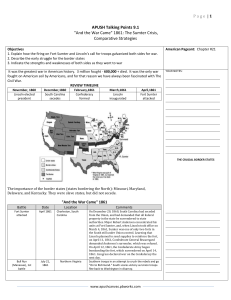
... gave Union a staging ground for offensives against southern cities along the Mississippi ...
... gave Union a staging ground for offensives against southern cities along the Mississippi ...

America`s History Seventh Edition
... economy was far superior to that of the South: more output, twothirds of railroads, and two-thirds of population. Southerners hoped to trade cotton for much needed supplies. Congress enacted a neomercantilist program of government-assisted economic development; imposed high tariffs, offered “free la ...
... economy was far superior to that of the South: more output, twothirds of railroads, and two-thirds of population. Southerners hoped to trade cotton for much needed supplies. Congress enacted a neomercantilist program of government-assisted economic development; imposed high tariffs, offered “free la ...
Ballston Spa`s Abner Doubleday A Brief Biographical Sketch
... leaving 4,000 dead Confederates. Total casualties: 23,000 Union, 28,000 Confederates Reinforced with troops from the East, Grant is able to push Southern troops back and prepare for assault on Atlanta and the heart of the Confederacy Grant prepares for assault on Richmond. When Lincoln's Cabinet com ...
... leaving 4,000 dead Confederates. Total casualties: 23,000 Union, 28,000 Confederates Reinforced with troops from the East, Grant is able to push Southern troops back and prepare for assault on Atlanta and the heart of the Confederacy Grant prepares for assault on Richmond. When Lincoln's Cabinet com ...
Third Winchester Driving Tour
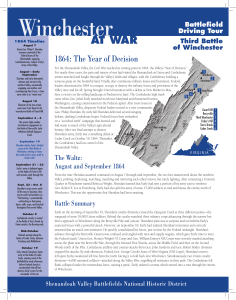
... Early on the morning of September 19, Sheridan’s cavalry divisions crossed the Opequon Creek at three different points—the vanguard of some 39,000 Union soldiers. Behind the cavalry marched three infantry corps advancing through the narrow but direct approach to Winchester along the Berryville Pike ...
... Early on the morning of September 19, Sheridan’s cavalry divisions crossed the Opequon Creek at three different points—the vanguard of some 39,000 Union soldiers. Behind the cavalry marched three infantry corps advancing through the narrow but direct approach to Winchester along the Berryville Pike ...
Lifelong Learning Academy American Civil War Daniel Stephens
... After the war he commanded the Louisiana Militia for awhile then resigned to teach military tactics and artillery at VMI. At the start of the war Jackson is given the rank of Colonel and trains ...
... After the war he commanded the Louisiana Militia for awhile then resigned to teach military tactics and artillery at VMI. At the start of the war Jackson is given the rank of Colonel and trains ...

The Battle Of Vicksburg
... Vicksburg, surrounding the Confederate army but also trapping hundreds of civilians in the city now turned into a war zone. Union troops began to dig siege works and place artillery to bombard the town as Southern soldiers and civilians prepared to withstand the coming onslaught. The Battle of Vicks ...
... Vicksburg, surrounding the Confederate army but also trapping hundreds of civilians in the city now turned into a war zone. Union troops began to dig siege works and place artillery to bombard the town as Southern soldiers and civilians prepared to withstand the coming onslaught. The Battle of Vicks ...

CH 16 1862 to 1865
... George B. McClellan Union soldiers found copy of Lee’s orders A cautious leader Hoped to attack before Lee could reunite army ...
... George B. McClellan Union soldiers found copy of Lee’s orders A cautious leader Hoped to attack before Lee could reunite army ...
The Civil War - Coronado High School
... -Lee led his army on the offensive into Maryland across the Potomac -He hoped that a major Confederate victory in the North would convince Britain to give official recognition and support -McClellan was reinstated with his command; he knew about Lee’s battle plan (Confederate officer dropped a copy) ...
... -Lee led his army on the offensive into Maryland across the Potomac -He hoped that a major Confederate victory in the North would convince Britain to give official recognition and support -McClellan was reinstated with his command; he knew about Lee’s battle plan (Confederate officer dropped a copy) ...

Part 4
... The night they drove old Dixie down And the bells were ringing The night they drove old Dixie down And all the people were singing They went, "Na, na, na…" The night they drove old Dixie down And all the bells were ringing The night they drove old Dixie down And the people were singing They went, "N ...
... The night they drove old Dixie down And the bells were ringing The night they drove old Dixie down And all the people were singing They went, "Na, na, na…" The night they drove old Dixie down And all the bells were ringing The night they drove old Dixie down And the people were singing They went, "N ...

Wilmot Proviso
... their ship at Havana, Cuba. Demanding the release of 2 Confederates. Lincoln then proceeded to release them. ...
... their ship at Havana, Cuba. Demanding the release of 2 Confederates. Lincoln then proceeded to release them. ...
Battle-Richmond-Brochure
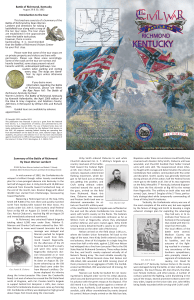
... units with calm skill. The inexperienced Union Infantry fought with courage and determination the veteran Confederate foot soldiers commanded with fine order and discipline. Scott’s cavalry was generally dominant during almost all of the action; half the Federal horses never got to the battle at all. ...
... units with calm skill. The inexperienced Union Infantry fought with courage and determination the veteran Confederate foot soldiers commanded with fine order and discipline. Scott’s cavalry was generally dominant during almost all of the action; half the Federal horses never got to the battle at all. ...

For Starters
... 250,000 Confederate soldiers lost their lives No war has ever resulted in more American deaths Before the war, Americans referred to “these United States” After they began speaking of “the United States”. • Millions of African Americans had gained their freedom. ...
... 250,000 Confederate soldiers lost their lives No war has ever resulted in more American deaths Before the war, Americans referred to “these United States” After they began speaking of “the United States”. • Millions of African Americans had gained their freedom. ...
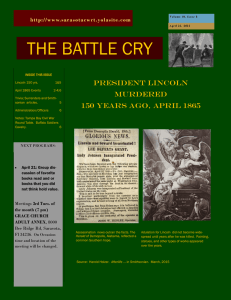
THE BATTLE CRY - Sarasota Civil War Round Table
... Lee continued his retreat. But now mutiny was a problem. General Ewell had to surrender his men at Sayler’s Creek when they refused to carry out his order to fight advancing Union troops. April 7th: Grant called on Lee to surrender the Army of Northern Virginia. Lee was effectively surrounded by a v ...
... Lee continued his retreat. But now mutiny was a problem. General Ewell had to surrender his men at Sayler’s Creek when they refused to carry out his order to fight advancing Union troops. April 7th: Grant called on Lee to surrender the Army of Northern Virginia. Lee was effectively surrounded by a v ...
Battle of Antietam

The Battle of Antietam /ænˈtiːtəm/, also known as the Battle of Sharpsburg, particularly in the South, fought on September 17, 1862, near Sharpsburg, Maryland, and Antietam Creek as part of the Maryland Campaign, was the first major battle in the American Civil War to take place on Union soil. It is the bloodiest single-day battle in American history, with a combined tally of dead, wounded, and missing at 22,717.After pursuing Confederate General Robert E. Lee into Maryland, Union Army Maj. Gen. George B. McClellan launched attacks against Lee's army, in defensive positions behind Antietam Creek. At dawn on September 17, Maj. Gen. Joseph Hooker's corps mounted a powerful assault on Lee's left flank. Attacks and counterattacks swept across Miller's Cornfield and fighting swirled around the Dunker Church. Union assaults against the Sunken Road eventually pierced the Confederate center, but the Federal advantage was not followed up. In the afternoon, Union Maj. Gen. Ambrose Burnside's corps entered the action, capturing a stone bridge over Antietam Creek and advancing against the Confederate right. At a crucial moment, Confederate Maj. Gen. A. P. Hill's division arrived from Harpers Ferry and launched a surprise counterattack, driving back Burnside and ending the battle. Although outnumbered two-to-one, Lee committed his entire force, while McClellan sent in less than three-quarters of his army, enabling Lee to fight the Federals to a standstill. During the night, both armies consolidated their lines. In spite of crippling casualties, Lee continued to skirmish with McClellan throughout September 18, while removing his battered army south of the Potomac River.Despite having superiority of numbers, McClellan's attacks failed to achieve force concentration, allowing Lee to counter by shifting forces and moving interior lines to meet each challenge. Despite ample reserve forces that could have been deployed to exploit localized successes, McClellan failed to destroy Lee's army. McClellan had halted Lee's invasion of Maryland, but Lee was able to withdraw his army back to Virginia without interference from the cautious McClellan. Although the battle was tactically inconclusive, the Confederate troops had withdrawn first from the battlefield, making it, in military terms, a Union victory. It had significance as enough of a victory to give President Abraham Lincoln the confidence to announce his Emancipation Proclamation, which discouraged the British and French governments from potential plans for recognition of the Confederacy.