The Indiana 51st Infantry Regiment
... end of large-scale fighting in the Western Theater of the American Civil War. It was fought at Nashville, Tennessee, on December 15–16, 1864, between the Confederate Army of Tennessee under Lt. Gen. John Bell Hood and Federal forces under Maj. Gen. George H. Thomas. In one of the largest victories a ...
... end of large-scale fighting in the Western Theater of the American Civil War. It was fought at Nashville, Tennessee, on December 15–16, 1864, between the Confederate Army of Tennessee under Lt. Gen. John Bell Hood and Federal forces under Maj. Gen. George H. Thomas. In one of the largest victories a ...
Chapter 14 Study Guide
... 1. Which state was the first to secede from the Union? 2. When was the Confederacy formed? 3. Who were the original members of the Confederacy? ...
... 1. Which state was the first to secede from the Union? 2. When was the Confederacy formed? 3. Who were the original members of the Confederacy? ...
Gettysburg Power point presentation
... George Pickett leads 15,000 Confederate soldiers in a charge across the low ground separating the two forces “High Tide of the Confederacy” – Northern-most point reached by Confederate army – Closest and last chance for Confederacy to win the War ...
... George Pickett leads 15,000 Confederate soldiers in a charge across the low ground separating the two forces “High Tide of the Confederacy” – Northern-most point reached by Confederate army – Closest and last chance for Confederacy to win the War ...

Civil War - TeacherWeb
... more serious threat. Learning that the Confederacy had arranged to purchase Laird rams (ships with iron rams) from Britain for use against the North’s naval blockade, Adams persuaded the British government to cancel the sale rather than risk war with the United States. 3. Failure of Cotton Diplomacy ...
... more serious threat. Learning that the Confederacy had arranged to purchase Laird rams (ships with iron rams) from Britain for use against the North’s naval blockade, Adams persuaded the British government to cancel the sale rather than risk war with the United States. 3. Failure of Cotton Diplomacy ...
The American Civil War (1861–1865) was a separatist conflict
... United States Federal government (the "Union") and eleven Southern slave states that declared their secession and formed the Confederate States of America, led by President Jefferson Davis. The Union, led by President Abraham Lincoln and the Republican Party, opposed the expansion of slavery and rej ...
... United States Federal government (the "Union") and eleven Southern slave states that declared their secession and formed the Confederate States of America, led by President Jefferson Davis. The Union, led by President Abraham Lincoln and the Republican Party, opposed the expansion of slavery and rej ...

the civil war - Eastern Greene Schools
... Southern appeals to Britain & France “Trent Affair” Blockade runners William Seward Charles Francis Adams ...
... Southern appeals to Britain & France “Trent Affair” Blockade runners William Seward Charles Francis Adams ...

TE 407 Unit Plan Lesson Plan 4
... Location: Tennessee Confederate Commander: Braxton Bragg Union Commander: William S. Rosecrans Confederate Forces Engaged: 37,739 Union Forces Engaged: 41,400 Winner: Union Casualties: 24,645 (12,906 Union and 11,739 Confederate) In late December 1862, Union and Confederate forces clashed at the Bat ...
... Location: Tennessee Confederate Commander: Braxton Bragg Union Commander: William S. Rosecrans Confederate Forces Engaged: 37,739 Union Forces Engaged: 41,400 Winner: Union Casualties: 24,645 (12,906 Union and 11,739 Confederate) In late December 1862, Union and Confederate forces clashed at the Bat ...
ch21TheFurnaceofCivilWar
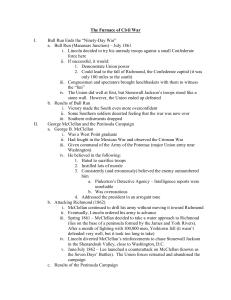
... Fredericksburg, VA. 10,000 Northern soldiers were killed or wounded b. General Hooker i. Burnside yielded command to his subordinate, Hooker ii. May 1863 – In Chancellorsville, VA, Lee divided his numerically inferior force and sent Stonewall Jackson to attack the Union flank. The strategy worked ii ...
... Fredericksburg, VA. 10,000 Northern soldiers were killed or wounded b. General Hooker i. Burnside yielded command to his subordinate, Hooker ii. May 1863 – In Chancellorsville, VA, Lee divided his numerically inferior force and sent Stonewall Jackson to attack the Union flank. The strategy worked ii ...

Chapter 15 The Start of the Civil War
... Tried farming, real estate West Point graduate Incredible military leader He liked to drag race horses! Won the war and became two term president. ...
... Tried farming, real estate West Point graduate Incredible military leader He liked to drag race horses! Won the war and became two term president. ...

Major Battles of the Civil War
... The Confederate government had committed itself to an attack deep in Union territory. In addition to shocking the Union, it was hoped that this attack might influence England and France to again consider supporting the Confederacy. ...
... The Confederate government had committed itself to an attack deep in Union territory. In addition to shocking the Union, it was hoped that this attack might influence England and France to again consider supporting the Confederacy. ...
Civil War
... Stephens insisted on southern independence Peace talks came to be nothing April Lee down to 54,000 men and Grant had 115,000 Lee runs to the west to link up with Johnston’s army, to make last stand Grant cut Lee off heading west Lee’s men in very bad shape, he asked for terms of surrender Lee met Gr ...
... Stephens insisted on southern independence Peace talks came to be nothing April Lee down to 54,000 men and Grant had 115,000 Lee runs to the west to link up with Johnston’s army, to make last stand Grant cut Lee off heading west Lee’s men in very bad shape, he asked for terms of surrender Lee met Gr ...
File
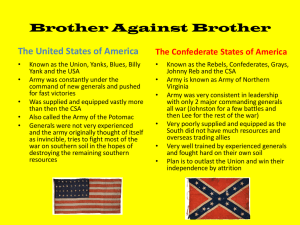
... • Lincoln originally asks Robert E. Lee to be the new commanding general of the Union Army but due to his family being in Virginia he declines • Lincoln then considers Ulysses S. Grant for command but Congress refuses to allow it over fears of his drinking, cursing and bad behavior; Congress goes as ...
... • Lincoln originally asks Robert E. Lee to be the new commanding general of the Union Army but due to his family being in Virginia he declines • Lincoln then considers Ulysses S. Grant for command but Congress refuses to allow it over fears of his drinking, cursing and bad behavior; Congress goes as ...
The North Wins
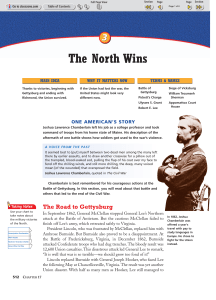
... Sherman waged total war: a war not only against enemy troops, but against everything that supports the enemy. His troops tore up rail lines, destroyed crops, and burned and looted towns. Sherman’s triumph in Atlanta was important for Lincoln. In 1864, the president was running for reelection, but hi ...
... Sherman waged total war: a war not only against enemy troops, but against everything that supports the enemy. His troops tore up rail lines, destroyed crops, and burned and looted towns. Sherman’s triumph in Atlanta was important for Lincoln. In 1864, the president was running for reelection, but hi ...
WV Commemorates 150th Anniversary of the Civil War
... Government of Virginia, a Union government to oppose the Confederate one in Richmond. In August, Confederate Gen. Robert E. Lee tried – and failed – to reclaim that part of Virginia, and by 1862 the conflict had shifted east. The First Campaign proved to be decisive: In 1863, the western counties un ...
... Government of Virginia, a Union government to oppose the Confederate one in Richmond. In August, Confederate Gen. Robert E. Lee tried – and failed – to reclaim that part of Virginia, and by 1862 the conflict had shifted east. The First Campaign proved to be decisive: In 1863, the western counties un ...
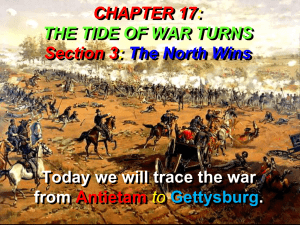
The Road to Gettysburg
... 6. In his Second Inaugural Address, what message did Lincoln send about the next task facing the nation? A. He called on the nation to utterly destroy the Southern economy. B. He called on the nation to finish the war and forgive the South for causing it. C. He called on the nation to make the Sout ...
... 6. In his Second Inaugural Address, what message did Lincoln send about the next task facing the nation? A. He called on the nation to utterly destroy the Southern economy. B. He called on the nation to finish the war and forgive the South for causing it. C. He called on the nation to make the Sout ...

The Roll Call - The State of New York and the Civil War
... George Thomas' boys. Grant said they better succeed, and they did. At the north end, Gen. Sherman found out how good of a fighting General Pat Cleburne was. Despite Sherman's very superior numbers, Cleburne, on the defensive, cleaned his clock. There is also a National Cemetery in Chattanooga, with ...
... George Thomas' boys. Grant said they better succeed, and they did. At the north end, Gen. Sherman found out how good of a fighting General Pat Cleburne was. Despite Sherman's very superior numbers, Cleburne, on the defensive, cleaned his clock. There is also a National Cemetery in Chattanooga, with ...

THE BATTLE OF FREDERICKSBURG BATTLE ANALYSIS
... •GEN Hunt, Chief of Artillery (Confederates), places 147 of 312 guns along Strafford Heights •MG Mc Law’s is given the mission to take Fredericksburg; COL Barksdale’s brigade executes •Finally, new crossing points were disseminated by Union Forces •Burnside new orders were issued and all Div Cdrs we ...
... •GEN Hunt, Chief of Artillery (Confederates), places 147 of 312 guns along Strafford Heights •MG Mc Law’s is given the mission to take Fredericksburg; COL Barksdale’s brigade executes •Finally, new crossing points were disseminated by Union Forces •Burnside new orders were issued and all Div Cdrs we ...
UNIT 111 THE CIVIL WAR
... 2) Control the Mississippi River 3) Capture Richmond c. This plan would eventually win the war for the Union. d. The only change would be by 1864, Lee’s army, not Richmond would be the objective. 2. The First Battle of Bull Run a. The Northern newspapers are screaming “on to Richmond.” b. By July 18 ...
... 2) Control the Mississippi River 3) Capture Richmond c. This plan would eventually win the war for the Union. d. The only change would be by 1864, Lee’s army, not Richmond would be the objective. 2. The First Battle of Bull Run a. The Northern newspapers are screaming “on to Richmond.” b. By July 18 ...

civil war cause and effect study guide
... of the war. Lee retreats back to the South. Lincoln issues the Emancipation Proclamation changing the course of the war. ...
... of the war. Lee retreats back to the South. Lincoln issues the Emancipation Proclamation changing the course of the war. ...

SECESSION AND THE CIVIL WAR
... contemplation the Union is perpetual confirmed by the history of the Union itself. The Union is much older than the Constitution. It was formed, in fact, by the Articles of Association in 1774. It was matured and continued by the Declaration of Independence in 1776. It was further matured, and the f ...
... contemplation the Union is perpetual confirmed by the history of the Union itself. The Union is much older than the Constitution. It was formed, in fact, by the Articles of Association in 1774. It was matured and continued by the Declaration of Independence in 1776. It was further matured, and the f ...

The Roll Call The Binghamton Civil War Historical Society and Round Table
... news when they learned, on the 13th, that the Maryland legislature narrowly passed a new state constitution abolishing the practice of slavery. A form of terrorism erupted on the northern home front when elements of Confederate civilian and military intruders came down across the St. Lawrence River ...
... news when they learned, on the 13th, that the Maryland legislature narrowly passed a new state constitution abolishing the practice of slavery. A form of terrorism erupted on the northern home front when elements of Confederate civilian and military intruders came down across the St. Lawrence River ...

Gettysburg Address. - Findlay City Schools Web Portal
... the Army of Northern Virginia in this struggle. I feel that it is so, and regard it as my duty to shift from myself the responsibility of any further effusion (spilling) of blood by asking of you the surrender of that portion of the Confederate States army known as the Army of Northern Virginia…… ...
... the Army of Northern Virginia in this struggle. I feel that it is so, and regard it as my duty to shift from myself the responsibility of any further effusion (spilling) of blood by asking of you the surrender of that portion of the Confederate States army known as the Army of Northern Virginia…… ...
Life in the Army
... in the Confederate army. Moreover, food sometimes could not get to market because trains were now being used to carry war materials. The Confederate army also seized food and other supplies for its own needs. Another problem, especially in the South, was inflation, an increase in price and decreas ...
... in the Confederate army. Moreover, food sometimes could not get to market because trains were now being used to carry war materials. The Confederate army also seized food and other supplies for its own needs. Another problem, especially in the South, was inflation, an increase in price and decreas ...

people.ucls.uchicago.edu
... Morning of The Battle of Antietam -Robert E. Lee and his army are by Antietam Creek -Lee plans secretly to have Stonewall jackson join his army from Harpers Ferry -if Lee is forced to retreat he must escape across Potomac to Virginia -Mclennan attacks first coming in from Lee’s left then his right ...
... Morning of The Battle of Antietam -Robert E. Lee and his army are by Antietam Creek -Lee plans secretly to have Stonewall jackson join his army from Harpers Ferry -if Lee is forced to retreat he must escape across Potomac to Virginia -Mclennan attacks first coming in from Lee’s left then his right ...
Battle of Antietam

The Battle of Antietam /ænˈtiːtəm/, also known as the Battle of Sharpsburg, particularly in the South, fought on September 17, 1862, near Sharpsburg, Maryland, and Antietam Creek as part of the Maryland Campaign, was the first major battle in the American Civil War to take place on Union soil. It is the bloodiest single-day battle in American history, with a combined tally of dead, wounded, and missing at 22,717.After pursuing Confederate General Robert E. Lee into Maryland, Union Army Maj. Gen. George B. McClellan launched attacks against Lee's army, in defensive positions behind Antietam Creek. At dawn on September 17, Maj. Gen. Joseph Hooker's corps mounted a powerful assault on Lee's left flank. Attacks and counterattacks swept across Miller's Cornfield and fighting swirled around the Dunker Church. Union assaults against the Sunken Road eventually pierced the Confederate center, but the Federal advantage was not followed up. In the afternoon, Union Maj. Gen. Ambrose Burnside's corps entered the action, capturing a stone bridge over Antietam Creek and advancing against the Confederate right. At a crucial moment, Confederate Maj. Gen. A. P. Hill's division arrived from Harpers Ferry and launched a surprise counterattack, driving back Burnside and ending the battle. Although outnumbered two-to-one, Lee committed his entire force, while McClellan sent in less than three-quarters of his army, enabling Lee to fight the Federals to a standstill. During the night, both armies consolidated their lines. In spite of crippling casualties, Lee continued to skirmish with McClellan throughout September 18, while removing his battered army south of the Potomac River.Despite having superiority of numbers, McClellan's attacks failed to achieve force concentration, allowing Lee to counter by shifting forces and moving interior lines to meet each challenge. Despite ample reserve forces that could have been deployed to exploit localized successes, McClellan failed to destroy Lee's army. McClellan had halted Lee's invasion of Maryland, but Lee was able to withdraw his army back to Virginia without interference from the cautious McClellan. Although the battle was tactically inconclusive, the Confederate troops had withdrawn first from the battlefield, making it, in military terms, a Union victory. It had significance as enough of a victory to give President Abraham Lincoln the confidence to announce his Emancipation Proclamation, which discouraged the British and French governments from potential plans for recognition of the Confederacy.