Warm-up for 03.09.10
... want to come back into the Union of not. • If a “state in rebellion” comes back to the Union within 100 days, it does not have to free its’ slaves! • After the President Lincoln issues this proclamation on Jan. 1, 1863, France and England (2 anti-slavery countries) had no choice but to “back” the No ...
... want to come back into the Union of not. • If a “state in rebellion” comes back to the Union within 100 days, it does not have to free its’ slaves! • After the President Lincoln issues this proclamation on Jan. 1, 1863, France and England (2 anti-slavery countries) had no choice but to “back” the No ...

Civil War
... N retreats to DC McDowell is replaced by McClellan: good trainer, organizer, but has “the slows” Seven Days Battle: Summer of 1862 (June 25-July 1) McClellan advances Meets S in series of battles North withdraws again to DC after meeting South McClellan replaced by Pope ...
... N retreats to DC McDowell is replaced by McClellan: good trainer, organizer, but has “the slows” Seven Days Battle: Summer of 1862 (June 25-July 1) McClellan advances Meets S in series of battles North withdraws again to DC after meeting South McClellan replaced by Pope ...
The Road to Gettysburg
... Before Vicksburg fell in July 1863, nearly all the major battles of the Civil War had been fought in Virginia or Tennessee, leaving the Deep South untouched by war. ...
... Before Vicksburg fell in July 1863, nearly all the major battles of the Civil War had been fought in Virginia or Tennessee, leaving the Deep South untouched by war. ...
Chapter 20 PowerPoint
... The Alabama sank sixty-four Union ships before it was destroyed off the coast of Cherbourg, France, in 1864. The Kearsarge rescued most of the Alabama’s crew from their sinking vessel, but Confederate captain Raphael Semmes managed to escape aboard an English yacht that had been observing the sea ba ...
... The Alabama sank sixty-four Union ships before it was destroyed off the coast of Cherbourg, France, in 1864. The Kearsarge rescued most of the Alabama’s crew from their sinking vessel, but Confederate captain Raphael Semmes managed to escape aboard an English yacht that had been observing the sea ba ...

The Civil War
... The Battle of Gettysburg in July of 1863 was the deadliest battle of the war. With the loss of so many troops, General Lee knew that the Confederate Army would never again have the strength to invade the North. After this, Lee began his retreat which would eventually lead to the end of the Civil War ...
... The Battle of Gettysburg in July of 1863 was the deadliest battle of the war. With the loss of so many troops, General Lee knew that the Confederate Army would never again have the strength to invade the North. After this, Lee began his retreat which would eventually lead to the end of the Civil War ...
3. The Dabneys Black Civil War Spies
... gone down about Richmond. That white shirt means (Confederate general) Hill; and when she moves it up to the west end of the line, Hill�s corps has moved upstream. That red one is (Confederate general) Stonewall. He�s down on the right now, and if he moves, she will move that red shirt." One morning ...
... gone down about Richmond. That white shirt means (Confederate general) Hill; and when she moves it up to the west end of the line, Hill�s corps has moved upstream. That red one is (Confederate general) Stonewall. He�s down on the right now, and if he moves, she will move that red shirt." One morning ...

Unit 9 ~ The Civil War
... – 90,000 Union forces – 75,000 Confederate forces – Lee orders Longstreet to attack Cemetery Ridge from his position on Seminary Ridge by advancing up the Emmitsburg Road – Longstreet goes through the peach orchard and the wheat field instead – Little Round Top was left undefended by the Union – Gen ...
... – 90,000 Union forces – 75,000 Confederate forces – Lee orders Longstreet to attack Cemetery Ridge from his position on Seminary Ridge by advancing up the Emmitsburg Road – Longstreet goes through the peach orchard and the wheat field instead – Little Round Top was left undefended by the Union – Gen ...

userfiles/424/my files/the civil war powerpoint?id=5151
... henceforth became as General “Stonewall Jackson". At the end of the battle the Union retreated. The Confederate soldiers won the first major battle of the Civil War. ...
... henceforth became as General “Stonewall Jackson". At the end of the battle the Union retreated. The Confederate soldiers won the first major battle of the Civil War. ...
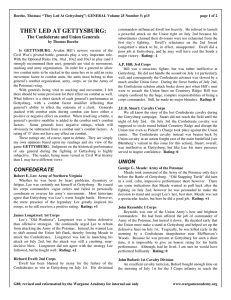
They Led at Gettysburg, The Confederate and Union Generals
... battle in time to justify the sacrifice of Buford’s 1st Cavalry Division. This was done based on his respect for Buford’s assessment without first hand verification. In a previous battle, the Cavalry made a similar stand in vain awaiting infantry support. Buford remained on station because it was Re ...
... battle in time to justify the sacrifice of Buford’s 1st Cavalry Division. This was done based on his respect for Buford’s assessment without first hand verification. In a previous battle, the Cavalry made a similar stand in vain awaiting infantry support. Buford remained on station because it was Re ...

Chapter 21 - Newton Public Schools
... Lincoln’s election victory in 1864 was sealed by Union military successes at a. Gettysburg, Antietam, and Vicksburg. b. the Wilderness, Lookout Mountain, and Appomattox. ...
... Lincoln’s election victory in 1864 was sealed by Union military successes at a. Gettysburg, Antietam, and Vicksburg. b. the Wilderness, Lookout Mountain, and Appomattox. ...

Civil War Power Point [8/20/2016]
... 2. July 2nd- North faced heavy attack but held firm 3. July 3rd – South had to retreat; lost too many men 4. North Won! ...
... 2. July 2nd- North faced heavy attack but held firm 3. July 3rd – South had to retreat; lost too many men 4. North Won! ...

Civil War Overview
... Union Army, especially the Commander-in-Chief Abraham Lincoln, was taking notice. Meanwhile, back east, Robert E. Lee’s army of Northern Virginia, bolstered by unprecedented success, made its first invasion of the North, meeting McClellan’s Army of the Potomac in Maryland at a place called Antietam ...
... Union Army, especially the Commander-in-Chief Abraham Lincoln, was taking notice. Meanwhile, back east, Robert E. Lee’s army of Northern Virginia, bolstered by unprecedented success, made its first invasion of the North, meeting McClellan’s Army of the Potomac in Maryland at a place called Antietam ...

Slide 1
... 2. July 2nd- North faced heavy attack but held firm 3. July 3rd – South had to retreat; lost too many men 4. North Won! ...
... 2. July 2nd- North faced heavy attack but held firm 3. July 3rd – South had to retreat; lost too many men 4. North Won! ...

Civil War
... – They instituted a draft to keep their army numbers high enough (so did the Confederacy) – A draft is essentially obligatory military service with very few exception made ...
... – They instituted a draft to keep their army numbers high enough (so did the Confederacy) – A draft is essentially obligatory military service with very few exception made ...

Chapter 11: The Civil War
... while moving other troops west and south to surprise the rebels from behind • Lee expected this and marched west leaving a few soldiers behind to it appear they remained • May 2, 1863-Jackson’s troops charged out of the woods at Hooker’s troops as they cooked dinner in their camps • Battle lasted 2 ...
... while moving other troops west and south to surprise the rebels from behind • Lee expected this and marched west leaving a few soldiers behind to it appear they remained • May 2, 1863-Jackson’s troops charged out of the woods at Hooker’s troops as they cooked dinner in their camps • Battle lasted 2 ...

File
... The Battle of Antietam, also known as the Battle of Sharpsburg, was fought on September 16–18, 1862. It was a confrontation between Union and Confederate forces under Generals George McClellan and Robert E. Lee. Federal armies brutalized the Confederacy; the combined casualties were more than twenty ...
... The Battle of Antietam, also known as the Battle of Sharpsburg, was fought on September 16–18, 1862. It was a confrontation between Union and Confederate forces under Generals George McClellan and Robert E. Lee. Federal armies brutalized the Confederacy; the combined casualties were more than twenty ...

The Civil War - 9th Grade World History Overview
... The first real land battle took place outside of Washington, D.C., when the Union army attacked a Southern position near a small creek named Bull Run. The Confederates quickly defeated the Union army and drove them back to the capital. The Confederacy continued its success in the East with victories ...
... The first real land battle took place outside of Washington, D.C., when the Union army attacked a Southern position near a small creek named Bull Run. The Confederates quickly defeated the Union army and drove them back to the capital. The Confederacy continued its success in the East with victories ...

CPUSH (Unit 6, #2) - Bekemeyer`s World
... ____________________ of slaves the new focus of the war for the North ...
... ____________________ of slaves the new focus of the war for the North ...
Civil War Powerpoint
... or any of them, in forced any efforts they may make forwhites their actual freedom...” to worry about their farms ...
... or any of them, in forced any efforts they may make forwhites their actual freedom...” to worry about their farms ...

January2005Newslette.. - Old Baldy Civil War Round Table
... He justified it by saying that black troops were not as well trained and they were more likely to fall prey to drawn attention from southern bushwackers. He silenced some of the criticism by implementing programs for freed slaves in Arkansas that generally succeeded in taking care of their immediate ...
... He justified it by saying that black troops were not as well trained and they were more likely to fall prey to drawn attention from southern bushwackers. He silenced some of the criticism by implementing programs for freed slaves in Arkansas that generally succeeded in taking care of their immediate ...

February - Colonel Hiram Parks Bell, Camp 1642
... March 24 – March Camp Meeting - Author Mark Lemon tells the story of Capt James L. Lemon, one of only two recipients of the SCV's Confederate Medal of Honor from Georgia. Civil War editor Keith Bohannon calls Marks book Feed Them the Steel one of the finest war narratives from a Confederate companyg ...
... March 24 – March Camp Meeting - Author Mark Lemon tells the story of Capt James L. Lemon, one of only two recipients of the SCV's Confederate Medal of Honor from Georgia. Civil War editor Keith Bohannon calls Marks book Feed Them the Steel one of the finest war narratives from a Confederate companyg ...

Ch. 20 The Civil War between the North and the
... battle, because it stopped the Confederates from getting what they so urgently needed-open recognition and aid from a foreign power. d. Lincoln too found enough encouragement in the results from Antietam to claim it as a Union victory. Grasping at a rare opportunity to make a bold change in policy, ...
... battle, because it stopped the Confederates from getting what they so urgently needed-open recognition and aid from a foreign power. d. Lincoln too found enough encouragement in the results from Antietam to claim it as a Union victory. Grasping at a rare opportunity to make a bold change in policy, ...
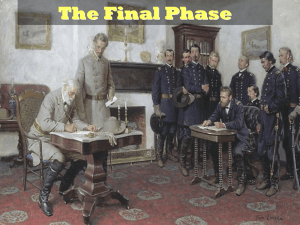
The Final Phase - Mr. Kittek
... quoted speeches of all-time. • Dedication of the Soldiers’ National Cemetery at Gettysburg, November 19, 1863. ...
... quoted speeches of all-time. • Dedication of the Soldiers’ National Cemetery at Gettysburg, November 19, 1863. ...

Civil War Powerpoint - Mr. Zindman`s History Class
... henceforth became as General “Stonewall Jackson". At the end of the battle the Union retreated. The Confederate soldiers won the first major battle of the Civil War. ...
... henceforth became as General “Stonewall Jackson". At the end of the battle the Union retreated. The Confederate soldiers won the first major battle of the Civil War. ...
Battle of Antietam

The Battle of Antietam /ænˈtiːtəm/, also known as the Battle of Sharpsburg, particularly in the South, fought on September 17, 1862, near Sharpsburg, Maryland, and Antietam Creek as part of the Maryland Campaign, was the first major battle in the American Civil War to take place on Union soil. It is the bloodiest single-day battle in American history, with a combined tally of dead, wounded, and missing at 22,717.After pursuing Confederate General Robert E. Lee into Maryland, Union Army Maj. Gen. George B. McClellan launched attacks against Lee's army, in defensive positions behind Antietam Creek. At dawn on September 17, Maj. Gen. Joseph Hooker's corps mounted a powerful assault on Lee's left flank. Attacks and counterattacks swept across Miller's Cornfield and fighting swirled around the Dunker Church. Union assaults against the Sunken Road eventually pierced the Confederate center, but the Federal advantage was not followed up. In the afternoon, Union Maj. Gen. Ambrose Burnside's corps entered the action, capturing a stone bridge over Antietam Creek and advancing against the Confederate right. At a crucial moment, Confederate Maj. Gen. A. P. Hill's division arrived from Harpers Ferry and launched a surprise counterattack, driving back Burnside and ending the battle. Although outnumbered two-to-one, Lee committed his entire force, while McClellan sent in less than three-quarters of his army, enabling Lee to fight the Federals to a standstill. During the night, both armies consolidated their lines. In spite of crippling casualties, Lee continued to skirmish with McClellan throughout September 18, while removing his battered army south of the Potomac River.Despite having superiority of numbers, McClellan's attacks failed to achieve force concentration, allowing Lee to counter by shifting forces and moving interior lines to meet each challenge. Despite ample reserve forces that could have been deployed to exploit localized successes, McClellan failed to destroy Lee's army. McClellan had halted Lee's invasion of Maryland, but Lee was able to withdraw his army back to Virginia without interference from the cautious McClellan. Although the battle was tactically inconclusive, the Confederate troops had withdrawn first from the battlefield, making it, in military terms, a Union victory. It had significance as enough of a victory to give President Abraham Lincoln the confidence to announce his Emancipation Proclamation, which discouraged the British and French governments from potential plans for recognition of the Confederacy.