Fredericksburg and Chancellorsville
... https://www.google.com/search?hl=en&site=imghp&tbm=isch&source=hp&biw=1366&bih=768&q=ulysses+s+grant&oq=Uly&gs_l=img.1.0.0l10.3502.4957.0.7795.3.3.0.0.0.0.442.872.1j31j1.3.0....0...1ac.1.43.img..1.2.506.9X0niL4Yu9Y#hl=en&q=battle+of+cold+harbor&tbm=isch&facrc=_&imgdii=_&imgrc=JEewMCqwxNJ7FM%253A%3B ...
... https://www.google.com/search?hl=en&site=imghp&tbm=isch&source=hp&biw=1366&bih=768&q=ulysses+s+grant&oq=Uly&gs_l=img.1.0.0l10.3502.4957.0.7795.3.3.0.0.0.0.442.872.1j31j1.3.0....0...1ac.1.43.img..1.2.506.9X0niL4Yu9Y#hl=en&q=battle+of+cold+harbor&tbm=isch&facrc=_&imgdii=_&imgrc=JEewMCqwxNJ7FM%253A%3B ...
Name
... a. Confederate troops searched for shoes in Pennsylvania. b. Lee invaded the North, hoping to fuel Northern discontent with the war. c. Lee hoped that a victory on Northern soil would lead European nations to recognize the Confederacy. d. All of the above are true. e. Both A & C 34. Which was NOT a ...
... a. Confederate troops searched for shoes in Pennsylvania. b. Lee invaded the North, hoping to fuel Northern discontent with the war. c. Lee hoped that a victory on Northern soil would lead European nations to recognize the Confederacy. d. All of the above are true. e. Both A & C 34. Which was NOT a ...
Maj. Gen. George B. McClellan - Camp Curtin Historical Society
... replace him. McClellan went into siege mode and made plans to batter Richmond into submission. Meanwhile, Lee was thinking offensively. He left a small force to guard Richmond and with Gen. Thomas “Stonewall” Jackson’s troops, newly arrived from victories in the Shenandoah Valley, planned an attack ...
... replace him. McClellan went into siege mode and made plans to batter Richmond into submission. Meanwhile, Lee was thinking offensively. He left a small force to guard Richmond and with Gen. Thomas “Stonewall” Jackson’s troops, newly arrived from victories in the Shenandoah Valley, planned an attack ...
how the civil war became a revolution
... differences. After Antietam, and the Emancipation Proclamation, the only way the war could end was by the outright victory of one side over the other. Either way, the result would be a revolutionary transformation of American politics and society. The road to Antietam, however, began long before Sep ...
... differences. After Antietam, and the Emancipation Proclamation, the only way the war could end was by the outright victory of one side over the other. Either way, the result would be a revolutionary transformation of American politics and society. The road to Antietam, however, began long before Sep ...

Civil War - Mrs. Rostas
... another Confederate victory when the Union was chased back by heavy artillery fire ►Southern morale remained high *Photo and information taken from www.americancivilwar.com/statepic/va/va026.html ...
... another Confederate victory when the Union was chased back by heavy artillery fire ►Southern morale remained high *Photo and information taken from www.americancivilwar.com/statepic/va/va026.html ...

Name_____________________________________
... 38. How did a Union cigar-loving soldier get lucky when it came to knowing Lee’s plan for Maryland? Found Lee’s plans wrapped around cigars ...
... 38. How did a Union cigar-loving soldier get lucky when it came to knowing Lee’s plan for Maryland? Found Lee’s plans wrapped around cigars ...

Slide 1
... • Grant’s army also had cut off the South’s trade with Europe. • General Grant then battled his way to Vicksburg attacking the town. • For 6 weeks, Union gunboats shelled the city from the river while Grant’s army attacked it from land. Slowly Union troops made their way into the city. • People in V ...
... • Grant’s army also had cut off the South’s trade with Europe. • General Grant then battled his way to Vicksburg attacking the town. • For 6 weeks, Union gunboats shelled the city from the river while Grant’s army attacked it from land. Slowly Union troops made their way into the city. • People in V ...
civilwar-1-2
... This convinced the Union of the need to focus on winning the war and focus on putting all their resources towards winning the war. ...
... This convinced the Union of the need to focus on winning the war and focus on putting all their resources towards winning the war. ...
Chapter 21 - Spokane Public Schools
... Recalled to Richmond in March 1862, Lee advised Confederate president Jefferson Davis as the peninsular campaign of Union general George B. McClellan developed. Then in the Battle of Seven Pines/Fair Oaks, Confederate general Joseph E. Johnston suffered serious wounds, and on June 1, 1862, Davis app ...
... Recalled to Richmond in March 1862, Lee advised Confederate president Jefferson Davis as the peninsular campaign of Union general George B. McClellan developed. Then in the Battle of Seven Pines/Fair Oaks, Confederate general Joseph E. Johnston suffered serious wounds, and on June 1, 1862, Davis app ...

document
... and supplies in the North & Sherman’s strategy of total war, which devastated much of the South ...
... and supplies in the North & Sherman’s strategy of total war, which devastated much of the South ...

The American Civil War 1860 – 1865 The Sectional Conflict Widens
... Who was the commander of all Confederate ...
... Who was the commander of all Confederate ...

Ch 21 Packet
... Lincoln’s election victory in 1864 was sealed by Union military successes at a. Gettysburg, Antietam, and Vicksburg. b. the Wilderness, Lookout Mountain, and Appomattox. ...
... Lincoln’s election victory in 1864 was sealed by Union military successes at a. Gettysburg, Antietam, and Vicksburg. b. the Wilderness, Lookout Mountain, and Appomattox. ...

Name: Date: Hour: Battles of the Civil War Battle Date Location
... 1) In terms of “bloodiest” battles, how does this rank? 2) Why was Lincoln disappointed with General McClellan? What happened as a result? 3) How did this battle impact Lincoln’s Emancipation Proclamation? Fredericksburg 1) Why did General Burnside Replace McClellan? 2) Why is this considered such a ...
... 1) In terms of “bloodiest” battles, how does this rank? 2) Why was Lincoln disappointed with General McClellan? What happened as a result? 3) How did this battle impact Lincoln’s Emancipation Proclamation? Fredericksburg 1) Why did General Burnside Replace McClellan? 2) Why is this considered such a ...

Texas and the Civil War
... Arkansas (AR), Tennessee (TN), and North Carolina (NC) • First military action of the war • This is the start of the Civil War! ...
... Arkansas (AR), Tennessee (TN), and North Carolina (NC) • First military action of the war • This is the start of the Civil War! ...

7044347_20_Civil War
... Richmond. This time, Lincoln sent General George B. McClellan with a well-trained army. A Confederate army led by General Robert E. Lee stopped McClellan’s advance. After a seven-day battle, the Union army withdrew. The North had again failed to defeat the Confederates. ...
... Richmond. This time, Lincoln sent General George B. McClellan with a well-trained army. A Confederate army led by General Robert E. Lee stopped McClellan’s advance. After a seven-day battle, the Union army withdrew. The North had again failed to defeat the Confederates. ...

File
... black soldiers to be raised in the North during the Civil War. Prior to 1863, no effort was made to recruit black troops as Union soldiers. The passage of the Emancipation Proclamation in December of 1862 provided the impetus for the use of free black men as soldiers and, at a time when state govern ...
... black soldiers to be raised in the North during the Civil War. Prior to 1863, no effort was made to recruit black troops as Union soldiers. The passage of the Emancipation Proclamation in December of 1862 provided the impetus for the use of free black men as soldiers and, at a time when state govern ...

My the Confederacy Lost
... If we had had anything like a fair chance, or less disparity of numbers, we should have won our cause and established our independence." The North had a potential manpower superiority of more than three to one (counting only white men) and Union armed forces had an actual superiority of two to one d ...
... If we had had anything like a fair chance, or less disparity of numbers, we should have won our cause and established our independence." The North had a potential manpower superiority of more than three to one (counting only white men) and Union armed forces had an actual superiority of two to one d ...

The Civil War
... CIVIL WAR TIMELINE: 1862 • Event 16: September -- Battle of Antietam • On September 17, General Lee decided to use the momentum from his recent win to confront General McClellan near Sharpsburg, Virginia. This battle proved to be the bloodiest day in American history with roughly 23,000 casualties. ...
... CIVIL WAR TIMELINE: 1862 • Event 16: September -- Battle of Antietam • On September 17, General Lee decided to use the momentum from his recent win to confront General McClellan near Sharpsburg, Virginia. This battle proved to be the bloodiest day in American history with roughly 23,000 casualties. ...

The Civil War
... States. If each State will only agree to mind its own business, and let its neighbors alone, there will be peace forever between us… I hold that the people of the slaveholding States are civilized men as well as ourselves; that they bear consciences as well as we, and that they are accountable to Go ...
... States. If each State will only agree to mind its own business, and let its neighbors alone, there will be peace forever between us… I hold that the people of the slaveholding States are civilized men as well as ourselves; that they bear consciences as well as we, and that they are accountable to Go ...

General Orders - Houston Civil War Round Table
... most historians regard as Confederate Gen. Robert E. Lee's greatest victory, he does so in a manner that keeps the reader totally enthralled, page after page. Focusing as much on ordinary soldiers as he does on generals (including Confederate Thomas J. "Stonewall" Jackson, who was fatally wounded by ...
... most historians regard as Confederate Gen. Robert E. Lee's greatest victory, he does so in a manner that keeps the reader totally enthralled, page after page. Focusing as much on ordinary soldiers as he does on generals (including Confederate Thomas J. "Stonewall" Jackson, who was fatally wounded by ...

The Civil War - Paulding County Schools
... • There was little left in the South for people or troops to use for survival. • Lee surrendered to Grant in April 1865. • Grant became our 18th president. • He served 2 terms from 1869-1877. ...
... • There was little left in the South for people or troops to use for survival. • Lee surrendered to Grant in April 1865. • Grant became our 18th president. • He served 2 terms from 1869-1877. ...

Civil War Events
... • This Union victory left the South with _____________________________________ the war. • Both sides experienced major losses of life -- more than _____________________________________ on the battlefield. • Due to the loss of a large portion of Lee’s men, the _____________________________________ th ...
... • This Union victory left the South with _____________________________________ the war. • Both sides experienced major losses of life -- more than _____________________________________ on the battlefield. • Due to the loss of a large portion of Lee’s men, the _____________________________________ th ...
April—Charleston Harbor
... surrendered Atlanta, Georgia, on September 1; Sherman occupied the city the next day. The fall of Atlanta greatly boosted Northern morale. After three and a half months of incessant maneuvering and much hard fighting, Sherman forced Hood to abandon Atlanta, the munitions center of the Confederacy. S ...
... surrendered Atlanta, Georgia, on September 1; Sherman occupied the city the next day. The fall of Atlanta greatly boosted Northern morale. After three and a half months of incessant maneuvering and much hard fighting, Sherman forced Hood to abandon Atlanta, the munitions center of the Confederacy. S ...

The Civil War - Cloudfront.net
... • Event 16: September -- Battle of Antietam • On September 17, Confederate forces under General Lee were caught by General McClellan near Sharpsburg, Maryland. This battle proved to be the bloodiest day in American history with roughly 23,000 casualties. The battle had no clear winner, but because G ...
... • Event 16: September -- Battle of Antietam • On September 17, Confederate forces under General Lee were caught by General McClellan near Sharpsburg, Maryland. This battle proved to be the bloodiest day in American history with roughly 23,000 casualties. The battle had no clear winner, but because G ...

Battlefield Driving Tour
... infantry and artillery positioned themselves on the Prairie Grove ridge overlooking the Illinois River valley. The Federals forced the Southern cavalry to fall back to the ridge, then waded across the river under artillery fire. An artillery duel began at about 11AM in which the Confederate smoothbo ...
... infantry and artillery positioned themselves on the Prairie Grove ridge overlooking the Illinois River valley. The Federals forced the Southern cavalry to fall back to the ridge, then waded across the river under artillery fire. An artillery duel began at about 11AM in which the Confederate smoothbo ...
Battle of Antietam

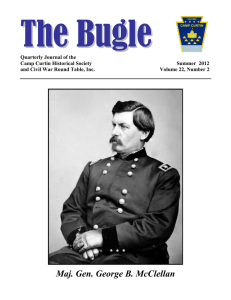
The Battle of Antietam /ænˈtiːtəm/, also known as the Battle of Sharpsburg, particularly in the South, fought on September 17, 1862, near Sharpsburg, Maryland, and Antietam Creek as part of the Maryland Campaign, was the first major battle in the American Civil War to take place on Union soil. It is the bloodiest single-day battle in American history, with a combined tally of dead, wounded, and missing at 22,717.After pursuing Confederate General Robert E. Lee into Maryland, Union Army Maj. Gen. George B. McClellan launched attacks against Lee's army, in defensive positions behind Antietam Creek. At dawn on September 17, Maj. Gen. Joseph Hooker's corps mounted a powerful assault on Lee's left flank. Attacks and counterattacks swept across Miller's Cornfield and fighting swirled around the Dunker Church. Union assaults against the Sunken Road eventually pierced the Confederate center, but the Federal advantage was not followed up. In the afternoon, Union Maj. Gen. Ambrose Burnside's corps entered the action, capturing a stone bridge over Antietam Creek and advancing against the Confederate right. At a crucial moment, Confederate Maj. Gen. A. P. Hill's division arrived from Harpers Ferry and launched a surprise counterattack, driving back Burnside and ending the battle. Although outnumbered two-to-one, Lee committed his entire force, while McClellan sent in less than three-quarters of his army, enabling Lee to fight the Federals to a standstill. During the night, both armies consolidated their lines. In spite of crippling casualties, Lee continued to skirmish with McClellan throughout September 18, while removing his battered army south of the Potomac River.Despite having superiority of numbers, McClellan's attacks failed to achieve force concentration, allowing Lee to counter by shifting forces and moving interior lines to meet each challenge. Despite ample reserve forces that could have been deployed to exploit localized successes, McClellan failed to destroy Lee's army. McClellan had halted Lee's invasion of Maryland, but Lee was able to withdraw his army back to Virginia without interference from the cautious McClellan. Although the battle was tactically inconclusive, the Confederate troops had withdrawn first from the battlefield, making it, in military terms, a Union victory. It had significance as enough of a victory to give President Abraham Lincoln the confidence to announce his Emancipation Proclamation, which discouraged the British and French governments from potential plans for recognition of the Confederacy.