
General Grant said
... henceforth became as General “Stonewall Jackson". At the end of the battle the Union retreated. The Confederate soldiers won the first major battle of the Civil War. ...
... henceforth became as General “Stonewall Jackson". At the end of the battle the Union retreated. The Confederate soldiers won the first major battle of the Civil War. ...

17 - Coppell ISD
... ≥ Early in 1863, after many attempts to capture Vicksburg, Gen US Grant showed ...
... ≥ Early in 1863, after many attempts to capture Vicksburg, Gen US Grant showed ...

The Battle of Hatchie (Davis) Bridge by sfcdan (Formatted Word
... numbers were too great and the retreat fell into a panic. The left side of the Confederate line dissolved leaving Dawson and his artillerymen stranded. With nothing left to move the guns Dawson did what he could but the 53rd Indiana claimed all but one of his pieces. Half of the 1st Texas Legion mad ...
... numbers were too great and the retreat fell into a panic. The left side of the Confederate line dissolved leaving Dawson and his artillerymen stranded. With nothing left to move the guns Dawson did what he could but the 53rd Indiana claimed all but one of his pieces. Half of the 1st Texas Legion mad ...

2 The Civil War
... The Confederate strategy during the war was an Offensive Defense Protect Southern territory from “Northern aggression” but attack into Union territory when the opportunity presents itself Drag out the war as long as possible to make the North quit Get Britain and France to join their cause because ...
... The Confederate strategy during the war was an Offensive Defense Protect Southern territory from “Northern aggression” but attack into Union territory when the opportunity presents itself Drag out the war as long as possible to make the North quit Get Britain and France to join their cause because ...
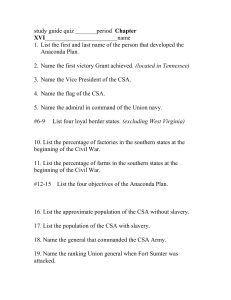
ch16 study guide quiz
... 4. Name the battle that secured the Mississippi River for the USA. 5. Name the general that secured the Mississippi River for the USA. 6. List the month and year of the Gettysburg Address. 7. Name the person that delivered the Gettysburg Address. 8. Name the state where Fort Donelson is located. a.) ...
... 4. Name the battle that secured the Mississippi River for the USA. 5. Name the general that secured the Mississippi River for the USA. 6. List the month and year of the Gettysburg Address. 7. Name the person that delivered the Gettysburg Address. 8. Name the state where Fort Donelson is located. a.) ...

The American Civil War 1860 – 1865
... b. slavery was a necessary evil. c. slavery was cruel and morally wrong. d. slaves were generally happy in bondage. 3. “Bleeding Kansas” earned its nickname from clashes over a. the Gadsden Purchase. c. slavery. ...
... b. slavery was a necessary evil. c. slavery was cruel and morally wrong. d. slaves were generally happy in bondage. 3. “Bleeding Kansas” earned its nickname from clashes over a. the Gadsden Purchase. c. slavery. ...

A Turning Point in the Civil War
... be here dedicated to the great task remaining before us -- that from these honored dead we take increased devotion to that cause for which they gave the last full measure of devotion -- that we here highly resolve that these dead shall not have died in vain, that this nation under God shall have a n ...
... be here dedicated to the great task remaining before us -- that from these honored dead we take increased devotion to that cause for which they gave the last full measure of devotion -- that we here highly resolve that these dead shall not have died in vain, that this nation under God shall have a n ...

vol. xxxvii, no. 2 november 1996
... night at a crossroads waiting for the brigade of General Fitz Lee to rendezvous with them. “At sunrise yesterday,” continued Jeb, “a large body of cavalry from the very direction from which Lee was expected approached. Of course I thought it was Lee as no Yankees had been about for a month, but as a ...
... night at a crossroads waiting for the brigade of General Fitz Lee to rendezvous with them. “At sunrise yesterday,” continued Jeb, “a large body of cavalry from the very direction from which Lee was expected approached. Of course I thought it was Lee as no Yankees had been about for a month, but as a ...

Worksheet by RJ Tarr at www.activehistory.co.uk / 1 ActiveHistory
... President Abraham Lincoln's appointment of General Grant as overall commander of the Union forces, with his close friend General Sherman as his second in command, was the final military act which turned the tide of the war. In the March to the Sea (Nov-Dec 1864, Atlanta) General Sherman pushed from ...
... President Abraham Lincoln's appointment of General Grant as overall commander of the Union forces, with his close friend General Sherman as his second in command, was the final military act which turned the tide of the war. In the March to the Sea (Nov-Dec 1864, Atlanta) General Sherman pushed from ...

Document
... o To mostly fight in the South This allowed them to maneuver trough the trees more easily. They thought that it would be better for them but instead they ended up getting deprived of their food and supplies. ...
... o To mostly fight in the South This allowed them to maneuver trough the trees more easily. They thought that it would be better for them but instead they ended up getting deprived of their food and supplies. ...

Let`s Define… - Social Studies Resource Site
... three powerful Union attacks near Dunker Church. 9 a.m. – 1 p.m. Union attacks on the Sunken Road force Confederate soldiers to retreat toward Sharpsburg. Both sides suffering many casualties. ...
... three powerful Union attacks near Dunker Church. 9 a.m. – 1 p.m. Union attacks on the Sunken Road force Confederate soldiers to retreat toward Sharpsburg. Both sides suffering many casualties. ...

Chapter 4 Civil War and Reconstruction
... three powerful Union attacks near Dunker Church. 9 a.m. – 1 p.m. Union attacks on the Sunken Road force Confederate soldiers to retreat toward Sharpsburg. Both sides suffering many casualties. ...
... three powerful Union attacks near Dunker Church. 9 a.m. – 1 p.m. Union attacks on the Sunken Road force Confederate soldiers to retreat toward Sharpsburg. Both sides suffering many casualties. ...

The American Civil War
... • Fort Sumter, located on an island in the harbor of Charleston, South Carolina, was one of the few remaining federal forts in Confederate territory. • President Davis offered to purchase Fort Sumter and other Union possession in Confederate territory, but Lincoln refused. • Union troops at Fort Sum ...
... • Fort Sumter, located on an island in the harbor of Charleston, South Carolina, was one of the few remaining federal forts in Confederate territory. • President Davis offered to purchase Fort Sumter and other Union possession in Confederate territory, but Lincoln refused. • Union troops at Fort Sum ...

Goal 3 Part 2 OUTLINE
... Only a few days after the South's surrender, Lincoln was assassinated. He was shot by ____________________in the head while attending a play at Ford's Theatre in Washington. ...
... Only a few days after the South's surrender, Lincoln was assassinated. He was shot by ____________________in the head while attending a play at Ford's Theatre in Washington. ...

The American Civil War
... • SSUSH9 The student will identify key events, issues, and individuals relating to the causes, course, and consequences of the Civil War. • b. Describe President Lincoln’s efforts to preserve the Union as seen in his second inaugural address and the Gettysburg speech and in his use of emergency pow ...
... • SSUSH9 The student will identify key events, issues, and individuals relating to the causes, course, and consequences of the Civil War. • b. Describe President Lincoln’s efforts to preserve the Union as seen in his second inaugural address and the Gettysburg speech and in his use of emergency pow ...

SECESSION AND THE CIVIL WAR
... national governments. It is safe to assert that no government proper ever had a provision in its organic law for its own termination. … Descending from these general principles, we find the proposition that in legal contemplation the Union is perpetual confirmed by the history of the Union itself. T ...
... national governments. It is safe to assert that no government proper ever had a provision in its organic law for its own termination. … Descending from these general principles, we find the proposition that in legal contemplation the Union is perpetual confirmed by the history of the Union itself. T ...
The Civil War - Issaquah Connect
... • Open act of Rebellion • As defender of constitution Lincoln feels he must call up troops to fight the seceding states. • Southerners saw this as an action against them • As a result upper south states of Virginia, Arkansas, Tennessee, and North Carolina, join Confederacy. • 4 Border states with Sl ...
... • Open act of Rebellion • As defender of constitution Lincoln feels he must call up troops to fight the seceding states. • Southerners saw this as an action against them • As a result upper south states of Virginia, Arkansas, Tennessee, and North Carolina, join Confederacy. • 4 Border states with Sl ...

Shoot them in the back
... soldiers into battle. For all his energy, McClellan lacked decisiveness. Lincoln wanted a general who would advance, take risks, and fight, but McClellan went into winter quarters. "If General McClellan does not want to use the army I would like to borrow it," Lincoln declared in frustration. James ...
... soldiers into battle. For all his energy, McClellan lacked decisiveness. Lincoln wanted a general who would advance, take risks, and fight, but McClellan went into winter quarters. "If General McClellan does not want to use the army I would like to borrow it," Lincoln declared in frustration. James ...

to read a detailed history of the Doubleday Inn and its grounds.
... Oak Hill Battle Summary, July 1, 1863 Oak Ridge was the scene of vicious fighting on Wednesday July 1, 1863. This, the opening day of the momentous Battle of Gettysburg, along with the concurrent fall of Vicksburg, was the turning point of the American Civil War. The Battle of Gettysburg began in t ...
... Oak Hill Battle Summary, July 1, 1863 Oak Ridge was the scene of vicious fighting on Wednesday July 1, 1863. This, the opening day of the momentous Battle of Gettysburg, along with the concurrent fall of Vicksburg, was the turning point of the American Civil War. The Battle of Gettysburg began in t ...

Civil-War-Student-PwrPt-Ch-15-AmStI-13 - gcalella
... Lincoln orders attack of 20K Confederates at Manassas July ...
... Lincoln orders attack of 20K Confederates at Manassas July ...

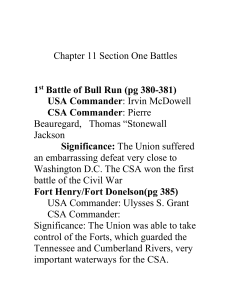
Chapter 11 Section One Battles
... Union army, forcing Lincoln to fire Pope and return command to McClellan. Battle of Antietam USA Commander:Gen. McClellan CSA Commander Gen Robert E. Lee Significance: Lee’s army is almost destroyed in the bloodiest fighting of the war. McClellan does not pursue him. ...
... Union army, forcing Lincoln to fire Pope and return command to McClellan. Battle of Antietam USA Commander:Gen. McClellan CSA Commander Gen Robert E. Lee Significance: Lee’s army is almost destroyed in the bloodiest fighting of the war. McClellan does not pursue him. ...

Civil War, 1861-1865 - Loudoun County Public Schools
... Gettysburg- Day 3 (July 3) • Lee ordered an attack on the middle of the Union lines – For 2 hours fire rang out and could be heard as far as Pittsburgh • Longstreet thinks he has weakened the Union forces and orders men under Gen. Pickett to march across the battlefield and attack the center of the ...
... Gettysburg- Day 3 (July 3) • Lee ordered an attack on the middle of the Union lines – For 2 hours fire rang out and could be heard as far as Pittsburgh • Longstreet thinks he has weakened the Union forces and orders men under Gen. Pickett to march across the battlefield and attack the center of the ...

Chapter 21 Study Guide
... unconditional surrender: the force which surrenders agrees in advance to accept anything required of it by the victors Lincoln on initial Union war aims: “My paramount object in this struggle is to save the Union and is not either to save or to destroy slavery.” [text, p. 453] size of the United Sta ...
... unconditional surrender: the force which surrenders agrees in advance to accept anything required of it by the victors Lincoln on initial Union war aims: “My paramount object in this struggle is to save the Union and is not either to save or to destroy slavery.” [text, p. 453] size of the United Sta ...
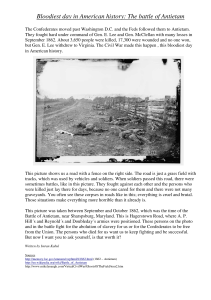
Bloodiest day in American history: The battle of Antietam
... are about 40 dead soldiers. So you can see it was a very bad day in the history of America. In the background you can see lots of trees and shrubs. But it’s horrible because these soldiers lie there in the sun, so there must be a very bad smell. But where were they buried? All the dead soldiers were ...
... are about 40 dead soldiers. So you can see it was a very bad day in the history of America. In the background you can see lots of trees and shrubs. But it’s horrible because these soldiers lie there in the sun, so there must be a very bad smell. But where were they buried? All the dead soldiers were ...
Battle of Antietam

The Battle of Antietam /ænˈtiːtəm/, also known as the Battle of Sharpsburg, particularly in the South, fought on September 17, 1862, near Sharpsburg, Maryland, and Antietam Creek as part of the Maryland Campaign, was the first major battle in the American Civil War to take place on Union soil. It is the bloodiest single-day battle in American history, with a combined tally of dead, wounded, and missing at 22,717.After pursuing Confederate General Robert E. Lee into Maryland, Union Army Maj. Gen. George B. McClellan launched attacks against Lee's army, in defensive positions behind Antietam Creek. At dawn on September 17, Maj. Gen. Joseph Hooker's corps mounted a powerful assault on Lee's left flank. Attacks and counterattacks swept across Miller's Cornfield and fighting swirled around the Dunker Church. Union assaults against the Sunken Road eventually pierced the Confederate center, but the Federal advantage was not followed up. In the afternoon, Union Maj. Gen. Ambrose Burnside's corps entered the action, capturing a stone bridge over Antietam Creek and advancing against the Confederate right. At a crucial moment, Confederate Maj. Gen. A. P. Hill's division arrived from Harpers Ferry and launched a surprise counterattack, driving back Burnside and ending the battle. Although outnumbered two-to-one, Lee committed his entire force, while McClellan sent in less than three-quarters of his army, enabling Lee to fight the Federals to a standstill. During the night, both armies consolidated their lines. In spite of crippling casualties, Lee continued to skirmish with McClellan throughout September 18, while removing his battered army south of the Potomac River.Despite having superiority of numbers, McClellan's attacks failed to achieve force concentration, allowing Lee to counter by shifting forces and moving interior lines to meet each challenge. Despite ample reserve forces that could have been deployed to exploit localized successes, McClellan failed to destroy Lee's army. McClellan had halted Lee's invasion of Maryland, but Lee was able to withdraw his army back to Virginia without interference from the cautious McClellan. Although the battle was tactically inconclusive, the Confederate troops had withdrawn first from the battlefield, making it, in military terms, a Union victory. It had significance as enough of a victory to give President Abraham Lincoln the confidence to announce his Emancipation Proclamation, which discouraged the British and French governments from potential plans for recognition of the Confederacy.