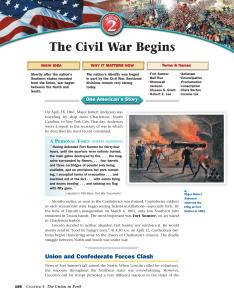
The Civil War Begins
... failed to have his troops dig trenches or set out adequate guards and patrols, thousands of Confederate soldiers carried out a surprise attack. Grant averted disaster by reorganizing his troops and driving the Confederate forces away the next day. However, Shiloh demonstrated what a bloody slaughter ...
... failed to have his troops dig trenches or set out adequate guards and patrols, thousands of Confederate soldiers carried out a surprise attack. Grant averted disaster by reorganizing his troops and driving the Confederate forces away the next day. However, Shiloh demonstrated what a bloody slaughter ...

Civil War
... Some people thought Lincoln became too powerful during the Civil War. He ended habeas corpus for a time. This meant people could be arrested and jailed without proof they had committed a crime. This violated the United States Constitution. People suspected of being Confederate spies were jailed. Lin ...
... Some people thought Lincoln became too powerful during the Civil War. He ended habeas corpus for a time. This meant people could be arrested and jailed without proof they had committed a crime. This violated the United States Constitution. People suspected of being Confederate spies were jailed. Lin ...

CW lecture-1 - WordPress.com
... War comes when Southern states (now calling themselves “The Confederacy”) open fire on a small garrison of Federal troops stationed at Fort Sumter in Charleston harbor on April 12th, 1861. The bombardment will last 33 hours before the fort surrenders. In response, Lincoln calls for 75,000 volunt ...
... War comes when Southern states (now calling themselves “The Confederacy”) open fire on a small garrison of Federal troops stationed at Fort Sumter in Charleston harbor on April 12th, 1861. The bombardment will last 33 hours before the fort surrenders. In response, Lincoln calls for 75,000 volunt ...

17 - Coppell ISD
... In 1864, President Lincoln had appointed Ulysses S. Grant Commander in Chief of the Union Army. Grant said, “The art of war is simple, find out where your enemy is, get at him as soon as you can and strike him as hard as you can, and keep moving on.” To Gen Ulysses S. Grant, every problem had a solu ...
... In 1864, President Lincoln had appointed Ulysses S. Grant Commander in Chief of the Union Army. Grant said, “The art of war is simple, find out where your enemy is, get at him as soon as you can and strike him as hard as you can, and keep moving on.” To Gen Ulysses S. Grant, every problem had a solu ...

Section 1 The Civil War Begins
... New Weapons • Rifles more accurate, faster loading, fire more rounds than muskets • Minié ball (more destructive bullet), grenades, land mines are used • Fighting from trenches, barricades new advantage in infantry attacks ...
... New Weapons • Rifles more accurate, faster loading, fire more rounds than muskets • Minié ball (more destructive bullet), grenades, land mines are used • Fighting from trenches, barricades new advantage in infantry attacks ...

Chapter 15 - GEOCITIES.ws
... The confederates to slow him down attacked his army 25 miles from the target, Grant’s army couldn’t handle it, but his reinforcements helped. Attack on New Orleans: With the move of troops from New Orleans the confederates left its biggest city with 3000 protectors giving the north a chance to c ...
... The confederates to slow him down attacked his army 25 miles from the target, Grant’s army couldn’t handle it, but his reinforcements helped. Attack on New Orleans: With the move of troops from New Orleans the confederates left its biggest city with 3000 protectors giving the north a chance to c ...

The Battles of Lawrenceburg and Dog Walk, Kentucky
... separately. The first phase was the Battle of Lawrenceburg which occurred on October 8, 1862 (the same day as the Battle of Perryville). At this time of course, the Confederate forces were by no means in retreat mode. Their dreams of liberating Kentucky had not yet been dashed. A large portion of th ...
... separately. The first phase was the Battle of Lawrenceburg which occurred on October 8, 1862 (the same day as the Battle of Perryville). At this time of course, the Confederate forces were by no means in retreat mode. Their dreams of liberating Kentucky had not yet been dashed. A large portion of th ...

NAME_________________________CLASS___
... Why did Lee want to go to Maryland? Win a battle on northern soil to lower Union morale ...
... Why did Lee want to go to Maryland? Win a battle on northern soil to lower Union morale ...

Unit 5 Review Reading - Waterford Union High School
... Then, in June, General Robert E. Lee took command of the Confederate forces. On June 26 the two armies met in the Seven Days’ Battles. These battles pushed McClellan away from Richmond. During the Second Battle of Bull Run, Jackson’s troops defeated another Union army before it could march directly ...
... Then, in June, General Robert E. Lee took command of the Confederate forces. On June 26 the two armies met in the Seven Days’ Battles. These battles pushed McClellan away from Richmond. During the Second Battle of Bull Run, Jackson’s troops defeated another Union army before it could march directly ...

Chapter 17-The Civil War
... A brilliant strategist, organizer, and trainer of troops during the American Civil War (18611865), General George McClellan was praised as a "young Napoleon," but his timidity on the battlefield caused President Abraham Lincoln to replace him as leader of the Union forces. ...
... A brilliant strategist, organizer, and trainer of troops during the American Civil War (18611865), General George McClellan was praised as a "young Napoleon," but his timidity on the battlefield caused President Abraham Lincoln to replace him as leader of the Union forces. ...

CH 21 Notes Part 2
... MAC is removed from Command after the failure to follow Lee’s retreat from Antietam and engage the enemy…HE IS DONE…militarily…he runs for President in 1864 against Lincoln and loses Burnside (side-burns) takes command and promptly gets the Union Army slaughtered at Fredericksburg, Virginia Hook ...
... MAC is removed from Command after the failure to follow Lee’s retreat from Antietam and engage the enemy…HE IS DONE…militarily…he runs for President in 1864 against Lincoln and loses Burnside (side-burns) takes command and promptly gets the Union Army slaughtered at Fredericksburg, Virginia Hook ...
Antietam: A Failure To Achieve Victory
... considered Harper's Ferry to be of no great importance and to be indefensible. 10 Lee, however, determined that the position at Harper's Ferry, if it could be gained, would benefit the Confederate cause. Lee was surprised that the Federal Troops at Harper's Ferry and also Martinsburg had not already ...
... considered Harper's Ferry to be of no great importance and to be indefensible. 10 Lee, however, determined that the position at Harper's Ferry, if it could be gained, would benefit the Confederate cause. Lee was surprised that the Federal Troops at Harper's Ferry and also Martinsburg had not already ...

Our Best Men: Patrick Ronayne Cleburne
... It is said that slavery is all we are fighting for, and if we give it up we give up all. Even if this were true, which we deny, slavery is not all our enemies are fighting for. It is merely the pretense to establish sectional superiority and a more centralized form of government, and to deprive us o ...
... It is said that slavery is all we are fighting for, and if we give it up we give up all. Even if this were true, which we deny, slavery is not all our enemies are fighting for. It is merely the pretense to establish sectional superiority and a more centralized form of government, and to deprive us o ...
Vermont at Bull Run - Vermont Historical Society
... messenger for help. Gen. Bee of South Carolina, hearing the roar of battle upstream beyond the stone bridge, was already on his way toward the fight with his brigade. He took a strong position on the flat-topped Henry Hill, planted his batteries, and sent word to Evans to fall back and join him. Ev ...
... messenger for help. Gen. Bee of South Carolina, hearing the roar of battle upstream beyond the stone bridge, was already on his way toward the fight with his brigade. He took a strong position on the flat-topped Henry Hill, planted his batteries, and sent word to Evans to fall back and join him. Ev ...

South
... than the states it had created them Believed the Union had to be preserved South believed that majority rule was a threat to their liberty North believed South was pouting because they lost the election Lincoln said that the national ...
... than the states it had created them Believed the Union had to be preserved South believed that majority rule was a threat to their liberty North believed South was pouting because they lost the election Lincoln said that the national ...

apush ch 21
... the Army of Northern Virginia in this struggle. I feel that it is so, and regard it as my duty to shift from myself the responsibility of any further effusion (spilling) of blood by asking of you the surrender of that portion of the Confederate States army known as the Army of Northern Virginia…… ...
... the Army of Northern Virginia in this struggle. I feel that it is so, and regard it as my duty to shift from myself the responsibility of any further effusion (spilling) of blood by asking of you the surrender of that portion of the Confederate States army known as the Army of Northern Virginia…… ...

Chapter 10/11
... • General Winfield Scott asked Robert E. Lee to command the Union’s troops. • Lee was one of the best senior officers in the United States Army, but he was from Virginia, so when his state voted to secede, Lee chose to support the Confederacy. • The South had a strong military tradition and one-thir ...
... • General Winfield Scott asked Robert E. Lee to command the Union’s troops. • Lee was one of the best senior officers in the United States Army, but he was from Virginia, so when his state voted to secede, Lee chose to support the Confederacy. • The South had a strong military tradition and one-thir ...

Battle of Kinston
... Union infantry as they deployed on either side of the Wilmington Road. The outnumbered Confederates held for three desperate hours until their left flank was overrun. At noon, Evans ordered his troops into Kinston and Jones bridge burned. In the chaos, only those in the center and east of the road g ...
... Union infantry as they deployed on either side of the Wilmington Road. The outnumbered Confederates held for three desperate hours until their left flank was overrun. At noon, Evans ordered his troops into Kinston and Jones bridge burned. In the chaos, only those in the center and east of the road g ...

Slide 1
... the Army of Northern Virginia in this struggle. I feel that it is so, and regard it as my duty to shift from myself the responsibility of any further effusion (spilling) of blood by asking of you the surrender of that portion of the Confederate States army known as the Army of Northern Virginia…… ...
... the Army of Northern Virginia in this struggle. I feel that it is so, and regard it as my duty to shift from myself the responsibility of any further effusion (spilling) of blood by asking of you the surrender of that portion of the Confederate States army known as the Army of Northern Virginia…… ...
Continued
... • Anaconda Plan: 3-pronged Union strategy to win the war 1) blockade Southern ports 2) divide Confederacy in two in the west 3) capture Richmond, VA (Confed capital) • Confederate strategy: play defense, invade the North if the opportunity arises ...
... • Anaconda Plan: 3-pronged Union strategy to win the war 1) blockade Southern ports 2) divide Confederacy in two in the west 3) capture Richmond, VA (Confed capital) • Confederate strategy: play defense, invade the North if the opportunity arises ...

battles and campaigns
... Union’s sizable losses during the conflict (12,080 dead, 9,600 wounded, and 1,769 missing or taken prisoner). The Battle of Stones River (also known as the Battle of Murfreesboro). From December 31, 1862, to January 2, 1863, the Union’s Army of the Cumberland under Major General William S. Rosecrans ...
... Union’s sizable losses during the conflict (12,080 dead, 9,600 wounded, and 1,769 missing or taken prisoner). The Battle of Stones River (also known as the Battle of Murfreesboro). From December 31, 1862, to January 2, 1863, the Union’s Army of the Cumberland under Major General William S. Rosecrans ...

the sergeants mess - 8th Kentucky Infantry
... Crittenden advanced with Zollicoffer's own brigade in the lead. Zollicoffer put the 15th Mississippi Infantry in line of battle advancing up the road, with his other regiments following. This force was sufficient to push the Federals off the hill and into the woods below. However, the dawn was dark ...
... Crittenden advanced with Zollicoffer's own brigade in the lead. Zollicoffer put the 15th Mississippi Infantry in line of battle advancing up the road, with his other regiments following. This force was sufficient to push the Federals off the hill and into the woods below. However, the dawn was dark ...

Unit 6-Civil War
... as well as factories which produced more guns, ammunition, and supplies for the war, which gave them the advantage to win the war. Fort Sumter: The war began at Fort Sumter, a US military fort in Charleston, South Carolina. The Confederate States of America demanded that this US fort surrender becau ...
... as well as factories which produced more guns, ammunition, and supplies for the war, which gave them the advantage to win the war. Fort Sumter: The war began at Fort Sumter, a US military fort in Charleston, South Carolina. The Confederate States of America demanded that this US fort surrender becau ...
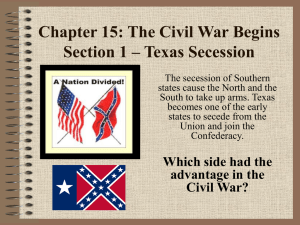
The Civil War Begins
... – Fall of Fort Sumter unites North; volunteers rush to enlist – Virginia unwilling to fight the South; secedes from Union • This is very important, because Virginia is the most populated state in the South, and Robert E. Lee is from Virginia ...
... – Fall of Fort Sumter unites North; volunteers rush to enlist – Virginia unwilling to fight the South; secedes from Union • This is very important, because Virginia is the most populated state in the South, and Robert E. Lee is from Virginia ...

CH 21 Part 1 RQs
... 32 Where does the CSA go to trade with Britain? 33 What % of profit do smugglers make when successful? 34 ***In 1862 what is the name of the Confederate ship that was perceived to be the main threat to the continuing success of the Union blockade? 35 What is the name of the ship that was seen as the ...
... 32 Where does the CSA go to trade with Britain? 33 What % of profit do smugglers make when successful? 34 ***In 1862 what is the name of the Confederate ship that was perceived to be the main threat to the continuing success of the Union blockade? 35 What is the name of the ship that was seen as the ...
Battle of Antietam

The Battle of Antietam /ænˈtiːtəm/, also known as the Battle of Sharpsburg, particularly in the South, fought on September 17, 1862, near Sharpsburg, Maryland, and Antietam Creek as part of the Maryland Campaign, was the first major battle in the American Civil War to take place on Union soil. It is the bloodiest single-day battle in American history, with a combined tally of dead, wounded, and missing at 22,717.After pursuing Confederate General Robert E. Lee into Maryland, Union Army Maj. Gen. George B. McClellan launched attacks against Lee's army, in defensive positions behind Antietam Creek. At dawn on September 17, Maj. Gen. Joseph Hooker's corps mounted a powerful assault on Lee's left flank. Attacks and counterattacks swept across Miller's Cornfield and fighting swirled around the Dunker Church. Union assaults against the Sunken Road eventually pierced the Confederate center, but the Federal advantage was not followed up. In the afternoon, Union Maj. Gen. Ambrose Burnside's corps entered the action, capturing a stone bridge over Antietam Creek and advancing against the Confederate right. At a crucial moment, Confederate Maj. Gen. A. P. Hill's division arrived from Harpers Ferry and launched a surprise counterattack, driving back Burnside and ending the battle. Although outnumbered two-to-one, Lee committed his entire force, while McClellan sent in less than three-quarters of his army, enabling Lee to fight the Federals to a standstill. During the night, both armies consolidated their lines. In spite of crippling casualties, Lee continued to skirmish with McClellan throughout September 18, while removing his battered army south of the Potomac River.Despite having superiority of numbers, McClellan's attacks failed to achieve force concentration, allowing Lee to counter by shifting forces and moving interior lines to meet each challenge. Despite ample reserve forces that could have been deployed to exploit localized successes, McClellan failed to destroy Lee's army. McClellan had halted Lee's invasion of Maryland, but Lee was able to withdraw his army back to Virginia without interference from the cautious McClellan. Although the battle was tactically inconclusive, the Confederate troops had withdrawn first from the battlefield, making it, in military terms, a Union victory. It had significance as enough of a victory to give President Abraham Lincoln the confidence to announce his Emancipation Proclamation, which discouraged the British and French governments from potential plans for recognition of the Confederacy.