
THE CIVIL WAR - algonac.k12.mi.us
... Chancellorsville May 1-14, 1863 The general for the Confederates was Robert E. Lee The general for the Yankees was Joseph Hooker. South had 45,000 soldiers and North had ...
... Chancellorsville May 1-14, 1863 The general for the Confederates was Robert E. Lee The general for the Yankees was Joseph Hooker. South had 45,000 soldiers and North had ...

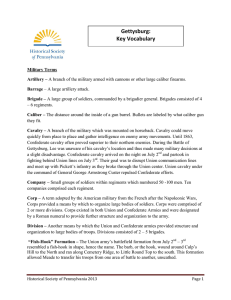
Gettysburg: Key Vocabulary - Historical Society of Pennsylvania
... Richard S. Ewell – Promoted to Corp commander before the Battle of Gettysburg, the Virginiaborn Ewell, in addition to Longstreet, also faced criticism following the battle. In the aftermath of the engagements on July 1st, Ewell missed an opportunity to order his troops to the peak of Culp’s Hill. E ...
... Richard S. Ewell – Promoted to Corp commander before the Battle of Gettysburg, the Virginiaborn Ewell, in addition to Longstreet, also faced criticism following the battle. In the aftermath of the engagements on July 1st, Ewell missed an opportunity to order his troops to the peak of Culp’s Hill. E ...

Chapter Themes: READ THIS—these are model thesis
... “The old federal republic in which the national government had rarely touched the average citizen except through the post-office gave way to a more centralized polity that taxed the people directly and created an internal revenue bureau to collect these taxes, drafted men into the army, expanded the ...
... “The old federal republic in which the national government had rarely touched the average citizen except through the post-office gave way to a more centralized polity that taxed the people directly and created an internal revenue bureau to collect these taxes, drafted men into the army, expanded the ...

The Civil War The Election of Lincoln A. Following Abraham
... Lee issued a “Proclamation to the People of Maryland,” inviting them to ally themselves with the South. The offer was rejected. The Union then found a copy of Lee’s battle plans wrapped around a cigar. With his battle plans intercepted, Lee lost the element of surprise. On September 17, 1862 the Uni ...
... Lee issued a “Proclamation to the People of Maryland,” inviting them to ally themselves with the South. The offer was rejected. The Union then found a copy of Lee’s battle plans wrapped around a cigar. With his battle plans intercepted, Lee lost the element of surprise. On September 17, 1862 the Uni ...

The Civil War - Cloudfront.net
... May 5–6 The Battle of the Wilderness in Virginia is the first of a bloody series of month-long engagements between Grant and Lee. June 1–3 The Battle of Cold Harbor results in heavy Union casualties. Grant prepares for a ten month siege of Petersburg. June 28 Lincoln signs a bill repealing the fugit ...
... May 5–6 The Battle of the Wilderness in Virginia is the first of a bloody series of month-long engagements between Grant and Lee. June 1–3 The Battle of Cold Harbor results in heavy Union casualties. Grant prepares for a ten month siege of Petersburg. June 28 Lincoln signs a bill repealing the fugit ...

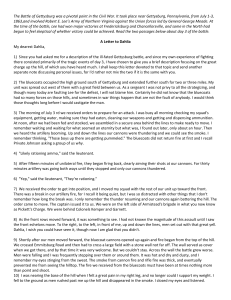
The Battle of Gettysburg was a pivotal point in the Civil War. It took
... 1) Since you had asked me for a description of the ill-fated Gettysburg battle, and since my own experience of fighting there consisted primarily of the tragic events of day 3, I have chosen to give you a brief description focusing on the great charge up the hill, of which you have heard much. I sha ...
... 1) Since you had asked me for a description of the ill-fated Gettysburg battle, and since my own experience of fighting there consisted primarily of the tragic events of day 3, I have chosen to give you a brief description focusing on the great charge up the hill, of which you have heard much. I sha ...

Civil War Test NAME____________________________
... b. discrimination d. slavery ____ 13. Lincoln’s Plan for Reconstruction called for a. trying Confederate leaders for war crimes. b. guaranteeing African American voting rights. c. revolutionizing Southern institutions, habits, and manners. d. reconciling with the South rather than punishing it. ____ ...
... b. discrimination d. slavery ____ 13. Lincoln’s Plan for Reconstruction called for a. trying Confederate leaders for war crimes. b. guaranteeing African American voting rights. c. revolutionizing Southern institutions, habits, and manners. d. reconciling with the South rather than punishing it. ____ ...

war of attrition - werkmeisteramericanhistoryii
... shoes in the town, and the Confederates formed a raiding party. As the party approached the town, they were met by Union fire. ...
... shoes in the town, and the Confederates formed a raiding party. As the party approached the town, they were met by Union fire. ...

Chapter 21 packet!
... Lincoln’s election victory in 1864 was sealed by Union military successes at a. Gettysburg, Antietam, and Vicksburg. b. the Wilderness, Lookout Mountain, and Appomattox. ...
... Lincoln’s election victory in 1864 was sealed by Union military successes at a. Gettysburg, Antietam, and Vicksburg. b. the Wilderness, Lookout Mountain, and Appomattox. ...

2nd Semester Final – Project Overview
... Causes of the Civil War II a. John Brown’s Raid on Harpers Ferry, Popular Sovereignty, The Brooks/Sumner Attack, Harriet Beecher Stowe’s Uncle Tom’s Cabin, The LincolnDouglas Debates, The Election of 1860 ...
... Causes of the Civil War II a. John Brown’s Raid on Harpers Ferry, Popular Sovereignty, The Brooks/Sumner Attack, Harriet Beecher Stowe’s Uncle Tom’s Cabin, The LincolnDouglas Debates, The Election of 1860 ...

Civil War 2013 powerpoint
... maintain the freedom of such persons, and will do no act or acts to repress such persons, or any of them, in any efforts they may make for their actual freedom...” ...
... maintain the freedom of such persons, and will do no act or acts to repress such persons, or any of them, in any efforts they may make for their actual freedom...” ...
The Civil War (USH)
... Naming the Battles of the War Battle of Bull Run (N)=Battle of Manassas (S) Battle of Antietam (N)=Battle of Sharpsburg (S) Why did the United States names prevail? ...
... Naming the Battles of the War Battle of Bull Run (N)=Battle of Manassas (S) Battle of Antietam (N)=Battle of Sharpsburg (S) Why did the United States names prevail? ...

Chap14-CivilWar - AP US Government & Politics
... Was the Emancipation too little, too late? How did the emancipation edict affect the politics and military affairs of the North? ...
... Was the Emancipation too little, too late? How did the emancipation edict affect the politics and military affairs of the North? ...

Main Idea 1
... to the Confederacy. • Lincoln was impressed with Grant’s victories; gave him command of Union army – Grant forced Lee to fight series of battles in Virginia that stretched Confederate soldiers and supplies to limit ...
... to the Confederacy. • Lincoln was impressed with Grant’s victories; gave him command of Union army – Grant forced Lee to fight series of battles in Virginia that stretched Confederate soldiers and supplies to limit ...

Chapter 15 - The Civil War
... to the Confederacy. • Lincoln was impressed with Grant’s victories; gave him command of Union army – Grant forced Lee to fight series of battles in Virginia that stretched Confederate soldiers and supplies to limit • Wilderness Campaign: series of battles designed to capture Confederate capital of R ...
... to the Confederacy. • Lincoln was impressed with Grant’s victories; gave him command of Union army – Grant forced Lee to fight series of battles in Virginia that stretched Confederate soldiers and supplies to limit • Wilderness Campaign: series of battles designed to capture Confederate capital of R ...

Battle of Shiloh Battle of Fredericksburg
... One of the strengths of the Confederate army during the war was that it used the in the South as cover against invading forces. ...
... One of the strengths of the Confederate army during the war was that it used the in the South as cover against invading forces. ...

United States History Chapter 11
... Explain Northern and Southern military strategies to capture their opponent’s capital. How did McClellan hurt the Union cause? He was too cautious in his approach to Battle, he constantly felt he was outnumbered (even though he was not) and he failed to pursue Lee’s Army after victories giving him t ...
... Explain Northern and Southern military strategies to capture their opponent’s capital. How did McClellan hurt the Union cause? He was too cautious in his approach to Battle, he constantly felt he was outnumbered (even though he was not) and he failed to pursue Lee’s Army after victories giving him t ...

THE YEAR OF LINCOLN CHRONOLOGY 1861-1865
... July 4, 1863 - Vicksburg, the last Confederate stronghold on the Mississippi River, surrenders to Gen. Grant and the Army of the West after a six week siege. With the Union now in control of the Mississippi, the Confederacy is effectively split in two, cut off from its western allies. July 18, 1863 ...
... July 4, 1863 - Vicksburg, the last Confederate stronghold on the Mississippi River, surrenders to Gen. Grant and the Army of the West after a six week siege. With the Union now in control of the Mississippi, the Confederacy is effectively split in two, cut off from its western allies. July 18, 1863 ...

The Civil War - Notes
... whether that policy concerned slavery or another issue, such as tariffs. Slavery was, therefore, considered the catalyst for the nation’s rupture, but not the primary cause. It was not until Lincoln’s Emancipation Proclamation that slavery emerged as the central issue at stake. In the East, the Unio ...
... whether that policy concerned slavery or another issue, such as tariffs. Slavery was, therefore, considered the catalyst for the nation’s rupture, but not the primary cause. It was not until Lincoln’s Emancipation Proclamation that slavery emerged as the central issue at stake. In the East, the Unio ...
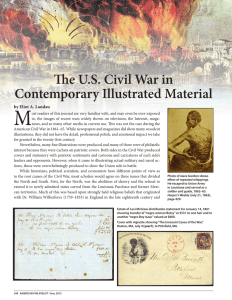
The US Civil War in Contemporary Illustrated Material
... One of the scarcest CSA propaganda pieces was a songsheet with the sentimental Union song “Just Before the Battle, Mother” written in 1863 by George Frederick Root, who also wrote “Battle Cry of Freedom” (1862) and “Tramp! Tramp! Tramp!” (1864). The sheet was illustrated by Confederate troops advanc ...
... One of the scarcest CSA propaganda pieces was a songsheet with the sentimental Union song “Just Before the Battle, Mother” written in 1863 by George Frederick Root, who also wrote “Battle Cry of Freedom” (1862) and “Tramp! Tramp! Tramp!” (1864). The sheet was illustrated by Confederate troops advanc ...

Events Leading to Civil War
... b. Describe President Lincoln’s efforts to preserve the Union as seen in his second inaugural address and the Gettysburg speech and in his use of emergency powers, such as his decision to suspend habeas corpus. c. Describe the roles of Ulysses Grant, Robert E. Lee, “Stonewall” Jackson, William T. Sh ...
... b. Describe President Lincoln’s efforts to preserve the Union as seen in his second inaugural address and the Gettysburg speech and in his use of emergency powers, such as his decision to suspend habeas corpus. c. Describe the roles of Ulysses Grant, Robert E. Lee, “Stonewall” Jackson, William T. Sh ...

Diplomacy
... situations in which England or France would intervene with the weapons and supplies ❧ Foreign intervention loomed as an intense hope for the confederacy and a great fear of the north. ❧ Anger over the Trent Affair was balanced by resentment of southern assumptions about British dependence on cotto ...
... situations in which England or France would intervene with the weapons and supplies ❧ Foreign intervention loomed as an intense hope for the confederacy and a great fear of the north. ❧ Anger over the Trent Affair was balanced by resentment of southern assumptions about British dependence on cotto ...
Battle of Antietam

The Battle of Antietam /ænˈtiːtəm/, also known as the Battle of Sharpsburg, particularly in the South, fought on September 17, 1862, near Sharpsburg, Maryland, and Antietam Creek as part of the Maryland Campaign, was the first major battle in the American Civil War to take place on Union soil. It is the bloodiest single-day battle in American history, with a combined tally of dead, wounded, and missing at 22,717.After pursuing Confederate General Robert E. Lee into Maryland, Union Army Maj. Gen. George B. McClellan launched attacks against Lee's army, in defensive positions behind Antietam Creek. At dawn on September 17, Maj. Gen. Joseph Hooker's corps mounted a powerful assault on Lee's left flank. Attacks and counterattacks swept across Miller's Cornfield and fighting swirled around the Dunker Church. Union assaults against the Sunken Road eventually pierced the Confederate center, but the Federal advantage was not followed up. In the afternoon, Union Maj. Gen. Ambrose Burnside's corps entered the action, capturing a stone bridge over Antietam Creek and advancing against the Confederate right. At a crucial moment, Confederate Maj. Gen. A. P. Hill's division arrived from Harpers Ferry and launched a surprise counterattack, driving back Burnside and ending the battle. Although outnumbered two-to-one, Lee committed his entire force, while McClellan sent in less than three-quarters of his army, enabling Lee to fight the Federals to a standstill. During the night, both armies consolidated their lines. In spite of crippling casualties, Lee continued to skirmish with McClellan throughout September 18, while removing his battered army south of the Potomac River.Despite having superiority of numbers, McClellan's attacks failed to achieve force concentration, allowing Lee to counter by shifting forces and moving interior lines to meet each challenge. Despite ample reserve forces that could have been deployed to exploit localized successes, McClellan failed to destroy Lee's army. McClellan had halted Lee's invasion of Maryland, but Lee was able to withdraw his army back to Virginia without interference from the cautious McClellan. Although the battle was tactically inconclusive, the Confederate troops had withdrawn first from the battlefield, making it, in military terms, a Union victory. It had significance as enough of a victory to give President Abraham Lincoln the confidence to announce his Emancipation Proclamation, which discouraged the British and French governments from potential plans for recognition of the Confederacy.