
Chapter 17 Notes
... 4. Union forces tried to hold the high ground on Cemetery Ridge, Culp’s Hill, Little Round Top, Big Round Top, and Rock Creek 5. Confederate forces attempted to dislodge, or remove, them 6. On July 3, Lee ordered General George Pickett to mount a direct attack on the middle of the Union line 7. Geor ...
... 4. Union forces tried to hold the high ground on Cemetery Ridge, Culp’s Hill, Little Round Top, Big Round Top, and Rock Creek 5. Confederate forces attempted to dislodge, or remove, them 6. On July 3, Lee ordered General George Pickett to mount a direct attack on the middle of the Union line 7. Geor ...
File
... the United Sates” since it opened in 1893. The Texas of the Great Locomotive Chase is housed here along with many artifacts. ...
... the United Sates” since it opened in 1893. The Texas of the Great Locomotive Chase is housed here along with many artifacts. ...


Chapter 15 – A Nation Divided
... Chapter 23: To what extent did Reconstruction bring African American’s closer to full citizenship? ...
... Chapter 23: To what extent did Reconstruction bring African American’s closer to full citizenship? ...


Notes
... - She was a strong supporter of the southern cause. - used her friendship w/govt officials to learn just when and how the Union planned to attack Richmond - had to find a way to deliver this info to Confederate leaders w/out being caught - used coded messages (see pic in chpt 22) - was arrested for ...
... - She was a strong supporter of the southern cause. - used her friendship w/govt officials to learn just when and how the Union planned to attack Richmond - had to find a way to deliver this info to Confederate leaders w/out being caught - used coded messages (see pic in chpt 22) - was arrested for ...

America: A Concise History 3e
... compromise. South Carolina fired the first shots when President Lincoln sent supplies to reinforce federal troops at Fort Sumter in Charleston Harbor. Lincoln succeeded in keeping four of the eight states of the Upper South plus newly created West Virginia in the Union. Both Lincoln and Jefferson Da ...
... compromise. South Carolina fired the first shots when President Lincoln sent supplies to reinforce federal troops at Fort Sumter in Charleston Harbor. Lincoln succeeded in keeping four of the eight states of the Upper South plus newly created West Virginia in the Union. Both Lincoln and Jefferson Da ...

SECTIONALISM (ch 13, 15)
... half-free. I do not expect the Union to be dissolved - I do not expect the house to fall - but I do expect it will cease to be divided. It will become all one thing or all the other. ~ Abraham Lincoln, 1858 (Republican candidate for Illinois senate ...
... half-free. I do not expect the Union to be dissolved - I do not expect the house to fall - but I do expect it will cease to be divided. It will become all one thing or all the other. ~ Abraham Lincoln, 1858 (Republican candidate for Illinois senate ...
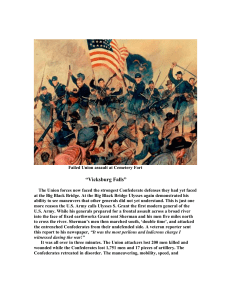
Battle at the Big Black River Bridge
... Confederates retreated in disorder. The maneuvering, mobility, speed, and ...
... Confederates retreated in disorder. The maneuvering, mobility, speed, and ...
October - 7th Maryland
... The next action our boys participated in was a little better known action known as the Boydton Plank Road or Hatcher's Run, October 27-28.This also took place in Dinwiddie County. This action was directed by Maj. Gen. Winfield Scott Hancock with divisions from three Union corps (II, V, and IX) and G ...
... The next action our boys participated in was a little better known action known as the Boydton Plank Road or Hatcher's Run, October 27-28.This also took place in Dinwiddie County. This action was directed by Maj. Gen. Winfield Scott Hancock with divisions from three Union corps (II, V, and IX) and G ...
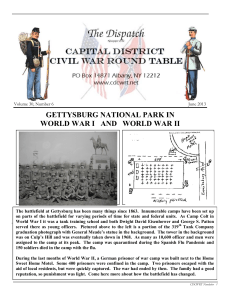
GETTYSBURG NATIONAL PARK IN WORLD WAR I AND WORLD
... massed reinforcements to attack the Culp’s Hill side of Cemetery Hill, thus preventing Meade from shifting forces to support his line on Cemetery Ridge. Hood’s and McLaw’s divisions were to pin down the Union left. The divisions of Pettigrew and Trimble of A.P. Hill’s corps were to attack the southw ...
... massed reinforcements to attack the Culp’s Hill side of Cemetery Hill, thus preventing Meade from shifting forces to support his line on Cemetery Ridge. Hood’s and McLaw’s divisions were to pin down the Union left. The divisions of Pettigrew and Trimble of A.P. Hill’s corps were to attack the southw ...

A New Birth of Freedom - Warren County Schools
... towards the South?______________________________________________________________ The End of the War 43. As Sherman began to move north to meet up with Grant near Richmond what were his two (2) goals? _______________________________________________ ____________________ _____________________ ...
... towards the South?______________________________________________________________ The End of the War 43. As Sherman began to move north to meet up with Grant near Richmond what were his two (2) goals? _______________________________________________ ____________________ _____________________ ...
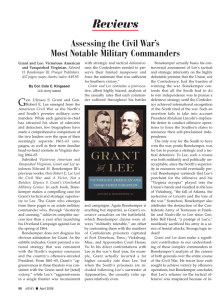
Reviews - Association of the United States Army
... 12th Cavalry (supported by Troop B, 1st Squadron, 1st Cavalry Regiment) prevented the enemy from driving free-world forces from the strategic Que Son Valley, terrain essential for control of Quang Nam Province. Although the battalion was encircled on February 4 by elements of the 6th North Vietnames ...
... 12th Cavalry (supported by Troop B, 1st Squadron, 1st Cavalry Regiment) prevented the enemy from driving free-world forces from the strategic Que Son Valley, terrain essential for control of Quang Nam Province. Although the battalion was encircled on February 4 by elements of the 6th North Vietnames ...

the civil war
... weeks later, the Union naval forces captured New Orleans, the South’s largest city. The Second Battle of Bull Run ended in a Confederate victory. Lee’s army was now only 20 miles from Washington, D.C. In 1862 the armies fought in the single bloodiest day of the war at the Battle of Antietam. After t ...
... weeks later, the Union naval forces captured New Orleans, the South’s largest city. The Second Battle of Bull Run ended in a Confederate victory. Lee’s army was now only 20 miles from Washington, D.C. In 1862 the armies fought in the single bloodiest day of the war at the Battle of Antietam. After t ...

The Civil War
... The Confederate strategy during the war was an Offensive Defense Protect Southern territory from “Northern aggression” but attack into Union territory when the opportunity presents itself Drag out the war as long as possible to make the North quit Get Britain and France to join their cause because ...
... The Confederate strategy during the war was an Offensive Defense Protect Southern territory from “Northern aggression” but attack into Union territory when the opportunity presents itself Drag out the war as long as possible to make the North quit Get Britain and France to join their cause because ...
History - Vermont Historical Society
... But a Union army marching south would find itself moving farther and farther from Richmond, the strategic center of the eastern theater. Lee, therefore, could use the Valley to threaten the enemy's capital and thus divert forces from other areas to its defense, Grant could not. General Grant knew t ...
... But a Union army marching south would find itself moving farther and farther from Richmond, the strategic center of the eastern theater. Lee, therefore, could use the Valley to threaten the enemy's capital and thus divert forces from other areas to its defense, Grant could not. General Grant knew t ...

The Furnace of Civil War
... Virginia. It was an old U.S. wooden ship that was plated with metal armor. It was a great threat to the Northern blockades because it had the ability to crush through the wooden ships. • On March 9, 1862, the Union ironclad, the Monitor, and the Confederate Merrimack met and fought to a standstill. ...
... Virginia. It was an old U.S. wooden ship that was plated with metal armor. It was a great threat to the Northern blockades because it had the ability to crush through the wooden ships. • On March 9, 1862, the Union ironclad, the Monitor, and the Confederate Merrimack met and fought to a standstill. ...

The Battle of Perryville and Stones River
... then a general in the Confederate States Army—a principal commander in the Western Theater of the American Civil War and later the military adviser to Confederate President Jefferson Davis. He established a reputation as a strict disciplinarian, but also as a junior officer willing to publicly argue ...
... then a general in the Confederate States Army—a principal commander in the Western Theater of the American Civil War and later the military adviser to Confederate President Jefferson Davis. He established a reputation as a strict disciplinarian, but also as a junior officer willing to publicly argue ...

The Civil War
... Confederates turn back Union Troops, Gen. Irvin McDowell replaced by Gen. George McClellan Peninsula Campaign, march from Washington → Richmond May 1862, McClellan, 2½ months to go 65 miles, Johnston stops McClellan outside Richmond Seven Days Battle, Robert E. Lee, defeats McClellan, Union abandons ...
... Confederates turn back Union Troops, Gen. Irvin McDowell replaced by Gen. George McClellan Peninsula Campaign, march from Washington → Richmond May 1862, McClellan, 2½ months to go 65 miles, Johnston stops McClellan outside Richmond Seven Days Battle, Robert E. Lee, defeats McClellan, Union abandons ...
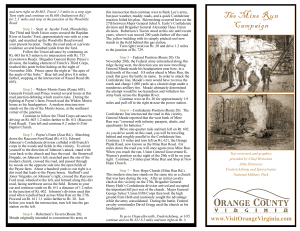
Mine Run Campaign - Visit Orange County VA
... Stop 5 – Federal Position (Route 20). On November 28th, the Federal army entrenched along this ridge facing west, the direction you are now travelling. General Meade made his headquarters near here, in a field north of the road. 0.8 miles ahead is Mine Run, the creek that gave the battle its name. I ...
... Stop 5 – Federal Position (Route 20). On November 28th, the Federal army entrenched along this ridge facing west, the direction you are now travelling. General Meade made his headquarters near here, in a field north of the road. 0.8 miles ahead is Mine Run, the creek that gave the battle its name. I ...

Effects of the Civil War
... or any of them, in forced any efforts they may make forwhites their actual freedom...” to worry about their farms ...
... or any of them, in forced any efforts they may make forwhites their actual freedom...” to worry about their farms ...

A - cloudfront.net
... B. Grant won at Fort Henry and Fort Donelson, where commander asked for terms and Grant demanded “immediate and unconditional surrender” C. Fought a hard battle at Shiloh (April 6-7, 1862) D. Lincoln combated demands for the removal of “Unconditional Surrender” Grant --- Lincoln said, “I can’t spare ...
... B. Grant won at Fort Henry and Fort Donelson, where commander asked for terms and Grant demanded “immediate and unconditional surrender” C. Fought a hard battle at Shiloh (April 6-7, 1862) D. Lincoln combated demands for the removal of “Unconditional Surrender” Grant --- Lincoln said, “I can’t spare ...
Battle of Antietam

The Battle of Antietam /ænˈtiːtəm/, also known as the Battle of Sharpsburg, particularly in the South, fought on September 17, 1862, near Sharpsburg, Maryland, and Antietam Creek as part of the Maryland Campaign, was the first major battle in the American Civil War to take place on Union soil. It is the bloodiest single-day battle in American history, with a combined tally of dead, wounded, and missing at 22,717.After pursuing Confederate General Robert E. Lee into Maryland, Union Army Maj. Gen. George B. McClellan launched attacks against Lee's army, in defensive positions behind Antietam Creek. At dawn on September 17, Maj. Gen. Joseph Hooker's corps mounted a powerful assault on Lee's left flank. Attacks and counterattacks swept across Miller's Cornfield and fighting swirled around the Dunker Church. Union assaults against the Sunken Road eventually pierced the Confederate center, but the Federal advantage was not followed up. In the afternoon, Union Maj. Gen. Ambrose Burnside's corps entered the action, capturing a stone bridge over Antietam Creek and advancing against the Confederate right. At a crucial moment, Confederate Maj. Gen. A. P. Hill's division arrived from Harpers Ferry and launched a surprise counterattack, driving back Burnside and ending the battle. Although outnumbered two-to-one, Lee committed his entire force, while McClellan sent in less than three-quarters of his army, enabling Lee to fight the Federals to a standstill. During the night, both armies consolidated their lines. In spite of crippling casualties, Lee continued to skirmish with McClellan throughout September 18, while removing his battered army south of the Potomac River.Despite having superiority of numbers, McClellan's attacks failed to achieve force concentration, allowing Lee to counter by shifting forces and moving interior lines to meet each challenge. Despite ample reserve forces that could have been deployed to exploit localized successes, McClellan failed to destroy Lee's army. McClellan had halted Lee's invasion of Maryland, but Lee was able to withdraw his army back to Virginia without interference from the cautious McClellan. Although the battle was tactically inconclusive, the Confederate troops had withdrawn first from the battlefield, making it, in military terms, a Union victory. It had significance as enough of a victory to give President Abraham Lincoln the confidence to announce his Emancipation Proclamation, which discouraged the British and French governments from potential plans for recognition of the Confederacy.