
Unit 8 - PowerPoints - The American Civil War
... The Battle of Antietam, also known as the Battle of Sharpsburg, was fought on September 16–18, 1862. It was a confrontation between Union and Confederate forces under Generals George McClellan and Robert E. Lee. Federal armies brutalized the Confederacy; the combined casualties were more than twenty ...
... The Battle of Antietam, also known as the Battle of Sharpsburg, was fought on September 16–18, 1862. It was a confrontation between Union and Confederate forces under Generals George McClellan and Robert E. Lee. Federal armies brutalized the Confederacy; the combined casualties were more than twenty ...

Presentation
... ended without a clear winner, it had important effects on the North: –The battle convinced Britain & France not to support the Confederacy in the war –The battle convinced Lincoln that the time was right to make the emancipation of slaves the new focus of the war for the North ...
... ended without a clear winner, it had important effects on the North: –The battle convinced Britain & France not to support the Confederacy in the war –The battle convinced Lincoln that the time was right to make the emancipation of slaves the new focus of the war for the North ...

May 06, 2013
... Why was the Battle of Gettysburg considered a turning point in the Civil War? Lee, who hoped a victory in this northern city would convince the Union to ask for peace, lost one third of his army during the battle. Afterward, he withdrew to Virginia and conducted only a defensive war on southern soil ...
... Why was the Battle of Gettysburg considered a turning point in the Civil War? Lee, who hoped a victory in this northern city would convince the Union to ask for peace, lost one third of his army during the battle. Afterward, he withdrew to Virginia and conducted only a defensive war on southern soil ...

Standard 9 - bervelynbenson
... Vicksburg, Battle of Gettysburg, and the Battle for Atlanta and the impact of geography on these battles. Describe the significance of the Emancipation Proclamation. Explain the importance of the growing economic disparity between the North and the South through an examination of population, functio ...
... Vicksburg, Battle of Gettysburg, and the Battle for Atlanta and the impact of geography on these battles. Describe the significance of the Emancipation Proclamation. Explain the importance of the growing economic disparity between the North and the South through an examination of population, functio ...

The Experiences of the 57th Georgia Infantry in the Civil War - H-Net
... of Tennessee to help defend Vicksburg. In this twist of fate they missed participating in the Battle of Stones River and instead found themselves attached to Maj. Gen. Carter Stevenson’s division marching into central Mississippi. At the Battle of Champion’s Hill on May 16, 1863, the 57th Georgia fi ...
... of Tennessee to help defend Vicksburg. In this twist of fate they missed participating in the Battle of Stones River and instead found themselves attached to Maj. Gen. Carter Stevenson’s division marching into central Mississippi. At the Battle of Champion’s Hill on May 16, 1863, the 57th Georgia fi ...

The U.S. Civil War
... the South. He did not want it to extent into the territories. Lincoln was under a lot of pressure. As the number of dead increased Northerners pushed to destroy slavery. The Proclamation Renews Spirit: After the Emancipation Proclamation the war became a moral war and revitalized the ...
... the South. He did not want it to extent into the territories. Lincoln was under a lot of pressure. As the number of dead increased Northerners pushed to destroy slavery. The Proclamation Renews Spirit: After the Emancipation Proclamation the war became a moral war and revitalized the ...
![TffiBAITLE OTANTIBILM: ATI]ruNG PIOINTIN THE WAR by East](http://s1.studyres.com/store/data/013125615_1-cb0978fa4b396017e7fbbe0ff52e99d3-300x300.png)
TffiBAITLE OTANTIBILM: ATI]ruNG PIOINTIN THE WAR by East
... receive assistance, specifically from France and Britain.4 ...
... receive assistance, specifically from France and Britain.4 ...

Document
... December 1862: Confederate Troops dug trenches and defeated Union at Battle of Fredricksburg,VA – 12,600 Union casualties May 1863: Chancellorsville, VA. Confederate troops with ½ as many men as Union cuts Union into pieces. Stonewall Jackson shot by own men. July 2-4, 1863: Battle of Gettysburg rag ...
... December 1862: Confederate Troops dug trenches and defeated Union at Battle of Fredricksburg,VA – 12,600 Union casualties May 1863: Chancellorsville, VA. Confederate troops with ½ as many men as Union cuts Union into pieces. Stonewall Jackson shot by own men. July 2-4, 1863: Battle of Gettysburg rag ...

The American Civil War
... Shiloh, close to the Mississippi border. S April - Confederate soldiers surprised the Union army and inflicted significant casualties before the Union army could re-group and force Confederate forces to retreat. S Both sides became aware of the need for defensive measures while “in camp”, bloody eng ...
... Shiloh, close to the Mississippi border. S April - Confederate soldiers surprised the Union army and inflicted significant casualties before the Union army could re-group and force Confederate forces to retreat. S Both sides became aware of the need for defensive measures while “in camp”, bloody eng ...

The Civil War: 1861-1865
... XI. End of the War in the East: Grant’s Virginia Campaign A. Grant promoted to lead all Union armies after Lincoln’s dismay with Meade after Gettysburg 1. Meade still remained head of the Army of the Potomac 2. Grant’s strategy: attack Rebel armies simultaneously thus not allowing them to assist one ...
... XI. End of the War in the East: Grant’s Virginia Campaign A. Grant promoted to lead all Union armies after Lincoln’s dismay with Meade after Gettysburg 1. Meade still remained head of the Army of the Potomac 2. Grant’s strategy: attack Rebel armies simultaneously thus not allowing them to assist one ...

THE CIVIL WAR 1861-1864
... fight in the North. North escaped in the night after a bombardment from Southern forces- losing too many men ...
... fight in the North. North escaped in the night after a bombardment from Southern forces- losing too many men ...
BATTLE ANALYSIS OUTLINE TOPIC: BATTLE OF
... The defensive position that Lee established stretched over a seven-mile-long area. e. Key Terrain. Key terrain was one of the most important strategic points for both sides throughout the war. In close to medium range warfare, the importance of gaining tactical advantage carries even more weight in ...
... The defensive position that Lee established stretched over a seven-mile-long area. e. Key Terrain. Key terrain was one of the most important strategic points for both sides throughout the war. In close to medium range warfare, the importance of gaining tactical advantage carries even more weight in ...

The Furnace of Civil War, 1861–1865
... A series of Union military victories just before the election of 1864 guaranteed Lincoln’s victory over McClellan and ended the South’s last hope. ...
... A series of Union military victories just before the election of 1864 guaranteed Lincoln’s victory over McClellan and ended the South’s last hope. ...

Standard 9
... Confederate Army of Northern Virginia in the American Civil War. He was adored by his men and seen as the face of the Confederacy. Lee became the great Southern hero of the ...
... Confederate Army of Northern Virginia in the American Civil War. He was adored by his men and seen as the face of the Confederacy. Lee became the great Southern hero of the ...

Document
... List the first 7 states to secede from the Union. Which state was the first to secede? What state held a peace conference to bring the Confederacy back into the Union? Why did the election of 1860 lead to secession? Explain. Who was chosen to be the leader of the Confederate States of America & wher ...
... List the first 7 states to secede from the Union. Which state was the first to secede? What state held a peace conference to bring the Confederacy back into the Union? Why did the election of 1860 lead to secession? Explain. Who was chosen to be the leader of the Confederate States of America & wher ...


CH 21 Notes Part 1
... -******MAC is a perfectionist and finds great success training troops and energizing the Union Cause…HOWEVER … his greatest flaw is that when tasked with great objectives he is TOO CAUTIOUS and “has the slows,” these factors when engaging so brilliant and motivated an enemy, CSA Generals, Johnston-L ...
... -******MAC is a perfectionist and finds great success training troops and energizing the Union Cause…HOWEVER … his greatest flaw is that when tasked with great objectives he is TOO CAUTIOUS and “has the slows,” these factors when engaging so brilliant and motivated an enemy, CSA Generals, Johnston-L ...
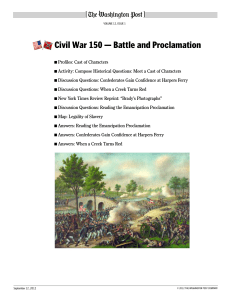
Civil War 150 — Battle and Proclamation
... 2. Harpers Ferry was a gate to the Shenandoah Valley where grains and foods were grown. It is close enough to D.C. to protect the capital of the Union. It was at the upper end of a water route to D.C. 3. Lee planned to cross the Potomac River, taking his forces north. He needed to hold the garrison ...
... 2. Harpers Ferry was a gate to the Shenandoah Valley where grains and foods were grown. It is close enough to D.C. to protect the capital of the Union. It was at the upper end of a water route to D.C. 3. Lee planned to cross the Potomac River, taking his forces north. He needed to hold the garrison ...

Civil War
... Another abolitionist named John Brown wanted to help slaves by giving them guns to rebel against their masters. In October 1859, Brown and a group of men took over a government gun storage facility in Harpers Ferry, Virginia. (It is now located in West Virginia.) Local soldiers surrounded the area b ...
... Another abolitionist named John Brown wanted to help slaves by giving them guns to rebel against their masters. In October 1859, Brown and a group of men took over a government gun storage facility in Harpers Ferry, Virginia. (It is now located in West Virginia.) Local soldiers surrounded the area b ...


Civil War
... • Southern leaders – put loyalty to their home state above everything else and fought for the protection * See Key Leaders of their homes and property chart provided by the teacher (some did not support secession) ...
... • Southern leaders – put loyalty to their home state above everything else and fought for the protection * See Key Leaders of their homes and property chart provided by the teacher (some did not support secession) ...

24CivilWar1861to1863
... •Picture celebrated the Emancipation Proclamation in 1863. •While it placed a white Union soldier in the center: •It also portrayed the important role of African American troops and emphasized the importance of education and literacy. ...
... •Picture celebrated the Emancipation Proclamation in 1863. •While it placed a white Union soldier in the center: •It also portrayed the important role of African American troops and emphasized the importance of education and literacy. ...

The Civil War
... 1. The Union strategy during the war was called the _____________________ Plan: a. ____________________ the coast, seize the Mississippi River to _______________ the South, & take Richmond b. Exploit South’s dependency on foreign trade & its inability to _________________________________ weapons c. ...
... 1. The Union strategy during the war was called the _____________________ Plan: a. ____________________ the coast, seize the Mississippi River to _______________ the South, & take Richmond b. Exploit South’s dependency on foreign trade & its inability to _________________________________ weapons c. ...
Battle of Antietam

The Battle of Antietam /ænˈtiːtəm/, also known as the Battle of Sharpsburg, particularly in the South, fought on September 17, 1862, near Sharpsburg, Maryland, and Antietam Creek as part of the Maryland Campaign, was the first major battle in the American Civil War to take place on Union soil. It is the bloodiest single-day battle in American history, with a combined tally of dead, wounded, and missing at 22,717.After pursuing Confederate General Robert E. Lee into Maryland, Union Army Maj. Gen. George B. McClellan launched attacks against Lee's army, in defensive positions behind Antietam Creek. At dawn on September 17, Maj. Gen. Joseph Hooker's corps mounted a powerful assault on Lee's left flank. Attacks and counterattacks swept across Miller's Cornfield and fighting swirled around the Dunker Church. Union assaults against the Sunken Road eventually pierced the Confederate center, but the Federal advantage was not followed up. In the afternoon, Union Maj. Gen. Ambrose Burnside's corps entered the action, capturing a stone bridge over Antietam Creek and advancing against the Confederate right. At a crucial moment, Confederate Maj. Gen. A. P. Hill's division arrived from Harpers Ferry and launched a surprise counterattack, driving back Burnside and ending the battle. Although outnumbered two-to-one, Lee committed his entire force, while McClellan sent in less than three-quarters of his army, enabling Lee to fight the Federals to a standstill. During the night, both armies consolidated their lines. In spite of crippling casualties, Lee continued to skirmish with McClellan throughout September 18, while removing his battered army south of the Potomac River.Despite having superiority of numbers, McClellan's attacks failed to achieve force concentration, allowing Lee to counter by shifting forces and moving interior lines to meet each challenge. Despite ample reserve forces that could have been deployed to exploit localized successes, McClellan failed to destroy Lee's army. McClellan had halted Lee's invasion of Maryland, but Lee was able to withdraw his army back to Virginia without interference from the cautious McClellan. Although the battle was tactically inconclusive, the Confederate troops had withdrawn first from the battlefield, making it, in military terms, a Union victory. It had significance as enough of a victory to give President Abraham Lincoln the confidence to announce his Emancipation Proclamation, which discouraged the British and French governments from potential plans for recognition of the Confederacy.