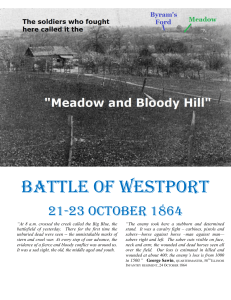
Read More - Battle of Westport
... the Big Blue River at the Byram's Ford crossing was the scene of two successive battles on October 22 and 23, 1864 — the first a Confederate victory and the second a Union victory. A total of approximately 11,000 troops clashed on October 22 and 23, 1864 over the Hallowed Ground at Byram’s Ford. On ...
... the Big Blue River at the Byram's Ford crossing was the scene of two successive battles on October 22 and 23, 1864 — the first a Confederate victory and the second a Union victory. A total of approximately 11,000 troops clashed on October 22 and 23, 1864 over the Hallowed Ground at Byram’s Ford. On ...

The Civil War
... The Confederates were successful on the first day, but fortunately for General Grant, the death of Johnston and the arrival of additional Union troops, led to a successful counter attack the following day. This was the first battle in the Western Hemisphere in which 100,000 men were ...
... The Confederates were successful on the first day, but fortunately for General Grant, the death of Johnston and the arrival of additional Union troops, led to a successful counter attack the following day. This was the first battle in the Western Hemisphere in which 100,000 men were ...

Ch 16 Test - Geneva Area City Schools
... b. wanted to keep his army strong and send the reserves to Ohio. c. thought the battle was already causing too many casualties. Wanted to end it quickly. d. thought General Lee was gathering reserves for a counterattack. He feared losing to Lee. The Civil War began with the a. election of Abraham Li ...
... b. wanted to keep his army strong and send the reserves to Ohio. c. thought the battle was already causing too many casualties. Wanted to end it quickly. d. thought General Lee was gathering reserves for a counterattack. He feared losing to Lee. The Civil War began with the a. election of Abraham Li ...
The Peninsula Campaign
... south of the city and on a strongly fortified ridge just west of the city known as Marye's Heights. On December 13, the "grand division" of Maj. Gen. William B. Franklin was able to pierce the defensive line of Confederate Lt. Gen. Stonewall Jackson to the south, but was finally repulsed. Burnside o ...
... south of the city and on a strongly fortified ridge just west of the city known as Marye's Heights. On December 13, the "grand division" of Maj. Gen. William B. Franklin was able to pierce the defensive line of Confederate Lt. Gen. Stonewall Jackson to the south, but was finally repulsed. Burnside o ...

of the Civil War
... – McClellan caught up with Lee’s troops at Sharpsburg, Md. – A savage single day of fighting left 23,000 dead. – Lincoln’s order to “destroy the rebel army” was ignored. – McClellan allowed the rebels to retreat into Virginia. – He was relieved of command. The Battle of Fredericksburg – Ambrose Burn ...
... – McClellan caught up with Lee’s troops at Sharpsburg, Md. – A savage single day of fighting left 23,000 dead. – Lincoln’s order to “destroy the rebel army” was ignored. – McClellan allowed the rebels to retreat into Virginia. – He was relieved of command. The Battle of Fredericksburg – Ambrose Burn ...

Unit 8 - PowerPoints - The American Civil War
... There were many causes for the outbreak of the Civil War. Many people agree slavery was the main cause for the war, but it is not the only reason. Sectional differences also led to conflicts. Northern and Southern states were developing different lifestyles and cultures. Differences in the economic ...
... There were many causes for the outbreak of the Civil War. Many people agree slavery was the main cause for the war, but it is not the only reason. Sectional differences also led to conflicts. Northern and Southern states were developing different lifestyles and cultures. Differences in the economic ...

Unit 8 - PowerPoints - The American Civil War
... The Battle of Antietam, also known as the Battle of Sharpsburg, was fought on September 16–18, 1862. It was a confrontation between Union and Confederate forces under Generals George McClellan and Robert E. Lee. Federal armies brutalized the Confederacy; the combined casualties were more than twenty ...
... The Battle of Antietam, also known as the Battle of Sharpsburg, was fought on September 16–18, 1862. It was a confrontation between Union and Confederate forces under Generals George McClellan and Robert E. Lee. Federal armies brutalized the Confederacy; the combined casualties were more than twenty ...
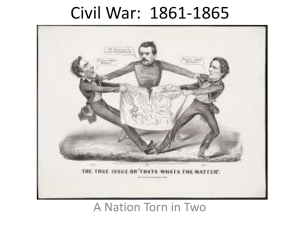
Civil War: 1861-1865 - Amherst County High School
... copy of Lee’s battle plans wrapped around a discarded pack of cigars • McClellan now able to plan a counterattack • With 75,000 troops, McClellan met Lee at Antietam Creek in Maryland ...
... copy of Lee’s battle plans wrapped around a discarded pack of cigars • McClellan now able to plan a counterattack • With 75,000 troops, McClellan met Lee at Antietam Creek in Maryland ...

Name: Date: ______ 1. Which of the following courses of action did
... A) Europe's refusal to help the South before the battle. B) the Union's discovery of Robert E. Lee's battle plans. C) Lincoln's removal of General McClellan from his command. D) the use of the new repeating rifle for the first time. E) the death of Stonewall Jackson during the battle. ...
... A) Europe's refusal to help the South before the battle. B) the Union's discovery of Robert E. Lee's battle plans. C) Lincoln's removal of General McClellan from his command. D) the use of the new repeating rifle for the first time. E) the death of Stonewall Jackson during the battle. ...
The Second Army Corps at Antietam - H-Net
... contention is weaker. He proves that Sumner did not, in fact, send Sedgwick’s division blindly into the West In terms of interpreting the Battle of Antietam, Unfurl Those Colors! boasts an impressive assortment of maps Woods. Armstrong points out that Sumner performed a that detail the Second Corps’ ...
... contention is weaker. He proves that Sumner did not, in fact, send Sedgwick’s division blindly into the West In terms of interpreting the Battle of Antietam, Unfurl Those Colors! boasts an impressive assortment of maps Woods. Armstrong points out that Sumner performed a that detail the Second Corps’ ...

TSB
... the Twelfth corps ran around and down the military crest of the large, northern summit of Culp’s Hill, into a swale, then again up and over the smaller of the two summits. Slocum arrayed his line with Geary’s Second Division running along a serrated front, following the contour of the land. Greene’s ...
... the Twelfth corps ran around and down the military crest of the large, northern summit of Culp’s Hill, into a swale, then again up and over the smaller of the two summits. Slocum arrayed his line with Geary’s Second Division running along a serrated front, following the contour of the land. Greene’s ...

The real Souljo Boi - MAT
... opening shot. "I sprang out of bed." she wrote. "And on my knees--prostrate--I prayed as I never prayed before." The shelling of Fort Sumter from the batteries ringing the harbor awakened Charleston's residents, who rushed out into the predawn darkness to watch the shells arc over the water and burs ...
... opening shot. "I sprang out of bed." she wrote. "And on my knees--prostrate--I prayed as I never prayed before." The shelling of Fort Sumter from the batteries ringing the harbor awakened Charleston's residents, who rushed out into the predawn darkness to watch the shells arc over the water and burs ...
Chapter 11-5: The Final Phase
... – Grant made William Tecumseh Sherman commander on the western front – Grant wanted to take advantage of the Confederate shortages of men and supplies to end the war before the November election. – Ordered Sherman to “get into the interior of the enemy’s country as far as you can and inflict all the ...
... – Grant made William Tecumseh Sherman commander on the western front – Grant wanted to take advantage of the Confederate shortages of men and supplies to end the war before the November election. – Ordered Sherman to “get into the interior of the enemy’s country as far as you can and inflict all the ...
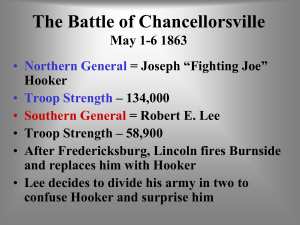
The Battle of Chancellorsville
... • Hooker thinks his army is safely positioned • Stonewall Jackson’s men surprise the Union troops • Hooker is then hit with fragments from a porch and knocked unconscious • He lost control of the army and ordered a withdrawal ...
... • Hooker thinks his army is safely positioned • Stonewall Jackson’s men surprise the Union troops • Hooker is then hit with fragments from a porch and knocked unconscious • He lost control of the army and ordered a withdrawal ...

Civil War Battles in Texas
... allowed for all this but, in the end, did nothing, due to the lack of a written document. The fall of Galveston meant that one more important Confederate port was closed to commerce. But the port of Galveston was not shut down for long. Result(s): Union victory ...
... allowed for all this but, in the end, did nothing, due to the lack of a written document. The fall of Galveston meant that one more important Confederate port was closed to commerce. But the port of Galveston was not shut down for long. Result(s): Union victory ...

Gettysburg - Barrington 220
... mistake – the South’s men were torn apart. The North actually had a chance to “finish them off”, but Lincoln’s generals let them retreat. One third of general Lee’s army was dead or wounded. ...
... mistake – the South’s men were torn apart. The North actually had a chance to “finish them off”, but Lincoln’s generals let them retreat. One third of general Lee’s army was dead or wounded. ...

The Civil War - WLWV Staff Blogs
... • Lincoln was much more willing to crush dissent during the war than Davis was • Some problems in the North, though few: – Ex parte Milligan (1866): civilians can not be tried by military courts when civil courts are open • A man was sentenced to death by a military court for conspiring to free Conf ...
... • Lincoln was much more willing to crush dissent during the war than Davis was • Some problems in the North, though few: – Ex parte Milligan (1866): civilians can not be tried by military courts when civil courts are open • A man was sentenced to death by a military court for conspiring to free Conf ...

Civil War - mrbeckwithhistory
... November, 1861 – George B. McClellan named General-in-Chief of Union February, 1862 – Union offensive opened in the West – Ulysses S. Grant March, 1862 – battle of ironclad ships – Union Monitor v. Merrimac ...
... November, 1861 – George B. McClellan named General-in-Chief of Union February, 1862 – Union offensive opened in the West – Ulysses S. Grant March, 1862 – battle of ironclad ships – Union Monitor v. Merrimac ...

Casualties - Schoolwires.net
... Part of this operation was called the Maryland Campaign. The Confederate army had won a series of battles and was looking to extend itself further into the North. In order to accomplish this goal, they had to secure supply routes from the South into the North. Maryland was a border state and, althou ...
... Part of this operation was called the Maryland Campaign. The Confederate army had won a series of battles and was looking to extend itself further into the North. In order to accomplish this goal, they had to secure supply routes from the South into the North. Maryland was a border state and, althou ...

b. Describe President Lincoln`s efforts to preserve the Union as seen
... The writs of habeas corpus are a person’s right not to be imprisoned unless charged with a crime and given a trial Lincoln suspended these common rights in an effort to stop anyone from supporting the Confederate cause and to prevent those who encouraged others to resist the draft ...
... The writs of habeas corpus are a person’s right not to be imprisoned unless charged with a crime and given a trial Lincoln suspended these common rights in an effort to stop anyone from supporting the Confederate cause and to prevent those who encouraged others to resist the draft ...

Chapter 21: The Furnace of Civil War, 1861–1865
... The South’s victory in the First Battle of Bull Run gave it a great advantage in morale during the first year of the Civil War. 2. T F General George McClellan’s Peninsula Campaign failed through a combination of his own excessive caution and Robert E. Lee’s vigorous attacks. 3. T F The failed Penin ...
... The South’s victory in the First Battle of Bull Run gave it a great advantage in morale during the first year of the Civil War. 2. T F General George McClellan’s Peninsula Campaign failed through a combination of his own excessive caution and Robert E. Lee’s vigorous attacks. 3. T F The failed Penin ...
The Furnace of Civil War
... – Battle went back and forth over 3 days – General George Pickett’s charge against Union lines driven back, breaking Confederate advance, forcing Lee to retreat ...
... – Battle went back and forth over 3 days – General George Pickett’s charge against Union lines driven back, breaking Confederate advance, forcing Lee to retreat ...

Civil War Assignment #2
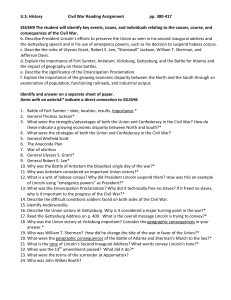
... d. Explain the importance of Fort Sumter, Antietam, Vicksburg, Gettysburg, and the Battle for Atlanta and the impact of geography on these battles. e. Describe the significance of the Emancipation Proclamation. f. Explain the importance of the growing economic disparity between the North and the Sou ...
... d. Explain the importance of Fort Sumter, Antietam, Vicksburg, Gettysburg, and the Battle for Atlanta and the impact of geography on these battles. e. Describe the significance of the Emancipation Proclamation. f. Explain the importance of the growing economic disparity between the North and the Sou ...
Battle of Antietam

The Battle of Antietam /ænˈtiːtəm/, also known as the Battle of Sharpsburg, particularly in the South, fought on September 17, 1862, near Sharpsburg, Maryland, and Antietam Creek as part of the Maryland Campaign, was the first major battle in the American Civil War to take place on Union soil. It is the bloodiest single-day battle in American history, with a combined tally of dead, wounded, and missing at 22,717.After pursuing Confederate General Robert E. Lee into Maryland, Union Army Maj. Gen. George B. McClellan launched attacks against Lee's army, in defensive positions behind Antietam Creek. At dawn on September 17, Maj. Gen. Joseph Hooker's corps mounted a powerful assault on Lee's left flank. Attacks and counterattacks swept across Miller's Cornfield and fighting swirled around the Dunker Church. Union assaults against the Sunken Road eventually pierced the Confederate center, but the Federal advantage was not followed up. In the afternoon, Union Maj. Gen. Ambrose Burnside's corps entered the action, capturing a stone bridge over Antietam Creek and advancing against the Confederate right. At a crucial moment, Confederate Maj. Gen. A. P. Hill's division arrived from Harpers Ferry and launched a surprise counterattack, driving back Burnside and ending the battle. Although outnumbered two-to-one, Lee committed his entire force, while McClellan sent in less than three-quarters of his army, enabling Lee to fight the Federals to a standstill. During the night, both armies consolidated their lines. In spite of crippling casualties, Lee continued to skirmish with McClellan throughout September 18, while removing his battered army south of the Potomac River.Despite having superiority of numbers, McClellan's attacks failed to achieve force concentration, allowing Lee to counter by shifting forces and moving interior lines to meet each challenge. Despite ample reserve forces that could have been deployed to exploit localized successes, McClellan failed to destroy Lee's army. McClellan had halted Lee's invasion of Maryland, but Lee was able to withdraw his army back to Virginia without interference from the cautious McClellan. Although the battle was tactically inconclusive, the Confederate troops had withdrawn first from the battlefield, making it, in military terms, a Union victory. It had significance as enough of a victory to give President Abraham Lincoln the confidence to announce his Emancipation Proclamation, which discouraged the British and French governments from potential plans for recognition of the Confederacy.