
The Civil War 1861-1865
... 1. Why do you think the loss of Stonewall Jackson was so devastating to the Confederacy? 2. Why was the Battle of Gettysburg such an important victory for the Union? How might things have been different had the Confederacy won the battle? 3. Should Lee have been relieved of command because of his st ...
... 1. Why do you think the loss of Stonewall Jackson was so devastating to the Confederacy? 2. Why was the Battle of Gettysburg such an important victory for the Union? How might things have been different had the Confederacy won the battle? 3. Should Lee have been relieved of command because of his st ...

Civil War - TeacherWeb
... 1. Why do you think the loss of Stonewall Jackson was so devastating to the Confederacy? 2. Why was the Battle of Gettysburg such an important victory for the Union? How might things have been different had the Confederacy won the battle? 3. Should Lee have been relieved of command because of his st ...
... 1. Why do you think the loss of Stonewall Jackson was so devastating to the Confederacy? 2. Why was the Battle of Gettysburg such an important victory for the Union? How might things have been different had the Confederacy won the battle? 3. Should Lee have been relieved of command because of his st ...

Chapter 21 The Furnace of Civil War 1861-1865
... peninsula, then move to Richmond – Moved too slowly, allowing Confederates to strengthen position, and Confederate General Joseph Johnston inflicted heavy losses ...
... peninsula, then move to Richmond – Moved too slowly, allowing Confederates to strengthen position, and Confederate General Joseph Johnston inflicted heavy losses ...

File
... Tracked down, shot and killed after a 12-day manhunt Jefferson Davis First and only President of Confederacy Also served as Secretary of War for the Confederacy His economic policies and military strategies failed to give the South what it needed to defeat the North Ulysses S. Grant Union ...
... Tracked down, shot and killed after a 12-day manhunt Jefferson Davis First and only President of Confederacy Also served as Secretary of War for the Confederacy His economic policies and military strategies failed to give the South what it needed to defeat the North Ulysses S. Grant Union ...

Civil War Discovery
... Once Pope found Jackson’s position, he attacked beginning the Second Battle of Bull Run. The Confederates were outnumbered but fought back ferociously and kept their position… even throwing rocks when they ran out of ammunition ...
... Once Pope found Jackson’s position, he attacked beginning the Second Battle of Bull Run. The Confederates were outnumbered but fought back ferociously and kept their position… even throwing rocks when they ran out of ammunition ...
Guided Tour Civil War Battles
... General Lee now decided to invade Union territory, hoping a victory in the North would bring more help from Foreign countries. But the Battle of Antietam, fought in Maryland, resulted in heavy losses. An estimated 24,000 Northern and Southern troops were killed in one of the bloodiest battles of the ...
... General Lee now decided to invade Union territory, hoping a victory in the North would bring more help from Foreign countries. But the Battle of Antietam, fought in Maryland, resulted in heavy losses. An estimated 24,000 Northern and Southern troops were killed in one of the bloodiest battles of the ...

Battles of the Civil War in Texas
... Ranch, they destroyed the rest of the supplies not torched the day before and continued on. A few miles forward, they became involved in a sharp firefight. After the fighting stopped, Barrett led his force back to a bluff at Tulosa on the river where the men could prepare dinner and camp for the nig ...
... Ranch, they destroyed the rest of the supplies not torched the day before and continued on. A few miles forward, they became involved in a sharp firefight. After the fighting stopped, Barrett led his force back to a bluff at Tulosa on the river where the men could prepare dinner and camp for the nig ...


Chapter 16- The Civil War Review Section 1
... in June, General Robert E. Lee took command of the Confederate forces. On June 26 the two armies met in the Seven Days’ Battles. These battles pushed McClellan away from Richmond. During the Second Battle of Bull Run, Jackson’s troops defeated another Union army before it could march directly on Ric ...
... in June, General Robert E. Lee took command of the Confederate forces. On June 26 the two armies met in the Seven Days’ Battles. These battles pushed McClellan away from Richmond. During the Second Battle of Bull Run, Jackson’s troops defeated another Union army before it could march directly on Ric ...
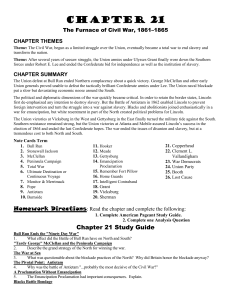
questions about the “varying viewpoints”
... The Union defeat at Bull Run ended Northern complacency about a quick victory. George McClellan and other early Union generals proved unable to defeat the tactically brilliant Confederate armies under Lee. The Union naval blockade put a slow but devastating economic noose around the South. The polit ...
... The Union defeat at Bull Run ended Northern complacency about a quick victory. George McClellan and other early Union generals proved unable to defeat the tactically brilliant Confederate armies under Lee. The Union naval blockade put a slow but devastating economic noose around the South. The polit ...

The American Civil War
... Shiloh, close to the Mississippi border. S April - Confederate soldiers surprised the Union army and inflicted significant casualties before the Union army could re-group and force Confederate forces to retreat. S Both sides became aware of the need for defensive measures while “in camp”, bloody eng ...
... Shiloh, close to the Mississippi border. S April - Confederate soldiers surprised the Union army and inflicted significant casualties before the Union army could re-group and force Confederate forces to retreat. S Both sides became aware of the need for defensive measures while “in camp”, bloody eng ...
Teacher`s Guide - Penguin Random House
... together,” then orders Jackson and Longstreet to Harper’s Ferry where 12,000 Federal troops pose a danger to the Confederate flank. In September 1862, after the Union suffers a second disaster at Manassas (Bull Run), General Pope is replaced. Confederate successes far out-number the Union’s. But a c ...
... together,” then orders Jackson and Longstreet to Harper’s Ferry where 12,000 Federal troops pose a danger to the Confederate flank. In September 1862, after the Union suffers a second disaster at Manassas (Bull Run), General Pope is replaced. Confederate successes far out-number the Union’s. But a c ...

Chapter 22: The Civil War Section 1
... In the spring of 1861, President Lincoln and General Winfield Scott planned the Union’s war strategy. Journalists called this strategy the Anaconda Plan because it resembled the crushing death grip of an anaconda snake. Rose Greenhow’s Dilemma Greenhow was a strong supporter of the Southern cause. S ...
... In the spring of 1861, President Lincoln and General Winfield Scott planned the Union’s war strategy. Journalists called this strategy the Anaconda Plan because it resembled the crushing death grip of an anaconda snake. Rose Greenhow’s Dilemma Greenhow was a strong supporter of the Southern cause. S ...

tennessee - National Park Service History
... 9 o'clock Prentiss' whole division broke and fell back in confusion before the onrush of four Confederate brigades. Prentiss rallied about 1,000 of his men and took u p a position along an old sunken road in a densely wooded area on a line that fresh Union troops were forming. This proved to be a st ...
... 9 o'clock Prentiss' whole division broke and fell back in confusion before the onrush of four Confederate brigades. Prentiss rallied about 1,000 of his men and took u p a position along an old sunken road in a densely wooded area on a line that fresh Union troops were forming. This proved to be a st ...

Events Leading to Civil War
... b. Describe President Lincoln’s efforts to preserve the Union as seen in his second inaugural address and the Gettysburg speech and in his use of emergency powers, such as his decision to suspend habeas corpus. c. Describe the roles of Ulysses Grant, Robert E. Lee, “Stonewall” Jackson, William T. Sh ...
... b. Describe President Lincoln’s efforts to preserve the Union as seen in his second inaugural address and the Gettysburg speech and in his use of emergency powers, such as his decision to suspend habeas corpus. c. Describe the roles of Ulysses Grant, Robert E. Lee, “Stonewall” Jackson, William T. Sh ...

usnotesapr23The Battle of Gettysburg
... There was a Confederate General, Robert Rodes, an engineer; he never brought his troops from Gettysburg to Cemetery Hill, to gain an advantage. But because he did not get the order to advance his troops he never took Cemetery Hill, which would have been a huge advantage. Day 3…July 3, You win the ...
... There was a Confederate General, Robert Rodes, an engineer; he never brought his troops from Gettysburg to Cemetery Hill, to gain an advantage. But because he did not get the order to advance his troops he never took Cemetery Hill, which would have been a huge advantage. Day 3…July 3, You win the ...

usnotesapr23The Battle of Gettysburg.doc
... There was a Confederate General, Robert Rodes, an engineer; he never brought his troops from Gettysburg to Cemetery Hill, to gain an advantage. But because he did not get the order to advance his troops he never took Cemetery Hill, which would have been a huge advantage. Day 3…July 3, You win the ...
... There was a Confederate General, Robert Rodes, an engineer; he never brought his troops from Gettysburg to Cemetery Hill, to gain an advantage. But because he did not get the order to advance his troops he never took Cemetery Hill, which would have been a huge advantage. Day 3…July 3, You win the ...
THE CIVIL WAR - algonac.k12.mi.us
... McClellan waits for better conditions & extends his flank to unite with Gen. McDowell (40,000 men) Lee sees an opportunity… His main man is Stonewall Jackson The hero of the Shenandoah Valley… ...
... McClellan waits for better conditions & extends his flank to unite with Gen. McDowell (40,000 men) Lee sees an opportunity… His main man is Stonewall Jackson The hero of the Shenandoah Valley… ...

Civil War Major Battles
... Burnside called off the attacks after six with great losses Outcome = Confederate victory ...
... Burnside called off the attacks after six with great losses Outcome = Confederate victory ...

Civil War - Springtown ISD
... Burnside called off the attacks after six with great losses Outcome = Confederate victory ...
... Burnside called off the attacks after six with great losses Outcome = Confederate victory ...

Civil War Battles Powerpoint
... Burnside called off the attacks after six with great losses Outcome = Confederate victory ...
... Burnside called off the attacks after six with great losses Outcome = Confederate victory ...
File
... Hooker’s strategy seemed about to work, but for some reason he hesitated and had his flanking forces take a defensive position at Chancellorsville (located a few miles west of Fredericksburg). ...
... Hooker’s strategy seemed about to work, but for some reason he hesitated and had his flanking forces take a defensive position at Chancellorsville (located a few miles west of Fredericksburg). ...

Library of Congress
... forces; McClellan does not act on info for 18 hours! • It is the bloodiest day of the war: 23,000 (2x the number of dead and wounded on D-Day) • Some consider Antietam the high water mark of the South’s chances for victory (vs. Gettysburg) because foreign powers never come as close to endorsing Conf ...
... forces; McClellan does not act on info for 18 hours! • It is the bloodiest day of the war: 23,000 (2x the number of dead and wounded on D-Day) • Some consider Antietam the high water mark of the South’s chances for victory (vs. Gettysburg) because foreign powers never come as close to endorsing Conf ...

heart of the Confederacy - Mrs. Byrd Georgia Studies
... The battle would prove to be the most important battle of the Civil War. On July 1, 1863 the greatest battle ever fought on the continent of North America began. In three days of terrible fighting, both sides fought bravely. The Confederate Army suffered 28,000 killed, wounded, or ...
... The battle would prove to be the most important battle of the Civil War. On July 1, 1863 the greatest battle ever fought on the continent of North America began. In three days of terrible fighting, both sides fought bravely. The Confederate Army suffered 28,000 killed, wounded, or ...

CHAPTER 15 PRACTICE TEST MULTIPLE CHOICE 1. Which of the
... vastly improved military tactics and fighting conditions for the soldiers. size of the armies on both sides. extensive army and navy cooperation in planning and executing the war. ...
... vastly improved military tactics and fighting conditions for the soldiers. size of the armies on both sides. extensive army and navy cooperation in planning and executing the war. ...
Battle of Antietam

The Battle of Antietam /ænˈtiːtəm/, also known as the Battle of Sharpsburg, particularly in the South, fought on September 17, 1862, near Sharpsburg, Maryland, and Antietam Creek as part of the Maryland Campaign, was the first major battle in the American Civil War to take place on Union soil. It is the bloodiest single-day battle in American history, with a combined tally of dead, wounded, and missing at 22,717.After pursuing Confederate General Robert E. Lee into Maryland, Union Army Maj. Gen. George B. McClellan launched attacks against Lee's army, in defensive positions behind Antietam Creek. At dawn on September 17, Maj. Gen. Joseph Hooker's corps mounted a powerful assault on Lee's left flank. Attacks and counterattacks swept across Miller's Cornfield and fighting swirled around the Dunker Church. Union assaults against the Sunken Road eventually pierced the Confederate center, but the Federal advantage was not followed up. In the afternoon, Union Maj. Gen. Ambrose Burnside's corps entered the action, capturing a stone bridge over Antietam Creek and advancing against the Confederate right. At a crucial moment, Confederate Maj. Gen. A. P. Hill's division arrived from Harpers Ferry and launched a surprise counterattack, driving back Burnside and ending the battle. Although outnumbered two-to-one, Lee committed his entire force, while McClellan sent in less than three-quarters of his army, enabling Lee to fight the Federals to a standstill. During the night, both armies consolidated their lines. In spite of crippling casualties, Lee continued to skirmish with McClellan throughout September 18, while removing his battered army south of the Potomac River.Despite having superiority of numbers, McClellan's attacks failed to achieve force concentration, allowing Lee to counter by shifting forces and moving interior lines to meet each challenge. Despite ample reserve forces that could have been deployed to exploit localized successes, McClellan failed to destroy Lee's army. McClellan had halted Lee's invasion of Maryland, but Lee was able to withdraw his army back to Virginia without interference from the cautious McClellan. Although the battle was tactically inconclusive, the Confederate troops had withdrawn first from the battlefield, making it, in military terms, a Union victory. It had significance as enough of a victory to give President Abraham Lincoln the confidence to announce his Emancipation Proclamation, which discouraged the British and French governments from potential plans for recognition of the Confederacy.