
Shifting Tides
... At the top of your Timeline and Map Worksheet is a chart listing the battles including their location and date. ...
... At the top of your Timeline and Map Worksheet is a chart listing the battles including their location and date. ...
File
... Antietam • The battle is known as the single bloodiest day in the Civil War. • Because the casualties were so high, Lincoln said that if the South didn’t stop the war, he would free the slaves…and he did. • South won the battle. Picture Credit: www.trubador.com/bridge.htm ...
... Antietam • The battle is known as the single bloodiest day in the Civil War. • Because the casualties were so high, Lincoln said that if the South didn’t stop the war, he would free the slaves…and he did. • South won the battle. Picture Credit: www.trubador.com/bridge.htm ...
The Road to Gettysburg
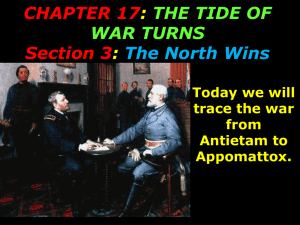
... For each of the following events, describe one or more of the immediate outcomes described in the section. 1. The Confederate Army under General Robert E. Lee battled Union troops under General Joseph Hooker at Chancellorsville, Virginia. 2. Lee's army crossed into Pennsylvania and encountered Union ...
... For each of the following events, describe one or more of the immediate outcomes described in the section. 1. The Confederate Army under General Robert E. Lee battled Union troops under General Joseph Hooker at Chancellorsville, Virginia. 2. Lee's army crossed into Pennsylvania and encountered Union ...

Civil War Battles Jigsaw
... responsibility to effective lead. This he did not do. He used the creek as a protective moat around his regiment, a strategy most soldiers questioned. Lincoln ends up questioning it so much he eventually demotes McClellan and replaces him with General Grant as the top commander. General Robert E. Le ...
... responsibility to effective lead. This he did not do. He used the creek as a protective moat around his regiment, a strategy most soldiers questioned. Lincoln ends up questioning it so much he eventually demotes McClellan and replaces him with General Grant as the top commander. General Robert E. Le ...

Civil War
... • Grant was looking for control of Corinth and as luck would have it this is where Johnston had retreated after Ft. Henry and Donnelson • Confederates attacked at Shiloh and were successful until Union reinforcements arrived (Buell) • Confederate commander was Gen. Albert Sydney Johnston (killed) an ...
... • Grant was looking for control of Corinth and as luck would have it this is where Johnston had retreated after Ft. Henry and Donnelson • Confederates attacked at Shiloh and were successful until Union reinforcements arrived (Buell) • Confederate commander was Gen. Albert Sydney Johnston (killed) an ...

Packet Pages
... 6. On the third day of battle, General Lee planned to charge the center of the Union line using three divisions of Confederate soldiers, the largest under the command of General ________________. This attack was a _________________. 7. Of the 14,000 men who took part, only about ___________ returned ...
... 6. On the third day of battle, General Lee planned to charge the center of the Union line using three divisions of Confederate soldiers, the largest under the command of General ________________. This attack was a _________________. 7. Of the 14,000 men who took part, only about ___________ returned ...

The Civil War
... Grant believed in the concept of total war war that attacks not only the enemy troops, but also supplies, cities, and anything that supports the enemy. While he was moving toward Richmond, Grant sent General William Tecumseh Sherman to cause as much damage as possible to the deep South. ...
... Grant believed in the concept of total war war that attacks not only the enemy troops, but also supplies, cities, and anything that supports the enemy. While he was moving toward Richmond, Grant sent General William Tecumseh Sherman to cause as much damage as possible to the deep South. ...

Early`s Raid - Narrative Side
... war. Both men enjoyed comfortable upbringings before the war and had successful postwar literary careers. In other ways, they were very different. Early was famous for his temper, profanity, and aggressiveness in combat. Gen. Robert E. Lee called him “my bad old man.” In contrast, Wallace had a dipl ...
... war. Both men enjoyed comfortable upbringings before the war and had successful postwar literary careers. In other ways, they were very different. Early was famous for his temper, profanity, and aggressiveness in combat. Gen. Robert E. Lee called him “my bad old man.” In contrast, Wallace had a dipl ...

Pawhuska United States History
... 5. ____________________ is best known for her role as leader of the Underground Railroad. 6. ____________________ became famous for writing the controversial book Uncle Tom's Cabin. 7. NC's governor during most of the Civil War was _________________________. 8. _____________________ was the famous l ...
... 5. ____________________ is best known for her role as leader of the Underground Railroad. 6. ____________________ became famous for writing the controversial book Uncle Tom's Cabin. 7. NC's governor during most of the Civil War was _________________________. 8. _____________________ was the famous l ...

The Civil War
... – He drew up a plan for the Northern Invasion • He left it with another officer • The officer left it behind in camp • The Union took over the abandoned camp and stumbled upon the plans • General George McClellan now knew Lee’s every move ...
... – He drew up a plan for the Northern Invasion • He left it with another officer • The officer left it behind in camp • The Union took over the abandoned camp and stumbled upon the plans • General George McClellan now knew Lee’s every move ...

Scribed Notes: Available at completion of chapter
... battle-field of that war. We have come to dedicate a portion of that field, as a final resting place for those who here gave their lives that that nation might live. It is altogether fitting and proper that we should do this. But, in a larger sense, we can not dedicate -- we can not consecrate -- we ...
... battle-field of that war. We have come to dedicate a portion of that field, as a final resting place for those who here gave their lives that that nation might live. It is altogether fitting and proper that we should do this. But, in a larger sense, we can not dedicate -- we can not consecrate -- we ...

Gettysburg DBQ Hook Exercise (p. 461) July 3, 1863 in Gettysburg
... 2. The Confederates were on the offensive. The arrows show that the Confederates led by General Pickett were attacking from the west. 3. Between ½ and ¾ of a mile. 4. The Union forces had the high ground. This gave them a big advantage as they could fire down on the advancing Confederate soldiers wi ...
... 2. The Confederates were on the offensive. The arrows show that the Confederates led by General Pickett were attacking from the west. 3. Between ½ and ¾ of a mile. 4. The Union forces had the high ground. This gave them a big advantage as they could fire down on the advancing Confederate soldiers wi ...

The Civil War- Part II
... keep the Confederates from using the river to ___________troops, and it would also separate Arkansas, Texas, and Louisiana from the rest of the _______________________________. Confederate plans 1. Fight a ______________________war until _________________________tired of fighting and _______________ ...
... keep the Confederates from using the river to ___________troops, and it would also separate Arkansas, Texas, and Louisiana from the rest of the _______________________________. Confederate plans 1. Fight a ______________________war until _________________________tired of fighting and _______________ ...

Mr - WordPress.com
... 16. Naval commander who led the attack on New Orleans. a. George McClellan c. Ulysses S, Grant b. David Farragut d. Jake Peterson ...
... 16. Naval commander who led the attack on New Orleans. a. George McClellan c. Ulysses S, Grant b. David Farragut d. Jake Peterson ...

Chapter 15- Secession and the Civil War (upload)
... Admit absence of two-party system, by 1863, Davis had lost much support ...
... Admit absence of two-party system, by 1863, Davis had lost much support ...

The Civil War 1861-1865
... • Confederate attack nearly wiped out Union forces on first day • Grant counterattacked the next day • Union victory ...
... • Confederate attack nearly wiped out Union forces on first day • Grant counterattacked the next day • Union victory ...
The Civil War (1861
... The Homestead Act of 1862 was passed by the U.S. Congress. It provided for the transfer of 160 acres (65 hectares) of unoccupied public land to each homesteader on payment of a nominal fee after five years of residence; land could also be acquired after six months of residence at $1.25 an acre. The ...
... The Homestead Act of 1862 was passed by the U.S. Congress. It provided for the transfer of 160 acres (65 hectares) of unoccupied public land to each homesteader on payment of a nominal fee after five years of residence; land could also be acquired after six months of residence at $1.25 an acre. The ...

The Civil War
... Lincoln replaced Pope with McClellan The North and Lincoln needed a victory ...
... Lincoln replaced Pope with McClellan The North and Lincoln needed a victory ...
Chapter One - University of South Carolina
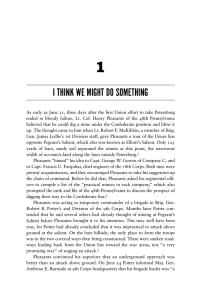
... As early as June 21, three days after the first Union effort to take Petersburg ended in bloody failure, Lt. Col. Henry Pleasants of the 48th Pennsylvania believed that he could dig a mine under the Confederate position and blow it up. The thought came to him when Lt. Robert F. McKibbin, a member of ...
... As early as June 21, three days after the first Union effort to take Petersburg ended in bloody failure, Lt. Col. Henry Pleasants of the 48th Pennsylvania believed that he could dig a mine under the Confederate position and blow it up. The thought came to him when Lt. Robert F. McKibbin, a member of ...

Unit 8 - PowerPoints - The American Civil War
... The Battle of Antietam, also known as the Battle of Sharpsburg, was fought on September 16–18, 1862. It was a confrontation between Union and Confederate forces under Generals George McClellan and Robert E. Lee. Federal armies brutalized the Confederacy; the combined casualties were more than twenty ...
... The Battle of Antietam, also known as the Battle of Sharpsburg, was fought on September 16–18, 1862. It was a confrontation between Union and Confederate forces under Generals George McClellan and Robert E. Lee. Federal armies brutalized the Confederacy; the combined casualties were more than twenty ...

1285430824_413275
... Slow to move, McClellan finally advanced on Richmond, moving within 7 miles of the Confederate capital. Lee moved in behind Union forces, threatening Washington, D.C. The Seven Days Battles followed, which forced McClellan to retreat. ...
... Slow to move, McClellan finally advanced on Richmond, moving within 7 miles of the Confederate capital. Lee moved in behind Union forces, threatening Washington, D.C. The Seven Days Battles followed, which forced McClellan to retreat. ...

ccsk12.net - Catawba County Schools
... They also would fight harder because they were protecting their homes. The Confederacy also had superior generals and better ...
... They also would fight harder because they were protecting their homes. The Confederacy also had superior generals and better ...

CHAPTER 25 World War II
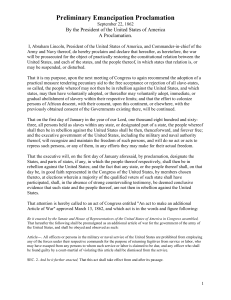
... That it is my purpose, upon the next meeting of Congress to again recommend the adoption of a practical measure tendering pecuniary aid to the free acceptance or rejection of all slave-states, so called, the people whereof may not then be in rebellion against the United States, and which states, may ...
... That it is my purpose, upon the next meeting of Congress to again recommend the adoption of a practical measure tendering pecuniary aid to the free acceptance or rejection of all slave-states, so called, the people whereof may not then be in rebellion against the United States, and which states, may ...
Battle of Antietam

The Battle of Antietam /ænˈtiːtəm/, also known as the Battle of Sharpsburg, particularly in the South, fought on September 17, 1862, near Sharpsburg, Maryland, and Antietam Creek as part of the Maryland Campaign, was the first major battle in the American Civil War to take place on Union soil. It is the bloodiest single-day battle in American history, with a combined tally of dead, wounded, and missing at 22,717.After pursuing Confederate General Robert E. Lee into Maryland, Union Army Maj. Gen. George B. McClellan launched attacks against Lee's army, in defensive positions behind Antietam Creek. At dawn on September 17, Maj. Gen. Joseph Hooker's corps mounted a powerful assault on Lee's left flank. Attacks and counterattacks swept across Miller's Cornfield and fighting swirled around the Dunker Church. Union assaults against the Sunken Road eventually pierced the Confederate center, but the Federal advantage was not followed up. In the afternoon, Union Maj. Gen. Ambrose Burnside's corps entered the action, capturing a stone bridge over Antietam Creek and advancing against the Confederate right. At a crucial moment, Confederate Maj. Gen. A. P. Hill's division arrived from Harpers Ferry and launched a surprise counterattack, driving back Burnside and ending the battle. Although outnumbered two-to-one, Lee committed his entire force, while McClellan sent in less than three-quarters of his army, enabling Lee to fight the Federals to a standstill. During the night, both armies consolidated their lines. In spite of crippling casualties, Lee continued to skirmish with McClellan throughout September 18, while removing his battered army south of the Potomac River.Despite having superiority of numbers, McClellan's attacks failed to achieve force concentration, allowing Lee to counter by shifting forces and moving interior lines to meet each challenge. Despite ample reserve forces that could have been deployed to exploit localized successes, McClellan failed to destroy Lee's army. McClellan had halted Lee's invasion of Maryland, but Lee was able to withdraw his army back to Virginia without interference from the cautious McClellan. Although the battle was tactically inconclusive, the Confederate troops had withdrawn first from the battlefield, making it, in military terms, a Union victory. It had significance as enough of a victory to give President Abraham Lincoln the confidence to announce his Emancipation Proclamation, which discouraged the British and French governments from potential plans for recognition of the Confederacy.