
CIVIL WAR Time-Line 1861-1865 - Miami Beach Senior High School
... July 11–12 Confederate forces under Jubal Early probe and fire upon the northern defenses of Washington, D.C., throwing the Capital into a state of high alert. August 5 Admiral David G. Farragut wins the Battle of Mobile Bay. (U.S.A. Victory) September 2 After forcing the Confederate army of John Be ...
... July 11–12 Confederate forces under Jubal Early probe and fire upon the northern defenses of Washington, D.C., throwing the Capital into a state of high alert. August 5 Admiral David G. Farragut wins the Battle of Mobile Bay. (U.S.A. Victory) September 2 After forcing the Confederate army of John Be ...

Chapter 6 Notes
... 2) New rifles led to more death 3) Medical facilities were overwhelmed & not high quality ...
... 2) New rifles led to more death 3) Medical facilities were overwhelmed & not high quality ...
Civil_War_Presentation
... • Analyze why to Confederacy was created • Describe the Crittenden Compromise • Evaluate the impact of President Lincoln rejecting the Crittenden Compromise • Describe the battle of Fort Sumter ...
... • Analyze why to Confederacy was created • Describe the Crittenden Compromise • Evaluate the impact of President Lincoln rejecting the Crittenden Compromise • Describe the battle of Fort Sumter ...

The American Civil War
... battlefield of that war. We have come to dedicate a portion of that field as a final resting-place for those who here gave their lives that that nation might live. It is altogether fitting and proper that we should do this. But in a larger sense, we cannot dedicate, we cannot consecrate, we cannot h ...
... battlefield of that war. We have come to dedicate a portion of that field as a final resting-place for those who here gave their lives that that nation might live. It is altogether fitting and proper that we should do this. But in a larger sense, we cannot dedicate, we cannot consecrate, we cannot h ...

Lincoln to
... in TN. Fort Henry and Fort Donelson. “Unconditional Surrender” By the end of Spring 1862Union controlled all major forts on the MS river except Ulysses S. Grant one in Vicksburg, MS. Western Theater is going good for the Union! ...
... in TN. Fort Henry and Fort Donelson. “Unconditional Surrender” By the end of Spring 1862Union controlled all major forts on the MS river except Ulysses S. Grant one in Vicksburg, MS. Western Theater is going good for the Union! ...

Study help for Unit 6 test Clicker questions with answers
... c. Meade and Grant d. Sherman and Burnside ...
... c. Meade and Grant d. Sherman and Burnside ...

The Civil War
... which they gave the last full measure of devotion - that we here highly resolve that these dead shall not have died in vain - that this nation, under God, shall have a new birth of freedom - and that government of the people, by the people, for the people, shall not perish from the earth. Abraham Li ...
... which they gave the last full measure of devotion - that we here highly resolve that these dead shall not have died in vain - that this nation, under God, shall have a new birth of freedom - and that government of the people, by the people, for the people, shall not perish from the earth. Abraham Li ...
Civil War
... Commanded the Union armies of the West The most destructive campaign against a civilian population during the Civil War (1861-65) Union general William T. Sherman abandoned his supply line and marched across Georgia to the Atlantic He led an army of 62,000 men on an overland march to Savanna To ...
... Commanded the Union armies of the West The most destructive campaign against a civilian population during the Civil War (1861-65) Union general William T. Sherman abandoned his supply line and marched across Georgia to the Atlantic He led an army of 62,000 men on an overland march to Savanna To ...

Time Line of The Civil War, 1861
... Pennsylvania. General Hooker, who had been planning June 1863 to attack Richmond, was instead forced to follow Lee. Hooker, never comfortable with his commander, General Halleck, resigned on June 28, and General George Meade replaced him as commander of the Army of the Potomac. On July 1, a chance e ...
... Pennsylvania. General Hooker, who had been planning June 1863 to attack Richmond, was instead forced to follow Lee. Hooker, never comfortable with his commander, General Halleck, resigned on June 28, and General George Meade replaced him as commander of the Army of the Potomac. On July 1, a chance e ...
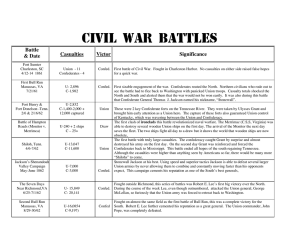
Civil War Battles Chart
... pinned down at Antietam Creek by Gen. McLellan. The Union victory forced Lee back to the South. It also gave Lincoln the good news he needed to issue the Emancipation Proclamation which freed all slaves in areas not controlled by the Union. Confederate General Braxton Bragg lead his army into Kentuc ...
... pinned down at Antietam Creek by Gen. McLellan. The Union victory forced Lee back to the South. It also gave Lincoln the good news he needed to issue the Emancipation Proclamation which freed all slaves in areas not controlled by the Union. Confederate General Braxton Bragg lead his army into Kentuc ...
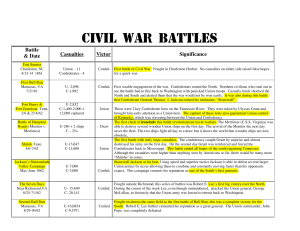
Civil War Battles Chart
... pinned down at Antietam Creek by Gen. McLellan. The Union victory forced Lee back to the South. It also gave Lincoln the good news he needed to issue the Emancipation Proclamation which freed all slaves in areas not controlled by the Union. Confederate General Braxton Bragg lead his army into Kentuc ...
... pinned down at Antietam Creek by Gen. McLellan. The Union victory forced Lee back to the South. It also gave Lincoln the good news he needed to issue the Emancipation Proclamation which freed all slaves in areas not controlled by the Union. Confederate General Braxton Bragg lead his army into Kentuc ...
Ch 11 Civil War Powerpoint
... Late August Lee attacked Pope’s forces Jackson’s forces attacked after surrounding Pope Confederate victory Lincoln was very upset ...
... Late August Lee attacked Pope’s forces Jackson’s forces attacked after surrounding Pope Confederate victory Lincoln was very upset ...

The Civil War - Issues, Individuals and Events
... Battle took place July 1-3, 1863. At Gettysburg, Pennsylvania, Union forces of 97,000 were commanded by George Meade. Lee Commanded the Confederate force of 75,000. The battle ended in a stalemate with the Confederacy forced to retreat from the field. It was the bloodiest battle of the war and h ...
... Battle took place July 1-3, 1863. At Gettysburg, Pennsylvania, Union forces of 97,000 were commanded by George Meade. Lee Commanded the Confederate force of 75,000. The battle ended in a stalemate with the Confederacy forced to retreat from the field. It was the bloodiest battle of the war and h ...

A) Define the Subject: The Battle of Chancellorsville
... confederate soldier. Confederate Soldiers were more loyal fighters and believed wholeheartedly in “the cause”. Men from the confederate states were more wiling to fight, and even the women and older people of the south contributed everything to winning the war. e) The Union, since it was the north t ...
... confederate soldier. Confederate Soldiers were more loyal fighters and believed wholeheartedly in “the cause”. Men from the confederate states were more wiling to fight, and even the women and older people of the south contributed everything to winning the war. e) The Union, since it was the north t ...
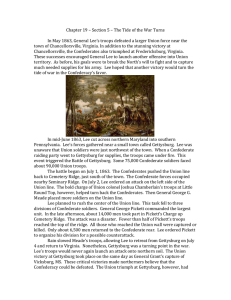
Chapter 19 – Section 5 – The Tide of the War Turns In May 1863
... President Lincoln expressed the Union’s new sense of confidence and commitment. He delivered the Gettysburg Address on November 19, 1863. This short, moving speech is one of the most famous in American history. Lincoln spoke of the importance of liberty, equality, and democratic ideals. He reminded ...
... President Lincoln expressed the Union’s new sense of confidence and commitment. He delivered the Gettysburg Address on November 19, 1863. This short, moving speech is one of the most famous in American history. Lincoln spoke of the importance of liberty, equality, and democratic ideals. He reminded ...

Chapter 21 The Furnace of Civil War, 1861-1865
... recovering from a cart accident but fought off his attacker and survived • The man assigned to Johnson lost his nerve • Booth was hunted down and died in a shootout at a farm in Virginia on April 26th • Many were arrested and four were tried and executed as part of the conspiracy • As time wore on, ...
... recovering from a cart accident but fought off his attacker and survived • The man assigned to Johnson lost his nerve • Booth was hunted down and died in a shootout at a farm in Virginia on April 26th • Many were arrested and four were tried and executed as part of the conspiracy • As time wore on, ...
Vermont at Gettysburg - Vermont Historical Society
... dry their throats were from marching for hours in the choking dust! How they longed for the old spring in the back pasture with its clear bubbling water! Well, it was a nice dream at any rate, but this was war and blood and death. The sky grew light in the east; the bugles sounded, and they dragged ...
... dry their throats were from marching for hours in the choking dust! How they longed for the old spring in the back pasture with its clear bubbling water! Well, it was a nice dream at any rate, but this was war and blood and death. The sky grew light in the east; the bugles sounded, and they dragged ...

Chapter 6 Notes
... 2) New rifles led to more death 3) Medical facilities were overwhelmed & not high quality ...
... 2) New rifles led to more death 3) Medical facilities were overwhelmed & not high quality ...
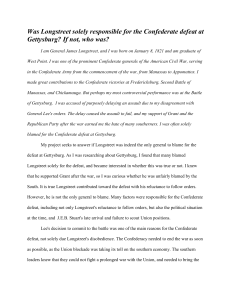
WasLongstreet responsible for gettysburg - campbell-hist
... victory at Chancellorsville had been largely defensive. Once Lee's Army of Northern Virginia advanced into Pennsylvania, he needed a quick victory. So when Lee engaged Union forces at Gettysburg on July 1st, 1863, he committed all his available forces to battle. The Confederate victories on the firs ...
... victory at Chancellorsville had been largely defensive. Once Lee's Army of Northern Virginia advanced into Pennsylvania, he needed a quick victory. So when Lee engaged Union forces at Gettysburg on July 1st, 1863, he committed all his available forces to battle. The Confederate victories on the firs ...

The War That Divided A Nation - Vernon Independent School
... man Union Army Of The Potomac under General George G. Meade met, by chance, when a Confederate brigade sent forward for supplies observed a forward column of Meade's cavalry. Of the more than 2,000 land engagements of the Civil War, Gettysburg ranks supreme. Although the Battle of Gettysburg did not ...
... man Union Army Of The Potomac under General George G. Meade met, by chance, when a Confederate brigade sent forward for supplies observed a forward column of Meade's cavalry. Of the more than 2,000 land engagements of the Civil War, Gettysburg ranks supreme. Although the Battle of Gettysburg did not ...

The War to End Slavery
... 1-Abraham Lincoln rand against Stephen Douglas A) Both from Illinois B) Ran against each other for US Senate in 1858 C) Had series of debates during campaign D) Put Lincoln in National spotlight eventhough ...
... 1-Abraham Lincoln rand against Stephen Douglas A) Both from Illinois B) Ran against each other for US Senate in 1858 C) Had series of debates during campaign D) Put Lincoln in National spotlight eventhough ...

Chapter 11 PowerPoint - Henry County Schools
... • Union advantages: soldiers, factories, food, railroads • Confederate advantages: cotton profits, generals, ...
... • Union advantages: soldiers, factories, food, railroads • Confederate advantages: cotton profits, generals, ...

Events and Battles
... Philippi, Barbour County, Virginia (now West Virginia) The Battle of Philippi, fought June 3, 1861, in what is now West Virginia, is known as the "first land battle of the Civil War" or the "first inland battle of the Civil War." A minor affair that lasted less than 20 minutes and resulted in no fat ...
... Philippi, Barbour County, Virginia (now West Virginia) The Battle of Philippi, fought June 3, 1861, in what is now West Virginia, is known as the "first land battle of the Civil War" or the "first inland battle of the Civil War." A minor affair that lasted less than 20 minutes and resulted in no fat ...
chapter 14 - Cengage Learning
... Evaluate the presidency of Abraham Lincoln. Was he an effective wartime president? What were his ...
... Evaluate the presidency of Abraham Lincoln. Was he an effective wartime president? What were his ...
Battle of Antietam

The Battle of Antietam /ænˈtiːtəm/, also known as the Battle of Sharpsburg, particularly in the South, fought on September 17, 1862, near Sharpsburg, Maryland, and Antietam Creek as part of the Maryland Campaign, was the first major battle in the American Civil War to take place on Union soil. It is the bloodiest single-day battle in American history, with a combined tally of dead, wounded, and missing at 22,717.After pursuing Confederate General Robert E. Lee into Maryland, Union Army Maj. Gen. George B. McClellan launched attacks against Lee's army, in defensive positions behind Antietam Creek. At dawn on September 17, Maj. Gen. Joseph Hooker's corps mounted a powerful assault on Lee's left flank. Attacks and counterattacks swept across Miller's Cornfield and fighting swirled around the Dunker Church. Union assaults against the Sunken Road eventually pierced the Confederate center, but the Federal advantage was not followed up. In the afternoon, Union Maj. Gen. Ambrose Burnside's corps entered the action, capturing a stone bridge over Antietam Creek and advancing against the Confederate right. At a crucial moment, Confederate Maj. Gen. A. P. Hill's division arrived from Harpers Ferry and launched a surprise counterattack, driving back Burnside and ending the battle. Although outnumbered two-to-one, Lee committed his entire force, while McClellan sent in less than three-quarters of his army, enabling Lee to fight the Federals to a standstill. During the night, both armies consolidated their lines. In spite of crippling casualties, Lee continued to skirmish with McClellan throughout September 18, while removing his battered army south of the Potomac River.Despite having superiority of numbers, McClellan's attacks failed to achieve force concentration, allowing Lee to counter by shifting forces and moving interior lines to meet each challenge. Despite ample reserve forces that could have been deployed to exploit localized successes, McClellan failed to destroy Lee's army. McClellan had halted Lee's invasion of Maryland, but Lee was able to withdraw his army back to Virginia without interference from the cautious McClellan. Although the battle was tactically inconclusive, the Confederate troops had withdrawn first from the battlefield, making it, in military terms, a Union victory. It had significance as enough of a victory to give President Abraham Lincoln the confidence to announce his Emancipation Proclamation, which discouraged the British and French governments from potential plans for recognition of the Confederacy.