
After 1862 Union forces controlled the Manassas area for the
... Fall 1862 after the Battle of Second Manassas (Bull Run) With the defeat of Pope's army at the Battle of Second Manassas, Prince William County was only briefly behind Confederate lines. For the remainder of 1862 the county was again under the watchful eye of Union troops. To secure the area, in the ...
... Fall 1862 after the Battle of Second Manassas (Bull Run) With the defeat of Pope's army at the Battle of Second Manassas, Prince William County was only briefly behind Confederate lines. For the remainder of 1862 the county was again under the watchful eye of Union troops. To secure the area, in the ...

The Civil War - Northwest ISD Moodle
... the South like a snake 0 President Lincoln ordered a naval blockade to prevent the South from receiving materials, export cotton, or create a navy 0 Lead by: George McClellan and Ulysses S. Grant ...
... the South like a snake 0 President Lincoln ordered a naval blockade to prevent the South from receiving materials, export cotton, or create a navy 0 Lead by: George McClellan and Ulysses S. Grant ...

1860s Military Technology - Waterford Public Schools
... developed a plan to defeat the Confederacy. He would pursue Lee’s army in Virginia while other Union forces, under the command of General William Sherman would push eastward toward Atlanta, Georgia. Sherman began moving southward from Tennessee and he had taken Atlanta by September of 1864. After ta ...
... developed a plan to defeat the Confederacy. He would pursue Lee’s army in Virginia while other Union forces, under the command of General William Sherman would push eastward toward Atlanta, Georgia. Sherman began moving southward from Tennessee and he had taken Atlanta by September of 1864. After ta ...

Civil War Events 2
... THE EMANCIPATION PROCLAMATION LINCOLN ISSUED THE PROCLAMATION FIVE DAYS AFTER ANTIETAM • “ON THE FIRST DAY OF JANUARY, IN THE YEAR OF OUR LORD 1863, ALL PERSONS HELD AS SLAVES WITHIN ANY STATE, OR DESIGNATED PART OF A STATE, THE PEOPLE WHEREOF SHALL BE THEN IN REBELLION AGAINST THE ...
... THE EMANCIPATION PROCLAMATION LINCOLN ISSUED THE PROCLAMATION FIVE DAYS AFTER ANTIETAM • “ON THE FIRST DAY OF JANUARY, IN THE YEAR OF OUR LORD 1863, ALL PERSONS HELD AS SLAVES WITHIN ANY STATE, OR DESIGNATED PART OF A STATE, THE PEOPLE WHEREOF SHALL BE THEN IN REBELLION AGAINST THE ...

Civil_Progress
... The Union won most of the seven days but on the last day, the Confederates drove off the Union! ~Paul ...
... The Union won most of the seven days but on the last day, the Confederates drove off the Union! ~Paul ...

The North Takes Charge
... Gettysburg, PA Shoeless troops hear there is footwear in Gettysburg ◦ Go to find it and meet up with Gen. Lee’s forces ...
... Gettysburg, PA Shoeless troops hear there is footwear in Gettysburg ◦ Go to find it and meet up with Gen. Lee’s forces ...
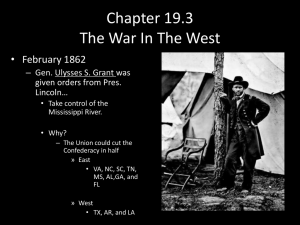
Chapter 19.3 The War In The West
... • No food: – Texas » Beef and corn – Arkansas » Corn and Wheat – Louisiana » Fresh Fish ...
... • No food: – Texas » Beef and corn – Arkansas » Corn and Wheat – Louisiana » Fresh Fish ...
The Civil War Begins - Catawba County Schools
... bringing a quick end to the war. Union forces under Irvin McDowell march for Richmond. This leads to the First Battle of Bull Run (Manassas) ...
... bringing a quick end to the war. Union forces under Irvin McDowell march for Richmond. This leads to the First Battle of Bull Run (Manassas) ...

Print this PDF
... positions. By 5:15, the first shots had been fired. Through the morning, Union forces had slowly pushed Confederate forces back until they broke through the Confederate right flank at about 11:30, sending them into a disorganized retreat. General McDowell elected not to pursue the retreating Confede ...
... positions. By 5:15, the first shots had been fired. Through the morning, Union forces had slowly pushed Confederate forces back until they broke through the Confederate right flank at about 11:30, sending them into a disorganized retreat. General McDowell elected not to pursue the retreating Confede ...

File
... • Water approach to Richmond , 100,000 troops • Battle of Yorktown – takes a month due to Confederate trickery* • Abe sends reinforcements to chase Stonewall Jackson, rather than help GBM ...
... • Water approach to Richmond , 100,000 troops • Battle of Yorktown – takes a month due to Confederate trickery* • Abe sends reinforcements to chase Stonewall Jackson, rather than help GBM ...

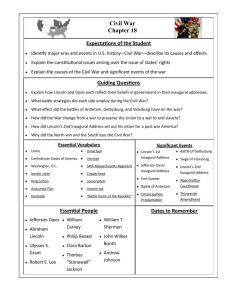
Chapter 18 and 19 Civil War and Reconstruction
... Virginia farmers a break. Still hoping to get European support. Confederate officer accidentally left Lee’s battle plans behind at a campsite and Union soldiers found them, giving McClellan a chance to stop Lee. Battle of Antietam near Sharpsburg, Maryland. Bloodiest day in American History with 25, ...
... Virginia farmers a break. Still hoping to get European support. Confederate officer accidentally left Lee’s battle plans behind at a campsite and Union soldiers found them, giving McClellan a chance to stop Lee. Battle of Antietam near Sharpsburg, Maryland. Bloodiest day in American History with 25, ...

Civil War PP
... relating to the causes, course, and consequences of the Civil War. • b. Describe President Lincoln’s efforts to preserve the Union as seen in his second inaugural address and the Gettysburg speech and in his use of emergency powers, such as his decision to suspend habeas corpus. • c. Describe the ro ...
... relating to the causes, course, and consequences of the Civil War. • b. Describe President Lincoln’s efforts to preserve the Union as seen in his second inaugural address and the Gettysburg speech and in his use of emergency powers, such as his decision to suspend habeas corpus. • c. Describe the ro ...

Key Events and Battles of the Civil War (Answer Key)
... Civil War is support slavery. The Civil War becomes a moral war Gen. Hooker defeated by Lee, but Stonewall Jackson is mistakenly shot by his own men and killed. After a long siege, General Ulysses Grant is able to take full Union control of the Mississippi River. The largest battle in the Western He ...
... Civil War is support slavery. The Civil War becomes a moral war Gen. Hooker defeated by Lee, but Stonewall Jackson is mistakenly shot by his own men and killed. After a long siege, General Ulysses Grant is able to take full Union control of the Mississippi River. The largest battle in the Western He ...

The Civil War - Petal School District
... 45. Battle of Bull Run (1st Manassas) July, 1861 (first major battle) ...
... 45. Battle of Bull Run (1st Manassas) July, 1861 (first major battle) ...
Civil War PPt
... Because the press and the public were demanding action, Lincoln decided that the Union army drilling near Washington, D.C. should attack Confederate forces at Bull Run (30 miles southwest). Confederate troops under Stonewall Jackson were able to repel the attack and sent the Union forces retreating ...
... Because the press and the public were demanding action, Lincoln decided that the Union army drilling near Washington, D.C. should attack Confederate forces at Bull Run (30 miles southwest). Confederate troops under Stonewall Jackson were able to repel the attack and sent the Union forces retreating ...
Expert Testimony of James McPherson
... determined after careful examination of official records and other sources that what is now the Walmart Site lies within the “study area,” and is therefore part of, both of those battlefields. The Battle of the Wilderness Was Critical to the Outcome of the Civil War By the spring of 1864, the Civil ...
... determined after careful examination of official records and other sources that what is now the Walmart Site lies within the “study area,” and is therefore part of, both of those battlefields. The Battle of the Wilderness Was Critical to the Outcome of the Civil War By the spring of 1864, the Civil ...

File
... invading Union forces. Before long, they believed, the Union would tire of battle and leave the Confederacy in peace. Believing their cause was just, volunteers on both sides rushed to enlist. The 70,000 new troops that marched into battle on Wilmer McLean's farm in 1861 were certain the other side ...
... invading Union forces. Before long, they believed, the Union would tire of battle and leave the Confederacy in peace. Believing their cause was just, volunteers on both sides rushed to enlist. The 70,000 new troops that marched into battle on Wilmer McLean's farm in 1861 were certain the other side ...
the american civil war
... sparked campaigns. Largest armies employed as critical arena. Western Theatre: Much the larger theatre stretching from the Appalachian Mountains to the Mississippi River containing two critical rail junctions, Chattanooga and Atlanta. The former fell to the Union in November 1863, the latter in Sept ...
... sparked campaigns. Largest armies employed as critical arena. Western Theatre: Much the larger theatre stretching from the Appalachian Mountains to the Mississippi River containing two critical rail junctions, Chattanooga and Atlanta. The former fell to the Union in November 1863, the latter in Sept ...


Study Guide - ajvagliokhs
... 104. What ratio of Union soldiers was killed by disease? 105. What ratio of Confederate soldiers was killed by disease? 106. What year was the US Sanitary Commission formed? 107. What idea did the Commission promote and continued to promote after the end of the war? 108. What were Hooker’s goals pri ...
... 104. What ratio of Union soldiers was killed by disease? 105. What ratio of Confederate soldiers was killed by disease? 106. What year was the US Sanitary Commission formed? 107. What idea did the Commission promote and continued to promote after the end of the war? 108. What were Hooker’s goals pri ...

File - MsTurnbull.com
... The _____________________________________ was ratified by the states and became law in December 1865. “Neither slavery nor involuntary servitude, except as punishment for crime whereof the party shall have been duly convicted, shall exist within the United States, or any place subject to their juris ...
... The _____________________________________ was ratified by the states and became law in December 1865. “Neither slavery nor involuntary servitude, except as punishment for crime whereof the party shall have been duly convicted, shall exist within the United States, or any place subject to their juris ...

Download! - Reed Novel Studies
... Four score and seven years ago our fathers brought forth on this continent, a new nation, conceived in Liberty, and dedicated to the proposition that all men are created equal. Now we are engaged in a great civil war, testing whether that nation, or any nation so conceived and so dedicated, can long ...
... Four score and seven years ago our fathers brought forth on this continent, a new nation, conceived in Liberty, and dedicated to the proposition that all men are created equal. Now we are engaged in a great civil war, testing whether that nation, or any nation so conceived and so dedicated, can long ...

Gettysburg: Leadership During the Civil War
... the Union line and take a very valuable hill. After holding the Confederates through two attacks, Chamberlain’s men were running low on morale and out of ammunition. With nothing to lose, he ordered a bayonet charge—instead of defending the hill, the Union men were going to attack the Confederates. ...
... the Union line and take a very valuable hill. After holding the Confederates through two attacks, Chamberlain’s men were running low on morale and out of ammunition. With nothing to lose, he ordered a bayonet charge—instead of defending the hill, the Union men were going to attack the Confederates. ...

Key Characters of the Civil War
... Was the President of the United States when the Civil War started. Freed the slaves because he hoped to gain support for the Union. In 1863, signed the _______________ ____________that said the _____ were _______ in the _______ Gave the famous ______ known as the __________ __________ Said that the ...
... Was the President of the United States when the Civil War started. Freed the slaves because he hoped to gain support for the Union. In 1863, signed the _______________ ____________that said the _____ were _______ in the _______ Gave the famous ______ known as the __________ __________ Said that the ...
Battle of Antietam

The Battle of Antietam /ænˈtiːtəm/, also known as the Battle of Sharpsburg, particularly in the South, fought on September 17, 1862, near Sharpsburg, Maryland, and Antietam Creek as part of the Maryland Campaign, was the first major battle in the American Civil War to take place on Union soil. It is the bloodiest single-day battle in American history, with a combined tally of dead, wounded, and missing at 22,717.After pursuing Confederate General Robert E. Lee into Maryland, Union Army Maj. Gen. George B. McClellan launched attacks against Lee's army, in defensive positions behind Antietam Creek. At dawn on September 17, Maj. Gen. Joseph Hooker's corps mounted a powerful assault on Lee's left flank. Attacks and counterattacks swept across Miller's Cornfield and fighting swirled around the Dunker Church. Union assaults against the Sunken Road eventually pierced the Confederate center, but the Federal advantage was not followed up. In the afternoon, Union Maj. Gen. Ambrose Burnside's corps entered the action, capturing a stone bridge over Antietam Creek and advancing against the Confederate right. At a crucial moment, Confederate Maj. Gen. A. P. Hill's division arrived from Harpers Ferry and launched a surprise counterattack, driving back Burnside and ending the battle. Although outnumbered two-to-one, Lee committed his entire force, while McClellan sent in less than three-quarters of his army, enabling Lee to fight the Federals to a standstill. During the night, both armies consolidated their lines. In spite of crippling casualties, Lee continued to skirmish with McClellan throughout September 18, while removing his battered army south of the Potomac River.Despite having superiority of numbers, McClellan's attacks failed to achieve force concentration, allowing Lee to counter by shifting forces and moving interior lines to meet each challenge. Despite ample reserve forces that could have been deployed to exploit localized successes, McClellan failed to destroy Lee's army. McClellan had halted Lee's invasion of Maryland, but Lee was able to withdraw his army back to Virginia without interference from the cautious McClellan. Although the battle was tactically inconclusive, the Confederate troops had withdrawn first from the battlefield, making it, in military terms, a Union victory. It had significance as enough of a victory to give President Abraham Lincoln the confidence to announce his Emancipation Proclamation, which discouraged the British and French governments from potential plans for recognition of the Confederacy.