
The American Civil War
... the Confederate States won large battles in Northern Virginia including the Seven Days Battles near Richmond, Virginia, and the Battle of 2nd Bull Run. ...
... the Confederate States won large battles in Northern Virginia including the Seven Days Battles near Richmond, Virginia, and the Battle of 2nd Bull Run. ...

The US Civil War
... mid-1864, pay commutation money. Many eligibles pooled their money to cover the cost of anyone drafted. Families used the substitute provision to select which man should go into the army and which should stay home • The great draft riot in New York City in July 1863 involved Irish immigrants who had ...
... mid-1864, pay commutation money. Many eligibles pooled their money to cover the cost of anyone drafted. Families used the substitute provision to select which man should go into the army and which should stay home • The great draft riot in New York City in July 1863 involved Irish immigrants who had ...

Civil War The North Wins
... You have been chosen by the post office to design a series of postage stamps on the Civil War. Choose three topics on the Civil War and describe your postage stamps. You may draw them for extra credit. ...
... You have been chosen by the post office to design a series of postage stamps on the Civil War. Choose three topics on the Civil War and describe your postage stamps. You may draw them for extra credit. ...
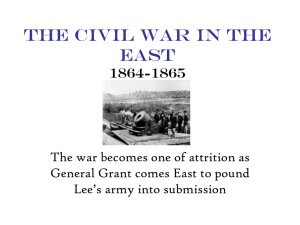
The Civil War in the East 1864-1865
... The Overland Campaign • Grant moves into the Wilderness • Terrible and bloody fighting • The Union forces are stopped • Grant does not retreat but rather moves south to get around Lee’s army ...
... The Overland Campaign • Grant moves into the Wilderness • Terrible and bloody fighting • The Union forces are stopped • Grant does not retreat but rather moves south to get around Lee’s army ...

Technology of the Civil War - Conejo Valley Unified School District
... seemed…in a sort of daze.” —Unnamed Tennessee soldier ...
... seemed…in a sort of daze.” —Unnamed Tennessee soldier ...

December
... When he realized his troops were being overwhelmed, Sykes ordered them to retreat from the top of the bluff. All regiments except the 118th came down from the bluffs and began crossing the river back to the Maryland side. Meanwhile the 118th were still in the line of battle all the while the other ...
... When he realized his troops were being overwhelmed, Sykes ordered them to retreat from the top of the bluff. All regiments except the 118th came down from the bluffs and began crossing the river back to the Maryland side. Meanwhile the 118th were still in the line of battle all the while the other ...
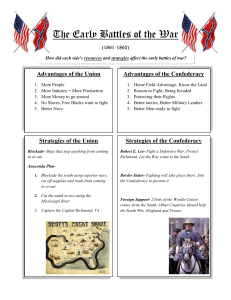
The Early Battles of the War Completed
... a war which introduced the first metallic rifle and pistol cartridges, the first repeating rifles and carbines, the first ironclad ships, and many other inventions which herald a change in warfare. But the military still relied on the old tried and trusted means of smoothbore muskets, paper cartridg ...
... a war which introduced the first metallic rifle and pistol cartridges, the first repeating rifles and carbines, the first ironclad ships, and many other inventions which herald a change in warfare. But the military still relied on the old tried and trusted means of smoothbore muskets, paper cartridg ...
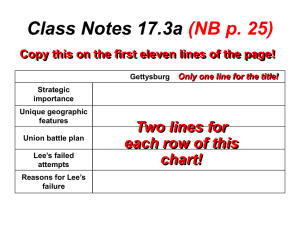
The Road to Gettysburg
... Battle of Antietam (September 1862) – McClellan stopped Lee’s Northern invasion, but failed to finish off Lee’s army, which retreated safely to Virginia. ...
... Battle of Antietam (September 1862) – McClellan stopped Lee’s Northern invasion, but failed to finish off Lee’s army, which retreated safely to Virginia. ...
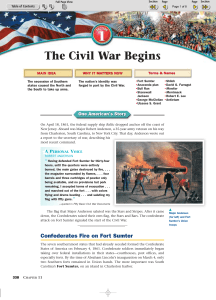
The Civil War Begins - Caggia Social Studies
... about three months after Fort Sumter fell. An army of 30,000 inexperienced Union soldiers on its way toward the Confederate capital at Richmond, only 100 miles from Washington, D.C., came upon an equally inexperienced Confederate army encamped near the little creek of Bull Run, just 25 miles from th ...
... about three months after Fort Sumter fell. An army of 30,000 inexperienced Union soldiers on its way toward the Confederate capital at Richmond, only 100 miles from Washington, D.C., came upon an equally inexperienced Confederate army encamped near the little creek of Bull Run, just 25 miles from th ...

May - McHenry County Civil War Round Table
... the proposition that all men are created equal. On May 8,Liberty, Union Maj. Gens. K. Warren destroy several railroad bridges along the same line, John Sedgwick unsuccessfully attempted to dislodge the severing one of the Confederacy's last vital lifelines and its During the ...
... the proposition that all men are created equal. On May 8,Liberty, Union Maj. Gens. K. Warren destroy several railroad bridges along the same line, John Sedgwick unsuccessfully attempted to dislodge the severing one of the Confederacy's last vital lifelines and its During the ...
General Order`s No. 9: Ending the war peacefully
... current hostilities between the North and South, and issued the order on April 10th to commanding officers. The document presented here is from a second group made out by Charles Marshall for distribution. Lee hoped his general order would help ease the South’s humiliation and sense of loss that cam ...
... current hostilities between the North and South, and issued the order on April 10th to commanding officers. The document presented here is from a second group made out by Charles Marshall for distribution. Lee hoped his general order would help ease the South’s humiliation and sense of loss that cam ...

The Civil War
... war effort struggled to keep going ► Abraham Lincoln had been re-elected to a second term as president in 1864 ► The only Confederate troops left were Lee’s troops in Virginia, and a small group in North Carolina ► They tried one more time to fight in March 1865, but failed ► On April 9, 1865, the C ...
... war effort struggled to keep going ► Abraham Lincoln had been re-elected to a second term as president in 1864 ► The only Confederate troops left were Lee’s troops in Virginia, and a small group in North Carolina ► They tried one more time to fight in March 1865, but failed ► On April 9, 1865, the C ...

Unit Notes
... -both sides lost heavily (it was the bloodiest single day of the war…and US history) -the actual fighting proved to be indecisive ...
... -both sides lost heavily (it was the bloodiest single day of the war…and US history) -the actual fighting proved to be indecisive ...
The Battle of Antietam
... “to attack the enemy’s left with the corps of Hooker and Mansfield, supported by Sumner’s and, if necessary, by Franklin’s; and as soon as matters looked favorably there, to move the corps of Burnside against the enemy’s extreme right, upon the ridge running to the south and rear of Sharpsburg, and, ...
... “to attack the enemy’s left with the corps of Hooker and Mansfield, supported by Sumner’s and, if necessary, by Franklin’s; and as soon as matters looked favorably there, to move the corps of Burnside against the enemy’s extreme right, upon the ridge running to the south and rear of Sharpsburg, and, ...

The Civil War
... Bring Union back together (not focused on Slavery at first) Blockade Southern ports – cut off supply lines Gain control of the Mississippi River – split confederacy Capture Richmond ...
... Bring Union back together (not focused on Slavery at first) Blockade Southern ports – cut off supply lines Gain control of the Mississippi River – split confederacy Capture Richmond ...

Civil War Technology - PHS
... • Cannons or guns, as they were sometimes called were fired in a relatively flat trajectory. • These were generally used as anti-personnel weapons. ...
... • Cannons or guns, as they were sometimes called were fired in a relatively flat trajectory. • These were generally used as anti-personnel weapons. ...


Chapter 3: The Civil War and Reconstruction
... Abolish slavery, reject all debts the state acquired, deprive all former Confederate government officials right to vote and hold office ...
... Abolish slavery, reject all debts the state acquired, deprive all former Confederate government officials right to vote and hold office ...

The Civil War
... • “Fire-eaters” want a victory and attacks • States don’t all agree on how war should be fought. • Keep troops home to defend their states Articles of Confederation parallels ...
... • “Fire-eaters” want a victory and attacks • States don’t all agree on how war should be fought. • Keep troops home to defend their states Articles of Confederation parallels ...

The Civil War on the West Shore
... Ewell was ready to attack Harrisburg but was ordered to Gettysburg before he could move on the capital. Maj. Gen. James Ewell Brown “Jeb” Stuart commanded the cavalry division of the Confederate Army. During a scouting mission, he became separated from the main army and had to make his way north ind ...
... Ewell was ready to attack Harrisburg but was ordered to Gettysburg before he could move on the capital. Maj. Gen. James Ewell Brown “Jeb” Stuart commanded the cavalry division of the Confederate Army. During a scouting mission, he became separated from the main army and had to make his way north ind ...

People of the Civil War
... _____________ was known as the “Angel of the Battlefield”. _____________ General of the Union Army. _____________ President of the United States during the War. _____________ General of the Confederate Army. _____________ 1st African American to be awarded the Congressional Medal of Honor. _________ ...
... _____________ was known as the “Angel of the Battlefield”. _____________ General of the Union Army. _____________ President of the United States during the War. _____________ General of the Confederate Army. _____________ 1st African American to be awarded the Congressional Medal of Honor. _________ ...

Civil War Study Guide
... such as sabers, cannons and warships. The fighting strategies of the Union (anaconda plan) and Confederacy (guerrilla warfare) also played into the weapons they used. The War Escalates 4. Choose a battle from the beginning of the war (Fort Sumter, First Bull Run, Shiloh or Antietam) and describe it ...
... such as sabers, cannons and warships. The fighting strategies of the Union (anaconda plan) and Confederacy (guerrilla warfare) also played into the weapons they used. The War Escalates 4. Choose a battle from the beginning of the war (Fort Sumter, First Bull Run, Shiloh or Antietam) and describe it ...


Chapter 18 The Civil War- Section 1 The War begins
... The battle called the Battle of Bull Run (a Creek) in the North was known as the as the Battle of Manassas (a settlement) in the south. The First Battle of Bull Run- the confederates won the first victory of the fighting but were a little disorganized. The battle demonstrated that both armies needed ...
... The battle called the Battle of Bull Run (a Creek) in the North was known as the as the Battle of Manassas (a settlement) in the south. The First Battle of Bull Run- the confederates won the first victory of the fighting but were a little disorganized. The battle demonstrated that both armies needed ...

The North in Charge
... which created tensions. Soldiers even began deserting and fighting for the North. Jefferson Davis struggled to run the Confederacy since his Congress fought at every turn and many wanted peace. Grant, after being appointed commander of all Union armies by Lincoln, appointed William Tecumseh Sherman ...
... which created tensions. Soldiers even began deserting and fighting for the North. Jefferson Davis struggled to run the Confederacy since his Congress fought at every turn and many wanted peace. Grant, after being appointed commander of all Union armies by Lincoln, appointed William Tecumseh Sherman ...
Battle of Antietam

The Battle of Antietam /ænˈtiːtəm/, also known as the Battle of Sharpsburg, particularly in the South, fought on September 17, 1862, near Sharpsburg, Maryland, and Antietam Creek as part of the Maryland Campaign, was the first major battle in the American Civil War to take place on Union soil. It is the bloodiest single-day battle in American history, with a combined tally of dead, wounded, and missing at 22,717.After pursuing Confederate General Robert E. Lee into Maryland, Union Army Maj. Gen. George B. McClellan launched attacks against Lee's army, in defensive positions behind Antietam Creek. At dawn on September 17, Maj. Gen. Joseph Hooker's corps mounted a powerful assault on Lee's left flank. Attacks and counterattacks swept across Miller's Cornfield and fighting swirled around the Dunker Church. Union assaults against the Sunken Road eventually pierced the Confederate center, but the Federal advantage was not followed up. In the afternoon, Union Maj. Gen. Ambrose Burnside's corps entered the action, capturing a stone bridge over Antietam Creek and advancing against the Confederate right. At a crucial moment, Confederate Maj. Gen. A. P. Hill's division arrived from Harpers Ferry and launched a surprise counterattack, driving back Burnside and ending the battle. Although outnumbered two-to-one, Lee committed his entire force, while McClellan sent in less than three-quarters of his army, enabling Lee to fight the Federals to a standstill. During the night, both armies consolidated their lines. In spite of crippling casualties, Lee continued to skirmish with McClellan throughout September 18, while removing his battered army south of the Potomac River.Despite having superiority of numbers, McClellan's attacks failed to achieve force concentration, allowing Lee to counter by shifting forces and moving interior lines to meet each challenge. Despite ample reserve forces that could have been deployed to exploit localized successes, McClellan failed to destroy Lee's army. McClellan had halted Lee's invasion of Maryland, but Lee was able to withdraw his army back to Virginia without interference from the cautious McClellan. Although the battle was tactically inconclusive, the Confederate troops had withdrawn first from the battlefield, making it, in military terms, a Union victory. It had significance as enough of a victory to give President Abraham Lincoln the confidence to announce his Emancipation Proclamation, which discouraged the British and French governments from potential plans for recognition of the Confederacy.