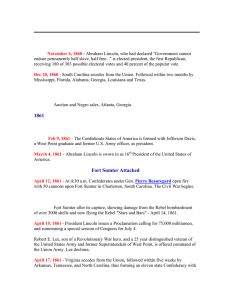
1861 Fort Sumter Attacked
... Only Lee's Army at Petersburg and Johnston's forces in North Carolina remain to fight for the South against Northern forces now numbering 280,000 men. March 4, 1865 - Inauguration ceremonies for President Lincoln in Washington. "With malice toward none; with charity for all...let us strive on to fin ...
... Only Lee's Army at Petersburg and Johnston's forces in North Carolina remain to fight for the South against Northern forces now numbering 280,000 men. March 4, 1865 - Inauguration ceremonies for President Lincoln in Washington. "With malice toward none; with charity for all...let us strive on to fin ...

The U.S. Civil War
... Jefferson Davis R.E. Lee Thomas Stonewall Jackson A.P. Hill James Longstreet Jeb Stuart ...
... Jefferson Davis R.E. Lee Thomas Stonewall Jackson A.P. Hill James Longstreet Jeb Stuart ...

No Slide Title
... – McClellan’s performance dismayed Lincoln, who reduced his authority by placing him under General Henry Halleck – Halleck called off the Peninsula Campaign – Lee defeated General John Pope’s forces at the Second Battle of Bull Run in August 1862, and Lincoln once again turned to McClellan – Lee hop ...
... – McClellan’s performance dismayed Lincoln, who reduced his authority by placing him under General Henry Halleck – Halleck called off the Peninsula Campaign – Lee defeated General John Pope’s forces at the Second Battle of Bull Run in August 1862, and Lincoln once again turned to McClellan – Lee hop ...

Civil War Battles
... New Weapons • Rifles more accurate, faster loading, fire more rounds than muskets • Minié ball (more destructive bullet), grenades, land mines are used • Fighting from trenches, barricades new advantage in infantry attacks NEXT ...
... New Weapons • Rifles more accurate, faster loading, fire more rounds than muskets • Minié ball (more destructive bullet), grenades, land mines are used • Fighting from trenches, barricades new advantage in infantry attacks NEXT ...

Letter To His Son
... anarchy and civil war (chaotic) • Wants it to be peaceful • Says the 1st 4 states have already succeeded, and 4 more (including his own) are expected to follow • Believes North has been unfair to South ...
... anarchy and civil war (chaotic) • Wants it to be peaceful • Says the 1st 4 states have already succeeded, and 4 more (including his own) are expected to follow • Believes North has been unfair to South ...

The Furnace of Civil War, 1861-1865 A. True or False Where the
... immediately below. ___ 1. The First Battle of Bull Run was the turning point of the Civil War because it convinced the South the war would be long and difficult ___ 2. The Emancipation Proclamation was more important for its political effects on the North and Europe than for its freeing large number ...
... immediately below. ___ 1. The First Battle of Bull Run was the turning point of the Civil War because it convinced the South the war would be long and difficult ___ 2. The Emancipation Proclamation was more important for its political effects on the North and Europe than for its freeing large number ...

Ch 20-21 w answers
... Gettysburg and Vicksburg- two battles that allow the North to win the CW • Vicksburg- N. controls Miss. River, splits S. in half – Grant- becomes the Gen. Lincoln needs to win the war ...
... Gettysburg and Vicksburg- two battles that allow the North to win the CW • Vicksburg- N. controls Miss. River, splits S. in half – Grant- becomes the Gen. Lincoln needs to win the war ...


Battles and notes - Mrs. Ball`s Social Studies Class
... New Weapons • Rifles more accurate, faster loading, fire more rounds than muskets • Minié ball (more destructive bullet), grenades, land mines are used • Fighting from trenches, barricades new advantage in infantry attacks NEXT ...
... New Weapons • Rifles more accurate, faster loading, fire more rounds than muskets • Minié ball (more destructive bullet), grenades, land mines are used • Fighting from trenches, barricades new advantage in infantry attacks NEXT ...

File - SEHS
... – Robert E. Lee of VA asked to lead Federal army vs. Confederacy – Refused – VA came before Union ...
... – Robert E. Lee of VA asked to lead Federal army vs. Confederacy – Refused – VA came before Union ...

November 6, 1860 - Abraham Lincoln, who had declared
... June 3, 1864 - A costly mistake by Grant results in 7,000 Union casualties in twenty minutes during an offensive against fortified Rebels at Cold Harbor in Virginia. Many of the Union soldiers in the failed assault had predicted the outcome, including a dead soldier from Massachusetts whose last ent ...
... June 3, 1864 - A costly mistake by Grant results in 7,000 Union casualties in twenty minutes during an offensive against fortified Rebels at Cold Harbor in Virginia. Many of the Union soldiers in the failed assault had predicted the outcome, including a dead soldier from Massachusetts whose last ent ...

November 6, 1860
... June 3, 1864 - A costly mistake by Grant results in 7,000 Union casualties in twenty minutes during an offensive against fortified Rebels at Cold Harbor in Virginia. Many of the Union soldiers in the failed assault had predicted the outcome, including a dead soldier from Massachusetts whose last ent ...
... June 3, 1864 - A costly mistake by Grant results in 7,000 Union casualties in twenty minutes during an offensive against fortified Rebels at Cold Harbor in Virginia. Many of the Union soldiers in the failed assault had predicted the outcome, including a dead soldier from Massachusetts whose last ent ...
the civil war - Northwest ISD Moodle
... Foreign Affairs and Diplomacy • Southern appeals to Britain & France • Blockade runners • William Seward ...
... Foreign Affairs and Diplomacy • Southern appeals to Britain & France • Blockade runners • William Seward ...

Civil War notes
... In February 1862, the Union Army captured Fort Henry on the Tennessee River. This left the river undefended, and during the next few weeks the Union Army and Navy began working their way upstream with little resistance. Eventually, the commanders decided that they would try to take over Corinth, a s ...
... In February 1862, the Union Army captured Fort Henry on the Tennessee River. This left the river undefended, and during the next few weeks the Union Army and Navy began working their way upstream with little resistance. Eventually, the commanders decided that they would try to take over Corinth, a s ...

Final Review Guide
... put in charge of the ARMY OF THE POTOMAC after the first major battle. The man who led the Union to the “hardly” victory at ANTIETAM. 8. __________________________________________ The name of the Union ironclad at Hampton Roads (what was the southern ironclad? _______________________________________ ...
... put in charge of the ARMY OF THE POTOMAC after the first major battle. The man who led the Union to the “hardly” victory at ANTIETAM. 8. __________________________________________ The name of the Union ironclad at Hampton Roads (what was the southern ironclad? _______________________________________ ...

The Tide of War Turns
... - The fighting here raged for 3 days - 90,000 Union troops clashed with 75,000 Confederate troops - The turning point of the Battle was when General George Pickett was ordered to mount a direct attack on the middle of the Union lines; a deadly mistake - This was known as Pickett’s Charge - Lee’s hop ...
... - The fighting here raged for 3 days - 90,000 Union troops clashed with 75,000 Confederate troops - The turning point of the Battle was when General George Pickett was ordered to mount a direct attack on the middle of the Union lines; a deadly mistake - This was known as Pickett’s Charge - Lee’s hop ...
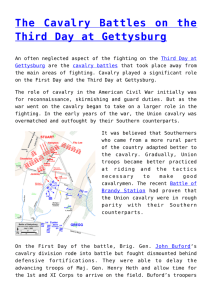
The Cavalry Battles on the Third Day at Gettysburg
... attack against the Union center the next day. He was to protect the Confederate left flank and attempt to move around the Union right flank and into their rear. If Stuart’s forces could proceed south from the York Pike along the Low Dutch Road, they would soon reach the Baltimore Pike, the main aven ...
... attack against the Union center the next day. He was to protect the Confederate left flank and attempt to move around the Union right flank and into their rear. If Stuart’s forces could proceed south from the York Pike along the Low Dutch Road, they would soon reach the Baltimore Pike, the main aven ...

Mort Künstler - Mort Kunstler
... service for a Confederate officer on her plantation, with women, children, and loyal slaves looking on—it caused such a sensation that impoverished residents of the ruined city threw coins and jewelry into a nearby pail to aid wounded soldiers. Not everyone appreciated these early efforts to consecr ...
... service for a Confederate officer on her plantation, with women, children, and loyal slaves looking on—it caused such a sensation that impoverished residents of the ruined city threw coins and jewelry into a nearby pail to aid wounded soldiers. Not everyone appreciated these early efforts to consecr ...

The Civil War (1861–1865) - Red Hook Central Schools
... • Poor nutrition and contaminated foods led to dysentery and typhoid fever. Malaria and pneumonia were also killers. • A Union soldier was three times more likely to die in camp or in a hospital than he was to be killed on the battlefield. • Some 4,000 women served as nurses for the Union army. By t ...
... • Poor nutrition and contaminated foods led to dysentery and typhoid fever. Malaria and pneumonia were also killers. • A Union soldier was three times more likely to die in camp or in a hospital than he was to be killed on the battlefield. • Some 4,000 women served as nurses for the Union army. By t ...

Name: Date - Bibb County Schools
... July, 1863: Battle of Gettysburg, Gettysburg, Pennsylvania: This battle was the ___________________ battle of the entire war. General ______________ Confederate Army met Union General George __________________ outside of Gettysburg , Pennsylvania. The armies fought for several days. Approximately __ ...
... July, 1863: Battle of Gettysburg, Gettysburg, Pennsylvania: This battle was the ___________________ battle of the entire war. General ______________ Confederate Army met Union General George __________________ outside of Gettysburg , Pennsylvania. The armies fought for several days. Approximately __ ...
The Consequences of a Confederate Victory at Gettysburg
... Meade, Hancock and Warren down to Vincent and Chamberlain, Hill pins the Army of the Potomac on its left and Longstreet’s attacks on the right unhinge the Union position. If Longstreet had moved earlier, he would have faced Sickles and III Corps in their original position, which may or may not have ...
... Meade, Hancock and Warren down to Vincent and Chamberlain, Hill pins the Army of the Potomac on its left and Longstreet’s attacks on the right unhinge the Union position. If Longstreet had moved earlier, he would have faced Sickles and III Corps in their original position, which may or may not have ...

THE AMERICAN CIVIL WAR
... The Battle of Cold Harbor lasted from May 31 to June 12, 1864, in Hanover County, Virginia. Union General Philip Sheridan led a successful attack against Confederate troops, which lasted until the Confederacy called reinforcements to the area. Sheridan followed in similar fashion, enlisting the help ...
... The Battle of Cold Harbor lasted from May 31 to June 12, 1864, in Hanover County, Virginia. Union General Philip Sheridan led a successful attack against Confederate troops, which lasted until the Confederacy called reinforcements to the area. Sheridan followed in similar fashion, enlisting the help ...

Chapter 17-3 Power Point Notes KEY
... In September, 1862, Union forces turned back Southern troops at the bloody Battle of Antietam. Confederate leaders still hoped, however, to win a victory in the North. ...
... In September, 1862, Union forces turned back Southern troops at the bloody Battle of Antietam. Confederate leaders still hoped, however, to win a victory in the North. ...

Civil War Battles and Technology
... ● Lincoln makes Grant commander of all Union armies – beginning of 1864 ● Grant made his headquarters with the Army of the Potomac - places Maj. Gen. Sherman in command of most of the western armies. ● Grant takes up total war. ● Union forces in the East attempted to maneuver past Lee and fought sev ...
... ● Lincoln makes Grant commander of all Union armies – beginning of 1864 ● Grant made his headquarters with the Army of the Potomac - places Maj. Gen. Sherman in command of most of the western armies. ● Grant takes up total war. ● Union forces in the East attempted to maneuver past Lee and fought sev ...
Battle of Antietam

The Battle of Antietam /ænˈtiːtəm/, also known as the Battle of Sharpsburg, particularly in the South, fought on September 17, 1862, near Sharpsburg, Maryland, and Antietam Creek as part of the Maryland Campaign, was the first major battle in the American Civil War to take place on Union soil. It is the bloodiest single-day battle in American history, with a combined tally of dead, wounded, and missing at 22,717.After pursuing Confederate General Robert E. Lee into Maryland, Union Army Maj. Gen. George B. McClellan launched attacks against Lee's army, in defensive positions behind Antietam Creek. At dawn on September 17, Maj. Gen. Joseph Hooker's corps mounted a powerful assault on Lee's left flank. Attacks and counterattacks swept across Miller's Cornfield and fighting swirled around the Dunker Church. Union assaults against the Sunken Road eventually pierced the Confederate center, but the Federal advantage was not followed up. In the afternoon, Union Maj. Gen. Ambrose Burnside's corps entered the action, capturing a stone bridge over Antietam Creek and advancing against the Confederate right. At a crucial moment, Confederate Maj. Gen. A. P. Hill's division arrived from Harpers Ferry and launched a surprise counterattack, driving back Burnside and ending the battle. Although outnumbered two-to-one, Lee committed his entire force, while McClellan sent in less than three-quarters of his army, enabling Lee to fight the Federals to a standstill. During the night, both armies consolidated their lines. In spite of crippling casualties, Lee continued to skirmish with McClellan throughout September 18, while removing his battered army south of the Potomac River.Despite having superiority of numbers, McClellan's attacks failed to achieve force concentration, allowing Lee to counter by shifting forces and moving interior lines to meet each challenge. Despite ample reserve forces that could have been deployed to exploit localized successes, McClellan failed to destroy Lee's army. McClellan had halted Lee's invasion of Maryland, but Lee was able to withdraw his army back to Virginia without interference from the cautious McClellan. Although the battle was tactically inconclusive, the Confederate troops had withdrawn first from the battlefield, making it, in military terms, a Union victory. It had significance as enough of a victory to give President Abraham Lincoln the confidence to announce his Emancipation Proclamation, which discouraged the British and French governments from potential plans for recognition of the Confederacy.