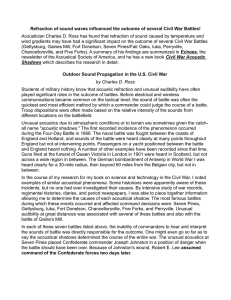
Refraction of sound waves influenced the outcome of several Civil
... The scene - After the Union debacle at Bull Run, George C. McClellan was placed in command of the forces around Washington. Rather than move towards Richmond directly overland, McClellan decided to save his infantry some work by shipping them to the peninsula southeast of Richmond to begin his attac ...
... The scene - After the Union debacle at Bull Run, George C. McClellan was placed in command of the forces around Washington. Rather than move towards Richmond directly overland, McClellan decided to save his infantry some work by shipping them to the peninsula southeast of Richmond to begin his attac ...
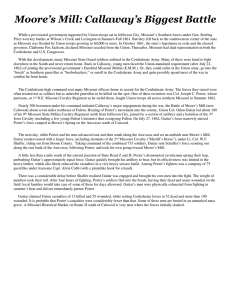
Battle of Moore`s Mill - Kingdom of Callaway Civil War Heritage
... guerrillas under fearsome Capt. Alvin Cobb (with a piratelike hook for a hand). There was a considerable delay before Shaffer realized Guitar was engaged and brought his own men into the fight. The weight of numbers took their toll. After four hours of fighting, Porter’s soldiers fled into the brush ...
... guerrillas under fearsome Capt. Alvin Cobb (with a piratelike hook for a hand). There was a considerable delay before Shaffer realized Guitar was engaged and brought his own men into the fight. The weight of numbers took their toll. After four hours of fighting, Porter’s soldiers fled into the brush ...

American Civil War
... 56. What battle took place on the second day at Gettysburg? 57. Who commanded the 20th Maine during this battle? ...
... 56. What battle took place on the second day at Gettysburg? 57. Who commanded the 20th Maine during this battle? ...

Battle of Bull Run
... Richmond. The Seven Days Battles cost the Union 16000 and the South 20,000 but the Union left Richmond. • The Union is forced from Virginia ...
... Richmond. The Seven Days Battles cost the Union 16000 and the South 20,000 but the Union left Richmond. • The Union is forced from Virginia ...

Chapter 17 Section 1 terms and names
... ________________________________________________________________________ ________________________________________________________________________ ________________________________________________________________________ ...
... ________________________________________________________________________ ________________________________________________________________________ ________________________________________________________________________ ...

A. Sectionalism – _______________________________________________________________________ The Nation Splits Apart (Ch. 10)
... A. Union, under Grant’s command, was surprised by Confederates - reinforcements arrived w/ Gen. Buell B. Brutal battle – ________________________________________________________________________ C. Nearly 25,000 died - more than Revolutionary War, War of 1812 and Mexican War combined! D. Shiloh opene ...
... A. Union, under Grant’s command, was surprised by Confederates - reinforcements arrived w/ Gen. Buell B. Brutal battle – ________________________________________________________________________ C. Nearly 25,000 died - more than Revolutionary War, War of 1812 and Mexican War combined! D. Shiloh opene ...
CIVIL WAR In the spring of 1861, decades of simmering tensions
... Carolina. Lincoln responded by calling for a volunteer army from each state to recapture federal property, which led to declarations of secession by four more slave states. Both sides raised armies as the Union seized control of the border states early in the war and established a naval blockade. La ...
... Carolina. Lincoln responded by calling for a volunteer army from each state to recapture federal property, which led to declarations of secession by four more slave states. Both sides raised armies as the Union seized control of the border states early in the war and established a naval blockade. La ...

Study Guide for SS8H6 The student will analyze the impact of the
... Union Blockade – blocked Confederate ports to keep from shipping cotton out and getting supplies from Europe Anaconda Plan – capture the Miss. River 4. Name 2 main Confederate strategies for winning the war and how they operated: King Cotton Diplomacy – belief Europe would need Southern cotton and h ...
... Union Blockade – blocked Confederate ports to keep from shipping cotton out and getting supplies from Europe Anaconda Plan – capture the Miss. River 4. Name 2 main Confederate strategies for winning the war and how they operated: King Cotton Diplomacy – belief Europe would need Southern cotton and h ...

The Drummer Boy of Shiloh, Cross-Curricular Conn.: Social Studies
... The Battle of Shiloh was fought on April 6 and 7, 1862. Thirteen thousand Union soldiers and ten thousand Confederate soldiers died—the greatest loss of life of any battle ever fought before on United States soil. Twice the number of soldiers died at Shiloh than during the four previous battles comb ...
... The Battle of Shiloh was fought on April 6 and 7, 1862. Thirteen thousand Union soldiers and ten thousand Confederate soldiers died—the greatest loss of life of any battle ever fought before on United States soil. Twice the number of soldiers died at Shiloh than during the four previous battles comb ...

Civil War Battle begins
... • Document gave the Southern Confederacy a choice: Quit the war and keep slavery alive or keep fighting and slaves would be forever free • Deadline was January 1, 1863 • The Confederate leaders continued the war and the slaves were declared free by the United States government in 1863 ...
... • Document gave the Southern Confederacy a choice: Quit the war and keep slavery alive or keep fighting and slaves would be forever free • Deadline was January 1, 1863 • The Confederate leaders continued the war and the slaves were declared free by the United States government in 1863 ...

Slide 1
... Although the Emancipation Proclamation did not immediately free a single slave, it fundamentally transformed the character of the war. After January 1, 1863, every advance of federal troops expanded the domain of freedom. Moreover, the Proclamation announced the acceptance of black men into the Uni ...
... Although the Emancipation Proclamation did not immediately free a single slave, it fundamentally transformed the character of the war. After January 1, 1863, every advance of federal troops expanded the domain of freedom. Moreover, the Proclamation announced the acceptance of black men into the Uni ...

21 CivilWar
... Union, and is not either to save or to destroy slavery. If I could save the Union without freeing any slave I would do it, and if I could save it by freeing all the slaves I would do it; and if I could save it by freeing some and leaving others alone I would also do that. What I do about slavery, an ...
... Union, and is not either to save or to destroy slavery. If I could save the Union without freeing any slave I would do it, and if I could save it by freeing all the slaves I would do it; and if I could save it by freeing some and leaving others alone I would also do that. What I do about slavery, an ...

Lecture - Chapter 4, Key Battles of the Civil War, Part 2
... - Late June, 1863: Lee decides to take the battle to the Union again; the land/people of VA can no longer support the troops - July 1st: Union and Confederate skirmishers bump into each other outside Gettysburg; neither side prepared to fight - After a brief battle, Union troops retreat chaotically ...
... - Late June, 1863: Lee decides to take the battle to the Union again; the land/people of VA can no longer support the troops - July 1st: Union and Confederate skirmishers bump into each other outside Gettysburg; neither side prepared to fight - After a brief battle, Union troops retreat chaotically ...

The_Civil_War
... Bull Run: the Test Battle • July 1861, the first battle of the Civil War • Just miles from Washington DC • Equal forces clash, yet the Union forces are easily routed in a panicked retreat – The South does not advance, it is disorganized itself • What if? ...
... Bull Run: the Test Battle • July 1861, the first battle of the Civil War • Just miles from Washington DC • Equal forces clash, yet the Union forces are easily routed in a panicked retreat – The South does not advance, it is disorganized itself • What if? ...
Antietam - History Channel
... On September 17, 1862, at Antietam Creek, Maryland, over 23,000 Union and Confederate soldiers (nine times the number who fell on the beaches of Normandy) were killed or wounded. This cataclysmic battle was the bloodiest day of fighting in American history, with a stunning number of casualties left ...
... On September 17, 1862, at Antietam Creek, Maryland, over 23,000 Union and Confederate soldiers (nine times the number who fell on the beaches of Normandy) were killed or wounded. This cataclysmic battle was the bloodiest day of fighting in American history, with a stunning number of casualties left ...

Unit 8 - PowerPoints - The American Civil War
... Fredericksburg was the site of a battle in December 1862. Union General Ambrose Burnside led a march on Richmond, but was delayed for more than two weeks because of latearriving supplies. General Lee positioned his army, deploying snipers to pick off Federal troops. Confederate artillery decimated U ...
... Fredericksburg was the site of a battle in December 1862. Union General Ambrose Burnside led a march on Richmond, but was delayed for more than two weeks because of latearriving supplies. General Lee positioned his army, deploying snipers to pick off Federal troops. Confederate artillery decimated U ...

Civil War Battle Chart
... Abraham Lincoln replaced Gen. George B. McClellan with Gen. Ambrose Burnside in November 1862 in command of the Army of the Potomac. Burnside proposed to move toward Fredericksburg, Virginia, as a preliminary to an offensive against ...
... Abraham Lincoln replaced Gen. George B. McClellan with Gen. Ambrose Burnside in November 1862 in command of the Army of the Potomac. Burnside proposed to move toward Fredericksburg, Virginia, as a preliminary to an offensive against ...

The American Civil War
... audience of 20,000 people. “The world will little note, nor long remember what we say here, but it can never forget what they did here. It is for us the living, rather, to be dedicated here to the unfinished work which they who fought here have thus far so nobly advanced. It is rather for us to be h ...
... audience of 20,000 people. “The world will little note, nor long remember what we say here, but it can never forget what they did here. It is for us the living, rather, to be dedicated here to the unfinished work which they who fought here have thus far so nobly advanced. It is rather for us to be h ...

Critical Events in the Civil War
... • Ironclads were warships covered with iron. They could withstand attack better than wooden ships. First used in 1862, especially helped Grant on the Mississippi. ...
... • Ironclads were warships covered with iron. They could withstand attack better than wooden ships. First used in 1862, especially helped Grant on the Mississippi. ...

Power Point 15-5 - United States History Mr. Canfield
... nation, under God, shall have a new birth of freedom.” ...
... nation, under God, shall have a new birth of freedom.” ...

No Slide Title
... Lee Invades the North • General Lee, troops invade Maryland (September 1862) • Several reasons for taking war to the North: - hopes victory in North will force President Lincoln to talk peace - gives Virginia farmers a rest from war during harvest - Confederates could plunder Northern farmers for fo ...
... Lee Invades the North • General Lee, troops invade Maryland (September 1862) • Several reasons for taking war to the North: - hopes victory in North will force President Lincoln to talk peace - gives Virginia farmers a rest from war during harvest - Confederates could plunder Northern farmers for fo ...
The Civil War 1864-1865
... Both sides have similar/equal strength, and each side attempts to force their opponent to surrender by wearing the other down over an extended period of time Grant to Meade: “Lee’s army is your objective!” Strategic Deployments of the Plan: Eastern Theater – Meade’s AOTP pursues Lee’s ANV ...
... Both sides have similar/equal strength, and each side attempts to force their opponent to surrender by wearing the other down over an extended period of time Grant to Meade: “Lee’s army is your objective!” Strategic Deployments of the Plan: Eastern Theater – Meade’s AOTP pursues Lee’s ANV ...

The Furnace of Civil War
... – Meade (with 92,000 men) took stand on a low ridge over a valley – Lee (with 76,000 men) moved in to attack – Battle went back and forth over 3 days – General George Pickett’s charge against Union lines driven back, breaking Confederate advance, forcing Lee to retreat ...
... – Meade (with 92,000 men) took stand on a low ridge over a valley – Lee (with 76,000 men) moved in to attack – Battle went back and forth over 3 days – General George Pickett’s charge against Union lines driven back, breaking Confederate advance, forcing Lee to retreat ...
week nine handouts, history 302
... (VI Corps) and Hancock’s II Corps on the Plank Road. Fighting was fierce but inconclusive as both sides attempted to maneuver in the dense woods. Darkness halted the fighting, and both sides rushed forward reinforcements. At dawn on May 6, Hancock attacked along the Plank Road, driving Hill’s Corps ...
... (VI Corps) and Hancock’s II Corps on the Plank Road. Fighting was fierce but inconclusive as both sides attempted to maneuver in the dense woods. Darkness halted the fighting, and both sides rushed forward reinforcements. At dawn on May 6, Hancock attacked along the Plank Road, driving Hill’s Corps ...
Battle of Antietam

The Battle of Antietam /ænˈtiːtəm/, also known as the Battle of Sharpsburg, particularly in the South, fought on September 17, 1862, near Sharpsburg, Maryland, and Antietam Creek as part of the Maryland Campaign, was the first major battle in the American Civil War to take place on Union soil. It is the bloodiest single-day battle in American history, with a combined tally of dead, wounded, and missing at 22,717.After pursuing Confederate General Robert E. Lee into Maryland, Union Army Maj. Gen. George B. McClellan launched attacks against Lee's army, in defensive positions behind Antietam Creek. At dawn on September 17, Maj. Gen. Joseph Hooker's corps mounted a powerful assault on Lee's left flank. Attacks and counterattacks swept across Miller's Cornfield and fighting swirled around the Dunker Church. Union assaults against the Sunken Road eventually pierced the Confederate center, but the Federal advantage was not followed up. In the afternoon, Union Maj. Gen. Ambrose Burnside's corps entered the action, capturing a stone bridge over Antietam Creek and advancing against the Confederate right. At a crucial moment, Confederate Maj. Gen. A. P. Hill's division arrived from Harpers Ferry and launched a surprise counterattack, driving back Burnside and ending the battle. Although outnumbered two-to-one, Lee committed his entire force, while McClellan sent in less than three-quarters of his army, enabling Lee to fight the Federals to a standstill. During the night, both armies consolidated their lines. In spite of crippling casualties, Lee continued to skirmish with McClellan throughout September 18, while removing his battered army south of the Potomac River.Despite having superiority of numbers, McClellan's attacks failed to achieve force concentration, allowing Lee to counter by shifting forces and moving interior lines to meet each challenge. Despite ample reserve forces that could have been deployed to exploit localized successes, McClellan failed to destroy Lee's army. McClellan had halted Lee's invasion of Maryland, but Lee was able to withdraw his army back to Virginia without interference from the cautious McClellan. Although the battle was tactically inconclusive, the Confederate troops had withdrawn first from the battlefield, making it, in military terms, a Union victory. It had significance as enough of a victory to give President Abraham Lincoln the confidence to announce his Emancipation Proclamation, which discouraged the British and French governments from potential plans for recognition of the Confederacy.