
entire article as PDF - West Virginia Executive Magazine
... abolitionist John Brown’s 1859 raid on the federal arsenal. During the war it became the base of operations for Union invasions into the Shenandoah Valley. In September 1862, as part of the Maryland Campaign, Stonewall Jackson captured 12,500 Union soldiers stationed in Harpers Ferry, an event that ...
... abolitionist John Brown’s 1859 raid on the federal arsenal. During the war it became the base of operations for Union invasions into the Shenandoah Valley. In September 1862, as part of the Maryland Campaign, Stonewall Jackson captured 12,500 Union soldiers stationed in Harpers Ferry, an event that ...

Gettysburg Play Dough Assignment Directions: The Battle of
... Union defensive position south of the town. While simultaneous attacks were supposed to have occurred on Culp’s Hill and Cemetery Ridge, the attacks too place six hours apart and were unsuccessful. Though Union forces held onto Culp’s Hill, the Confederate forces did drive back the Union troops in a ...
... Union defensive position south of the town. While simultaneous attacks were supposed to have occurred on Culp’s Hill and Cemetery Ridge, the attacks too place six hours apart and were unsuccessful. Though Union forces held onto Culp’s Hill, the Confederate forces did drive back the Union troops in a ...

Chapter 21 Focus Questions: Essay question: What was the relative
... Why did Lee invade Pennsylvania in the summer of 1863? How was the Battle of Gettysburg significant in the war’s outcome? Why was the Union victory at Vicksburg significant? How did Generals such as Grant and Sherman overcome the supply disadvantage of fighting a war of conquest? What were the three ...
... Why did Lee invade Pennsylvania in the summer of 1863? How was the Battle of Gettysburg significant in the war’s outcome? Why was the Union victory at Vicksburg significant? How did Generals such as Grant and Sherman overcome the supply disadvantage of fighting a war of conquest? What were the three ...

The War Begins • Main Idea 1: Following the outbreak of war at Fort
... Fought in Mexican-American War ...
... Fought in Mexican-American War ...

Civil war battles - teacher copy
... Antietam was the bloodiest single day of the Civil War. Over 23,000 total soldiers were killed or wounded in this battle in the border state of Maryland. Although the Union won the battle, the Confederates did not lose any ground, only more men. This was the first major victory for the Union army in ...
... Antietam was the bloodiest single day of the Civil War. Over 23,000 total soldiers were killed or wounded in this battle in the border state of Maryland. Although the Union won the battle, the Confederates did not lose any ground, only more men. This was the first major victory for the Union army in ...
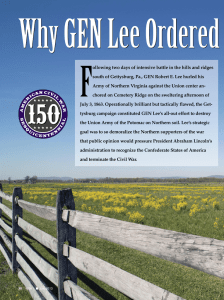
Following two days of intensive battle in the hills and ridges south of
... flawed. As he surveyed the field, GEN Lee believed that, had LTG James Longstreet’s assault against MG Meade’s southern flank been coordinated with fellow corps commander LTG Richard S. Ewell’s attack against the northern extremity of the Union line on Culp’s Hill, the Confederates would have crushe ...
... flawed. As he surveyed the field, GEN Lee believed that, had LTG James Longstreet’s assault against MG Meade’s southern flank been coordinated with fellow corps commander LTG Richard S. Ewell’s attack against the northern extremity of the Union line on Culp’s Hill, the Confederates would have crushe ...

Chapter 16 Section 2 Early Stages of the War PowerPoint
... ship’s shells bounced off its iron sides • The Union had its own ironclad warship, the Monitor • March 9th, the two ironclads met in battle • Neither could sink the other ...
... ship’s shells bounced off its iron sides • The Union had its own ironclad warship, the Monitor • March 9th, the two ironclads met in battle • Neither could sink the other ...

APUSH UNIT 6 Dr. I. Ibokette Unit 6: Civil War, Reconstruction and
... September 1862-Harper's Ferry. Union General McClellan defeated Confederate General Lee at South Mountain and Crampton's Gap in September, but did not move quickly enough to save Harper's Ferry, which fell to Confederate General Jackson on September 15, along with a great number of men and a large b ...
... September 1862-Harper's Ferry. Union General McClellan defeated Confederate General Lee at South Mountain and Crampton's Gap in September, but did not move quickly enough to save Harper's Ferry, which fell to Confederate General Jackson on September 15, along with a great number of men and a large b ...

Study Questions for Chapter 21 and 22 Test
... 1. Who was General McClellan? 2. Who was General Lee? 3. What happened at Bull Run? 4. Who helped to ruin the North’s chances at the Battle of Bull Run? 5. What happened at the Battle of Antietem? 6. What happened at Gettysburg? 7. Who gave the Gettysburg address and why? 8. What were the Monitor an ...
... 1. Who was General McClellan? 2. Who was General Lee? 3. What happened at Bull Run? 4. Who helped to ruin the North’s chances at the Battle of Bull Run? 5. What happened at the Battle of Antietem? 6. What happened at Gettysburg? 7. Who gave the Gettysburg address and why? 8. What were the Monitor an ...

Southern Victories African Americans in the Civil War
... showed daring and a brilliant command of tactics. Although Hooker had twice as many men, Lee divided his forces. Some Confederate troops confronted the main Union force. Others under the leadership of Stonewall Jackson secretly marched to a spot at the far end of the Union line. The risky plan worke ...
... showed daring and a brilliant command of tactics. Although Hooker had twice as many men, Lee divided his forces. Some Confederate troops confronted the main Union force. Others under the leadership of Stonewall Jackson secretly marched to a spot at the far end of the Union line. The risky plan worke ...

Compare and Contrast the Battle of Gettysburg
... Confederates forces to break the Union possession of the West along the base of the Rocky Mountains. Although the Confederate army was able to push the Union forces back through the pass, they were forced to retreat when their supply train was destroyed and their horses and mules were killed or driv ...
... Confederates forces to break the Union possession of the West along the base of the Rocky Mountains. Although the Confederate army was able to push the Union forces back through the pass, they were forced to retreat when their supply train was destroyed and their horses and mules were killed or driv ...

Review - Catawba County Schools
... Date of the 1 Battle of Bull Run? What was the confederates name for the battle? Which side won? What was Thomas J. Jackson’s nickname? What was Ulysses S. Grant’s nickname? Name the two ironclad’s that fought and which side did they belong to? Name of the battle in 1862 in Tennessee that produced m ...
... Date of the 1 Battle of Bull Run? What was the confederates name for the battle? Which side won? What was Thomas J. Jackson’s nickname? What was Ulysses S. Grant’s nickname? Name the two ironclad’s that fought and which side did they belong to? Name of the battle in 1862 in Tennessee that produced m ...

II. African Americans in the War
... Richmond was never captured, and the Confederates were only 20 miles away from Washington, D.C. McClellan's army was pushed back, but it was larger than Lee's and still close to Richmond. Stonewall Jackson's troops met Lee's army and were attacked by Pope's troops on August 29 at Bull Run. The Secon ...
... Richmond was never captured, and the Confederates were only 20 miles away from Washington, D.C. McClellan's army was pushed back, but it was larger than Lee's and still close to Richmond. Stonewall Jackson's troops met Lee's army and were attacked by Pope's troops on August 29 at Bull Run. The Secon ...

Print › Chapter 20: Girding for War: The North and the South (1861
... difficult to do; national power was weak; Jefferson Davis was never really popular ...
... difficult to do; national power was weak; Jefferson Davis was never really popular ...

The Civil War The early years 1861-62
... reinforcements arrive on the Tennessee River. • Grant reorganizes and launches a counterattack the next day. ...
... reinforcements arrive on the Tennessee River. • Grant reorganizes and launches a counterattack the next day. ...

Chapter 21 Reading Guide
... What do blacks in the South do as the war goes on? Who does Lincoln put in place as commander of the Army of the Potomac after firing McClellan following Antietam? How does this new commander fail at Fredericksburg? Who becomes commander of the Army of the Potomac after Fredericksburg? Why is Chance ...
... What do blacks in the South do as the war goes on? Who does Lincoln put in place as commander of the Army of the Potomac after firing McClellan following Antietam? How does this new commander fail at Fredericksburg? Who becomes commander of the Army of the Potomac after Fredericksburg? Why is Chance ...
1864-65
... All of the campaigns were to begin the first week of May, 1864. More than a quarter of a million men in blue are ready to attack the South. Waiting for them would be the Southern Armies and their generals. ...
... All of the campaigns were to begin the first week of May, 1864. More than a quarter of a million men in blue are ready to attack the South. Waiting for them would be the Southern Armies and their generals. ...

Chapter 16 - Humble ISD
... sought control of Mississippi River in order to split the Confederacy in half H. Scott’s plan took time to develop and many people wanted a quick strike on Richmond, VA, which was the capital city of the Confederacy ...
... sought control of Mississippi River in order to split the Confederacy in half H. Scott’s plan took time to develop and many people wanted a quick strike on Richmond, VA, which was the capital city of the Confederacy ...

Spring 2010 issue
... Union Brigadier General William Averell to secure the Virginia-Tennessee railroad, an important Confederate supply line. Moving south with his Federal force of approximately 4,000 men through the new state of West Virginia in November, 1863, Averell encountered the Confederate army of Brigadier Gene ...
... Union Brigadier General William Averell to secure the Virginia-Tennessee railroad, an important Confederate supply line. Moving south with his Federal force of approximately 4,000 men through the new state of West Virginia in November, 1863, Averell encountered the Confederate army of Brigadier Gene ...

Ch 13 The State of Texas 1848-1860
... The Battle was a bloody and both sides suffered a combined 20,000 __________________. The Union won the battle and invaded south along the ________________ River. ...
... The Battle was a bloody and both sides suffered a combined 20,000 __________________. The Union won the battle and invaded south along the ________________ River. ...

Civil War Study Guide
... VA, TN, ARK – Richmond, VA. becomes Confederate capital • Slave States that stay with the Union – MD, KY, ...
... VA, TN, ARK – Richmond, VA. becomes Confederate capital • Slave States that stay with the Union – MD, KY, ...

First Battle of Bull Run in The Civil War
... First Battle of Bull Run in The Civil War Jul 21, 1861 General Winfield Scott wanted to wait. He didn’t think much of the flood of volunteers that had rushed to enlist following Fort Sumter. They needed months of training before they could be sent into battle. But the Northern public was anxious fo ...
... First Battle of Bull Run in The Civil War Jul 21, 1861 General Winfield Scott wanted to wait. He didn’t think much of the flood of volunteers that had rushed to enlist following Fort Sumter. They needed months of training before they could be sent into battle. But the Northern public was anxious fo ...
Chapter 11 The Civil War Guided Notes
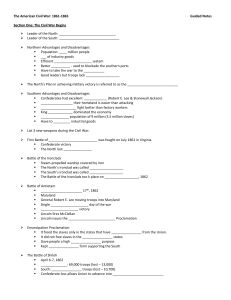
... Better __________ - used to blockade the southern ports Have to take the war to the ___________ Good leaders but troops lack __________________ ...
... Better __________ - used to blockade the southern ports Have to take the war to the ___________ Good leaders but troops lack __________________ ...

Gettysburg Date State Leaders N/S Victor & importance of outcome
... Washington, D.C. and attacking Richmond, Virginia ...
... Washington, D.C. and attacking Richmond, Virginia ...
Chapter 16
... Must defeat the Confederacy at Manassas, VA first. (near Washington D.C.) General McDowell (North) marched to Manassas. Spectators came to watch the war. Attacked Confederacy near Bull Run creek. ...
... Must defeat the Confederacy at Manassas, VA first. (near Washington D.C.) General McDowell (North) marched to Manassas. Spectators came to watch the war. Attacked Confederacy near Bull Run creek. ...
Battle of Antietam

The Battle of Antietam /ænˈtiːtəm/, also known as the Battle of Sharpsburg, particularly in the South, fought on September 17, 1862, near Sharpsburg, Maryland, and Antietam Creek as part of the Maryland Campaign, was the first major battle in the American Civil War to take place on Union soil. It is the bloodiest single-day battle in American history, with a combined tally of dead, wounded, and missing at 22,717.After pursuing Confederate General Robert E. Lee into Maryland, Union Army Maj. Gen. George B. McClellan launched attacks against Lee's army, in defensive positions behind Antietam Creek. At dawn on September 17, Maj. Gen. Joseph Hooker's corps mounted a powerful assault on Lee's left flank. Attacks and counterattacks swept across Miller's Cornfield and fighting swirled around the Dunker Church. Union assaults against the Sunken Road eventually pierced the Confederate center, but the Federal advantage was not followed up. In the afternoon, Union Maj. Gen. Ambrose Burnside's corps entered the action, capturing a stone bridge over Antietam Creek and advancing against the Confederate right. At a crucial moment, Confederate Maj. Gen. A. P. Hill's division arrived from Harpers Ferry and launched a surprise counterattack, driving back Burnside and ending the battle. Although outnumbered two-to-one, Lee committed his entire force, while McClellan sent in less than three-quarters of his army, enabling Lee to fight the Federals to a standstill. During the night, both armies consolidated their lines. In spite of crippling casualties, Lee continued to skirmish with McClellan throughout September 18, while removing his battered army south of the Potomac River.Despite having superiority of numbers, McClellan's attacks failed to achieve force concentration, allowing Lee to counter by shifting forces and moving interior lines to meet each challenge. Despite ample reserve forces that could have been deployed to exploit localized successes, McClellan failed to destroy Lee's army. McClellan had halted Lee's invasion of Maryland, but Lee was able to withdraw his army back to Virginia without interference from the cautious McClellan. Although the battle was tactically inconclusive, the Confederate troops had withdrawn first from the battlefield, making it, in military terms, a Union victory. It had significance as enough of a victory to give President Abraham Lincoln the confidence to announce his Emancipation Proclamation, which discouraged the British and French governments from potential plans for recognition of the Confederacy.