
sons of confederate veterans - Albert Sidney Johnston Camp #67
... Gen. George McClellan was moving both his army and himself today, and moving is never an enjoyable process. The Army of the Potomac had to be transferred from its home base near Alexandria, just outside Washington, to Ft. Monroe, Va. This involved going down the Potomac River and Chesapeake Bay. The ...
... Gen. George McClellan was moving both his army and himself today, and moving is never an enjoyable process. The Army of the Potomac had to be transferred from its home base near Alexandria, just outside Washington, to Ft. Monroe, Va. This involved going down the Potomac River and Chesapeake Bay. The ...

The Furnace of Civil War
... – Meade (with 92,000 men) took stand on a low ridge over a valley – Lee (with 76,000 men) moved in to attack – Battle went back and forth over 3 days – General George Pickett’s charge against Union lines driven back, breaking Confederate advance, forcing Lee to retreat ...
... – Meade (with 92,000 men) took stand on a low ridge over a valley – Lee (with 76,000 men) moved in to attack – Battle went back and forth over 3 days – General George Pickett’s charge against Union lines driven back, breaking Confederate advance, forcing Lee to retreat ...

Causes of the Civil War - Appleton Area School District
... buildings. Only one person was killed (one of the Ruffians), but the door to violence had been breached. The Pottawatomie Creek Massacre. A few days later, in retaliation for the Lawrence raid, abolitionist forces under the zealot John Brown attacked a small proslavery settlement on Pottawatomie C ...
... buildings. Only one person was killed (one of the Ruffians), but the door to violence had been breached. The Pottawatomie Creek Massacre. A few days later, in retaliation for the Lawrence raid, abolitionist forces under the zealot John Brown attacked a small proslavery settlement on Pottawatomie C ...


George B. McClellan - Northern Highlands
... George Brinton McClellan is often remembered as the great organizer of the Union Army of the Potomac. Nicknamed "Young Napoleon," "Little Mac" was immensely popular with the men who served under his command. His military command style, however, put him at odds with President Abraham Lincoln, and wou ...
... George Brinton McClellan is often remembered as the great organizer of the Union Army of the Potomac. Nicknamed "Young Napoleon," "Little Mac" was immensely popular with the men who served under his command. His military command style, however, put him at odds with President Abraham Lincoln, and wou ...
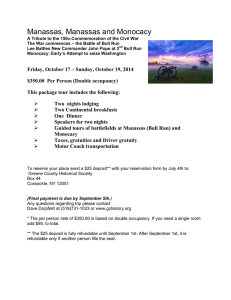
Manassas, Manassas and Monocacy
... President Lincoln to command the newly formed Army of Virginia, was soundly beaten by Gen. Robert E. Lee’s Army of Northern Virginia. In order to draw Pope’s army into battle, Jackson ordered an attack on the Federal column that was passing across his front on the Warrenton Turnpike on August 28. Fi ...
... President Lincoln to command the newly formed Army of Virginia, was soundly beaten by Gen. Robert E. Lee’s Army of Northern Virginia. In order to draw Pope’s army into battle, Jackson ordered an attack on the Federal column that was passing across his front on the Warrenton Turnpike on August 28. Fi ...


Civil War Turning Points
... was better positioned. The Union (blue) was located on high ground south of the town. Confederate (red) General George Pickett heroically led his men to roust the Union. They failed. Lee and his army retreated back to Virginia. ...
... was better positioned. The Union (blue) was located on high ground south of the town. Confederate (red) General George Pickett heroically led his men to roust the Union. They failed. Lee and his army retreated back to Virginia. ...

the civil war - OCPS TeacherPress
... XI. END OF THE WAR IN THE EAST: Grant’s Virginia Campaign A. Grant promoted to head of all Union armies after Lincoln’s dismay with Meade after Gettysburg 1. Meade still remained head of the Army of the Potomac 2. Grant’s strategy to attack the enemy’s armies simultaneously thus not allowing them to ...
... XI. END OF THE WAR IN THE EAST: Grant’s Virginia Campaign A. Grant promoted to head of all Union armies after Lincoln’s dismay with Meade after Gettysburg 1. Meade still remained head of the Army of the Potomac 2. Grant’s strategy to attack the enemy’s armies simultaneously thus not allowing them to ...

Chapter_21_E-Notes
... XI. END OF THE WAR IN THE EAST: Grant’s Virginia Campaign A. Grant promoted to head of all Union armies after Lincoln’s dismay with Meade after Gettysburg 1. Meade still remained head of the Army of the Potomac 2. Grant’s strategy to attack the enemy’s armies simultaneously thus not allowing them to ...
... XI. END OF THE WAR IN THE EAST: Grant’s Virginia Campaign A. Grant promoted to head of all Union armies after Lincoln’s dismay with Meade after Gettysburg 1. Meade still remained head of the Army of the Potomac 2. Grant’s strategy to attack the enemy’s armies simultaneously thus not allowing them to ...

Civil War Begins - Reeths
... They also would fight harder because they were protecting their homes. The Confederacy also had superior generals and better ...
... They also would fight harder because they were protecting their homes. The Confederacy also had superior generals and better ...
Chapter 1
... final resting place of Springfield, Illinois. In New York City, 160,000 mourners accompanied the hearse as the funeral procession slowly made its way down Broadway. Scalpers sold choice window seats for four dollars and up. Blacks were barred from participating, until the mayor changed his mind at t ...
... final resting place of Springfield, Illinois. In New York City, 160,000 mourners accompanied the hearse as the funeral procession slowly made its way down Broadway. Scalpers sold choice window seats for four dollars and up. Blacks were barred from participating, until the mayor changed his mind at t ...

Gettysburg Notes - tchrmack
... The Confederate defeats at Gettysburg and Vicksburg cost the South so many men and so much of its supplies. The army was low on food, shoes, uniforms, guns, and ammunition. Due to lack of food back home, many Confederates deserted the army to go back to farming and keeping their families alive. Many ...
... The Confederate defeats at Gettysburg and Vicksburg cost the South so many men and so much of its supplies. The army was low on food, shoes, uniforms, guns, and ammunition. Due to lack of food back home, many Confederates deserted the army to go back to farming and keeping their families alive. Many ...

Civil War
... • Andersonville, GA was worst Confederate prison camp • Drinking water was from a creek that also was a sewer ...
... • Andersonville, GA was worst Confederate prison camp • Drinking water was from a creek that also was a sewer ...

north-south
... Ulysses S. Grant At Shiloh in April, Grant fought one of the bloodiest battles in the West and ...
... Ulysses S. Grant At Shiloh in April, Grant fought one of the bloodiest battles in the West and ...

Don Kadar at 61895 Fairland Drive, South Lyon, MI 48178
... usually composed of six guns of which were most often of the same caliber. This simplified training and logistics. The battery was further broken down into sections, led by a Lieutenant and consisting of two guns. Artillery brigades were composed of five batteries and led by a Colonel. Infantry Corp ...
... usually composed of six guns of which were most often of the same caliber. This simplified training and logistics. The battery was further broken down into sections, led by a Lieutenant and consisting of two guns. Artillery brigades were composed of five batteries and led by a Colonel. Infantry Corp ...

LIFE DURING THE WAR
... UNIT 7: MILITARY CONFLICT LESSON 7.5: Part 4: Life During the War and Turning Points ...
... UNIT 7: MILITARY CONFLICT LESSON 7.5: Part 4: Life During the War and Turning Points ...

Worksheet
... Worksheet American History Chapter 11 “The Civil War” 1. The first shots fired of the American Civil War were fired on fort _________, South Carolina. 2. What was the Southern goal of the Civil War? 3. What were Border States? List them. ...
... Worksheet American History Chapter 11 “The Civil War” 1. The first shots fired of the American Civil War were fired on fort _________, South Carolina. 2. What was the Southern goal of the Civil War? 3. What were Border States? List them. ...

Civil War study sheet Answers
... 6 Why did Lincoln issue the Emancipation Proclamation? To make to war about slavery so Great Britain and France wouldn’t help the South 7 Why did Lincoln suspend the right of habeas corpus? To prevent people from interfering with the war effort. He felt that if s soldier ran away he would be shot, y ...
... 6 Why did Lincoln issue the Emancipation Proclamation? To make to war about slavery so Great Britain and France wouldn’t help the South 7 Why did Lincoln suspend the right of habeas corpus? To prevent people from interfering with the war effort. He felt that if s soldier ran away he would be shot, y ...

Major Battles of the Civil War and Technology
... weaken Northern resolve. The war's final outcome was yet unknown, and it would be left to other battles to decide whether the sacrifice at Manassas was part of the high price of Southern independence, or the cost of one country again united under the national standard. ...
... weaken Northern resolve. The war's final outcome was yet unknown, and it would be left to other battles to decide whether the sacrifice at Manassas was part of the high price of Southern independence, or the cost of one country again united under the national standard. ...

The Civil War (1861
... troops until he had to order a retreat – 20,000 troops wounded or killed – newspapers wanted Grant fired – Lincoln said “I can’t spare this man; he fights” ...
... troops until he had to order a retreat – 20,000 troops wounded or killed – newspapers wanted Grant fired – Lincoln said “I can’t spare this man; he fights” ...

Mobilization, North and South
... • Confederate victories (1st Bull Run, Peninsular Campaign, 2nd Bull Run) • Poor Union leadership: Irvin McDowell, George McClellan • Good Confederate leadership: Robert E. Lee and Stonewall Jackson • Union success in West due to Ulysses S. Grant ...
... • Confederate victories (1st Bull Run, Peninsular Campaign, 2nd Bull Run) • Poor Union leadership: Irvin McDowell, George McClellan • Good Confederate leadership: Robert E. Lee and Stonewall Jackson • Union success in West due to Ulysses S. Grant ...
RUMBLINGS OF CIVIL WAR 1845
... Draft- the requirement of all males, ages 18-35 to register for military service. North Carolina- supplied around 96 percent of the state's men (ages 20-60), and lost 40,000 men; more than any other southern state. ...
... Draft- the requirement of all males, ages 18-35 to register for military service. North Carolina- supplied around 96 percent of the state's men (ages 20-60), and lost 40,000 men; more than any other southern state. ...

Chapter 12 slide show
... The Battle of Antietam • The two armies met at Sharpsburg, Maryland, on September 17,1862. • In the first three hours of fighting, 12,000 soldiers from both sides were either killed or wounded. • The North won the battle, but failed to chase down the southern army and destroy it. • It was the blood ...
... The Battle of Antietam • The two armies met at Sharpsburg, Maryland, on September 17,1862. • In the first three hours of fighting, 12,000 soldiers from both sides were either killed or wounded. • The North won the battle, but failed to chase down the southern army and destroy it. • It was the blood ...

Study Guide Ch. 21 AP US History The Furnace of Civil War: 1861
... The Union victories at Vicksburg in the West and Gettysburg in the East finally turned the military tide against the South. Southern resistance remained strong, but Lincoln’s victory in the election of 1864 ended the last hope for turning the tide. The war ended the issues of disunion and slavery, b ...
... The Union victories at Vicksburg in the West and Gettysburg in the East finally turned the military tide against the South. Southern resistance remained strong, but Lincoln’s victory in the election of 1864 ended the last hope for turning the tide. The war ended the issues of disunion and slavery, b ...
Battle of Antietam

The Battle of Antietam /ænˈtiːtəm/, also known as the Battle of Sharpsburg, particularly in the South, fought on September 17, 1862, near Sharpsburg, Maryland, and Antietam Creek as part of the Maryland Campaign, was the first major battle in the American Civil War to take place on Union soil. It is the bloodiest single-day battle in American history, with a combined tally of dead, wounded, and missing at 22,717.After pursuing Confederate General Robert E. Lee into Maryland, Union Army Maj. Gen. George B. McClellan launched attacks against Lee's army, in defensive positions behind Antietam Creek. At dawn on September 17, Maj. Gen. Joseph Hooker's corps mounted a powerful assault on Lee's left flank. Attacks and counterattacks swept across Miller's Cornfield and fighting swirled around the Dunker Church. Union assaults against the Sunken Road eventually pierced the Confederate center, but the Federal advantage was not followed up. In the afternoon, Union Maj. Gen. Ambrose Burnside's corps entered the action, capturing a stone bridge over Antietam Creek and advancing against the Confederate right. At a crucial moment, Confederate Maj. Gen. A. P. Hill's division arrived from Harpers Ferry and launched a surprise counterattack, driving back Burnside and ending the battle. Although outnumbered two-to-one, Lee committed his entire force, while McClellan sent in less than three-quarters of his army, enabling Lee to fight the Federals to a standstill. During the night, both armies consolidated their lines. In spite of crippling casualties, Lee continued to skirmish with McClellan throughout September 18, while removing his battered army south of the Potomac River.Despite having superiority of numbers, McClellan's attacks failed to achieve force concentration, allowing Lee to counter by shifting forces and moving interior lines to meet each challenge. Despite ample reserve forces that could have been deployed to exploit localized successes, McClellan failed to destroy Lee's army. McClellan had halted Lee's invasion of Maryland, but Lee was able to withdraw his army back to Virginia without interference from the cautious McClellan. Although the battle was tactically inconclusive, the Confederate troops had withdrawn first from the battlefield, making it, in military terms, a Union victory. It had significance as enough of a victory to give President Abraham Lincoln the confidence to announce his Emancipation Proclamation, which discouraged the British and French governments from potential plans for recognition of the Confederacy.