
Lesson Construction Template 900-1200 words
... officers who were loyal to their home states in the South decided to leave and join the Confederate army. For example, U.S. Army officer Richard Heron Anderson of South Carolina left his rank with the Union army and became a Confederate soldier. He gained prominence throughout the Confederate army, ...
... officers who were loyal to their home states in the South decided to leave and join the Confederate army. For example, U.S. Army officer Richard Heron Anderson of South Carolina left his rank with the Union army and became a Confederate soldier. He gained prominence throughout the Confederate army, ...

Mrs. Pisano`s Civil War Gazette
... Georgia, to see if that area would be a good place for a prison for captured Union soldiers. Winder decided that Andersonville was a good area to build the prison because it had fresh water available, it was by the Southwestern Railroad, it was located in the Deep South, and it had a population of l ...
... Georgia, to see if that area would be a good place for a prison for captured Union soldiers. Winder decided that Andersonville was a good area to build the prison because it had fresh water available, it was by the Southwestern Railroad, it was located in the Deep South, and it had a population of l ...

Civil War Techno-Lecture
... Fourscore and seven years ago our fathers brought forth on this continent a new nation, conceived in liberty, and dedicated to the proposition that all men are created equal. Now we are engaged in a great civil war, testing whether that nation, or any nation so conceived and so dedicated, can long ...
... Fourscore and seven years ago our fathers brought forth on this continent a new nation, conceived in liberty, and dedicated to the proposition that all men are created equal. Now we are engaged in a great civil war, testing whether that nation, or any nation so conceived and so dedicated, can long ...

Anaconda Plan - glanguagearts
... detail, proposing that 60,000 troops move down the Mississippi with gunboats until they had secured the river from Cairo, Ill., to the Gulf, which, in concert with an effective blockade, would seal off the South. Then, he believed, Union troops should stop, waiting for Southern Union sympathizers to ...
... detail, proposing that 60,000 troops move down the Mississippi with gunboats until they had secured the river from Cairo, Ill., to the Gulf, which, in concert with an effective blockade, would seal off the South. Then, he believed, Union troops should stop, waiting for Southern Union sympathizers to ...

THE FIRST MODERN WAR
... • Cannons or guns, as they were sometimes called were fired in a relatively flat trajectory. • These were generally used as anti-personnel weapons. ...
... • Cannons or guns, as they were sometimes called were fired in a relatively flat trajectory. • These were generally used as anti-personnel weapons. ...
Gettysburg Address – Lincoln describes the Civil
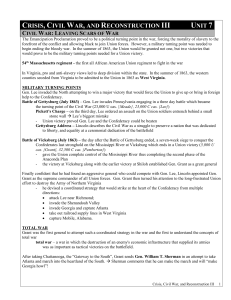
... In Virginia, pro and anti-slavery views led to deep division within the state. In the summer of 1863, the western counties seceded from Virginia to be admitted to the Union in 1863 as West Virginia. MILITARY TURNING POINTS Gen. Lee invaded the North attempting to win a major victory that would force ...
... In Virginia, pro and anti-slavery views led to deep division within the state. In the summer of 1863, the western counties seceded from Virginia to be admitted to the Union in 1863 as West Virginia. MILITARY TURNING POINTS Gen. Lee invaded the North attempting to win a major victory that would force ...

Gettysburg (cont`d)
... Why was the Battle of Gettysburg the turning point of the Civil War? The Battle of Gettysburg cost General Lee a third of his Confederate forces. For the rest of the war, Lee’s forces remained on the defensive, slowly giving ground to the advancing Union army. The Union’s victory strengthened the Re ...
... Why was the Battle of Gettysburg the turning point of the Civil War? The Battle of Gettysburg cost General Lee a third of his Confederate forces. For the rest of the war, Lee’s forces remained on the defensive, slowly giving ground to the advancing Union army. The Union’s victory strengthened the Re ...

Overview of the Civil War by Brinkley: Part 2
... Early in 1865, Sherman continued his destructive march, moving northward through South Carolina. He was virtually unopposed until he was well inside North Carolina, where a small force under Johnston could do no more than cause a brief delay. In April 1865, grants AOTP—still engaged in the prolonged ...
... Early in 1865, Sherman continued his destructive march, moving northward through South Carolina. He was virtually unopposed until he was well inside North Carolina, where a small force under Johnston could do no more than cause a brief delay. In April 1865, grants AOTP—still engaged in the prolonged ...

Chapter 21 Reading Guide
... war for emancipation, but white resentment in part of the North created political problems for Lincoln. The Union victories at Vicksburg in the West and Gettysburg in the East finally turned the military tide against the South. Southern resistance remained strong, but the Union victories at Atlanta ...
... war for emancipation, but white resentment in part of the North created political problems for Lincoln. The Union victories at Vicksburg in the West and Gettysburg in the East finally turned the military tide against the South. Southern resistance remained strong, but the Union victories at Atlanta ...

a Sample - Rainbow Resource
... Color the square blue if the battle was a Union victory. Color the square gray if the battle was a Confederate victory, or write a D in the square if the battle was a draw. Record the date of the battle in the parentheses. Write the name of the state, territory, or body of water in which the battle ...
... Color the square blue if the battle was a Union victory. Color the square gray if the battle was a Confederate victory, or write a D in the square if the battle was a draw. Record the date of the battle in the parentheses. Write the name of the state, territory, or body of water in which the battle ...

Chapter 14: The Civil War
... o Railroads made it possible for these large armies to be assembled and moved from place to place o Both the Union and Confederate armies learned to string telegraph wires along the routes of their troops B. The Opening Clashes, 1861 The Union and Confederacy fought their first major battle of the ...
... o Railroads made it possible for these large armies to be assembled and moved from place to place o Both the Union and Confederate armies learned to string telegraph wires along the routes of their troops B. The Opening Clashes, 1861 The Union and Confederacy fought their first major battle of the ...

Unit 8 - PowerPoints - The American Civil War
... The Battle of Gettysburg began as the Battle of Vicksburg was ending. Confederate General Lee forced federal troops, under General George C. Meade’s command, to lose ground as the Confederate forces attempted to take the city. Lee planned several attacks, including attacks at Peach Orchard and Devil ...
... The Battle of Gettysburg began as the Battle of Vicksburg was ending. Confederate General Lee forced federal troops, under General George C. Meade’s command, to lose ground as the Confederate forces attempted to take the city. Lee planned several attacks, including attacks at Peach Orchard and Devil ...

Ch 17 Lecture
... A. Battle of Gettysburg 1. After the Battle of Antietam, the Union lost many battles 2. Lincoln kept replacing the Union’s generals while Lee remained the southern general 3. Confederate General Lee continued moving troops to the north to fuel Northern discontent with the war and bring: a. calls for ...
... A. Battle of Gettysburg 1. After the Battle of Antietam, the Union lost many battles 2. Lincoln kept replacing the Union’s generals while Lee remained the southern general 3. Confederate General Lee continued moving troops to the north to fuel Northern discontent with the war and bring: a. calls for ...

File - Miss Lawson`s American History
... General Lee’s soldiers were tired, hungry and demoralized as well as outnumbered 6 to 1 ...
... General Lee’s soldiers were tired, hungry and demoralized as well as outnumbered 6 to 1 ...

Honors AH Civil War
... • Lee’s army tracked from Petersburg by Union troops to Appomattox Court House- April 9th , 1865 – “ There is nothing left for me to do but go and see General Grant, and I would rather die a thousand deaths…” General Robert E. Lee ...
... • Lee’s army tracked from Petersburg by Union troops to Appomattox Court House- April 9th , 1865 – “ There is nothing left for me to do but go and see General Grant, and I would rather die a thousand deaths…” General Robert E. Lee ...
Strategy of the Civil War 1863
... characterized as possessing low moral standards, because they subjected the Southern civilian population to indignities like Sherman's March to the Sea and Philip Sheridan's burning of the Shenandoah Valley in the Valley Campaigns of 1864. (Not true-ignores Confederate atrocities) Losses on the batt ...
... characterized as possessing low moral standards, because they subjected the Southern civilian population to indignities like Sherman's March to the Sea and Philip Sheridan's burning of the Shenandoah Valley in the Valley Campaigns of 1864. (Not true-ignores Confederate atrocities) Losses on the batt ...

civil war info for kids
... training and skill. General Robert E. Lee, The leader of the Confederate Army had to surrender to General Grant in 1865. Later General Grant became president of the United States twice. People remember him as a great war hero. They felt he did more as a leader of the army than what he did as preside ...
... training and skill. General Robert E. Lee, The leader of the Confederate Army had to surrender to General Grant in 1865. Later General Grant became president of the United States twice. People remember him as a great war hero. They felt he did more as a leader of the army than what he did as preside ...

Name Parent Signature ______ Civil War Study Guide Many
... Usually called the turning point of the Civil War, the Battle of Gettysburg was fought over three days in July, 1863, near the town of Gettysburg, Pennsylvania. The Confederate army tried to invade the North through Pennsylvania, but Union troops were able to push the Confederates back into Virginia ...
... Usually called the turning point of the Civil War, the Battle of Gettysburg was fought over three days in July, 1863, near the town of Gettysburg, Pennsylvania. The Confederate army tried to invade the North through Pennsylvania, but Union troops were able to push the Confederates back into Virginia ...
Civil War II - ARChapter5CivilWar
... • Early in 1862 Missouri called Arkansas back into section. • Union general, Samuel R. Curtis, pushed General Sterling Price’s Missouri Confederates out of the state into northwest Arkansas. • Curtis followed price into Arkansas . • Price joined with Arkansas’s General Ben McCulloch’s Confederate ar ...
... • Early in 1862 Missouri called Arkansas back into section. • Union general, Samuel R. Curtis, pushed General Sterling Price’s Missouri Confederates out of the state into northwest Arkansas. • Curtis followed price into Arkansas . • Price joined with Arkansas’s General Ben McCulloch’s Confederate ar ...

The Civil War
... • Copperheads were Northern democrats who were suspected of aiding the Confederate cause during the war. • Radical Republicans were a small group that favored the abolishment of slavery at the beginning of the war then advocated harsh treatment of the defeated South. ...
... • Copperheads were Northern democrats who were suspected of aiding the Confederate cause during the war. • Radical Republicans were a small group that favored the abolishment of slavery at the beginning of the war then advocated harsh treatment of the defeated South. ...


Chapter 22 Questions
... Why was Lincoln interested in attacking the Confederate force at Bull Run? (P.461) Who won the battle? (P.462) Why did victory at this battle hurt the South? (P.462) How did defeat at the first battle of Bull Run actually help the North? (P.462) What were George McClellan’s faults as an army General ...
... Why was Lincoln interested in attacking the Confederate force at Bull Run? (P.461) Who won the battle? (P.462) Why did victory at this battle hurt the South? (P.462) How did defeat at the first battle of Bull Run actually help the North? (P.462) What were George McClellan’s faults as an army General ...

CIVIL WAR Time-Line 1861-1865 - Miami Beach Senior High School
... July 11–12 Confederate forces under Jubal Early probe and fire upon the northern defenses of Washington, D.C., throwing the Capital into a state of high alert. August 5 Admiral David G. Farragut wins the Battle of Mobile Bay. (U.S.A. Victory) September 2 After forcing the Confederate army of John Be ...
... July 11–12 Confederate forces under Jubal Early probe and fire upon the northern defenses of Washington, D.C., throwing the Capital into a state of high alert. August 5 Admiral David G. Farragut wins the Battle of Mobile Bay. (U.S.A. Victory) September 2 After forcing the Confederate army of John Be ...

Chapter 15 Outline - Transforming Fire
... Slow to move, McClellan finally advanced on Richmond, moving within 7 miles of the Confederate capital. Lee moved in behind Union forces, threatening Washington, D.C. The Seven Days Battles followed, which forced McClellan to retreat. ...
... Slow to move, McClellan finally advanced on Richmond, moving within 7 miles of the Confederate capital. Lee moved in behind Union forces, threatening Washington, D.C. The Seven Days Battles followed, which forced McClellan to retreat. ...
Battle of Antietam

The Battle of Antietam /ænˈtiːtəm/, also known as the Battle of Sharpsburg, particularly in the South, fought on September 17, 1862, near Sharpsburg, Maryland, and Antietam Creek as part of the Maryland Campaign, was the first major battle in the American Civil War to take place on Union soil. It is the bloodiest single-day battle in American history, with a combined tally of dead, wounded, and missing at 22,717.After pursuing Confederate General Robert E. Lee into Maryland, Union Army Maj. Gen. George B. McClellan launched attacks against Lee's army, in defensive positions behind Antietam Creek. At dawn on September 17, Maj. Gen. Joseph Hooker's corps mounted a powerful assault on Lee's left flank. Attacks and counterattacks swept across Miller's Cornfield and fighting swirled around the Dunker Church. Union assaults against the Sunken Road eventually pierced the Confederate center, but the Federal advantage was not followed up. In the afternoon, Union Maj. Gen. Ambrose Burnside's corps entered the action, capturing a stone bridge over Antietam Creek and advancing against the Confederate right. At a crucial moment, Confederate Maj. Gen. A. P. Hill's division arrived from Harpers Ferry and launched a surprise counterattack, driving back Burnside and ending the battle. Although outnumbered two-to-one, Lee committed his entire force, while McClellan sent in less than three-quarters of his army, enabling Lee to fight the Federals to a standstill. During the night, both armies consolidated their lines. In spite of crippling casualties, Lee continued to skirmish with McClellan throughout September 18, while removing his battered army south of the Potomac River.Despite having superiority of numbers, McClellan's attacks failed to achieve force concentration, allowing Lee to counter by shifting forces and moving interior lines to meet each challenge. Despite ample reserve forces that could have been deployed to exploit localized successes, McClellan failed to destroy Lee's army. McClellan had halted Lee's invasion of Maryland, but Lee was able to withdraw his army back to Virginia without interference from the cautious McClellan. Although the battle was tactically inconclusive, the Confederate troops had withdrawn first from the battlefield, making it, in military terms, a Union victory. It had significance as enough of a victory to give President Abraham Lincoln the confidence to announce his Emancipation Proclamation, which discouraged the British and French governments from potential plans for recognition of the Confederacy.