
total war - River Dell Regional School District
... Battle of Bull Run st (1 Manassas), July, 1861 Lincoln sent 30,000 inexperienced soldiers to fight at Bull Run. ...
... Battle of Bull Run st (1 Manassas), July, 1861 Lincoln sent 30,000 inexperienced soldiers to fight at Bull Run. ...

Name______________________________ Date
... 15. Why was Vickburg such an important victory for the Union? ...
... 15. Why was Vickburg such an important victory for the Union? ...

The North`s Strategy of War
... George Meade fails to pursue Lee south into Virginia - Lincoln is furious, but the victory saves Meade from firing. The Siege of Vicksburg July 4, 1863 - General Grant breaks the siege of _________ after six weeks of stalemate - Texas, Arkansas, and Louisiana cut off from the rest of the Confede ...
... George Meade fails to pursue Lee south into Virginia - Lincoln is furious, but the victory saves Meade from firing. The Siege of Vicksburg July 4, 1863 - General Grant breaks the siege of _________ after six weeks of stalemate - Texas, Arkansas, and Louisiana cut off from the rest of the Confede ...

Military Leadership in the Civil War
... -Not real intelligent but a brave almost foolish general ready for fight at any time. -Famous for his Southern gentlemanly behavior around the ladies. -Led the famous “Pickett’s Charge” at Gettysburg and suffered the loss of over 50% of his men. *show video of leaders* ...
... -Not real intelligent but a brave almost foolish general ready for fight at any time. -Famous for his Southern gentlemanly behavior around the ladies. -Led the famous “Pickett’s Charge” at Gettysburg and suffered the loss of over 50% of his men. *show video of leaders* ...


the civil war
... he out-numbered and out-powered the confederate army One of his men found Lee’s plans wrapped around some cigars. He had the plans for the next battle at Antietam Creek ...
... he out-numbered and out-powered the confederate army One of his men found Lee’s plans wrapped around some cigars. He had the plans for the next battle at Antietam Creek ...

Teaching Resources - Jefferson Forest High School
... 6. Washington was threatened when a Confederate army under “Stonewall” Jackson marched north up the Shenandoah Valley in western Virginia; Jackson won a series of small engagements, tying down the larger Union forces. 7. General Robert E. Lee launched an attack outside Richmond and suffered heavy ca ...
... 6. Washington was threatened when a Confederate army under “Stonewall” Jackson marched north up the Shenandoah Valley in western Virginia; Jackson won a series of small engagements, tying down the larger Union forces. 7. General Robert E. Lee launched an attack outside Richmond and suffered heavy ca ...

Unit 8 - PowerPoints - The American Civil War
... The Battle of Antietam, also known as the Battle of Sharpsburg, was fought on September 16–18, 1862. It was a confrontation between Union and Confederate forces under Generals George McClellan and Robert E. Lee. Federal armies brutalized the Confederacy; the combined casualties were more than twenty ...
... The Battle of Antietam, also known as the Battle of Sharpsburg, was fought on September 16–18, 1862. It was a confrontation between Union and Confederate forces under Generals George McClellan and Robert E. Lee. Federal armies brutalized the Confederacy; the combined casualties were more than twenty ...
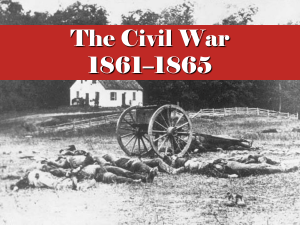
The Civil War 1861-1865
... • Attempt by Lee to invade the North • Near Sharpsburg, Maryland • McClellan tipped off to Lee’s plans when a soldier found secret orders wrapped around cigars • Single bloodiest day in American history Artillery Hell, a painting of early morning hostilities at Antietam ...
... • Attempt by Lee to invade the North • Near Sharpsburg, Maryland • McClellan tipped off to Lee’s plans when a soldier found secret orders wrapped around cigars • Single bloodiest day in American history Artillery Hell, a painting of early morning hostilities at Antietam ...

Civil War Events
... IN THE WAR. AS SLAVES HEARD ABOUT LINCOLN’S ACTION, MANY DESERTED THEIR PLANTATIONS WHEN THE UNION ARMY DREW NEAR, WHICH HURT THE SOUTHERN ECONOMY AND FORCED SOME MEN TO REMAIN AT HOME RATHER THAN FIGHT. 3. “KEPT BRITAIN OUT OF THE WAR” THE BRITISH MADE SEVERAL GESTURES TO THE CONFEDERACY, TO GET SO ...
... IN THE WAR. AS SLAVES HEARD ABOUT LINCOLN’S ACTION, MANY DESERTED THEIR PLANTATIONS WHEN THE UNION ARMY DREW NEAR, WHICH HURT THE SOUTHERN ECONOMY AND FORCED SOME MEN TO REMAIN AT HOME RATHER THAN FIGHT. 3. “KEPT BRITAIN OUT OF THE WAR” THE BRITISH MADE SEVERAL GESTURES TO THE CONFEDERACY, TO GET SO ...

Civil War Webquest - Merrillville Community School
... 3. Who did Lincoln name as General of the Union troops? 4. Lincoln’s main opponent in the 1864 election was _____, who Lincoln replaced as General of the Army of the ...
... 3. Who did Lincoln name as General of the Union troops? 4. Lincoln’s main opponent in the 1864 election was _____, who Lincoln replaced as General of the Army of the ...

The Civil War Ends
... Civilians often had to do without medicines and hospital supplies because they were needed on the battlefield. Quinine, an imported drug for fighting malaria and other fevers, could not be obtained. The shortages of all items became worse as large numbers of refugees fleeing the Union armies c ...
... Civilians often had to do without medicines and hospital supplies because they were needed on the battlefield. Quinine, an imported drug for fighting malaria and other fevers, could not be obtained. The shortages of all items became worse as large numbers of refugees fleeing the Union armies c ...

On Hallowed Ground
... important battle at Manassas, Virginia. Fighting began on August 28. During the battle, Confederate General Thomas "Stonewall" Jackson became a hero. Antietam (1862) The Confederate army launched its first invasion of the North by crossing into Maryland. The battle at Antietam Creek on September 17 ...
... important battle at Manassas, Virginia. Fighting began on August 28. During the battle, Confederate General Thomas "Stonewall" Jackson became a hero. Antietam (1862) The Confederate army launched its first invasion of the North by crossing into Maryland. The battle at Antietam Creek on September 17 ...

candidate
... the 2nd day and “Pickett’s Charge” on the 3rd day of the battle. – 51,000 casualties. Lee losses in his 2nd attempt to invade the North. Confederate army retreats back to Virginia. – Lee offers his resignation, Davis refuses it. – GETTYSBURG ADDRESS (NOV. 1863) – Lincoln outlines reasons for the war ...
... the 2nd day and “Pickett’s Charge” on the 3rd day of the battle. – 51,000 casualties. Lee losses in his 2nd attempt to invade the North. Confederate army retreats back to Virginia. – Lee offers his resignation, Davis refuses it. – GETTYSBURG ADDRESS (NOV. 1863) – Lincoln outlines reasons for the war ...

The Furnace of Civil War, 1861-1865
... A decisive victory for the Confederates in which Robert E. Lee took command After a series of attacks on General McClellan’s army, Lincoln ordered McClellan to retreat back to D.C. ...
... A decisive victory for the Confederates in which Robert E. Lee took command After a series of attacks on General McClellan’s army, Lincoln ordered McClellan to retreat back to D.C. ...

Ch 5 Lesson 2
... hampering its ability to move troops, supplies, and trade goods on the Mississippi River ...
... hampering its ability to move troops, supplies, and trade goods on the Mississippi River ...

QUIZ C: chapter 16, The Civil War Begins
... 7. _____ Why was the loss of New Orleans in April, 1862 (effect) such a devastating defeat for the Confederacy/South? a. complicated shipping and trading on the Mississippi c. most of the South's cotton was grown there b. most of the South's supplies were stored there d. New Orleans was the southern ...
... 7. _____ Why was the loss of New Orleans in April, 1862 (effect) such a devastating defeat for the Confederacy/South? a. complicated shipping and trading on the Mississippi c. most of the South's cotton was grown there b. most of the South's supplies were stored there d. New Orleans was the southern ...

Major Battles Begin - CEC American History
... As McCellan waited to attack Richmond – Lincoln turned Gen. Pope, who was forming a new Union army near D.C. July – Pope moved into northern VA with 50,000 troops. Lincoln ordered McCellan to attack to trap Lee’s forces between the two Union armies. McCellan once again, waited – Lincoln then orded h ...
... As McCellan waited to attack Richmond – Lincoln turned Gen. Pope, who was forming a new Union army near D.C. July – Pope moved into northern VA with 50,000 troops. Lincoln ordered McCellan to attack to trap Lee’s forces between the two Union armies. McCellan once again, waited – Lincoln then orded h ...

Fall Ozark Campaign of 1862
... Sarcoxie Road. A third brigade of Missouri militia—Missouri State Militia (MSM) and Enrolled Missouri Militia (EMM)—was located at Mt. Vernon, a small town northeast of Newtonia. Rather than march directly to Newtonia, the militia brigade under Col. George Hall was directed to take a much longer rou ...
... Sarcoxie Road. A third brigade of Missouri militia—Missouri State Militia (MSM) and Enrolled Missouri Militia (EMM)—was located at Mt. Vernon, a small town northeast of Newtonia. Rather than march directly to Newtonia, the militia brigade under Col. George Hall was directed to take a much longer rou ...
HERE
... the Seddon House, and some Generals believe he would have succeeded. In addition, William Averell was to be sent around Lee's left on a daring raid south which would end with himself and 1,000 hand picked men from 9 Regiments on the Virginia Peninsula. Unfortunately two Generals in Franklin's Grand ...
... the Seddon House, and some Generals believe he would have succeeded. In addition, William Averell was to be sent around Lee's left on a daring raid south which would end with himself and 1,000 hand picked men from 9 Regiments on the Virginia Peninsula. Unfortunately two Generals in Franklin's Grand ...

Gettysburg - Whitman Middle School
... Gettysburg, Battle of, a large battle in the American Civil War (1861-1865), took place in southern Pennsylvania from July 1 to July 3, 1863. The battle is named after the town on the battlefield. Union General George G. Meade led an army of about 90,000 men to victory against General Robert E. Lee' ...
... Gettysburg, Battle of, a large battle in the American Civil War (1861-1865), took place in southern Pennsylvania from July 1 to July 3, 1863. The battle is named after the town on the battlefield. Union General George G. Meade led an army of about 90,000 men to victory against General Robert E. Lee' ...

Ch 14 Outline Notes - Huber Heights City Schools
... - At this critical juncture of the war, General Grant mounted a major offensive in the West designed to split the Confederacy in two. - In this attack, he captured Vicksburg, in Mississippi, where he defeated two Confederate armies and laid siege to the city for six weeks until the Confederates surr ...
... - At this critical juncture of the war, General Grant mounted a major offensive in the West designed to split the Confederacy in two. - In this attack, he captured Vicksburg, in Mississippi, where he defeated two Confederate armies and laid siege to the city for six weeks until the Confederates surr ...

Bill`s notes: August 21, 1864 Capt. Jed Hotchkiss , the topographical
... On August 21, 1864, a large Union force had been bivouacked along a road about where Tuscawilla Drive (was Ridge Dr. prior to 2007) is today. The troops extended from about a quarter mile North of 51 to Summit Point road. The Confederate forces – two or three divisions – were just west of Harewood. ...
... On August 21, 1864, a large Union force had been bivouacked along a road about where Tuscawilla Drive (was Ridge Dr. prior to 2007) is today. The troops extended from about a quarter mile North of 51 to Summit Point road. The Confederate forces – two or three divisions – were just west of Harewood. ...

Civil War Notes
... South • Both Lincoln and Davis faced opposition to the war effort • The week after Ft. Sumter, Lincoln suspended the writ of habeas corpus in ...
... South • Both Lincoln and Davis faced opposition to the war effort • The week after Ft. Sumter, Lincoln suspended the writ of habeas corpus in ...

Battle of Antietam

The Battle of Antietam /ænˈtiːtəm/, also known as the Battle of Sharpsburg, particularly in the South, fought on September 17, 1862, near Sharpsburg, Maryland, and Antietam Creek as part of the Maryland Campaign, was the first major battle in the American Civil War to take place on Union soil. It is the bloodiest single-day battle in American history, with a combined tally of dead, wounded, and missing at 22,717.After pursuing Confederate General Robert E. Lee into Maryland, Union Army Maj. Gen. George B. McClellan launched attacks against Lee's army, in defensive positions behind Antietam Creek. At dawn on September 17, Maj. Gen. Joseph Hooker's corps mounted a powerful assault on Lee's left flank. Attacks and counterattacks swept across Miller's Cornfield and fighting swirled around the Dunker Church. Union assaults against the Sunken Road eventually pierced the Confederate center, but the Federal advantage was not followed up. In the afternoon, Union Maj. Gen. Ambrose Burnside's corps entered the action, capturing a stone bridge over Antietam Creek and advancing against the Confederate right. At a crucial moment, Confederate Maj. Gen. A. P. Hill's division arrived from Harpers Ferry and launched a surprise counterattack, driving back Burnside and ending the battle. Although outnumbered two-to-one, Lee committed his entire force, while McClellan sent in less than three-quarters of his army, enabling Lee to fight the Federals to a standstill. During the night, both armies consolidated their lines. In spite of crippling casualties, Lee continued to skirmish with McClellan throughout September 18, while removing his battered army south of the Potomac River.Despite having superiority of numbers, McClellan's attacks failed to achieve force concentration, allowing Lee to counter by shifting forces and moving interior lines to meet each challenge. Despite ample reserve forces that could have been deployed to exploit localized successes, McClellan failed to destroy Lee's army. McClellan had halted Lee's invasion of Maryland, but Lee was able to withdraw his army back to Virginia without interference from the cautious McClellan. Although the battle was tactically inconclusive, the Confederate troops had withdrawn first from the battlefield, making it, in military terms, a Union victory. It had significance as enough of a victory to give President Abraham Lincoln the confidence to announce his Emancipation Proclamation, which discouraged the British and French governments from potential plans for recognition of the Confederacy.