


- Hesston Middle School
... • Disagreements over the conduct of the war also arose in the North. Lincoln's main opponents were the Copperheads, Northern Democrats who favored peace with the South. (A copperhead is a poisonous snake that strikes without warning.) Lincoln had protesters arrested. He also suspended the writ of h ...
... • Disagreements over the conduct of the war also arose in the North. Lincoln's main opponents were the Copperheads, Northern Democrats who favored peace with the South. (A copperhead is a poisonous snake that strikes without warning.) Lincoln had protesters arrested. He also suspended the writ of h ...

17-2 War Affects Society
... Disagreements over the conduct of the war also arose in the North. Lincoln's main opponents were the Copperheads, Northern Democrats who favored peace with the South. (A copperhead is a poisonous snake that strikes without warning.) Lincoln had protesters arrested. He also suspended the writ of h ...
... Disagreements over the conduct of the war also arose in the North. Lincoln's main opponents were the Copperheads, Northern Democrats who favored peace with the South. (A copperhead is a poisonous snake that strikes without warning.) Lincoln had protesters arrested. He also suspended the writ of h ...

Lecture 16, The Civil War
... In May 1863 in the East, Robert E. Lee beat back an army twice his size at Chancellorsville. Losses were high on both sides with Lee losing 20 percent of his army. ...
... In May 1863 in the East, Robert E. Lee beat back an army twice his size at Chancellorsville. Losses were high on both sides with Lee losing 20 percent of his army. ...

Part One - Cloudfront.net
... In May 1863 in the East, Robert E. Lee beat back an army twice his size at Chancellorsville. Losses were high on both sides with Lee losing 20 percent of his army. ...
... In May 1863 in the East, Robert E. Lee beat back an army twice his size at Chancellorsville. Losses were high on both sides with Lee losing 20 percent of his army. ...


Gettysburg: A Turning Point (HA)
... Union and Confederate troops met on July 1, 1863, west of Gettysburg, Pennsylvania. The Union troops, about 90,000 strong, were led by newly appointed General George C. Meade. After a brief skirmish, they occupied four miles of high ground along an area known as Cemetery Ridge. About a mile to the ...
... Union and Confederate troops met on July 1, 1863, west of Gettysburg, Pennsylvania. The Union troops, about 90,000 strong, were led by newly appointed General George C. Meade. After a brief skirmish, they occupied four miles of high ground along an area known as Cemetery Ridge. About a mile to the ...

The Civil War Chapter 15.1
... • Ulysses S. Grant was commander of Union forces in West Bold and restless, he wanted to attack. • Western campaign focused on taking control of Mississippi River Would cut eastern part of Confederacy off from food sources in West Union could use bases on Mississippi to attack communication an ...
... • Ulysses S. Grant was commander of Union forces in West Bold and restless, he wanted to attack. • Western campaign focused on taking control of Mississippi River Would cut eastern part of Confederacy off from food sources in West Union could use bases on Mississippi to attack communication an ...

Early Years of the War - Washougal School District
... After the Union’s defeat at Bull Run, Lincoln removed McDowell and put General George McClellan in command. The general was a good organizer, but he was very cautious. For seven months, he trained his army but did not attack. “If General McClellan does not want to use the army,” a frustrated Lincoln ...
... After the Union’s defeat at Bull Run, Lincoln removed McDowell and put General George McClellan in command. The general was a good organizer, but he was very cautious. For seven months, he trained his army but did not attack. “If General McClellan does not want to use the army,” a frustrated Lincoln ...

Ch 14 The United States Civil War
... Southern communications and forcing Confederates out of Kentucky and part of Tennessee Victories for the North ...
... Southern communications and forcing Confederates out of Kentucky and part of Tennessee Victories for the North ...

CHAPTER 4: THE UNION IN PERIL
... the unconditional surrender of General Simon Bolivar Buckner at Fort Donelson. He had many successful battles, including the capture of Vicksburg, Mississippi, in 1863. After that, Lincoln put him in command of all the Union armies. Grant focused on dividing and destroying the Confederate armies. In ...
... the unconditional surrender of General Simon Bolivar Buckner at Fort Donelson. He had many successful battles, including the capture of Vicksburg, Mississippi, in 1863. After that, Lincoln put him in command of all the Union armies. Grant focused on dividing and destroying the Confederate armies. In ...

Week 4 - Vanderbilt University
... opened fire on the federal garrison at Fort Sumter to force them to lower the American flag Fighting begins in 1861, but really gets nasty in 1862 ...
... opened fire on the federal garrison at Fort Sumter to force them to lower the American flag Fighting begins in 1861, but really gets nasty in 1862 ...

Document
... Emancipation Proclamation:(define) Give 2 reasons why Lincoln found Emancipation to be a difficult issue: ...
... Emancipation Proclamation:(define) Give 2 reasons why Lincoln found Emancipation to be a difficult issue: ...

THE AMERICAN CIVIL WAR
... The First Battle of Bull Run • The first major battle of the Civil War ended in a victory for the Confederacy. – A turning point in attitudes: this war may not be as short as they thought. ...
... The First Battle of Bull Run • The first major battle of the Civil War ended in a victory for the Confederacy. – A turning point in attitudes: this war may not be as short as they thought. ...

- Franklin High School
... forcing his battered army to retreat into Virginia Major Civil War Battles, 1861-1862 ...
... forcing his battered army to retreat into Virginia Major Civil War Battles, 1861-1862 ...

Question 1
... c. Correct answer. Lincoln understood the Emancipation Proclamation to be a symbolic statement of justice. Through this document, Lincoln strengthened the moral cause of the Union. d. The Emancipation did not permanently end slavery. This was legally achieved by action of the individual states and b ...
... c. Correct answer. Lincoln understood the Emancipation Proclamation to be a symbolic statement of justice. Through this document, Lincoln strengthened the moral cause of the Union. d. The Emancipation did not permanently end slavery. This was legally achieved by action of the individual states and b ...

Battles People Hodge Podge The CSA Generals
... The name of the plan to blockade Southern ports, cutting off the Confederacy from the rest of the world. ...
... The name of the plan to blockade Southern ports, cutting off the Confederacy from the rest of the world. ...

SSUSH9 The student will identify key events, issues, and individuals
... Key Battles of the Civil War Union and Confederate forces fought many battles in the Civil War’s four years. Land battles were fought mostly in states west of the Mississippi River; sea battles were fought along the Atlantic Coast and in the Gulf of Mexico; and river battles were fought on the Missi ...
... Key Battles of the Civil War Union and Confederate forces fought many battles in the Civil War’s four years. Land battles were fought mostly in states west of the Mississippi River; sea battles were fought along the Atlantic Coast and in the Gulf of Mexico; and river battles were fought on the Missi ...
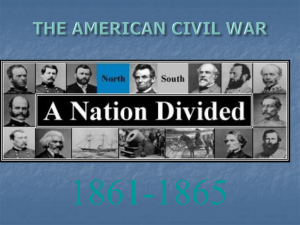
THE AMERICAN CIVIL WAR
... The Union decided to move against Richmond McClellan displayed weakness that would end his career McClellan delayed the attack and pushed too slow; he was in position to strike several times but surrendered the initiative Lee launched several surprise attacks and wins McClellan is replaced and the c ...
... The Union decided to move against Richmond McClellan displayed weakness that would end his career McClellan delayed the attack and pushed too slow; he was in position to strike several times but surrendered the initiative Lee launched several surprise attacks and wins McClellan is replaced and the c ...

The Civil War (1861-1865) -The Civil War lasted for four years. It was
... -The Civil War lasted for four years. It was the bloodiest Battle in American History. This war was the only war fought on American soil, by Americans. This war was a struggle for freedom trying to end slavery. -Ft. Sumter: It began in Wilmer McClain front yard. McClain was a peaceful farmer and his ...
... -The Civil War lasted for four years. It was the bloodiest Battle in American History. This war was the only war fought on American soil, by Americans. This war was a struggle for freedom trying to end slavery. -Ft. Sumter: It began in Wilmer McClain front yard. McClain was a peaceful farmer and his ...

Civil War Booklet
... objective was to combat preventable diseases and infections by improving conditions in army camps and hospitals. It also worked to provide relief to sick and wounded soldiers. By war’s end, the Sanitary Commission had provided almost $15 million in supplies—the vast majority of which had been collec ...
... objective was to combat preventable diseases and infections by improving conditions in army camps and hospitals. It also worked to provide relief to sick and wounded soldiers. By war’s end, the Sanitary Commission had provided almost $15 million in supplies—the vast majority of which had been collec ...

Kaden/Craig: Instructional PowerPoint: 1st Half CW
... What Occurred During the Battle? The battle took place from September 16-18, 1862. The Union had twice the amount of soldiers than the opponents in this battle. (87,000 to 45,000) After the Second battle of Bull Run, the Confederate army had made it into Union territory for the first time. The ...
... What Occurred During the Battle? The battle took place from September 16-18, 1862. The Union had twice the amount of soldiers than the opponents in this battle. (87,000 to 45,000) After the Second battle of Bull Run, the Confederate army had made it into Union territory for the first time. The ...

File - Ms. Albu`s Class Site
... shifted the tide of momentum in the Union’s favor. The change of events forced England and France to cancel major contracts to supply weapons and ships to the South. March to the Sea, Georgia: By the summer of 1864, the North had General Lee on the ropes several times but they could never deliver th ...
... shifted the tide of momentum in the Union’s favor. The change of events forced England and France to cancel major contracts to supply weapons and ships to the South. March to the Sea, Georgia: By the summer of 1864, the North had General Lee on the ropes several times but they could never deliver th ...

Crisis at Fort Sumter
... Union morale was low after defeats in Virginia and the Confederates determined to attack on Union soil, hoping to gain an early peace. Battle of Antietam – McClellan caught up with Lee’s troops at Sharpsburg, Md. – A savage single day of fighting left 23,000 dead. – Lincoln’s order to “destroy the r ...
... Union morale was low after defeats in Virginia and the Confederates determined to attack on Union soil, hoping to gain an early peace. Battle of Antietam – McClellan caught up with Lee’s troops at Sharpsburg, Md. – A savage single day of fighting left 23,000 dead. – Lincoln’s order to “destroy the r ...
Battle of Antietam

The Battle of Antietam /ænˈtiːtəm/, also known as the Battle of Sharpsburg, particularly in the South, fought on September 17, 1862, near Sharpsburg, Maryland, and Antietam Creek as part of the Maryland Campaign, was the first major battle in the American Civil War to take place on Union soil. It is the bloodiest single-day battle in American history, with a combined tally of dead, wounded, and missing at 22,717.After pursuing Confederate General Robert E. Lee into Maryland, Union Army Maj. Gen. George B. McClellan launched attacks against Lee's army, in defensive positions behind Antietam Creek. At dawn on September 17, Maj. Gen. Joseph Hooker's corps mounted a powerful assault on Lee's left flank. Attacks and counterattacks swept across Miller's Cornfield and fighting swirled around the Dunker Church. Union assaults against the Sunken Road eventually pierced the Confederate center, but the Federal advantage was not followed up. In the afternoon, Union Maj. Gen. Ambrose Burnside's corps entered the action, capturing a stone bridge over Antietam Creek and advancing against the Confederate right. At a crucial moment, Confederate Maj. Gen. A. P. Hill's division arrived from Harpers Ferry and launched a surprise counterattack, driving back Burnside and ending the battle. Although outnumbered two-to-one, Lee committed his entire force, while McClellan sent in less than three-quarters of his army, enabling Lee to fight the Federals to a standstill. During the night, both armies consolidated their lines. In spite of crippling casualties, Lee continued to skirmish with McClellan throughout September 18, while removing his battered army south of the Potomac River.Despite having superiority of numbers, McClellan's attacks failed to achieve force concentration, allowing Lee to counter by shifting forces and moving interior lines to meet each challenge. Despite ample reserve forces that could have been deployed to exploit localized successes, McClellan failed to destroy Lee's army. McClellan had halted Lee's invasion of Maryland, but Lee was able to withdraw his army back to Virginia without interference from the cautious McClellan. Although the battle was tactically inconclusive, the Confederate troops had withdrawn first from the battlefield, making it, in military terms, a Union victory. It had significance as enough of a victory to give President Abraham Lincoln the confidence to announce his Emancipation Proclamation, which discouraged the British and French governments from potential plans for recognition of the Confederacy.