
PowerPoint Civil War Review
... The Battle of Antietam, also known as the Battle of Sharpsburg, was fought on September 16–18, 1862. It was a confrontation between Union and Confederate forces under Generals George McClellan and Robert E. Lee. Federal armies brutalized the Confederacy; the combined casualties were more than twenty ...
... The Battle of Antietam, also known as the Battle of Sharpsburg, was fought on September 16–18, 1862. It was a confrontation between Union and Confederate forces under Generals George McClellan and Robert E. Lee. Federal armies brutalized the Confederacy; the combined casualties were more than twenty ...

9 -1 Guided Reading Activity 9-1
... DIRECTIONS: Using Headings and Subheadings Locate each heading below in your textbook. Then use the information under the correct subheading to help you write each answer. I. The Wartime Economies A. What led to the severe food shortages in the South in the winter of 1862? B. What was the result of ...
... DIRECTIONS: Using Headings and Subheadings Locate each heading below in your textbook. Then use the information under the correct subheading to help you write each answer. I. The Wartime Economies A. What led to the severe food shortages in the South in the winter of 1862? B. What was the result of ...
Civil War - Outline #4 – Chapters 16-17
... festive, many brought picnic baskets of food and drink Disappointed that the Southerners did not turn and run ...
... festive, many brought picnic baskets of food and drink Disappointed that the Southerners did not turn and run ...

JB APUSH Unit VB
... acting solely within the limits of any State, may be impeached by a vote of two-thirds of both branches of the Legislature thereof. ...
... acting solely within the limits of any State, may be impeached by a vote of two-thirds of both branches of the Legislature thereof. ...

Civil War
... them from the sides. If we do this their troops in the middle will not be any use to them. We can split into two groups and attack from both sides. Narrator- An entire day goes by and the Union army holds their ground on top of the ridge. General Lee grows impatient and orders George E. Pickett to l ...
... them from the sides. If we do this their troops in the middle will not be any use to them. We can split into two groups and attack from both sides. Narrator- An entire day goes by and the Union army holds their ground on top of the ridge. General Lee grows impatient and orders George E. Pickett to l ...
Ch. 15 The Civil War
... Description: On September 16, Maj. Gen. George B. McClellan confronted Lee’s Army of Northern Virginia at Sharpsburg, Maryland. At dawn September 17, Hooker’s corps mounted a powerful assault on Lee’s left flank that began the. Attacks and counterattacks swept across Miller’s cornfield and fighting ...
... Description: On September 16, Maj. Gen. George B. McClellan confronted Lee’s Army of Northern Virginia at Sharpsburg, Maryland. At dawn September 17, Hooker’s corps mounted a powerful assault on Lee’s left flank that began the. Attacks and counterattacks swept across Miller’s cornfield and fighting ...

Name: Date: Period: Unit 6: (Chapter 15-Sections 2-3)
... 33. Texas General _______________________________________________ killed in battle. 1) Considered one of the South’s BEST Generals 2) His death was a severe blow to Confederate forces 3) He fought at the battle of San Jacinto during the Texas Revolution. 34. Showed Americans that this would be a ___ ...
... 33. Texas General _______________________________________________ killed in battle. 1) Considered one of the South’s BEST Generals 2) His death was a severe blow to Confederate forces 3) He fought at the battle of San Jacinto during the Texas Revolution. 34. Showed Americans that this would be a ___ ...
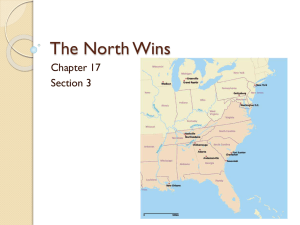

Chapter 11 Section 3 Notes
... For the second time, Lee had lost more than a third of his army. The next day, July 4, the Confederates began their retreat back to Virginia. This would be the last chance for the South to win the war and threaten the North. ...
... For the second time, Lee had lost more than a third of his army. The next day, July 4, the Confederates began their retreat back to Virginia. This would be the last chance for the South to win the war and threaten the North. ...
Ch 20/21 - cloudfront.net
... Gettysburg and Vicksburg- two battles that allow the North to win the CW • Vicksburg- N. controls Miss. River, splits S. in half – Grant- becomes the Gen. Lincoln needs to win the war ...
... Gettysburg and Vicksburg- two battles that allow the North to win the CW • Vicksburg- N. controls Miss. River, splits S. in half – Grant- becomes the Gen. Lincoln needs to win the war ...
Nuts and Bolts of the Civil War Relations with Foreign Nations
... a. Capt. Wilkes of the USS San Jacinto stopped the British mail steamer – the Trent b. He seized 2 Confederate Agents – Slidell and Mason c. The US people and press cheered, but England was angry – they wanted an apology and reparations d. The agents had been on their way to England and France e. Th ...
... a. Capt. Wilkes of the USS San Jacinto stopped the British mail steamer – the Trent b. He seized 2 Confederate Agents – Slidell and Mason c. The US people and press cheered, but England was angry – they wanted an apology and reparations d. The agents had been on their way to England and France e. Th ...

Chapter 14 - Prong Software
... ▪ 200,000 black men fought in Union army and navy ▪ Democrats objected, claiming lead to equality of races, but that was the point ▪ Slaves eagerly joined—rest of families often escaped to displaced persons’ camps, and despite bad treatment, stayed out of slavery ▪ Some discrimination in pay and wor ...
... ▪ 200,000 black men fought in Union army and navy ▪ Democrats objected, claiming lead to equality of races, but that was the point ▪ Slaves eagerly joined—rest of families often escaped to displaced persons’ camps, and despite bad treatment, stayed out of slavery ▪ Some discrimination in pay and wor ...

July 1-July 4, 1863.
... Now we are engaged in a great civil war, testing whether that nation, or any nation so conceived and so dedicated, can long endure. We are met on a great battlefield of that war. We have come to dedicate a portion of that field, as a final resting place for those who here gave their lives that that ...
... Now we are engaged in a great civil war, testing whether that nation, or any nation so conceived and so dedicated, can long endure. We are met on a great battlefield of that war. We have come to dedicate a portion of that field, as a final resting place for those who here gave their lives that that ...

Jackson and Lee Strike Back (Ch. 15)
... • Sends a dispatch to Secretary of War Stanton revealing his feelings of the battle • “ I have lost this battle because my force was too small…the government must not and cannot hold me responsible for the results… I have seen too many dead and wounded comrades to feel otherwise than that this gover ...
... • Sends a dispatch to Secretary of War Stanton revealing his feelings of the battle • “ I have lost this battle because my force was too small…the government must not and cannot hold me responsible for the results… I have seen too many dead and wounded comrades to feel otherwise than that this gover ...

July-Aug 2016 - American Civil War Roundtable of Australia
... Major General Joseph J Bartlett It was recognised that this answer is likely to be akin to blasphemy by the many diehard Chamberlain fans. Furthermore, the fact that Chamberlain’s claim of commanding the Union forces at the surrender ceremony has widespread currency (even James M McPherson repeats t ...
... Major General Joseph J Bartlett It was recognised that this answer is likely to be akin to blasphemy by the many diehard Chamberlain fans. Furthermore, the fact that Chamberlain’s claim of commanding the Union forces at the surrender ceremony has widespread currency (even James M McPherson repeats t ...

150 years later - Civil War Traveler
... 21 when two inexperienced armies clashed 20 miles west of Washington. The First Battle of Manassas (Bull Run) certainly was big by 1861 standards. More than 800 men were killed out of nearly 4,500 casualties suffered. The bloodshed during this stunning Confederate victory shocked the Union and woke ...
... 21 when two inexperienced armies clashed 20 miles west of Washington. The First Battle of Manassas (Bull Run) certainly was big by 1861 standards. More than 800 men were killed out of nearly 4,500 casualties suffered. The bloodshed during this stunning Confederate victory shocked the Union and woke ...

History Review Sheet Chapter 7~9
... attack him at Bull Run. He was angry about being attacked, so he decided to fight with Jackson. At the same time, Lee brought his men over and attacked from the other side The South again defeated the North at Bull Run. Lincoln put McClellan back in charge Antietam Lee had essentially pushed the ...
... attack him at Bull Run. He was angry about being attacked, so he decided to fight with Jackson. At the same time, Lee brought his men over and attacked from the other side The South again defeated the North at Bull Run. Lincoln put McClellan back in charge Antietam Lee had essentially pushed the ...
The Civil War
... July, 1861: Union loses the first major battle of the war, The Battle of Bull Run/Manassas. Lincoln hires George McClellan to head the Army of the Potomac (Union army in East). June, 1862: McClellan’s troops are forced to retreat after an unsuccessful attempt to take Richmond. September, 1862: Davis ...
... July, 1861: Union loses the first major battle of the war, The Battle of Bull Run/Manassas. Lincoln hires George McClellan to head the Army of the Potomac (Union army in East). June, 1862: McClellan’s troops are forced to retreat after an unsuccessful attempt to take Richmond. September, 1862: Davis ...

Civil War - West Point High School
... army into Maryland? • To get the war out of Virginia so farmers could grow and produce food. • To win a victory on northern soil and obtain recognition from Britain and France and hopefully force an end to the war. ...
... army into Maryland? • To get the war out of Virginia so farmers could grow and produce food. • To win a victory on northern soil and obtain recognition from Britain and France and hopefully force an end to the war. ...

Chapter 11 Notes - Garrard County Schools
... 2 Battle of Bull Run • Overly cautious McClellan waited outside Richmond. • Lincoln turned to John _______________ with his 50,000 troops in northern Virginia. • _______________________________ lured Pope into battle and defeated him. • Lincoln put McClellan back in command, telling his cabinet memb ...
... 2 Battle of Bull Run • Overly cautious McClellan waited outside Richmond. • Lincoln turned to John _______________ with his 50,000 troops in northern Virginia. • _______________________________ lured Pope into battle and defeated him. • Lincoln put McClellan back in command, telling his cabinet memb ...

Chapter 16 Civil War Study Guide
... What were the Border States and know who they were loyal too and why? What were the major strategies of the Union and Confederate armies? What side did the Native Americans support? Why? What were the major difficulties that the Union had to over come? What were the major difficulties that the Confe ...
... What were the Border States and know who they were loyal too and why? What were the major strategies of the Union and Confederate armies? What side did the Native Americans support? Why? What were the major difficulties that the Union had to over come? What were the major difficulties that the Confe ...

Ch 13 The Civil War
... “It is … for us to be here dedicated to the great task remaining before us … that we here highly resolve that these dead shall not have died in vain --- that this nation, under God, shall have a new birth of freedom --- and that government of the people, by the people, for the people, shall not peri ...
... “It is … for us to be here dedicated to the great task remaining before us … that we here highly resolve that these dead shall not have died in vain --- that this nation, under God, shall have a new birth of freedom --- and that government of the people, by the people, for the people, shall not peri ...
Battle of Antietam

The Battle of Antietam /ænˈtiːtəm/, also known as the Battle of Sharpsburg, particularly in the South, fought on September 17, 1862, near Sharpsburg, Maryland, and Antietam Creek as part of the Maryland Campaign, was the first major battle in the American Civil War to take place on Union soil. It is the bloodiest single-day battle in American history, with a combined tally of dead, wounded, and missing at 22,717.After pursuing Confederate General Robert E. Lee into Maryland, Union Army Maj. Gen. George B. McClellan launched attacks against Lee's army, in defensive positions behind Antietam Creek. At dawn on September 17, Maj. Gen. Joseph Hooker's corps mounted a powerful assault on Lee's left flank. Attacks and counterattacks swept across Miller's Cornfield and fighting swirled around the Dunker Church. Union assaults against the Sunken Road eventually pierced the Confederate center, but the Federal advantage was not followed up. In the afternoon, Union Maj. Gen. Ambrose Burnside's corps entered the action, capturing a stone bridge over Antietam Creek and advancing against the Confederate right. At a crucial moment, Confederate Maj. Gen. A. P. Hill's division arrived from Harpers Ferry and launched a surprise counterattack, driving back Burnside and ending the battle. Although outnumbered two-to-one, Lee committed his entire force, while McClellan sent in less than three-quarters of his army, enabling Lee to fight the Federals to a standstill. During the night, both armies consolidated their lines. In spite of crippling casualties, Lee continued to skirmish with McClellan throughout September 18, while removing his battered army south of the Potomac River.Despite having superiority of numbers, McClellan's attacks failed to achieve force concentration, allowing Lee to counter by shifting forces and moving interior lines to meet each challenge. Despite ample reserve forces that could have been deployed to exploit localized successes, McClellan failed to destroy Lee's army. McClellan had halted Lee's invasion of Maryland, but Lee was able to withdraw his army back to Virginia without interference from the cautious McClellan. Although the battle was tactically inconclusive, the Confederate troops had withdrawn first from the battlefield, making it, in military terms, a Union victory. It had significance as enough of a victory to give President Abraham Lincoln the confidence to announce his Emancipation Proclamation, which discouraged the British and French governments from potential plans for recognition of the Confederacy.