
EGE Exn oF TrrE Crun, Wrn
... to Virginia. Lincoln sent a message to General Meade ordering him to attack Lee's army before it crossed the Potomac River into Virginia. Like General McClellan, Meade waited too many days to attack. Lee's army escaped back into Virginia. Lee had lost more soldiers than the South's small population ...
... to Virginia. Lincoln sent a message to General Meade ordering him to attack Lee's army before it crossed the Potomac River into Virginia. Like General McClellan, Meade waited too many days to attack. Lee's army escaped back into Virginia. Lee had lost more soldiers than the South's small population ...

Battle of Appomattox Court House
... could be defended, if needful, by the suggestion that such a salute was not to the cause for which the flag of the Confederacy stood, but to its going down before the flag of the Union. My main reason, however, was one for which I sought no authority nor asked forgiveness. Before us in proud humilia ...
... could be defended, if needful, by the suggestion that such a salute was not to the cause for which the flag of the Confederacy stood, but to its going down before the flag of the Union. My main reason, however, was one for which I sought no authority nor asked forgiveness. Before us in proud humilia ...
What do these events mean
... replacing the first capital at Montgomery Alabama. 2. The reason for the move: to get and maintain support of Virginia throughout the war. 3. Another vital reason: to Richmond was only 105 miles from Washington and thus closer to seize it and end the war. 4. Between the two capitals, many bloody bat ...
... replacing the first capital at Montgomery Alabama. 2. The reason for the move: to get and maintain support of Virginia throughout the war. 3. Another vital reason: to Richmond was only 105 miles from Washington and thus closer to seize it and end the war. 4. Between the two capitals, many bloody bat ...

Civil War Study Guide – Part II This test will cover:
... _B___ I was president of the Confederate States of America. _C___I was the leader of the Army of Northern Virginia. _F___I was a former slave who escaped to the North _H___I was a slave who became a Civil War hero. _D___I became the leading Union general in 1863. _C___I surrendered at Appomattox Cou ...
... _B___ I was president of the Confederate States of America. _C___I was the leader of the Army of Northern Virginia. _F___I was a former slave who escaped to the North _H___I was a slave who became a Civil War hero. _D___I became the leading Union general in 1863. _C___I surrendered at Appomattox Cou ...

Focus Questions
... 13. What made Lincoln a great president? Was it primarily his political leadership or his personal qualities and character? ...
... 13. What made Lincoln a great president? Was it primarily his political leadership or his personal qualities and character? ...

File
... 11. What was the Merrimack (later named Virginia)? Who did it fight on March 9, 1862? Why was this battle important in the history of naval battles? (p. 459) 12. Who did Lee defeat at the Second Battle of Bull Run? Where did Lee attack after he won at the Second Battle of Bull Run? Why? (p. 459) 13 ...
... 11. What was the Merrimack (later named Virginia)? Who did it fight on March 9, 1862? Why was this battle important in the history of naval battles? (p. 459) 12. Who did Lee defeat at the Second Battle of Bull Run? Where did Lee attack after he won at the Second Battle of Bull Run? Why? (p. 459) 13 ...

people.ucls.uchicago.edu
... ● General Robert E. Lee surrendered to the Union. ● Lee had surrendered because of the battle of the previous day that exhausted his army ● Although the South had not fully surrendered Lee was the South’s best commander and commanded the largest army. ● Lee signed a Document that said that his soldi ...
... ● General Robert E. Lee surrendered to the Union. ● Lee had surrendered because of the battle of the previous day that exhausted his army ● Although the South had not fully surrendered Lee was the South’s best commander and commanded the largest army. ● Lee signed a Document that said that his soldi ...

Chapter Fourteen: The Civil War
... against us. And the job on our hands is too large for us. We would as well consent to separation at once, including surrender of this capital.” ...
... against us. And the job on our hands is too large for us. We would as well consent to separation at once, including surrender of this capital.” ...
Chapter 11 – The Civil War 1861-1865
... – Northerners were upset at how many casualties they were taking. When Lincoln told Grant that, Grant replied that he would like to continue the course of action if it takes all summer. Grant moved his army further South. (think how happy Lincoln must have been!) – Early June, Battle of Cold Harbor, ...
... – Northerners were upset at how many casualties they were taking. When Lincoln told Grant that, Grant replied that he would like to continue the course of action if it takes all summer. Grant moved his army further South. (think how happy Lincoln must have been!) – Early June, Battle of Cold Harbor, ...
Civil War Battles
... Significance: Union troops sent back to Washington in retreat; Lincoln forced to put McClellan back into command (“If he can’t fight himself, he excels in making others ready to fight”); the Confederacy was able to protect supply lines through the Shenandoah Valley to Richmond; final encouragement f ...
... Significance: Union troops sent back to Washington in retreat; Lincoln forced to put McClellan back into command (“If he can’t fight himself, he excels in making others ready to fight”); the Confederacy was able to protect supply lines through the Shenandoah Valley to Richmond; final encouragement f ...

The Last Full Measure - Quill Entertainment Company
... and most widely respected of all Civil War commanders. Though he opposed secession, he resigned from the U.S. Army to join the forces of his native state, rose to command the largest Confederate army and ultimately was named general-inchief of all Confederate land forces. He fought brilliantly and a ...
... and most widely respected of all Civil War commanders. Though he opposed secession, he resigned from the U.S. Army to join the forces of his native state, rose to command the largest Confederate army and ultimately was named general-inchief of all Confederate land forces. He fought brilliantly and a ...

Battle - People Server at UNCW
... John Pope followed by George C. McClellan again followed by Ambrose Burnside followed by Joseph J. Hooker followed by George G. Meade followed finally by the man that was able to win Ulysses S. Grant____________ ...
... John Pope followed by George C. McClellan again followed by Ambrose Burnside followed by Joseph J. Hooker followed by George G. Meade followed finally by the man that was able to win Ulysses S. Grant____________ ...
17-3 The North Wins
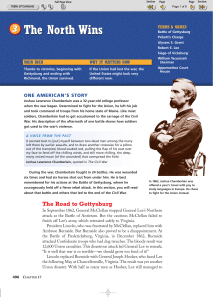
... Sherman waged total war: a war not only against enemy troops, but against everything that supports the enemy. His troops tore up rail lines, destroyed crops, and burned and looted towns. Sherman’s triumph in Atlanta was important for Lincoln. In 1864, the president was running for reelection, but hi ...
... Sherman waged total war: a war not only against enemy troops, but against everything that supports the enemy. His troops tore up rail lines, destroyed crops, and burned and looted towns. Sherman’s triumph in Atlanta was important for Lincoln. In 1864, the president was running for reelection, but hi ...
Lee`s Retreat - Civil War Traveler
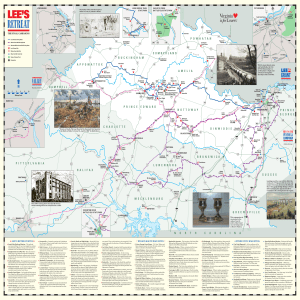
... skirmished with Union troops advancing from that direction. ...
... skirmished with Union troops advancing from that direction. ...
gettysburg 2013 xi
... the merit and sheer strength of the common soldier—as well as obvious competency at the division, brigade and regimental levels of leadership—a decisive defeat would have long since broken the U.S. Army of the Potomac. In their favor, the North fielded armies of tremendous size; consistently over 10 ...
... the merit and sheer strength of the common soldier—as well as obvious competency at the division, brigade and regimental levels of leadership—a decisive defeat would have long since broken the U.S. Army of the Potomac. In their favor, the North fielded armies of tremendous size; consistently over 10 ...

Civil War Worksheets
... The Emancipation Proclamation is a document that consists of two executive orders issued by United States President Abraham Lincoln during the American Civil War. The first one, issued on September 22, 1862, declared the freedom of all slaves in any state of the Confederate States of America as did ...
... The Emancipation Proclamation is a document that consists of two executive orders issued by United States President Abraham Lincoln during the American Civil War. The first one, issued on September 22, 1862, declared the freedom of all slaves in any state of the Confederate States of America as did ...
Fisher`s Hill Driving Tour
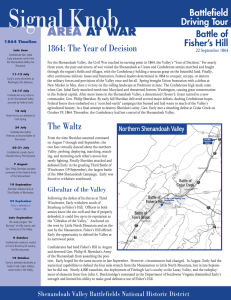
... tide, the pressure from the flank attack and subsequent frontal assaults of the VI and XIX Corps forced Early to withdraw. Sheridan’s troops pursued Early’s battered command through the night to Woodstock. ...
... tide, the pressure from the flank attack and subsequent frontal assaults of the VI and XIX Corps forced Early to withdraw. Sheridan’s troops pursued Early’s battered command through the night to Woodstock. ...
GettysburgTrailMaps
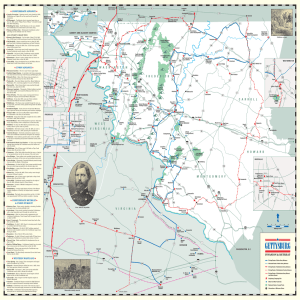
... lurched north toward Emmitsburg and east into Carroll County on a dual mission to confront the invaders and protect Baltimore and Washington, D.C., along the “Pipe Creek Line.” Stuart, meanwhile, separated from Lee, conducted a cavalry raid east of the main Federal army. Although Stuart captured 125 ...
... lurched north toward Emmitsburg and east into Carroll County on a dual mission to confront the invaders and protect Baltimore and Washington, D.C., along the “Pipe Creek Line.” Stuart, meanwhile, separated from Lee, conducted a cavalry raid east of the main Federal army. Although Stuart captured 125 ...
Lesley Gordon on Chancellorsville: The Battle and Its - H-Net
... The Confederate victory at the battle of Chancellorsville in the spring of 1863 stands as one of the most spectacular Southern successes in the Civil War’s eastern theater. On May 2, Robert E. Lee boldly divided his outnumbered force to stage an impressive surprise flank attack on Joseph Hooker’s Ar ...
... The Confederate victory at the battle of Chancellorsville in the spring of 1863 stands as one of the most spectacular Southern successes in the Civil War’s eastern theater. On May 2, Robert E. Lee boldly divided his outnumbered force to stage an impressive surprise flank attack on Joseph Hooker’s Ar ...
Civil War - apush-xl
... the refusal of the southern states to accept the Emancipation Proclamation General Robert E. Lee's defeat at Gettysburg the bombardment of Fort Sumter by South Carolina militia President Abraham Lincoln's re-election in 1864 ...
... the refusal of the southern states to accept the Emancipation Proclamation General Robert E. Lee's defeat at Gettysburg the bombardment of Fort Sumter by South Carolina militia President Abraham Lincoln's re-election in 1864 ...

Civil War - reneeASD10th
... One Union and one Confederate General List – their names, where they were from, one battle they fought, did they win or lose the battle, 3 facts about each one, a picture of each person, a date of birth and date of death, what did they do after the war? Research one famous battle from the Civil War ...
... One Union and one Confederate General List – their names, where they were from, one battle they fought, did they win or lose the battle, 3 facts about each one, a picture of each person, a date of birth and date of death, what did they do after the war? Research one famous battle from the Civil War ...
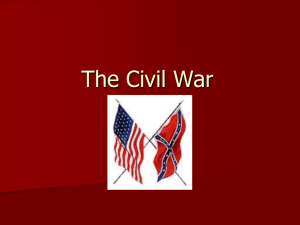
The Civil War
... probably ending the war much quicker 2. It probably saved thousands of soldier’s lives 3. It severely hurt the relationship between the North and the South 4. It left incredible damage in the South, causing much poverty and hunger ...
... probably ending the war much quicker 2. It probably saved thousands of soldier’s lives 3. It severely hurt the relationship between the North and the South 4. It left incredible damage in the South, causing much poverty and hunger ...

Battle of Antietam

The Battle of Antietam /ænˈtiːtəm/, also known as the Battle of Sharpsburg, particularly in the South, fought on September 17, 1862, near Sharpsburg, Maryland, and Antietam Creek as part of the Maryland Campaign, was the first major battle in the American Civil War to take place on Union soil. It is the bloodiest single-day battle in American history, with a combined tally of dead, wounded, and missing at 22,717.After pursuing Confederate General Robert E. Lee into Maryland, Union Army Maj. Gen. George B. McClellan launched attacks against Lee's army, in defensive positions behind Antietam Creek. At dawn on September 17, Maj. Gen. Joseph Hooker's corps mounted a powerful assault on Lee's left flank. Attacks and counterattacks swept across Miller's Cornfield and fighting swirled around the Dunker Church. Union assaults against the Sunken Road eventually pierced the Confederate center, but the Federal advantage was not followed up. In the afternoon, Union Maj. Gen. Ambrose Burnside's corps entered the action, capturing a stone bridge over Antietam Creek and advancing against the Confederate right. At a crucial moment, Confederate Maj. Gen. A. P. Hill's division arrived from Harpers Ferry and launched a surprise counterattack, driving back Burnside and ending the battle. Although outnumbered two-to-one, Lee committed his entire force, while McClellan sent in less than three-quarters of his army, enabling Lee to fight the Federals to a standstill. During the night, both armies consolidated their lines. In spite of crippling casualties, Lee continued to skirmish with McClellan throughout September 18, while removing his battered army south of the Potomac River.Despite having superiority of numbers, McClellan's attacks failed to achieve force concentration, allowing Lee to counter by shifting forces and moving interior lines to meet each challenge. Despite ample reserve forces that could have been deployed to exploit localized successes, McClellan failed to destroy Lee's army. McClellan had halted Lee's invasion of Maryland, but Lee was able to withdraw his army back to Virginia without interference from the cautious McClellan. Although the battle was tactically inconclusive, the Confederate troops had withdrawn first from the battlefield, making it, in military terms, a Union victory. It had significance as enough of a victory to give President Abraham Lincoln the confidence to announce his Emancipation Proclamation, which discouraged the British and French governments from potential plans for recognition of the Confederacy.