Civil War
... 6. How did this affect the Maryland legislature? 7. What other unpopular decision did Lincoln make in the North? 8. Define a ‘draft’. 9. With what two groups was his draft very unpopular? 10. Why did they resent it? 11. Describe what this resentment led to in July of 1863. 12. What was the outcome o ...
... 6. How did this affect the Maryland legislature? 7. What other unpopular decision did Lincoln make in the North? 8. Define a ‘draft’. 9. With what two groups was his draft very unpopular? 10. Why did they resent it? 11. Describe what this resentment led to in July of 1863. 12. What was the outcome o ...
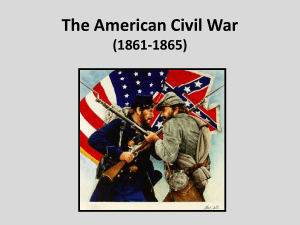
The American Civil War (1861
... 2. give VA farmers a rest during harvest season 3. get food and supplies from Northern farms 4. show that the Confederacy could win the war so other countries would support them ...
... 2. give VA farmers a rest during harvest season 3. get food and supplies from Northern farms 4. show that the Confederacy could win the war so other countries would support them ...
Academic Content Standards
... communications. Union armies sent an estimated 6 million telegrams over 15,000 miles of wire set up by the Signal Corps. The most spectacular railroad supply system was that maintained for Sherman during his siege of Atlanta: 1,600 tons of supplies arrived daily in 18 trains from Union depots northw ...
... communications. Union armies sent an estimated 6 million telegrams over 15,000 miles of wire set up by the Signal Corps. The most spectacular railroad supply system was that maintained for Sherman during his siege of Atlanta: 1,600 tons of supplies arrived daily in 18 trains from Union depots northw ...

Notes
... This is a pretty dense slide, so let me go over it with you. On September 22, 1862, just five days after the Battle of Antietam, Abraham Lincoln announced that he would issue a formal emancipation of all slaves in any state of the Confederate States of America that did not return to the Union contro ...
... This is a pretty dense slide, so let me go over it with you. On September 22, 1862, just five days after the Battle of Antietam, Abraham Lincoln announced that he would issue a formal emancipation of all slaves in any state of the Confederate States of America that did not return to the Union contro ...

The Battle of Hoover`s Gap
... Instead, Wilder led his men into Hoover's Gap at gallop and swept the enemy before them. They raced the three miles through ...
... Instead, Wilder led his men into Hoover's Gap at gallop and swept the enemy before them. They raced the three miles through ...

The Road to Civil War - Doral Academy Preparatory
... US navy, immigrants, African Americans Strong Gov’t Changing of Generals Expected war to be short ...
... US navy, immigrants, African Americans Strong Gov’t Changing of Generals Expected war to be short ...
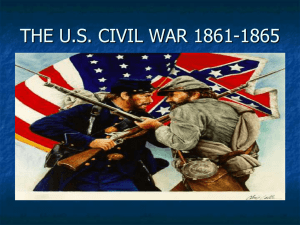

A look into the battles of the Civil War and their effects on the nation
... In the east,, Confederate forces under General Robert E. Lee invaded the northern state of Pennsylvania y ...
... In the east,, Confederate forces under General Robert E. Lee invaded the northern state of Pennsylvania y ...

The Civil War
... Use better military leadership to your advantage and outsmart Union generals. Battle of Bull Run (Manassas) 1. Lincoln sent 30,000 inexperienced soldiers to fight at Bull Run. 2. Northern troops were pushed back to D.C. 3. South won this battle but “lost the war” Why? ...
... Use better military leadership to your advantage and outsmart Union generals. Battle of Bull Run (Manassas) 1. Lincoln sent 30,000 inexperienced soldiers to fight at Bull Run. 2. Northern troops were pushed back to D.C. 3. South won this battle but “lost the war” Why? ...

Turning points of the U.S. Civil War
... The blockade strategy was designed to restrict supplies to the South. Small boats [blockade runners] were able to outrun large Union ships to provide supplies but much fewer supplies reached Southern ports. ...
... The blockade strategy was designed to restrict supplies to the South. Small boats [blockade runners] were able to outrun large Union ships to provide supplies but much fewer supplies reached Southern ports. ...

Civil War 09 ppt
... 4. Battle of 7 Pines: No clear victor, Confederacy leadership fell to Robert E. Lee 5. 2nd Battle of Bull Run: Confederacy won. 6. Battle of Antietam: North won. Bloodiest battle to that point. ...
... 4. Battle of 7 Pines: No clear victor, Confederacy leadership fell to Robert E. Lee 5. 2nd Battle of Bull Run: Confederacy won. 6. Battle of Antietam: North won. Bloodiest battle to that point. ...

James and Daniels Robert E. Lee Fabulous Presentation
... • One evening in 1865 he had an idea about marching north and defeating the union in their own territory and then take over Washington D.C. • They started the march in march 1865 • The Union and the South met in Gettysburg, Pa. • This will be the deciding factor of the turning out of the ...
... • One evening in 1865 he had an idea about marching north and defeating the union in their own territory and then take over Washington D.C. • They started the march in march 1865 • The Union and the South met in Gettysburg, Pa. • This will be the deciding factor of the turning out of the ...
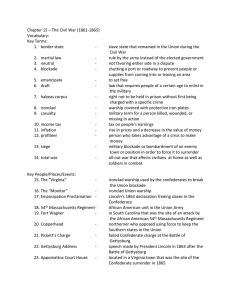
Chapter 15 - vocab and notes
... July 1863 – tides of war turned against the South Union forces won major battles in the East and in the West o West – triumph along the Mississippi River New Orleans Memphis o East – Gettysburg, under General George C. Meade Battle of Gettysburg one of the most important battles of the Civil War ...
... July 1863 – tides of war turned against the South Union forces won major battles in the East and in the West o West – triumph along the Mississippi River New Orleans Memphis o East – Gettysburg, under General George C. Meade Battle of Gettysburg one of the most important battles of the Civil War ...
Civil War – Overview - Stafford County Museum
... forced them withdraw across the river into Stafford. Hooker’s remaining forces defended until May 5th, when a general withdrawal of the army across the Rappahannock into Stafford at U.S. Ford was ordered. The Union army then returned to its Stafford positions and resumed defense of the capital. Hook ...
... forced them withdraw across the river into Stafford. Hooker’s remaining forces defended until May 5th, when a general withdrawal of the army across the Rappahannock into Stafford at U.S. Ford was ordered. The Union army then returned to its Stafford positions and resumed defense of the capital. Hook ...

This month—MONDAY, APRIL 27—the Michigan Regimental Round
... Lincoln meets with Gen Hooker and notes “our prime object is the enemies army in front of us, and is not with, or about, Richmond”. 7 Apr: Under Federal Flag Officer DuPont, his nine ironclads attack Fort Sumter but are repulsed with the loss from damage of the USS Keokuk. It becomes obvious that to ...
... Lincoln meets with Gen Hooker and notes “our prime object is the enemies army in front of us, and is not with, or about, Richmond”. 7 Apr: Under Federal Flag Officer DuPont, his nine ironclads attack Fort Sumter but are repulsed with the loss from damage of the USS Keokuk. It becomes obvious that to ...

The Civil War Comes to Wolf Bayou
... thought they could remain neutral and after the Conscription Act began to panic. Some slipped into Missouri early and others were turned back at the state line by Confederate picket lines. (A few from our area did go to Missouri for a short time.) Several Wolf Bayou men served in the Union Army and ...
... thought they could remain neutral and after the Conscription Act began to panic. Some slipped into Missouri early and others were turned back at the state line by Confederate picket lines. (A few from our area did go to Missouri for a short time.) Several Wolf Bayou men served in the Union Army and ...

JB APUSH Unit VB - jbapamh
... The House of Representatives shall choose their Speaker and other officers; and shall have the sole power of impeachment; except that any judicial or other Federal officer, resident and acting solely within the limits of any State, may be impeached by a vote of two-thirds of both branches of the Leg ...
... The House of Representatives shall choose their Speaker and other officers; and shall have the sole power of impeachment; except that any judicial or other Federal officer, resident and acting solely within the limits of any State, may be impeached by a vote of two-thirds of both branches of the Leg ...

Battle of Perryville
... precious drinking water, and ended more or less by default with the onset of darkness and the retreat of the tactical victor, the Confederates. It marked the end of the Kentucky Campaign of Confederate Generals Braxton Bragg and Edmund Kirby Smith and, like the campaign, was marked not only by fierc ...
... precious drinking water, and ended more or less by default with the onset of darkness and the retreat of the tactical victor, the Confederates. It marked the end of the Kentucky Campaign of Confederate Generals Braxton Bragg and Edmund Kirby Smith and, like the campaign, was marked not only by fierc ...

The Civil War Begins
... in all my life before. All my former experiences in battles, on marches, and at my capture were not a drop in the bucket as compared with this.--Walter E. Smith, Pvt., Co. K, 14th Illinois Infantry ...
... in all my life before. All my former experiences in battles, on marches, and at my capture were not a drop in the bucket as compared with this.--Walter E. Smith, Pvt., Co. K, 14th Illinois Infantry ...
March 8, 2017: "The Battle of Pittsburg Landing (Shiloh)"
... Later in the day, Federals established a defensive line covering Pittsburg Landing, anchored with artillery and augmented by Buell’s men, who had begun to arrive. The fighting that followed would stretch along a three-mile front and climax later in the day at the “Hornet’s Nest”* which Grant ordered ...
... Later in the day, Federals established a defensive line covering Pittsburg Landing, anchored with artillery and augmented by Buell’s men, who had begun to arrive. The fighting that followed would stretch along a three-mile front and climax later in the day at the “Hornet’s Nest”* which Grant ordered ...

A_CHAPTER11
... New Weapons • Rifles more accurate, faster loading, fire more rounds than muskets • Minié ball (more destructive bullet), grenades, land mines are used • Fighting from trenches, barricades new advantage in infantry attacks NEXT ...
... New Weapons • Rifles more accurate, faster loading, fire more rounds than muskets • Minié ball (more destructive bullet), grenades, land mines are used • Fighting from trenches, barricades new advantage in infantry attacks NEXT ...

A_CHAPTER11 - Lincoln County Schools
... New Weapons • Rifles more accurate, faster loading, fire more rounds than muskets • Minié ball (more destructive bullet), grenades, land mines are used • Fighting from trenches, barricades new advantage in infantry attacks NEXT ...
... New Weapons • Rifles more accurate, faster loading, fire more rounds than muskets • Minié ball (more destructive bullet), grenades, land mines are used • Fighting from trenches, barricades new advantage in infantry attacks NEXT ...
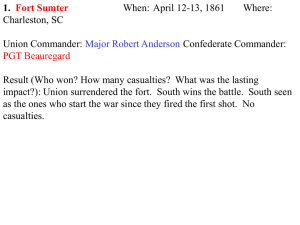
Civil War and Reconstruction PowerPoint
... circle around the army and Lee was left blind. The Union held the high ground at the end of day 1. Day 2 saw heavy fighting on the left flank. Joshua Lawerence Chamberlain and the 20th Maine held off their attack there on Little Round Top. Day 3 saw a suicidal charge against the center of the Union ...
... circle around the army and Lee was left blind. The Union held the high ground at the end of day 1. Day 2 saw heavy fighting on the left flank. Joshua Lawerence Chamberlain and the 20th Maine held off their attack there on Little Round Top. Day 3 saw a suicidal charge against the center of the Union ...

rocky mountain civil war round table
... Silver Lead Mining and Smelting Company. Jarius Hall died in 1903 at the age of 63 in England. But as Paul Harvey would like to say ‘now the rest of the story’. It was early evening on July 2, 1863 south of Gettysburg, when out of the west tree line, came the regiments of Confederate General Kershaw ...
... Silver Lead Mining and Smelting Company. Jarius Hall died in 1903 at the age of 63 in England. But as Paul Harvey would like to say ‘now the rest of the story’. It was early evening on July 2, 1863 south of Gettysburg, when out of the west tree line, came the regiments of Confederate General Kershaw ...
World Book® Online: American Civil War: Battles
... Heights get slaughtered. At the Battle of Fredericksburg, the Union army suffered approxi mately 13,000 casualties, mostly in front of Marye’s Heights. 26. In the middle of June, despite having a much larger force, Smith was reluctant to order a direct assault against the Confederates. ...
... Heights get slaughtered. At the Battle of Fredericksburg, the Union army suffered approxi mately 13,000 casualties, mostly in front of Marye’s Heights. 26. In the middle of June, despite having a much larger force, Smith was reluctant to order a direct assault against the Confederates. ...
Battle of Antietam

The Battle of Antietam /ænˈtiːtəm/, also known as the Battle of Sharpsburg, particularly in the South, fought on September 17, 1862, near Sharpsburg, Maryland, and Antietam Creek as part of the Maryland Campaign, was the first major battle in the American Civil War to take place on Union soil. It is the bloodiest single-day battle in American history, with a combined tally of dead, wounded, and missing at 22,717.After pursuing Confederate General Robert E. Lee into Maryland, Union Army Maj. Gen. George B. McClellan launched attacks against Lee's army, in defensive positions behind Antietam Creek. At dawn on September 17, Maj. Gen. Joseph Hooker's corps mounted a powerful assault on Lee's left flank. Attacks and counterattacks swept across Miller's Cornfield and fighting swirled around the Dunker Church. Union assaults against the Sunken Road eventually pierced the Confederate center, but the Federal advantage was not followed up. In the afternoon, Union Maj. Gen. Ambrose Burnside's corps entered the action, capturing a stone bridge over Antietam Creek and advancing against the Confederate right. At a crucial moment, Confederate Maj. Gen. A. P. Hill's division arrived from Harpers Ferry and launched a surprise counterattack, driving back Burnside and ending the battle. Although outnumbered two-to-one, Lee committed his entire force, while McClellan sent in less than three-quarters of his army, enabling Lee to fight the Federals to a standstill. During the night, both armies consolidated their lines. In spite of crippling casualties, Lee continued to skirmish with McClellan throughout September 18, while removing his battered army south of the Potomac River.Despite having superiority of numbers, McClellan's attacks failed to achieve force concentration, allowing Lee to counter by shifting forces and moving interior lines to meet each challenge. Despite ample reserve forces that could have been deployed to exploit localized successes, McClellan failed to destroy Lee's army. McClellan had halted Lee's invasion of Maryland, but Lee was able to withdraw his army back to Virginia without interference from the cautious McClellan. Although the battle was tactically inconclusive, the Confederate troops had withdrawn first from the battlefield, making it, in military terms, a Union victory. It had significance as enough of a victory to give President Abraham Lincoln the confidence to announce his Emancipation Proclamation, which discouraged the British and French governments from potential plans for recognition of the Confederacy.