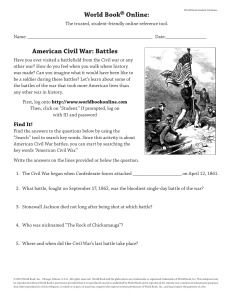
World Book® Online: American Civil War: Battles
... Heights get slaughtered. At the Battle of Fredericksburg, the Union army suffered approxi mately 13,000 casualties, mostly in front of Marye’s Heights. 26. In the middle of June, despite having a much larger force, Smith was reluctant to order a direct assault against the Confederates. ...
... Heights get slaughtered. At the Battle of Fredericksburg, the Union army suffered approxi mately 13,000 casualties, mostly in front of Marye’s Heights. 26. In the middle of June, despite having a much larger force, Smith was reluctant to order a direct assault against the Confederates. ...

March 2005 - American Civil War Roundtable of Australia
... Mud is no friend to any commander. In the Civil War, Ambrose Burnside’s famous “Mud March” after the Union defeat at Fredericksburg in late 1862 provided an air of farce now associated with him. After the slaughter at Marye’s Heights, Burnsides army settled down behind the Rappahannock River in Virg ...
... Mud is no friend to any commander. In the Civil War, Ambrose Burnside’s famous “Mud March” after the Union defeat at Fredericksburg in late 1862 provided an air of farce now associated with him. After the slaughter at Marye’s Heights, Burnsides army settled down behind the Rappahannock River in Virg ...

Predict what Lincoln will say in his second inaugural address Timeline
... a third to 40,000 men. In a month of fighting in northern and eastern Virginia, Grant lost almost 40,000 men, leading Peace Democrats to call him a “butcher.” But Confederate losses were also heavy—and southern troops could not be replaced. At the Battle of the Wilderness, in northern Virginia, Lee’ ...
... a third to 40,000 men. In a month of fighting in northern and eastern Virginia, Grant lost almost 40,000 men, leading Peace Democrats to call him a “butcher.” But Confederate losses were also heavy—and southern troops could not be replaced. At the Battle of the Wilderness, in northern Virginia, Lee’ ...

Identifying political and military turning points of the
... The blockade strategy was designed to restrict supplies to the South. Small boats [blockade runners] were able to outrun large Union ships to provide supplies but much fewer supplies reached Southern ports. ...
... The blockade strategy was designed to restrict supplies to the South. Small boats [blockade runners] were able to outrun large Union ships to provide supplies but much fewer supplies reached Southern ports. ...

The Civil War power point
... The Confederate strategy during the war was an Offensive Defense Protect Southern territory from “Northern aggression” but attack into Union territory when the opportunity presents itself Drag out the war as long as possible to make the North quit Get Britain and France to join their cause because ...
... The Confederate strategy during the war was an Offensive Defense Protect Southern territory from “Northern aggression” but attack into Union territory when the opportunity presents itself Drag out the war as long as possible to make the North quit Get Britain and France to join their cause because ...
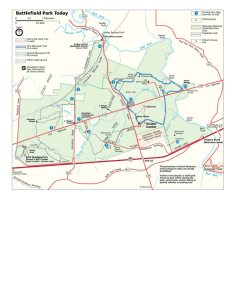
Printable Topo Hike Map
... Longstreet to attack, but “Old Pete” demurred. 11 Stone Bridge Finally, under cover of darkness, Jackson pushed his infantry forward from the The time was just not right, he said. distant ridge into this open field. King’s troops the defeated Union army withdrew across Bull swung to meet this attack ...
... Longstreet to attack, but “Old Pete” demurred. 11 Stone Bridge Finally, under cover of darkness, Jackson pushed his infantry forward from the The time was just not right, he said. distant ridge into this open field. King’s troops the defeated Union army withdrew across Bull swung to meet this attack ...

CHAPTER 15 The War to Save the Union
... He was concerned that emancipation would divide the North and injure the war effort. By mid-1862, Lincoln was convinced for military reasons that emancipation should become a northern war aim. Following the Battle of Antietam, he issued the Emancipation Proclamation that freed all slaves in areas st ...
... He was concerned that emancipation would divide the North and injure the war effort. By mid-1862, Lincoln was convinced for military reasons that emancipation should become a northern war aim. Following the Battle of Antietam, he issued the Emancipation Proclamation that freed all slaves in areas st ...

Civil War 1863-1865
... This executive order border states but it gave the freed all slaves in Confederate territories North a new reason fight ...
... This executive order border states but it gave the freed all slaves in Confederate territories North a new reason fight ...
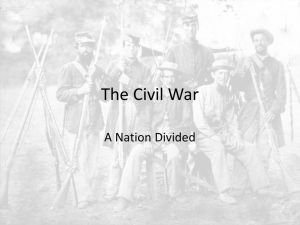
The Civil War
... • Conscription Act, martial law, impressment of supplies, tax on cotton/slaves ...
... • Conscription Act, martial law, impressment of supplies, tax on cotton/slaves ...

4.2_RochRev_May2013_Gettysburg.indd 30 4/17/13 9:52 PM
... helped repulse a Mississippi brigade in bitter fighting along Plum Run in front of Cemetery Ridge. At the other end of the Union position, a Confederate division advanced at dusk against Culp’s Hill, where only a single Union brigade of five regiments—including the 60th New York, commanded by Col. A ...
... helped repulse a Mississippi brigade in bitter fighting along Plum Run in front of Cemetery Ridge. At the other end of the Union position, a Confederate division advanced at dusk against Culp’s Hill, where only a single Union brigade of five regiments—including the 60th New York, commanded by Col. A ...

Chapter 10
... Meanwhile, another great battle was underway in the village of Gettysburg, Pennsylvania. It began when General Lee invaded the North a second time. On July 1, 1863, his army of approximately 75,000 troops met a Union force of about 95,000 just west of the town. The Battle of Gettysburg lasted for th ...
... Meanwhile, another great battle was underway in the village of Gettysburg, Pennsylvania. It began when General Lee invaded the North a second time. On July 1, 1863, his army of approximately 75,000 troops met a Union force of about 95,000 just west of the town. The Battle of Gettysburg lasted for th ...


Steps to the Civil War Flip Book
... 1. Color the border state one shade of blue. 2. Color the rest of the Union states a different shade of blue. 3. Color the Confederate states grey. 4. Label the location of each of the battles listed in the battle chart. a. Mark the battle with a blue dot if it is a Union victory b. Mark the battle ...
... 1. Color the border state one shade of blue. 2. Color the rest of the Union states a different shade of blue. 3. Color the Confederate states grey. 4. Label the location of each of the battles listed in the battle chart. a. Mark the battle with a blue dot if it is a Union victory b. Mark the battle ...

Get Ebooks Lee And His Army In Confederate History (Civil War
... that the battle was not the overwhelming defeat to the Army of Northern Virginia and the Confederate home front that it would later be portayed as by historians. He makes the argument that the loss of Vicksburg was seen as a vastly bigger loss and Gettysburg was more seen as a small defeat or even a ...
... that the battle was not the overwhelming defeat to the Army of Northern Virginia and the Confederate home front that it would later be portayed as by historians. He makes the argument that the loss of Vicksburg was seen as a vastly bigger loss and Gettysburg was more seen as a small defeat or even a ...

Civil War Research on the Surrender at the
... celebrate the downfall of the brave men who have fought today,” he said. “The war is over, and the Confederates…can return home as countrymen again. ...
... celebrate the downfall of the brave men who have fought today,” he said. “The war is over, and the Confederates…can return home as countrymen again. ...

Caring For the Wounded: The National Museum of Civil War Medicine
... and Confederate armies came through in a campaign that would eventually end in the bloody battle of Antietam. In 1863, both of the armies were through this area again on their way to Gettysburg just to our north. And finally, in 1864 there was a major campaign with an attempt to take Washington by G ...
... and Confederate armies came through in a campaign that would eventually end in the bloody battle of Antietam. In 1863, both of the armies were through this area again on their way to Gettysburg just to our north. And finally, in 1864 there was a major campaign with an attempt to take Washington by G ...

lancaster - Gettysburg Discussion Group
... “to all the citizens of Pennsylvania, who love liberty and are mindful of the history and traditions of their Revolutionary Fathers, and who feel that it is a sacred duty to guard and maintain the free institutions of our country, who hate treason and abettors and who are willing to defend their hom ...
... “to all the citizens of Pennsylvania, who love liberty and are mindful of the history and traditions of their Revolutionary Fathers, and who feel that it is a sacred duty to guard and maintain the free institutions of our country, who hate treason and abettors and who are willing to defend their hom ...
Union Campaigns Cripple the Confederacy
... worst defeat at the Battle of Cold Harbor in early June, just 10 miles northeast of Richmond. In only a few hours the Union army suffered 7,000 casualties. The battle delayed Grant’s plans to take the Confederate capital. Union forces had suffered twice as many casualties as the Confederates had, ye ...
... worst defeat at the Battle of Cold Harbor in early June, just 10 miles northeast of Richmond. In only a few hours the Union army suffered 7,000 casualties. The battle delayed Grant’s plans to take the Confederate capital. Union forces had suffered twice as many casualties as the Confederates had, ye ...

The Civil War
... What might have happened if the Confederates (South) defeated the Union (North) in the Battle of Antietam? ...
... What might have happened if the Confederates (South) defeated the Union (North) in the Battle of Antietam? ...

Civil war Quiz Material for Game
... 5. After Fort Sumter was fired upon, what did President Lincoln do as a first step in putting down the rebellion? Was this action a popular one in the North? 6. What were the original seven southern states that formed the Confederacy? What were the names of the four states that joined later? 7. Who ...
... 5. After Fort Sumter was fired upon, what did President Lincoln do as a first step in putting down the rebellion? Was this action a popular one in the North? 6. What were the original seven southern states that formed the Confederacy? What were the names of the four states that joined later? 7. Who ...
CIVIL WAR UNIT - Miss Christy`s room
... Lee's plan ended up with the Union Army. Therefore when Leee crossed the Potomac River into Maryland, he was blocked from Washington, D. C. by Union troops in a bloody battle at Sharpsburg near Antietam Creek. Lee realized that his army was in a bad position to receive supplies and withdrew his troo ...
... Lee's plan ended up with the Union Army. Therefore when Leee crossed the Potomac River into Maryland, he was blocked from Washington, D. C. by Union troops in a bloody battle at Sharpsburg near Antietam Creek. Lee realized that his army was in a bad position to receive supplies and withdrew his troo ...
Many Civil War battles have two names because the Confederates
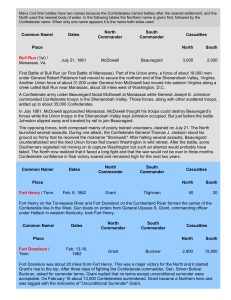
... The opposing forces, both composed mainly of poorly trained volunteers, clashed on July 21. The North launched several assaults. During one attack, the Confederate General Thomas J. Jackson stood his ground so firmly that he received the nickname "Stonewall." After halting several assaults, Beaurega ...
... The opposing forces, both composed mainly of poorly trained volunteers, clashed on July 21. The North launched several assaults. During one attack, the Confederate General Thomas J. Jackson stood his ground so firmly that he received the nickname "Stonewall." After halting several assaults, Beaurega ...
The Classic Novel of the Civil War
... to face. As the Rebels rush the low stone wall constructed hastily by Union troops, men fall fast— from wounds that cripple or disfigure and for the dead, no time for goodbyes. Chamberlain draws quick comfort from seeing his brother Tom alive and well after the first skirmish, but too many others ha ...
... to face. As the Rebels rush the low stone wall constructed hastily by Union troops, men fall fast— from wounds that cripple or disfigure and for the dead, no time for goodbyes. Chamberlain draws quick comfort from seeing his brother Tom alive and well after the first skirmish, but too many others ha ...
background - dehushistory
... prepared army into Virginia. His objective was the town of Manassas, an important railroad junction southwest of Washington. Opposing him was a smaller Confederate force under General P.G.T. Beauregard, the officer who had captured Fort Sumter. The Confederates were camped along Bull Run, a stream t ...
... prepared army into Virginia. His objective was the town of Manassas, an important railroad junction southwest of Washington. Opposing him was a smaller Confederate force under General P.G.T. Beauregard, the officer who had captured Fort Sumter. The Confederates were camped along Bull Run, a stream t ...
Battle of Antietam

The Battle of Antietam /ænˈtiːtəm/, also known as the Battle of Sharpsburg, particularly in the South, fought on September 17, 1862, near Sharpsburg, Maryland, and Antietam Creek as part of the Maryland Campaign, was the first major battle in the American Civil War to take place on Union soil. It is the bloodiest single-day battle in American history, with a combined tally of dead, wounded, and missing at 22,717.After pursuing Confederate General Robert E. Lee into Maryland, Union Army Maj. Gen. George B. McClellan launched attacks against Lee's army, in defensive positions behind Antietam Creek. At dawn on September 17, Maj. Gen. Joseph Hooker's corps mounted a powerful assault on Lee's left flank. Attacks and counterattacks swept across Miller's Cornfield and fighting swirled around the Dunker Church. Union assaults against the Sunken Road eventually pierced the Confederate center, but the Federal advantage was not followed up. In the afternoon, Union Maj. Gen. Ambrose Burnside's corps entered the action, capturing a stone bridge over Antietam Creek and advancing against the Confederate right. At a crucial moment, Confederate Maj. Gen. A. P. Hill's division arrived from Harpers Ferry and launched a surprise counterattack, driving back Burnside and ending the battle. Although outnumbered two-to-one, Lee committed his entire force, while McClellan sent in less than three-quarters of his army, enabling Lee to fight the Federals to a standstill. During the night, both armies consolidated their lines. In spite of crippling casualties, Lee continued to skirmish with McClellan throughout September 18, while removing his battered army south of the Potomac River.Despite having superiority of numbers, McClellan's attacks failed to achieve force concentration, allowing Lee to counter by shifting forces and moving interior lines to meet each challenge. Despite ample reserve forces that could have been deployed to exploit localized successes, McClellan failed to destroy Lee's army. McClellan had halted Lee's invasion of Maryland, but Lee was able to withdraw his army back to Virginia without interference from the cautious McClellan. Although the battle was tactically inconclusive, the Confederate troops had withdrawn first from the battlefield, making it, in military terms, a Union victory. It had significance as enough of a victory to give President Abraham Lincoln the confidence to announce his Emancipation Proclamation, which discouraged the British and French governments from potential plans for recognition of the Confederacy.