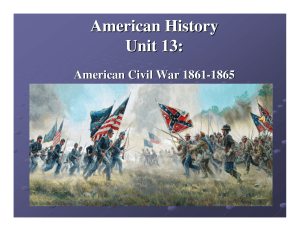
Union Victory
... cut the Confederacy in two and stop the flow of supplies to rebel troops. 3. Third, the Union planned to quickly capture the Confederate government headquarters located in Richmond, Virginia ...
... cut the Confederacy in two and stop the flow of supplies to rebel troops. 3. Third, the Union planned to quickly capture the Confederate government headquarters located in Richmond, Virginia ...
US Civil War
... When South Carolina seceded from the Union on December 20, 1860, United States army positioned themselves at Fort Sumter in South Carolina. Just after the inauguration of President Abraham Lincoln on March 4, 1861, Anderson reported that he had only a six week supply of food left in the fort and Con ...
... When South Carolina seceded from the Union on December 20, 1860, United States army positioned themselves at Fort Sumter in South Carolina. Just after the inauguration of President Abraham Lincoln on March 4, 1861, Anderson reported that he had only a six week supply of food left in the fort and Con ...

Civil War Battles
... Battle of Manassas First major battle of the Civil War. The Confederate 1st Battle of Bull Run victory made it clear that the war would not end quickly. Battle of Antietam ...
... Battle of Manassas First major battle of the Civil War. The Confederate 1st Battle of Bull Run victory made it clear that the war would not end quickly. Battle of Antietam ...

Chapter 17 Notes - Mahopac Central School District
... a) July 21, 1861 – Union soldiers left Washington, D.C. for Richmond b) They had barely left Washington, however, when they clashed with Confederates. c) The Battle of Bull Run took place near a small stream in Virginia. d) Southern troops did not turn and run as expected. Inspired by General Thomas ...
... a) July 21, 1861 – Union soldiers left Washington, D.C. for Richmond b) They had barely left Washington, however, when they clashed with Confederates. c) The Battle of Bull Run took place near a small stream in Virginia. d) Southern troops did not turn and run as expected. Inspired by General Thomas ...

Sectionalism and Civil War IFD presentation
... stated that there would be NO civil war, however, unless the South started one …..“In YOUR hands my dissatisfied fellow countrymen and not in MINE is the momentous issue of civil war”…….. ...
... stated that there would be NO civil war, however, unless the South started one …..“In YOUR hands my dissatisfied fellow countrymen and not in MINE is the momentous issue of civil war”…….. ...

US History Chapter 11 Notes The Civil War
... of battles known collectively as the Seven Days’ Battle - South lost more men but forced north to retreat Lee’ determination and unorthodox tactics caused McClellan leave Richmond Lee decided to invade the north - Hoped a victory in the north would convince Lincoln to ...
... of battles known collectively as the Seven Days’ Battle - South lost more men but forced north to retreat Lee’ determination and unorthodox tactics caused McClellan leave Richmond Lee decided to invade the north - Hoped a victory in the north would convince Lincoln to ...

Chapter 19
... • McClellan took Yorktown; clashed with Confederates near Richmond • Davis put General Robert E. Lee in charge in VA in June 1862 – Most talented officer on either side – Lincoln had asked him to join the Union in 1861 but he chose to remain loyal to his home (south) ...
... • McClellan took Yorktown; clashed with Confederates near Richmond • Davis put General Robert E. Lee in charge in VA in June 1862 – Most talented officer on either side – Lincoln had asked him to join the Union in 1861 but he chose to remain loyal to his home (south) ...

killing grounds-gettysburg s bloodiest acres
... Rich Kohr as he retraces the steps of the brigades thrown into this intense fight. 4:30-5:30PM: "Advance, Colonel, and take those colors!" On July 2, 1863, as Longstreet’s assault moved north, Confederates breached the Federal line along Emmitsburg Road. Having already sent Caldwell’s Division to th ...
... Rich Kohr as he retraces the steps of the brigades thrown into this intense fight. 4:30-5:30PM: "Advance, Colonel, and take those colors!" On July 2, 1863, as Longstreet’s assault moved north, Confederates breached the Federal line along Emmitsburg Road. Having already sent Caldwell’s Division to th ...
UNIT 3: THE CIVIL WAR
... Identify: Fort Sumter, Anaconda plan, Bull Run, George McClellan, Ulysses S. Grant, Shiloh, Robert E. Lee, Antietam. Why did people on both sides expect a short war? What were the strengths and weaknesses of each side? B. ...
... Identify: Fort Sumter, Anaconda plan, Bull Run, George McClellan, Ulysses S. Grant, Shiloh, Robert E. Lee, Antietam. Why did people on both sides expect a short war? What were the strengths and weaknesses of each side? B. ...

The Martyrdom of Lincoln
... Seward. Seward nearly died, which is why the editorial on page 474 writes of the strike on Lincoln and Seward. Furthermore, another accomplice was to assassinate Vice President Andrew Johnson—he didn’t get close enough to try. A great explanation of the whole plot can be found at the Famous Trials w ...
... Seward. Seward nearly died, which is why the editorial on page 474 writes of the strike on Lincoln and Seward. Furthermore, another accomplice was to assassinate Vice President Andrew Johnson—he didn’t get close enough to try. A great explanation of the whole plot can be found at the Famous Trials w ...

Unit 5.4 The Civil War - Dover Union Free School District
... 1. General Pope put in charge of Union army near Washington. 2. Combined forces of Lee, Jackson, & Longstreet forced Yankees to retreat again. -- Some blamed McClellan for not coming quickly to Pope’s aid. 3. Casualties: Union 16,054; Confederates 9,197 4. Lincoln once again gave McClellan command o ...
... 1. General Pope put in charge of Union army near Washington. 2. Combined forces of Lee, Jackson, & Longstreet forced Yankees to retreat again. -- Some blamed McClellan for not coming quickly to Pope’s aid. 3. Casualties: Union 16,054; Confederates 9,197 4. Lincoln once again gave McClellan command o ...

NOTES Civil War Strategies and Battles
... First battle between the ironclad warships; often called the Monitor & the Merrimack (renamed Virginia by the CSA.) June 25-July 1: The Seven Days Battle (Henrico County, Virginia) Series of battles in the Peninsula Campaign consisting of a Confederate counter-offensive which drove the Union Army aw ...
... First battle between the ironclad warships; often called the Monitor & the Merrimack (renamed Virginia by the CSA.) June 25-July 1: The Seven Days Battle (Henrico County, Virginia) Series of battles in the Peninsula Campaign consisting of a Confederate counter-offensive which drove the Union Army aw ...
2J Outlook 02-06-2011.qxd (Page J3)
... to oppose the Confederate one in Richmond. In August, Confederate Gen. Robert E. Lee tried — and failed — to reclaim that part of Virginia, and by 1862, the conflict had shifted east. The First Campaign proved to be decisive: In 1863, the western counties under Union control became the new state of ...
... to oppose the Confederate one in Richmond. In August, Confederate Gen. Robert E. Lee tried — and failed — to reclaim that part of Virginia, and by 1862, the conflict had shifted east. The First Campaign proved to be decisive: In 1863, the western counties under Union control became the new state of ...

Chapter 8
... Lincoln sent federal troops into Maryland and western Virginia (whose population was mostly loyal to the Union) People in the counties of western Virginia set ...
... Lincoln sent federal troops into Maryland and western Virginia (whose population was mostly loyal to the Union) People in the counties of western Virginia set ...

18 PROPERTY PROFESSIONAL Volume 17 Issue 3
... the fog of war, the fate of a nation and the lives of so many pivoted on the leadership skills and foibles of so few. ...
... the fog of war, the fate of a nation and the lives of so many pivoted on the leadership skills and foibles of so few. ...

Civil War
... his Confederate army retreated into Virginia. Union military success at the Battle of Antietam allowed President Lincoln to issue the Emancipation Proclamation. Because of this relationship to the Emancipation Proclamation, historians consider Antietam one of the war’s most important battles. The Un ...
... his Confederate army retreated into Virginia. Union military success at the Battle of Antietam allowed President Lincoln to issue the Emancipation Proclamation. Because of this relationship to the Emancipation Proclamation, historians consider Antietam one of the war’s most important battles. The Un ...

Battle of Galveston
... He had two river steamers, the Bayou City and the Neptune, converted to cotton-clad gunboats by the addition of cotton bales stacked on their decks and a few cannon. He planned a two-part attack to recapture the port; while he led infantry and artillery in an attack on the city, his new gunboats wou ...
... He had two river steamers, the Bayou City and the Neptune, converted to cotton-clad gunboats by the addition of cotton bales stacked on their decks and a few cannon. He planned a two-part attack to recapture the port; while he led infantry and artillery in an attack on the city, his new gunboats wou ...
Union Commander
... Reports say that people from Washington D.C. rode out by carriage and packed picnic lunches to watch the Union Army defeat the rebels…One lady commented – “ I suppose we will take Richmond by tomorrow.” Many of the civilians became tangled up with retreating soldiers during the chaos, following them ...
... Reports say that people from Washington D.C. rode out by carriage and packed picnic lunches to watch the Union Army defeat the rebels…One lady commented – “ I suppose we will take Richmond by tomorrow.” Many of the civilians became tangled up with retreating soldiers during the chaos, following them ...
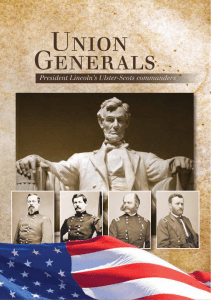
Union Generals - Ulster Scots Community Network
... would seem G. B. McClellan was of Ulster-Scots ancestry but chose to emphasize his Scottish ancestry rather than that of his Ulster-Scots forbearers. G. B. McClellan and H. B. McClellan’s great grandfather, Samuel McClellan served throughout the War of Independence with the Connecticut militia and ...
... would seem G. B. McClellan was of Ulster-Scots ancestry but chose to emphasize his Scottish ancestry rather than that of his Ulster-Scots forbearers. G. B. McClellan and H. B. McClellan’s great grandfather, Samuel McClellan served throughout the War of Independence with the Connecticut militia and ...
to read story - Fayette, Alabama
... medical reasons and professions. It also allowed those with financial means to either pay money for an exemption or to pay for a substitution to take their place, leaving the poor to fight the war. This act was repealed late in 1863and a revision of the draft act was passed to raise the qualifying a ...
... medical reasons and professions. It also allowed those with financial means to either pay money for an exemption or to pay for a substitution to take their place, leaving the poor to fight the war. This act was repealed late in 1863and a revision of the draft act was passed to raise the qualifying a ...
September 2016 Wig Wag - Camp #158
... 22 September: LGen Stephen D. Lee 27 September: RAdm Raphael Semmes 28 September: BGen John Gregg* LTC Alexander “Sandie” Pendleton* 2 October: Lt. Gen. Alexander P. Stewart 7 October: Maj. Gen. Bushrod Rust Johnson Lt. Gen. Richard H. Anderson Maj. Gen. William B. Bate 8 October: John H. Reagan, Po ...
... 22 September: LGen Stephen D. Lee 27 September: RAdm Raphael Semmes 28 September: BGen John Gregg* LTC Alexander “Sandie” Pendleton* 2 October: Lt. Gen. Alexander P. Stewart 7 October: Maj. Gen. Bushrod Rust Johnson Lt. Gen. Richard H. Anderson Maj. Gen. William B. Bate 8 October: John H. Reagan, Po ...

Chapter 11 Section 1 Resources, Strategies, and Early Battles
... At beginning of the Civil War, the South had strong advantages. • Military Strategy: Did not need to attack or conquer the North; had only to avoid defeat to win the war • Leadership: Many United States Army officers sided with the South at the outbreak of the war (foremost among them was Robert E. ...
... At beginning of the Civil War, the South had strong advantages. • Military Strategy: Did not need to attack or conquer the North; had only to avoid defeat to win the war • Leadership: Many United States Army officers sided with the South at the outbreak of the war (foremost among them was Robert E. ...

CIVIL WAR UNIT EXAM Name
... ideals of liberty, equality, and democracy. He used this as ammunition to show reasons again for why they were fighting this war. Pickett’s Charge- Confederate General George Pickett led nearly 15,000 troops on a one mile march toward Cemetery Ridge on the third day of fighting during the Battle of ...
... ideals of liberty, equality, and democracy. He used this as ammunition to show reasons again for why they were fighting this war. Pickett’s Charge- Confederate General George Pickett led nearly 15,000 troops on a one mile march toward Cemetery Ridge on the third day of fighting during the Battle of ...
Civil War Driving Guide Page 1
... Description: In combination with Maj. Gen. Benjamin Butler’s offensive north of the James River, Lt. Gen. Ulysses S. Grant extended his left flank to cut Confederate lines of communication southwest of Petersburg. Two divisions of the IX corps under Maj. Gen. John G. Parke, two divisions of the V Co ...
... Description: In combination with Maj. Gen. Benjamin Butler’s offensive north of the James River, Lt. Gen. Ulysses S. Grant extended his left flank to cut Confederate lines of communication southwest of Petersburg. Two divisions of the IX corps under Maj. Gen. John G. Parke, two divisions of the V Co ...
Battle of Antietam

The Battle of Antietam /ænˈtiːtəm/, also known as the Battle of Sharpsburg, particularly in the South, fought on September 17, 1862, near Sharpsburg, Maryland, and Antietam Creek as part of the Maryland Campaign, was the first major battle in the American Civil War to take place on Union soil. It is the bloodiest single-day battle in American history, with a combined tally of dead, wounded, and missing at 22,717.After pursuing Confederate General Robert E. Lee into Maryland, Union Army Maj. Gen. George B. McClellan launched attacks against Lee's army, in defensive positions behind Antietam Creek. At dawn on September 17, Maj. Gen. Joseph Hooker's corps mounted a powerful assault on Lee's left flank. Attacks and counterattacks swept across Miller's Cornfield and fighting swirled around the Dunker Church. Union assaults against the Sunken Road eventually pierced the Confederate center, but the Federal advantage was not followed up. In the afternoon, Union Maj. Gen. Ambrose Burnside's corps entered the action, capturing a stone bridge over Antietam Creek and advancing against the Confederate right. At a crucial moment, Confederate Maj. Gen. A. P. Hill's division arrived from Harpers Ferry and launched a surprise counterattack, driving back Burnside and ending the battle. Although outnumbered two-to-one, Lee committed his entire force, while McClellan sent in less than three-quarters of his army, enabling Lee to fight the Federals to a standstill. During the night, both armies consolidated their lines. In spite of crippling casualties, Lee continued to skirmish with McClellan throughout September 18, while removing his battered army south of the Potomac River.Despite having superiority of numbers, McClellan's attacks failed to achieve force concentration, allowing Lee to counter by shifting forces and moving interior lines to meet each challenge. Despite ample reserve forces that could have been deployed to exploit localized successes, McClellan failed to destroy Lee's army. McClellan had halted Lee's invasion of Maryland, but Lee was able to withdraw his army back to Virginia without interference from the cautious McClellan. Although the battle was tactically inconclusive, the Confederate troops had withdrawn first from the battlefield, making it, in military terms, a Union victory. It had significance as enough of a victory to give President Abraham Lincoln the confidence to announce his Emancipation Proclamation, which discouraged the British and French governments from potential plans for recognition of the Confederacy.