Gettysburg
... Copyright © Houghton Mifflin Company. All rights reserved. armies--dead, wounded, and missing--exceeded 50,000 men. ...
... Copyright © Houghton Mifflin Company. All rights reserved. armies--dead, wounded, and missing--exceeded 50,000 men. ...
Battle of Nashville - You Can Live History
... After years of fighting, the Union forces had at last broken the Confederate Army of Tennessee. In the Battle of Nashville, the northern forces lost a total of about 3,000 killed, wounded, captured or missing. The southern army had even higher losses. Hood lost about 6,000 killed, wounded, captured ...
... After years of fighting, the Union forces had at last broken the Confederate Army of Tennessee. In the Battle of Nashville, the northern forces lost a total of about 3,000 killed, wounded, captured or missing. The southern army had even higher losses. Hood lost about 6,000 killed, wounded, captured ...
April 2014 - 7th Florida Infantry Company K
... gun sale counter and ask for it though as they are not on display. They are not the premium caps we are used to, as I have had the occasional one that does not fire off, but it is a source at least. We had our battle at Narcoossee Mill in March. Very slow on Saturday, but a lot of action on Sunday. ...
... gun sale counter and ask for it though as they are not on display. They are not the premium caps we are used to, as I have had the occasional one that does not fire off, but it is a source at least. We had our battle at Narcoossee Mill in March. Very slow on Saturday, but a lot of action on Sunday. ...
Driving Tour - Trevilian Station Battlefield Foundation
... critical. His ammunition was nearly exhausted, Union artillery raked portions of his line, and Union sharpshooters picked off officers and enlisted men from the vantage point of a barn situated near the front. However, the Confederates persevered. By late afternoon additional ammunition reached the ...
... critical. His ammunition was nearly exhausted, Union artillery raked portions of his line, and Union sharpshooters picked off officers and enlisted men from the vantage point of a barn situated near the front. However, the Confederates persevered. By late afternoon additional ammunition reached the ...
A Violent Choice: Civil War, 1861-1865
... 4. Many surgeons at the front lines could do little more than amputate limbs to save lives. 5. Conditions were even worse in prison camps. IV. Waging Total War A. Lincoln’s Generals and Southern Successes 1. The Battle of Chancellorsville was a loss for both sides: the North lost the battle and the ...
... 4. Many surgeons at the front lines could do little more than amputate limbs to save lives. 5. Conditions were even worse in prison camps. IV. Waging Total War A. Lincoln’s Generals and Southern Successes 1. The Battle of Chancellorsville was a loss for both sides: the North lost the battle and the ...

Civil war presentation
... The battle of Gettysburg. Robert E. Lee was confident about invading the Union yet again. Lee’s plan was to capture a northern city and hope that the north would consider peace talks. The Confederate and Union troops met outside Gettysburg Pennsylvania. There they battled for three days straight. Bo ...
... The battle of Gettysburg. Robert E. Lee was confident about invading the Union yet again. Lee’s plan was to capture a northern city and hope that the north would consider peace talks. The Confederate and Union troops met outside Gettysburg Pennsylvania. There they battled for three days straight. Bo ...
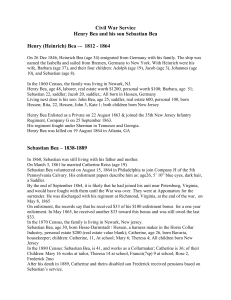
1863 Civil War: Henry Bea Enlisted as a Private on 22 August 1863
... throw his whole army rapidly by the right to threaten Nickajack creek and Turner's ferry across the Chattahoochee. Fought on 22 July 1864 at Decatur, GA. The regiment's next engagement was at the battle of Decatur, where it suffered severely, the casualties numbering 1 killed, 16 wounded, and 2 off ...
... throw his whole army rapidly by the right to threaten Nickajack creek and Turner's ferry across the Chattahoochee. Fought on 22 July 1864 at Decatur, GA. The regiment's next engagement was at the battle of Decatur, where it suffered severely, the casualties numbering 1 killed, 16 wounded, and 2 off ...
The Opening Fight at Gettysburg
... Ridge on the evening of June 30, or perhaps just a few hours earlier than it arrived on July 1. Would not the fighting on McPherson’s Ridge have had a much different outcome, one more favorable to Union success? Could they not have been able to attack Henry Heth’s lead Confederate division and then ...
... Ridge on the evening of June 30, or perhaps just a few hours earlier than it arrived on July 1. Would not the fighting on McPherson’s Ridge have had a much different outcome, one more favorable to Union success? Could they not have been able to attack Henry Heth’s lead Confederate division and then ...
USch11
... (A) They claimed more lives than any vessels before them. (B) They made the wooden navies obsolete. (C) The Merrimack was able to destroy the Monitor. (D) Both ships were unsinkable. ...
... (A) They claimed more lives than any vessels before them. (B) They made the wooden navies obsolete. (C) The Merrimack was able to destroy the Monitor. (D) Both ships were unsinkable. ...
Lincoln Faces a Crisis - Morris Plains School District
... – At first, the Union gained the upper hand, but quickly lost it when Confederate troops rallied around General Thomas “Stonewall” Jackson. • Fresh Confederate troops arrived overnight and the next day, the Union began a general retreat towards Washington D.C. – If the Confederates had pressed the a ...
... – At first, the Union gained the upper hand, but quickly lost it when Confederate troops rallied around General Thomas “Stonewall” Jackson. • Fresh Confederate troops arrived overnight and the next day, the Union began a general retreat towards Washington D.C. – If the Confederates had pressed the a ...
Lincoln is Elected
... big battle of the war? (Bull Run) What lesson did the North learn from this battle? (That victory would not be that easy; the North would have to prepare for a long, hard war.) 2. Ask students to describe the plan the North made to win the war. Write the main points of that plan on the chalkboard as ...
... big battle of the war? (Bull Run) What lesson did the North learn from this battle? (That victory would not be that easy; the North would have to prepare for a long, hard war.) 2. Ask students to describe the plan the North made to win the war. Write the main points of that plan on the chalkboard as ...
Gettysburg, Battle of
... The battle was a staggering defeat for the Army of Northern Virginia. Lee lost thousands of veteran officers and soldiers whom he could not replace. Indeed, the Gettysburg disaster and the fall of Vicksburg on 4 July were devastating blows to the Confederacy. One-fourth of the Confederate casualties ...
... The battle was a staggering defeat for the Army of Northern Virginia. Lee lost thousands of veteran officers and soldiers whom he could not replace. Indeed, the Gettysburg disaster and the fall of Vicksburg on 4 July were devastating blows to the Confederacy. One-fourth of the Confederate casualties ...

The Civil War and Reconstruction
... Delayed waiting for a Union victory- Announced after Antietam that unless the South laid down ...
... Delayed waiting for a Union victory- Announced after Antietam that unless the South laid down ...
Gettysburg Battlefield Lesson Plan
... the front and found that during the night General Lee and his Rebel Army had fallen back. It was impossible to march across the field without stepping upon dead or wounded men, while horses and broken Artillery lay on every side. We advanced to a sunken road [Emmitsburg Road] where we deployed as sk ...
... the front and found that during the night General Lee and his Rebel Army had fallen back. It was impossible to march across the field without stepping upon dead or wounded men, while horses and broken Artillery lay on every side. We advanced to a sunken road [Emmitsburg Road] where we deployed as sk ...

Civil War 150 Interactive
... Directions: Find answers to the following questions by exploring the topics from left to right. WHO THEY WERE 1. How many Americans fought in the Civil War? 2. How many African Americans fought for the Union? 3. How many women disguised and secretly serve? 4. How many Native American fought in the w ...
... Directions: Find answers to the following questions by exploring the topics from left to right. WHO THEY WERE 1. How many Americans fought in the Civil War? 2. How many African Americans fought for the Union? 3. How many women disguised and secretly serve? 4. How many Native American fought in the w ...

Click Here for Tableau Quote Packet
... “The stench from the dead between our line and theirs was … so nauseating that is was almost unendurable; but we had the advantage, as the wind carried it away from us to them. The dead covered more than five acres of ground about as thickly as they could be laid.” Confederate Colonel William C. Oat ...
... “The stench from the dead between our line and theirs was … so nauseating that is was almost unendurable; but we had the advantage, as the wind carried it away from us to them. The dead covered more than five acres of ground about as thickly as they could be laid.” Confederate Colonel William C. Oat ...
File
... • Confederate leaders wanted to follow Lee’s victories in Virginia with victory on northern soil. • Lee’s Confederate troops and McClellan’s Union army met along Antietam Creek in Maryland on September 17, ...
... • Confederate leaders wanted to follow Lee’s victories in Virginia with victory on northern soil. • Lee’s Confederate troops and McClellan’s Union army met along Antietam Creek in Maryland on September 17, ...
Library of Congress
... Copyright © Houghton Mifflin Company. All rights reserved. armies--dead, wounded, and missing--exceeded 50,000 men. ...
... Copyright © Houghton Mifflin Company. All rights reserved. armies--dead, wounded, and missing--exceeded 50,000 men. ...
Union Preserved, Freedom Secured
... Actor, Rebel Soldier at Gettysburg: Fredericksburg! Fredericksburg! “Seconds are centuries, minutes, ages. Men fire into each other’s faces not five feet apart. There are bayonet thrusts, saber strokes, pistol shots. Men going down on their hands and knees, spinning around like tops, throwing out th ...
... Actor, Rebel Soldier at Gettysburg: Fredericksburg! Fredericksburg! “Seconds are centuries, minutes, ages. Men fire into each other’s faces not five feet apart. There are bayonet thrusts, saber strokes, pistol shots. Men going down on their hands and knees, spinning around like tops, throwing out th ...
ROI, Leadership, and the Civil War - John Bryer
... Lee was virtually surrounded by Hooker’s much larger Union Army Lee could have savored victory and withdrawn to fight another day Against all military logic, Lee split his troops in the face of a numerically superior enemy – a bold, decisive maneuver ...
... Lee was virtually surrounded by Hooker’s much larger Union Army Lee could have savored victory and withdrawn to fight another day Against all military logic, Lee split his troops in the face of a numerically superior enemy – a bold, decisive maneuver ...

Born near Hodgenville, Ky
... Federal forces had reopened the Mississippi River and brought large sections of the South under Federal control, many in the North despaired of victory as casualties mounted in Lt. Gen. Ulysses S. Grant's offensive against Gen. Robert E. Lee's Confederate Army of ...
... Federal forces had reopened the Mississippi River and brought large sections of the South under Federal control, many in the North despaired of victory as casualties mounted in Lt. Gen. Ulysses S. Grant's offensive against Gen. Robert E. Lee's Confederate Army of ...

Civil War in Louisa County
... 9. Thompson’s Crossroads May 1-6, 1863 Union troops of Gen. George Stoneman camped during his raid to destroy fords and bridges crossing the South Anna River. His forces left behind the bodies of 200 exhausted horses and mules, slaughtered lest they fall into Confederate hands. ...
... 9. Thompson’s Crossroads May 1-6, 1863 Union troops of Gen. George Stoneman camped during his raid to destroy fords and bridges crossing the South Anna River. His forces left behind the bodies of 200 exhausted horses and mules, slaughtered lest they fall into Confederate hands. ...
Focus: If the South`s strategy for victory was to fight a defensive war
... Why is General Lee so far North? Railroad in Harrisburg Victory on northern soil could bring in European aid or help end war Turn East and attack Washington, D.C. General Lee (CSA) vs. General Meade (USA) Lee’s Plans o outflank the Union; frontal attack Meade’s Plans o Keep the high ground ...
... Why is General Lee so far North? Railroad in Harrisburg Victory on northern soil could bring in European aid or help end war Turn East and attack Washington, D.C. General Lee (CSA) vs. General Meade (USA) Lee’s Plans o outflank the Union; frontal attack Meade’s Plans o Keep the high ground ...
Civil War & Reconstruction
... Lee built up defenses around Richmond and waited for the northern election in Nov. 1864 – wanted Lincoln to lose and the North to give up – he knew it was their last chance Sherman’s March to the Sea: -moved southward from Chattanooga, TN towards Atlanta, GA – captured Atlanta on Sept. 2, 1864 -Nov. ...
... Lee built up defenses around Richmond and waited for the northern election in Nov. 1864 – wanted Lincoln to lose and the North to give up – he knew it was their last chance Sherman’s March to the Sea: -moved southward from Chattanooga, TN towards Atlanta, GA – captured Atlanta on Sept. 2, 1864 -Nov. ...
The Battle of Gettysburg - Crest Ridge R-VII
... troops’ morale was high but supplies were low, decided to take the bold move of invading Pennsylvania in the hopes of bringing the war to a quick end and suing for a peace that would be satisfactory to the South. He calculated that he could overcome his disadvantages in numbers by surprising the Uni ...
... troops’ morale was high but supplies were low, decided to take the bold move of invading Pennsylvania in the hopes of bringing the war to a quick end and suing for a peace that would be satisfactory to the South. He calculated that he could overcome his disadvantages in numbers by surprising the Uni ...
Battle of Antietam

The Battle of Antietam /ænˈtiːtəm/, also known as the Battle of Sharpsburg, particularly in the South, fought on September 17, 1862, near Sharpsburg, Maryland, and Antietam Creek as part of the Maryland Campaign, was the first major battle in the American Civil War to take place on Union soil. It is the bloodiest single-day battle in American history, with a combined tally of dead, wounded, and missing at 22,717.After pursuing Confederate General Robert E. Lee into Maryland, Union Army Maj. Gen. George B. McClellan launched attacks against Lee's army, in defensive positions behind Antietam Creek. At dawn on September 17, Maj. Gen. Joseph Hooker's corps mounted a powerful assault on Lee's left flank. Attacks and counterattacks swept across Miller's Cornfield and fighting swirled around the Dunker Church. Union assaults against the Sunken Road eventually pierced the Confederate center, but the Federal advantage was not followed up. In the afternoon, Union Maj. Gen. Ambrose Burnside's corps entered the action, capturing a stone bridge over Antietam Creek and advancing against the Confederate right. At a crucial moment, Confederate Maj. Gen. A. P. Hill's division arrived from Harpers Ferry and launched a surprise counterattack, driving back Burnside and ending the battle. Although outnumbered two-to-one, Lee committed his entire force, while McClellan sent in less than three-quarters of his army, enabling Lee to fight the Federals to a standstill. During the night, both armies consolidated their lines. In spite of crippling casualties, Lee continued to skirmish with McClellan throughout September 18, while removing his battered army south of the Potomac River.Despite having superiority of numbers, McClellan's attacks failed to achieve force concentration, allowing Lee to counter by shifting forces and moving interior lines to meet each challenge. Despite ample reserve forces that could have been deployed to exploit localized successes, McClellan failed to destroy Lee's army. McClellan had halted Lee's invasion of Maryland, but Lee was able to withdraw his army back to Virginia without interference from the cautious McClellan. Although the battle was tactically inconclusive, the Confederate troops had withdrawn first from the battlefield, making it, in military terms, a Union victory. It had significance as enough of a victory to give President Abraham Lincoln the confidence to announce his Emancipation Proclamation, which discouraged the British and French governments from potential plans for recognition of the Confederacy.