
Civil War Activity Summaries and Questions
... defeat of the war. The South’s win at Chancellorsville led to overconfidence among the Confederate – they believed that they couldn’t lose. Lee took advantage of this increased morale among his men. Confederate General Robert E. Lee led his troops north, hoping to get to a major northern city to “br ...
... defeat of the war. The South’s win at Chancellorsville led to overconfidence among the Confederate – they believed that they couldn’t lose. Lee took advantage of this increased morale among his men. Confederate General Robert E. Lee led his troops north, hoping to get to a major northern city to “br ...
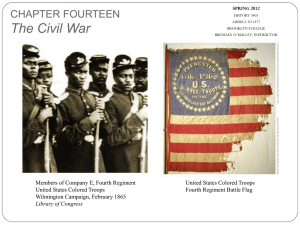
Chapter 14 Lecture PowerPont
... sailors, and laborers for the Union forces. In the first few months of the war, blacks were almost entirely excluded from serving; a few regiments sprung up in Union-occupied areas of the Confederacy. Growing Black Enlistment: After the Emancipation Proclamation, black enlistment increased greatly, ...
... sailors, and laborers for the Union forces. In the first few months of the war, blacks were almost entirely excluded from serving; a few regiments sprung up in Union-occupied areas of the Confederacy. Growing Black Enlistment: After the Emancipation Proclamation, black enlistment increased greatly, ...

What did the Emancipation Proclamation accomplish?
... Hoped to stop the Confederacy from using slave labor to aid in their war effort Thought Great Britain, France, and Spain would support the North because they were strong antislavery countries Needed to stop Great Britain's growing support for the Confederacy ...
... Hoped to stop the Confederacy from using slave labor to aid in their war effort Thought Great Britain, France, and Spain would support the North because they were strong antislavery countries Needed to stop Great Britain's growing support for the Confederacy ...
Allatoona Pass Battlefield
... At 3:00 in the morning, October 5th, CSA General Samuel French arrived at Allatoona with his division of 3,276 men. His orders were to take the fort and fill the pass with debris, burn the Etowah River bridge five miles away, and then rejoin Hood the next day at New Hope Church. Within a few hours, ...
... At 3:00 in the morning, October 5th, CSA General Samuel French arrived at Allatoona with his division of 3,276 men. His orders were to take the fort and fill the pass with debris, burn the Etowah River bridge five miles away, and then rejoin Hood the next day at New Hope Church. Within a few hours, ...

Why the Civil War was fought: Lincoln`s Second Inaugural Address
... II. “Tardy George” McClellan and the Peninsula Campaign A. Later in 1861, command of the Army of the Potomac (name of the Union army) was given to 34 year old General George B. McClellan, an excellent drillmaster and organizer of troops, but also a perfectionist who constantly believed that he was o ...
... II. “Tardy George” McClellan and the Peninsula Campaign A. Later in 1861, command of the Army of the Potomac (name of the Union army) was given to 34 year old General George B. McClellan, an excellent drillmaster and organizer of troops, but also a perfectionist who constantly believed that he was o ...

Civil War Power Point - Long Branch Public Schools
... • Merrimack vs. the Monitor – 1862 – South rebuilt old US warship (the Merrimack); used old iron rails to plate its sides; ship renamed the Virginia – March 9, 1862 – Monitor (a small Union iron ship) fought Merrimack to standstill – Confederates destroyed Merrimack to keep it from being captured b ...
... • Merrimack vs. the Monitor – 1862 – South rebuilt old US warship (the Merrimack); used old iron rails to plate its sides; ship renamed the Virginia – March 9, 1862 – Monitor (a small Union iron ship) fought Merrimack to standstill – Confederates destroyed Merrimack to keep it from being captured b ...
History 202: Class Notes - Linn
... Once the necessity of conquering the Southern people and eliminating its armies became clear to Northern leaders and generals, this strategy was quickly designed to counter-balance the South’s ability to shift forces along interior lines. The only way to achieve victory, Lincoln soon became convince ...
... Once the necessity of conquering the Southern people and eliminating its armies became clear to Northern leaders and generals, this strategy was quickly designed to counter-balance the South’s ability to shift forces along interior lines. The only way to achieve victory, Lincoln soon became convince ...
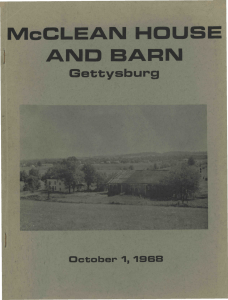
McCLEAN HOUSE AND BARN
... 13. The exact alignment of the regiments within the two divisions cannot be determined. The 1st Brigade, Third Division of the Eleventh Corps was on the left of the line. Three regiments (45th New York, 157th New York and 74th Pennsylvania) claim to have been the far left ., A... •-, //y. r.ha Eleve ...
... 13. The exact alignment of the regiments within the two divisions cannot be determined. The 1st Brigade, Third Division of the Eleventh Corps was on the left of the line. Three regiments (45th New York, 157th New York and 74th Pennsylvania) claim to have been the far left ., A... •-, //y. r.ha Eleve ...

Civil War Events - Paulding County Schools
... defeat of the war. The South’s win at Chancellorsville led to overconfidence among the Confederate – they believed that they couldn’t lose. Lee took advantage of this increased morale among his men. Confederate General Robert E. Lee led his troops north, hoping to get to a major northern city to “br ...
... defeat of the war. The South’s win at Chancellorsville led to overconfidence among the Confederate – they believed that they couldn’t lose. Lee took advantage of this increased morale among his men. Confederate General Robert E. Lee led his troops north, hoping to get to a major northern city to “br ...
1863: Shifting Tides
... General Grant, attacked the areas around Vicksburg and held the Confederate Army, under General Pemberton, under siege. Pemberton waited for reinforcements from Gen. Joseph Johnston’s Army of the Tennessee, but was forced to surrender the city on July 4 when reinforcements did not arrive. With the l ...
... General Grant, attacked the areas around Vicksburg and held the Confederate Army, under General Pemberton, under siege. Pemberton waited for reinforcements from Gen. Joseph Johnston’s Army of the Tennessee, but was forced to surrender the city on July 4 when reinforcements did not arrive. With the l ...
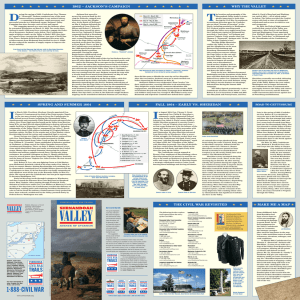
Narrative side - Civil War Travel
... Ulysses S. Grant general-in-chief of the Union armies. Together the two men created a plan to force the Confederates to defend several fronts, including the Shenandoah Valley, simultaneously and constantly. While Federal armies advanced elsewhere, Gen. Franz Sigel marched south up the Valley from Ma ...
... Ulysses S. Grant general-in-chief of the Union armies. Together the two men created a plan to force the Confederates to defend several fronts, including the Shenandoah Valley, simultaneously and constantly. While Federal armies advanced elsewhere, Gen. Franz Sigel marched south up the Valley from Ma ...
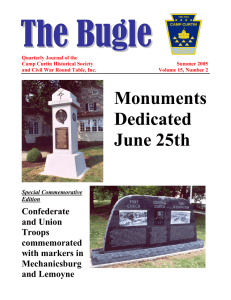
T h e
... the house, helped with the unveiling of the monument. Jenkins' Cavalry Brigade was in the Harrisburg area as the vanguard of Ewell's Corps, scouting the defenses of Pennsylvania's capital city. Jenkins' troops skirmished with Union militia at Oyster Point and Sporting Hill, the northernmost engageme ...
... the house, helped with the unveiling of the monument. Jenkins' Cavalry Brigade was in the Harrisburg area as the vanguard of Ewell's Corps, scouting the defenses of Pennsylvania's capital city. Jenkins' troops skirmished with Union militia at Oyster Point and Sporting Hill, the northernmost engageme ...

Bus Tour of Sherman`s March to be held on November 17
... of that order would inflict on helpless women and children." Sherman replied in these words: "I give full credit to your statements of the distress that will be occasioned by it, and yet I shall not revoke my order, because my orders are not designed to meet the humanities of the case." At the end o ...
... of that order would inflict on helpless women and children." Sherman replied in these words: "I give full credit to your statements of the distress that will be occasioned by it, and yet I shall not revoke my order, because my orders are not designed to meet the humanities of the case." At the end o ...

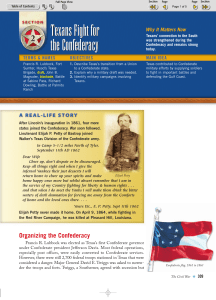
Texans Fight for the Confederacy Texans Fight for the Confederacy
... troops guarding the frontier of West Texas. But Confederate commanders had almost no troops to spare from fighting Union soldiers in the East. In most cases, Texans had to defend the frontier against Native Americans on their own for the first few years of the war. Most of the fighting in Texas cent ...
... troops guarding the frontier of West Texas. But Confederate commanders had almost no troops to spare from fighting Union soldiers in the East. In most cases, Texans had to defend the frontier against Native Americans on their own for the first few years of the war. Most of the fighting in Texas cent ...

Civil War Carousel Activity
... defeat of the war. The South’s win at Chancellorsville led to overconfidence among the Confederate – they believed that they couldn’t lose. Lee took advantage of this increased morale among his men. Confederate General Robert E. Lee led his troops north, hoping to get to a major northern city to “br ...
... defeat of the war. The South’s win at Chancellorsville led to overconfidence among the Confederate – they believed that they couldn’t lose. Lee took advantage of this increased morale among his men. Confederate General Robert E. Lee led his troops north, hoping to get to a major northern city to “br ...
No Slide Title
... •Picture celebrated the Emancipation Proclamation in 1863. •While it placed a white Union soldier in the center: •It also portrayed the important role of African American troops and emphasized the importance of education and literacy. ...
... •Picture celebrated the Emancipation Proclamation in 1863. •While it placed a white Union soldier in the center: •It also portrayed the important role of African American troops and emphasized the importance of education and literacy. ...
24aCW1861-1863 - Somerset Independent Schools
... •Picture celebrated the Emancipation Proclamation in 1863. •While it placed a white Union soldier in the center: •It also portrayed the important role of African American troops and emphasized the importance of education and literacy. ...
... •Picture celebrated the Emancipation Proclamation in 1863. •While it placed a white Union soldier in the center: •It also portrayed the important role of African American troops and emphasized the importance of education and literacy. ...
Comparing Bull Runs - Civil War Rumblings
... graduates of the Class of 1838. On the other hand, Lee despised the new Federal commander, Pope, as did a number of other officers on both sides. Among other things Pope’s bombastic rhetoric managed to harden attitudes of friends as well as foes. Both battles featured two of the same terrain feature ...
... graduates of the Class of 1838. On the other hand, Lee despised the new Federal commander, Pope, as did a number of other officers on both sides. Among other things Pope’s bombastic rhetoric managed to harden attitudes of friends as well as foes. Both battles featured two of the same terrain feature ...
1863: Shifting Tides
... General Grant, attacked the areas around Vicksburg and held the Confederate Army, under General Pemberton, under siege. Pemberton waited for reinforcements from Gen. Joseph Johnston’s Army of the Tennessee, but was forced to surrender the city on July 4 when reinforcements did not arrive. With the l ...
... General Grant, attacked the areas around Vicksburg and held the Confederate Army, under General Pemberton, under siege. Pemberton waited for reinforcements from Gen. Joseph Johnston’s Army of the Tennessee, but was forced to surrender the city on July 4 when reinforcements did not arrive. With the l ...
B. Mitchell`s Defense
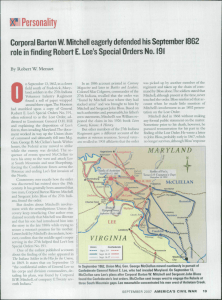
... Robert E. Lee's Special Orders No. 191, often referred to as the Lost Order, addressed to Lieutenant General D.H. Hill and explaining the disposition of Lee's forces, then invading Maryland.Tbe document worked its way up the Union chain of command and ultimately fell into Maj. Gen. George B. McClell ...
... Robert E. Lee's Special Orders No. 191, often referred to as the Lost Order, addressed to Lieutenant General D.H. Hill and explaining the disposition of Lee's forces, then invading Maryland.Tbe document worked its way up the Union chain of command and ultimately fell into Maj. Gen. George B. McClell ...
dedication of new yo..
... The battles of Waterloo and Gettysburg are sometimes compared. Both are included among the decisive conflicts recorded in history. The tactics in both battles have been much discussed and freely criticised. The contending hosts were not unlike in numbers, until the arrival of Blucher made the allied ...
... The battles of Waterloo and Gettysburg are sometimes compared. Both are included among the decisive conflicts recorded in history. The tactics in both battles have been much discussed and freely criticised. The contending hosts were not unlike in numbers, until the arrival of Blucher made the allied ...
The Battle of Gettysburg
... recapturing Chattanooga. The attack on Chattanooga was a southern defeat that brought General Ulysses S. Grant more attention and led to his promotion to the Commanding General of the U.S. Army. Once Chattanooga was defended and securely in Union hands, it was used as a launching point for Sherman’s ...
... recapturing Chattanooga. The attack on Chattanooga was a southern defeat that brought General Ulysses S. Grant more attention and led to his promotion to the Commanding General of the U.S. Army. Once Chattanooga was defended and securely in Union hands, it was used as a launching point for Sherman’s ...
Emancipation Proclamation
... •Picture celebrated the Emancipation Proclamation in 1863. •While it placed a white Union soldier in the center: •It also portrayed the important role of African American troops and emphasized the importance of education and literacy. ...
... •Picture celebrated the Emancipation Proclamation in 1863. •While it placed a white Union soldier in the center: •It also portrayed the important role of African American troops and emphasized the importance of education and literacy. ...

Name: Period: ______ Date: Chapter 11 Study Guide (75 Points
... Checkpoint: “What were some of the strengths and weaknesses of the Union and the Confederacy?” ...
... Checkpoint: “What were some of the strengths and weaknesses of the Union and the Confederacy?” ...
Battle of Antietam

The Battle of Antietam /ænˈtiːtəm/, also known as the Battle of Sharpsburg, particularly in the South, fought on September 17, 1862, near Sharpsburg, Maryland, and Antietam Creek as part of the Maryland Campaign, was the first major battle in the American Civil War to take place on Union soil. It is the bloodiest single-day battle in American history, with a combined tally of dead, wounded, and missing at 22,717.After pursuing Confederate General Robert E. Lee into Maryland, Union Army Maj. Gen. George B. McClellan launched attacks against Lee's army, in defensive positions behind Antietam Creek. At dawn on September 17, Maj. Gen. Joseph Hooker's corps mounted a powerful assault on Lee's left flank. Attacks and counterattacks swept across Miller's Cornfield and fighting swirled around the Dunker Church. Union assaults against the Sunken Road eventually pierced the Confederate center, but the Federal advantage was not followed up. In the afternoon, Union Maj. Gen. Ambrose Burnside's corps entered the action, capturing a stone bridge over Antietam Creek and advancing against the Confederate right. At a crucial moment, Confederate Maj. Gen. A. P. Hill's division arrived from Harpers Ferry and launched a surprise counterattack, driving back Burnside and ending the battle. Although outnumbered two-to-one, Lee committed his entire force, while McClellan sent in less than three-quarters of his army, enabling Lee to fight the Federals to a standstill. During the night, both armies consolidated their lines. In spite of crippling casualties, Lee continued to skirmish with McClellan throughout September 18, while removing his battered army south of the Potomac River.Despite having superiority of numbers, McClellan's attacks failed to achieve force concentration, allowing Lee to counter by shifting forces and moving interior lines to meet each challenge. Despite ample reserve forces that could have been deployed to exploit localized successes, McClellan failed to destroy Lee's army. McClellan had halted Lee's invasion of Maryland, but Lee was able to withdraw his army back to Virginia without interference from the cautious McClellan. Although the battle was tactically inconclusive, the Confederate troops had withdrawn first from the battlefield, making it, in military terms, a Union victory. It had significance as enough of a victory to give President Abraham Lincoln the confidence to announce his Emancipation Proclamation, which discouraged the British and French governments from potential plans for recognition of the Confederacy.