
Bringing the War to an End
... 1864. Union Maj. Gen. William T. Sherman invaded Georgia, opposed by the Confederate general Joseph E. Johnston. Johnston's Army of Tennessee withdrew toward Atlanta. Davis replaced Johnston with John Bell Hood, whose army was eventually besieged in Atlanta. The city fell on September 2, but casualt ...
... 1864. Union Maj. Gen. William T. Sherman invaded Georgia, opposed by the Confederate general Joseph E. Johnston. Johnston's Army of Tennessee withdrew toward Atlanta. Davis replaced Johnston with John Bell Hood, whose army was eventually besieged in Atlanta. The city fell on September 2, but casualt ...
A Critical Analysis of The Killer Angels
... movie as exhausted and desperate for the war to be over. Lee experiences an internal struggle each time he sends men into battle. The greatest example of Lee’s struggles is on the third day of battle, he is so determined to end the war in order for them to all go home that he orders a major attack, ...
... movie as exhausted and desperate for the war to be over. Lee experiences an internal struggle each time he sends men into battle. The greatest example of Lee’s struggles is on the third day of battle, he is so determined to end the war in order for them to all go home that he orders a major attack, ...

The Union In Peril: Civil War and Reconstruction
... First Battle of Manassas or The Battle of Bull Run July, 1861: First bloodshed on the battlefield Battle took place near Bull Run creek/city of Manassas ...
... First Battle of Manassas or The Battle of Bull Run July, 1861: First bloodshed on the battlefield Battle took place near Bull Run creek/city of Manassas ...
Grey Curves on Blankboard
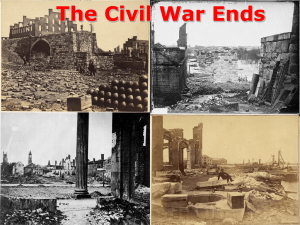
... • Sherman uses total war to cut a path 60 miles wide and 300 miles long through Georgia – His success aids in Lincoln’s victory in the election of 1864 – Breaks the spirit of the South Powerpoint Templates ...
... • Sherman uses total war to cut a path 60 miles wide and 300 miles long through Georgia – His success aids in Lincoln’s victory in the election of 1864 – Breaks the spirit of the South Powerpoint Templates ...
The Civil War (1861–1865)
... Civil War. Members of Booth's conspiracy team were rounded up, tried and quickly executed, including Mary Surratt whose boarding house was used as a meeting place. The bodies were left hanging from the scaffold a full half hour while photographs were taken. The hoods worn by the convicted can be see ...
... Civil War. Members of Booth's conspiracy team were rounded up, tried and quickly executed, including Mary Surratt whose boarding house was used as a meeting place. The bodies were left hanging from the scaffold a full half hour while photographs were taken. The hoods worn by the convicted can be see ...
The Civil War (1861–1865)
... Civil War. Members of Booth's conspiracy team were rounded up, tried and quickly executed, including Mary Surratt whose boarding house was used as a meeting place. The bodies were left hanging from the scaffold a full half hour while photographs were taken. The hoods worn by the convicted can be see ...
... Civil War. Members of Booth's conspiracy team were rounded up, tried and quickly executed, including Mary Surratt whose boarding house was used as a meeting place. The bodies were left hanging from the scaffold a full half hour while photographs were taken. The hoods worn by the convicted can be see ...
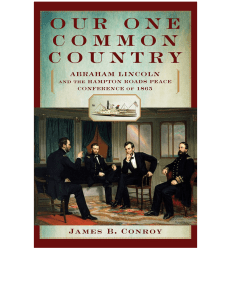
Abraham Lincoln and the Hampton Roads Peace Conference of 1865
... were coming to Hampton Roads in search of a way out. Entrenched in a fortified arc on the edge of Petersburg, Virginia, one day’s march from Richmond, General Robert E. Lee was praying for their success. The 50,000 men and boys of the Army of Northern Virginia were ragged, gaunt, and bleeding. The o ...
... were coming to Hampton Roads in search of a way out. Entrenched in a fortified arc on the edge of Petersburg, Virginia, one day’s march from Richmond, General Robert E. Lee was praying for their success. The 50,000 men and boys of the Army of Northern Virginia were ragged, gaunt, and bleeding. The o ...
Southern General Robert E. Lee Surrenders at Appomattox
... Lee rose as Grant walked into the house. Grant did not look like a great military leader, the chief of all Union armies. He was dressed simply. His clothes were the same as ...
... Lee rose as Grant walked into the house. Grant did not look like a great military leader, the chief of all Union armies. He was dressed simply. His clothes were the same as ...
Section 5 Decisive Battles
... Confederate Victories Burnside knew McClellan had been fired for being too cautious. So Burnside decided on a bold stroke. In December 1862, he marched his army of 120,000 men directly toward Richmond. Lee massed 75,000 men at Fredericksburg, Virginia, to block their path. Using traditional tactics, ...
... Confederate Victories Burnside knew McClellan had been fired for being too cautious. So Burnside decided on a bold stroke. In December 1862, he marched his army of 120,000 men directly toward Richmond. Lee massed 75,000 men at Fredericksburg, Virginia, to block their path. Using traditional tactics, ...
An Introduction to the Civil War - Via Sapientiae
... The first major battle of the war took place on July, 28, 1861. The battle lasted one day. It took place in Manassas, VA, a town in northern Virginia. General P. G. T. Beauregard was in charge of the Confederate forces and General Irwin McDowell commanded the Union troops. Civilians from Washington, ...
... The first major battle of the war took place on July, 28, 1861. The battle lasted one day. It took place in Manassas, VA, a town in northern Virginia. General P. G. T. Beauregard was in charge of the Confederate forces and General Irwin McDowell commanded the Union troops. Civilians from Washington, ...
Edward G. Longacre, The Early Morning of War: Bull Run, 1861
... member of the planter class. His captors asked why he, a nonslaveowner, was fighting to uphold slavery. He replied: ‘I’m fighting because you’re down here.’” ...
... member of the planter class. His captors asked why he, a nonslaveowner, was fighting to uphold slavery. He replied: ‘I’m fighting because you’re down here.’” ...

Humanitarian Acts: What Can Bystanders Do?
... Confederate garrison stationed there. From October 28 to November 13, 1864, Morristown was engulfed in a “battle between brothers” when Union forces that had taken control of nearby Knoxville were given the task of capturing neighboring Confederate-held areas. On the morning of October 23, Union tro ...
... Confederate garrison stationed there. From October 28 to November 13, 1864, Morristown was engulfed in a “battle between brothers” when Union forces that had taken control of nearby Knoxville were given the task of capturing neighboring Confederate-held areas. On the morning of October 23, Union tro ...
Echoes from the Blue and Gray
... down what he argued was a treacherous act of rebellion (four border slave states remained in the Union and two Union states were added during the Civil War). Four more states seceded making eleven Confederate states: Alabama, Arkansas, Florida, Georgia, Louisiana, Mississippi, North Carolina, South ...
... down what he argued was a treacherous act of rebellion (four border slave states remained in the Union and two Union states were added during the Civil War). Four more states seceded making eleven Confederate states: Alabama, Arkansas, Florida, Georgia, Louisiana, Mississippi, North Carolina, South ...
Chapter 21
... I. Bull Run Ends the “Ninety-Day War” • Bull Run (Manassas Junction) – Lincoln eventually concluded that an attack on a smaller Confederate force might be worth a try: • If successful it would demonstrate the superiority of Union arms • It might lead to the capture of the Confederate capital at Ric ...
... I. Bull Run Ends the “Ninety-Day War” • Bull Run (Manassas Junction) – Lincoln eventually concluded that an attack on a smaller Confederate force might be worth a try: • If successful it would demonstrate the superiority of Union arms • It might lead to the capture of the Confederate capital at Ric ...
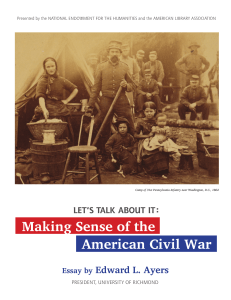
Let`s Talk About It: Making Sense of the American Civil War
... the Lower Mississippi Valley — indeed, to push the Union Army all the way back to the Ohio River — the Battle of Shiloh shattered any fantasies people had that the war would be won easily by either side. While the United States prevented the Confederacy from seizing the great victory it had imagine ...
... the Lower Mississippi Valley — indeed, to push the Union Army all the way back to the Ohio River — the Battle of Shiloh shattered any fantasies people had that the war would be won easily by either side. While the United States prevented the Confederacy from seizing the great victory it had imagine ...
introductory essay - American Library Association
... the Lower Mississippi Valley — indeed, to push the Union Army all the way back to the Ohio River — the Battle of Shiloh shattered any fantasies people had that the war would be won easily by either side. While the United States prevented the Confederacy from seizing the great victory it had imagine ...
... the Lower Mississippi Valley — indeed, to push the Union Army all the way back to the Ohio River — the Battle of Shiloh shattered any fantasies people had that the war would be won easily by either side. While the United States prevented the Confederacy from seizing the great victory it had imagine ...
The Battle of Chickamauga and its Aftermath
... and bushy woods were left to those who were too much worn to escape the rapid strides of the heroic Confederates. The left wing swept forward, and the right sprang to the broad Chattanooga highway. Like magic the Union army had melted away in our presence. A few hundred prisoners were picked up by b ...
... and bushy woods were left to those who were too much worn to escape the rapid strides of the heroic Confederates. The left wing swept forward, and the right sprang to the broad Chattanooga highway. Like magic the Union army had melted away in our presence. A few hundred prisoners were picked up by b ...
First Battle of Bull Run
... Tyler's men reached the Stone Bridge around 6 a.m.[6] At 5:15 a.m., Richardson's brigade fired a few artillery rounds across Mitchell's Ford on the Confederate right, some of which hit Beauregard's headquarters in the Wilmer McLean house as he was eating breakfast, alerting him to the fact that his ...
... Tyler's men reached the Stone Bridge around 6 a.m.[6] At 5:15 a.m., Richardson's brigade fired a few artillery rounds across Mitchell's Ford on the Confederate right, some of which hit Beauregard's headquarters in the Wilmer McLean house as he was eating breakfast, alerting him to the fact that his ...
Geology and the Gettysburg campaign
... The Gettysburg campaign began on June 3, 1863. On that day, Ewell’s Corps of the Army of Northern Virginia left Fredericksburg, marching by way of Culpeper toward the Blue Ridge and the Great Valley. A glance at the map might give the impression that the Confederate commander was taking a roundabou ...
... The Gettysburg campaign began on June 3, 1863. On that day, Ewell’s Corps of the Army of Northern Virginia left Fredericksburg, marching by way of Culpeper toward the Blue Ridge and the Great Valley. A glance at the map might give the impression that the Confederate commander was taking a roundabou ...
Chapter 10 - Michigan Open Book project
... abstain from involving themselves in the war until the South proved they could win (which they never did or at least not to the level that the Europeans needed to be persuaded). When Lincoln first called for volunteers after the battle at Fort Sumter, he and his advisors anticipated a quick conflict ...
... abstain from involving themselves in the war until the South proved they could win (which they never did or at least not to the level that the Europeans needed to be persuaded). When Lincoln first called for volunteers after the battle at Fort Sumter, he and his advisors anticipated a quick conflict ...
The First Day at Chancellorsville by Frank O`Reilly
... oracles of the bloody work at hand.” Federal infantry, under Major General Sykes, had advanced to a ridge overlooking Mott’s Run just as the Union cavalry withdrew across the stream. As the arriving Union division reached the Absalom McGee and Newton farms, it spotted the retreating 8th Pennsylvania ...
... oracles of the bloody work at hand.” Federal infantry, under Major General Sykes, had advanced to a ridge overlooking Mott’s Run just as the Union cavalry withdrew across the stream. As the arriving Union division reached the Absalom McGee and Newton farms, it spotted the retreating 8th Pennsylvania ...
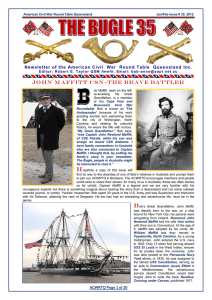
The Bugle #35 - American Civil War Round Table of Queensland
... one to give up, on return to the South, Maffitt took command of blockade runners Florrie (named after his daughter) and Lillian. After a brief tenure as commander of the ironclad C.S.S. Albemarle, where the ship dominated the Roanoke River and approaches to Plymouth in North Carolina, he returned to ...
... one to give up, on return to the South, Maffitt took command of blockade runners Florrie (named after his daughter) and Lillian. After a brief tenure as commander of the ironclad C.S.S. Albemarle, where the ship dominated the Roanoke River and approaches to Plymouth in North Carolina, he returned to ...
File
... and surrounds the city Vicksburg forced to surrender Union gains control of Mississippi River The South is split ...
... and surrounds the city Vicksburg forced to surrender Union gains control of Mississippi River The South is split ...
Ch. 9 PowerPoint
... The War in the East (cont.) • In late June 1862, Lee began a series of attacks on McClellan’s army that became known as the Seven Days’ Battle. • Lee could not defeat the Union army but did inflict heavy casualties and force McClellan to retreat to the James River. • Lincoln ordered McClellan to br ...
... The War in the East (cont.) • In late June 1862, Lee began a series of attacks on McClellan’s army that became known as the Seven Days’ Battle. • Lee could not defeat the Union army but did inflict heavy casualties and force McClellan to retreat to the James River. • Lincoln ordered McClellan to br ...
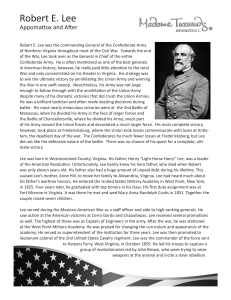
Lesson Plan - Madame Tussauds
... him to win battles and break down the defenses of the United States Army. His characteristics won him the loyalty of his officers, such as Thomas “Stonewall” Jackson, and great popularity among his soldiers. Lee led his army into the Battle of Gettysburg in 1863. This was one of the few battles foug ...
... him to win battles and break down the defenses of the United States Army. His characteristics won him the loyalty of his officers, such as Thomas “Stonewall” Jackson, and great popularity among his soldiers. Lee led his army into the Battle of Gettysburg in 1863. This was one of the few battles foug ...
Battle of Antietam

The Battle of Antietam /ænˈtiːtəm/, also known as the Battle of Sharpsburg, particularly in the South, fought on September 17, 1862, near Sharpsburg, Maryland, and Antietam Creek as part of the Maryland Campaign, was the first major battle in the American Civil War to take place on Union soil. It is the bloodiest single-day battle in American history, with a combined tally of dead, wounded, and missing at 22,717.After pursuing Confederate General Robert E. Lee into Maryland, Union Army Maj. Gen. George B. McClellan launched attacks against Lee's army, in defensive positions behind Antietam Creek. At dawn on September 17, Maj. Gen. Joseph Hooker's corps mounted a powerful assault on Lee's left flank. Attacks and counterattacks swept across Miller's Cornfield and fighting swirled around the Dunker Church. Union assaults against the Sunken Road eventually pierced the Confederate center, but the Federal advantage was not followed up. In the afternoon, Union Maj. Gen. Ambrose Burnside's corps entered the action, capturing a stone bridge over Antietam Creek and advancing against the Confederate right. At a crucial moment, Confederate Maj. Gen. A. P. Hill's division arrived from Harpers Ferry and launched a surprise counterattack, driving back Burnside and ending the battle. Although outnumbered two-to-one, Lee committed his entire force, while McClellan sent in less than three-quarters of his army, enabling Lee to fight the Federals to a standstill. During the night, both armies consolidated their lines. In spite of crippling casualties, Lee continued to skirmish with McClellan throughout September 18, while removing his battered army south of the Potomac River.Despite having superiority of numbers, McClellan's attacks failed to achieve force concentration, allowing Lee to counter by shifting forces and moving interior lines to meet each challenge. Despite ample reserve forces that could have been deployed to exploit localized successes, McClellan failed to destroy Lee's army. McClellan had halted Lee's invasion of Maryland, but Lee was able to withdraw his army back to Virginia without interference from the cautious McClellan. Although the battle was tactically inconclusive, the Confederate troops had withdrawn first from the battlefield, making it, in military terms, a Union victory. It had significance as enough of a victory to give President Abraham Lincoln the confidence to announce his Emancipation Proclamation, which discouraged the British and French governments from potential plans for recognition of the Confederacy.