
Quotes of Abraham Lincoln
... Second Battle of Bull Run: August 29-30 1862 Lee defeats Union armies under General Pope, opens way to Maryland Battle of Antietam: September 17, 1862 McClellan was restored to command, Lee’s battle plans were discovered and Mac successfully stopped Lee’s advance in the bloodiest single day of fight ...
... Second Battle of Bull Run: August 29-30 1862 Lee defeats Union armies under General Pope, opens way to Maryland Battle of Antietam: September 17, 1862 McClellan was restored to command, Lee’s battle plans were discovered and Mac successfully stopped Lee’s advance in the bloodiest single day of fight ...
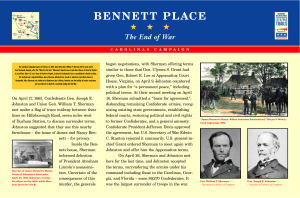
Bennett Place
... and single-shot carbines. Although the Confederates held the high ground, their weapons were no match for the Union soldiers’ new Spencer repeating rifles, and they withdrew, leaving three dead. About a mile upstream, the Confederates, with artillery, held the high ground and blocked ...
... and single-shot carbines. Although the Confederates held the high ground, their weapons were no match for the Union soldiers’ new Spencer repeating rifles, and they withdrew, leaving three dead. About a mile upstream, the Confederates, with artillery, held the high ground and blocked ...

Unwilling Witness to the Rage of Gettysburg
... recorded that “the man who did not have a limp in his gait in those trying days was a rare exception among his fellows.”8 James L. Bowen, historian of the 37th Massachusetts, in the 6th Corps, described the toll their epic march took upon the rank and file: Only the participant in like experiences c ...
... recorded that “the man who did not have a limp in his gait in those trying days was a rare exception among his fellows.”8 James L. Bowen, historian of the 37th Massachusetts, in the 6th Corps, described the toll their epic march took upon the rank and file: Only the participant in like experiences c ...
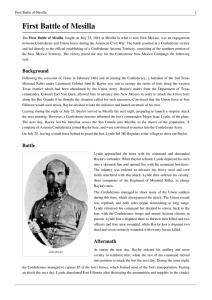
First Battle of Mesilla - Arizona Civil War Council
... The Confederates managed to shoot many of the Union soldiers during this time, which disorganized the attack. The Union assault was repulsed, and both sides began skirmishing at long range. Lynde reformed his command but decided to retreat back to the fort, with the Confederates troops and armed Ari ...
... The Confederates managed to shoot many of the Union soldiers during this time, which disorganized the attack. The Union assault was repulsed, and both sides began skirmishing at long range. Lynde reformed his command but decided to retreat back to the fort, with the Confederates troops and armed Ari ...
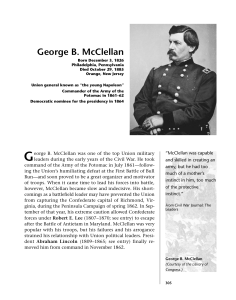
George B. McClellan - Scarsdale Public Schools
... launched another attack, he could have destroyed the Southern army. But the Union general was shaken by the high casualties his troops had suffered. “This Army is not now in condition to undertake another campaign nor to bring on another battle,” he stated. “I am tired of the sickening sight of the ...
... launched another attack, he could have destroyed the Southern army. But the Union general was shaken by the high casualties his troops had suffered. “This Army is not now in condition to undertake another campaign nor to bring on another battle,” he stated. “I am tired of the sickening sight of the ...

File - firestone falcons
... talk peace. • The Confederates planned to plunder Northern farms for supplies. ...
... talk peace. • The Confederates planned to plunder Northern farms for supplies. ...
Pickett`s Charge
... • 2- Involved infantry assault of approximately 15,000 Confederate soldiers • 3- Faced Union Major General George Meade and troops numbering 6,500 Federals • 4- The assault took nine brigades of Confederate soldiers • 5- Traveling over ¾ miles of open territory ...
... • 2- Involved infantry assault of approximately 15,000 Confederate soldiers • 3- Faced Union Major General George Meade and troops numbering 6,500 Federals • 4- The assault took nine brigades of Confederate soldiers • 5- Traveling over ¾ miles of open territory ...

Note Taking Study Guide
... Lee, who became commander of the Confederate army. The Confederacy also had a number of strategic advantages. According to the Anaconda Plan, Union forces would blockade southern ports and take control of the Mississippi River. This would split the Confederacy in two. The Union faced the problem of ...
... Lee, who became commander of the Confederate army. The Confederacy also had a number of strategic advantages. According to the Anaconda Plan, Union forces would blockade southern ports and take control of the Mississippi River. This would split the Confederacy in two. The Union faced the problem of ...

Document
... Civil War became a “total war” - must end slave labor in South - tower of strength - Lincoln’s cabinet - Lincoln waited for the right time ...
... Civil War became a “total war” - must end slave labor in South - tower of strength - Lincoln’s cabinet - Lincoln waited for the right time ...

CHAPTER 14 INDEPENDENT STUDY
... DAY 10 – Effects of the Civil War President Davis • Imprisoned for two years at Fort Monroe, Virginia, Davis was indicted for treason, but was never tried–the federal government feared that Davis would be able prove to a jury that the Southern secession of 1860 to 1861 was legal. Varina worked dete ...
... DAY 10 – Effects of the Civil War President Davis • Imprisoned for two years at Fort Monroe, Virginia, Davis was indicted for treason, but was never tried–the federal government feared that Davis would be able prove to a jury that the Southern secession of 1860 to 1861 was legal. Varina worked dete ...
February 2012 From The Adjutant
... and was assigned to light duty in the defenses of Richmond, Virginia while he recuperated. He recovered in time for General Robert E. Lee’s first invasion of the north in September, 1862, fighting at South Mountain and Sharpsburg. At Sharpsburg, he commanded one of two brigades that held out so long ...
... and was assigned to light duty in the defenses of Richmond, Virginia while he recuperated. He recovered in time for General Robert E. Lee’s first invasion of the north in September, 1862, fighting at South Mountain and Sharpsburg. At Sharpsburg, he commanded one of two brigades that held out so long ...
Echoes from the Blue and Gray
... down what he argued was a treacherous act of rebellion (four border slave states remained in the Union and two Union states were added during the Civil War). Four more states seceded making eleven Confederate states: Alabama, Arkansas, Florida, Georgia, Louisiana, Mississippi, North Carolina, South ...
... down what he argued was a treacherous act of rebellion (four border slave states remained in the Union and two Union states were added during the Civil War). Four more states seceded making eleven Confederate states: Alabama, Arkansas, Florida, Georgia, Louisiana, Mississippi, North Carolina, South ...
Civil War Battle of Glorieta Pass
... Marker #11: Bottom, Efraín M. Padró, (upper right) photo courtesy of the Colorado Historical Society scan #10025590; Marker #12: Pigeon’s Hospital by T. Harmon Parkhurst, courtesy Palace of the Governors Photo Archives (NMHM/DCA), negative #9690; (lower left) Courtesy of the Colorado Historical Soci ...
... Marker #11: Bottom, Efraín M. Padró, (upper right) photo courtesy of the Colorado Historical Society scan #10025590; Marker #12: Pigeon’s Hospital by T. Harmon Parkhurst, courtesy Palace of the Governors Photo Archives (NMHM/DCA), negative #9690; (lower left) Courtesy of the Colorado Historical Soci ...
Ch 16, pp. 462-483
... To take Richmond, the Union army would first have to defeat the Confederate troops stationed at the town of Manassas, Virginia. This was a railway center southwest of Washington, D.C. On July 21, 1861, Union forces commanded by General Irvin McDowell clashed with Confederate forces headed by General ...
... To take Richmond, the Union army would first have to defeat the Confederate troops stationed at the town of Manassas, Virginia. This was a railway center southwest of Washington, D.C. On July 21, 1861, Union forces commanded by General Irvin McDowell clashed with Confederate forces headed by General ...
The Surrenders - American Civil War Roundtable of Australia
... The actual official surrender ceremony was held three days later on April 12, four years to the day when Confederate forces opened fire on Fort Sumter in Charleston Harbour. Neither Grant nor Lee took part in this formal surrender ceremony, but contrary to the commonly recounted story, Joshua L Cha ...
... The actual official surrender ceremony was held three days later on April 12, four years to the day when Confederate forces opened fire on Fort Sumter in Charleston Harbour. Neither Grant nor Lee took part in this formal surrender ceremony, but contrary to the commonly recounted story, Joshua L Cha ...
Washington`s Principle: Civil-Military Relations 1776-2008
... Lee’s defensive line in the Battle of South Mountain on September 14 but again delayed his attack on Lee’s main column. It was not until September 17 that McClellan finally launched his attack east of Sharpsburg, Virginia. Lee was ready for him and the result was the bloodiest day in American histor ...
... Lee’s defensive line in the Battle of South Mountain on September 14 but again delayed his attack on Lee’s main column. It was not until September 17 that McClellan finally launched his attack east of Sharpsburg, Virginia. Lee was ready for him and the result was the bloodiest day in American histor ...
The Wilderness Campaign and Beyond: The Civil War Letters of
... was a detale of athousand men to get the stalled wagons back. (the rebels had a bord stuck up with big letters on it. Gen. ...
... was a detale of athousand men to get the stalled wagons back. (the rebels had a bord stuck up with big letters on it. Gen. ...
The American Civil War
... Timeline of Secession • February 18, 1861: Jefferson Davis inaugurated as President of the Confederacy. • March 4, 1861: Abraham Lincoln inaugurated as 16th President of the United States. • April 12, 1861: Fort Sumter fired upon by Confederates. ...
... Timeline of Secession • February 18, 1861: Jefferson Davis inaugurated as President of the Confederacy. • March 4, 1861: Abraham Lincoln inaugurated as 16th President of the United States. • April 12, 1861: Fort Sumter fired upon by Confederates. ...

HOW ONE MAN ARRIVED AT GETTYSBURG (Wesley Culp`s life
... South should be able to keep slavery joined the Confederate Army. This divided many families, including the Culp family. Wesley Culp, the son that went to college in the South, joined the Confederate army. His brother John believed that slavery should be abolished so he joined the Union soldiers of ...
... South should be able to keep slavery joined the Confederate Army. This divided many families, including the Culp family. Wesley Culp, the son that went to college in the South, joined the Confederate army. His brother John believed that slavery should be abolished so he joined the Union soldiers of ...

to view American Civil War Brochure
... know… During the Battle of Antietam, 12,401 Union men were killed, missing or wounded; double the casualties of D-Day, 82 years later. With a total of 23,000 casualties on both sides, it was the bloodiest single day of the Civil War. The Civil War was the first railway war, where both sides used an ...
... know… During the Battle of Antietam, 12,401 Union men were killed, missing or wounded; double the casualties of D-Day, 82 years later. With a total of 23,000 casualties on both sides, it was the bloodiest single day of the Civil War. The Civil War was the first railway war, where both sides used an ...
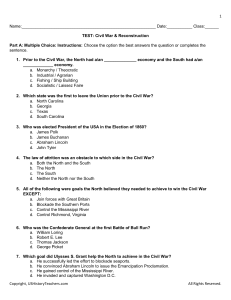
1 Copyright, USHistoryTeachers.com All Rights Reserved. Name: Dat
... d. He knew that Abraham Lincoln was not in Washington D.C. and that he would not be able to capture him if he invaded. 9. Why did Abraham Lincoln fire George McClellan? a. McClellan had plans to run against Lincoln in the Election of 1864. b. McClellan was using unethical war practices, such as stea ...
... d. He knew that Abraham Lincoln was not in Washington D.C. and that he would not be able to capture him if he invaded. 9. Why did Abraham Lincoln fire George McClellan? a. McClellan had plans to run against Lincoln in the Election of 1864. b. McClellan was using unethical war practices, such as stea ...

Chapter 21- Furnace of Civil War
... least for a time. By his successful defense of Richmond and defeat of McClellan, Lee had in effect ensured that the war would endure until slavery was uprooted and the Old South thoroughly destroyed. Lincoln himself, who had earlier professed his unwillingness to tamper with slavery where it already ...
... least for a time. By his successful defense of Richmond and defeat of McClellan, Lee had in effect ensured that the war would endure until slavery was uprooted and the Old South thoroughly destroyed. Lincoln himself, who had earlier professed his unwillingness to tamper with slavery where it already ...

Civil War Overview Lesson Plan
... The battle was a Confederate victory with Union casualties numbering 12,653 and Confederate casualties at 5,377. ...
... The battle was a Confederate victory with Union casualties numbering 12,653 and Confederate casualties at 5,377. ...
Battle of Antietam

The Battle of Antietam /ænˈtiːtəm/, also known as the Battle of Sharpsburg, particularly in the South, fought on September 17, 1862, near Sharpsburg, Maryland, and Antietam Creek as part of the Maryland Campaign, was the first major battle in the American Civil War to take place on Union soil. It is the bloodiest single-day battle in American history, with a combined tally of dead, wounded, and missing at 22,717.After pursuing Confederate General Robert E. Lee into Maryland, Union Army Maj. Gen. George B. McClellan launched attacks against Lee's army, in defensive positions behind Antietam Creek. At dawn on September 17, Maj. Gen. Joseph Hooker's corps mounted a powerful assault on Lee's left flank. Attacks and counterattacks swept across Miller's Cornfield and fighting swirled around the Dunker Church. Union assaults against the Sunken Road eventually pierced the Confederate center, but the Federal advantage was not followed up. In the afternoon, Union Maj. Gen. Ambrose Burnside's corps entered the action, capturing a stone bridge over Antietam Creek and advancing against the Confederate right. At a crucial moment, Confederate Maj. Gen. A. P. Hill's division arrived from Harpers Ferry and launched a surprise counterattack, driving back Burnside and ending the battle. Although outnumbered two-to-one, Lee committed his entire force, while McClellan sent in less than three-quarters of his army, enabling Lee to fight the Federals to a standstill. During the night, both armies consolidated their lines. In spite of crippling casualties, Lee continued to skirmish with McClellan throughout September 18, while removing his battered army south of the Potomac River.Despite having superiority of numbers, McClellan's attacks failed to achieve force concentration, allowing Lee to counter by shifting forces and moving interior lines to meet each challenge. Despite ample reserve forces that could have been deployed to exploit localized successes, McClellan failed to destroy Lee's army. McClellan had halted Lee's invasion of Maryland, but Lee was able to withdraw his army back to Virginia without interference from the cautious McClellan. Although the battle was tactically inconclusive, the Confederate troops had withdrawn first from the battlefield, making it, in military terms, a Union victory. It had significance as enough of a victory to give President Abraham Lincoln the confidence to announce his Emancipation Proclamation, which discouraged the British and French governments from potential plans for recognition of the Confederacy.