
Super Quiz Digest
... July of 1861, was the beginning of the tension. Eleven states had officially declared their independence from the United States of America. South Carolina responded to the election of Abraham Lincoln to the Presidency by calling for widespread secession. In April the first shots were fired when ...
... July of 1861, was the beginning of the tension. Eleven states had officially declared their independence from the United States of America. South Carolina responded to the election of Abraham Lincoln to the Presidency by calling for widespread secession. In April the first shots were fired when ...

09 TAJMT Chapter 02
... What do you think might have been the greatest advantage for the Confederates during the Civil War? A. They were fighting on their own land. ...
... What do you think might have been the greatest advantage for the Confederates during the Civil War? A. They were fighting on their own land. ...

If Lee Had Not Won the Battle of Gettysburg
... famous Confederatevictory of Gettysburgfurnish a fertile theme. There can be at this date no conceivable doubt that Pickett's charge would have been defeated if Stuart with his encircling cavalry had not arrived in the rear of the Union position at the supreme moment. Stuart might have been arrested ...
... famous Confederatevictory of Gettysburgfurnish a fertile theme. There can be at this date no conceivable doubt that Pickett's charge would have been defeated if Stuart with his encircling cavalry had not arrived in the rear of the Union position at the supreme moment. Stuart might have been arrested ...
1863: The Turning Point in The Civil War
... The Union surrounded Vicksburg and tried to control it for some time but the Confederates held their ground The Confederates were low on ammunition, food, and water and were all going to starve. On July 3rd John C. Pemberton received a letter from his soldiers saying if he couldn’t feed them, he sho ...
... The Union surrounded Vicksburg and tried to control it for some time but the Confederates held their ground The Confederates were low on ammunition, food, and water and were all going to starve. On July 3rd John C. Pemberton received a letter from his soldiers saying if he couldn’t feed them, he sho ...
The Encyclopedia of Civil War Battles
... John McIntosh Kell, and lieutenants Richard M. Armstrong, Joseph D. Wilson, Arthur Sinclair and John Lowe. Ship surgeons were Francis L. Galt and assistant surgeon David H. Llewellyn, who was British and somehow managed to sign on with Semmes, despite the risk of violating the British Foreign Enlist ...
... John McIntosh Kell, and lieutenants Richard M. Armstrong, Joseph D. Wilson, Arthur Sinclair and John Lowe. Ship surgeons were Francis L. Galt and assistant surgeon David H. Llewellyn, who was British and somehow managed to sign on with Semmes, despite the risk of violating the British Foreign Enlist ...
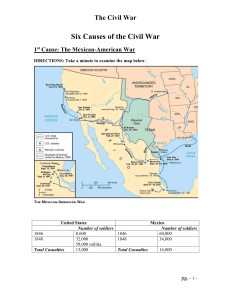
Civil War packet - Carrington Middle School
... unknown colonel from the Virginia Military Institute, Thomas J. Jackson, stood their ground and Jackson received his famous nickname, "Stonewall Jackson". The Confederates then launched a strong counterattack, and as the Union troops began withdrawing under fire, many panicked and it turned into a r ...
... unknown colonel from the Virginia Military Institute, Thomas J. Jackson, stood their ground and Jackson received his famous nickname, "Stonewall Jackson". The Confederates then launched a strong counterattack, and as the Union troops began withdrawing under fire, many panicked and it turned into a r ...
the press reports the battle of gettysburg
... whiskey was issued, Hood's division presented the liveliest spectacle I ever saw. Good humor and wit ran high, and it was difficult even to hear one's self talk.'3 Meanwhile the Federal army under Joseph Hooker was on its way north; it crossed the Potomac farther downstream and moved on to Frederick ...
... whiskey was issued, Hood's division presented the liveliest spectacle I ever saw. Good humor and wit ran high, and it was difficult even to hear one's self talk.'3 Meanwhile the Federal army under Joseph Hooker was on its way north; it crossed the Potomac farther downstream and moved on to Frederick ...

A terrible battlefield duel - confederate historical association of
... These regiments shared few physical characteristics in common. Neither knew their common fate nor destination when they left the fields of Virginia for the Potomac River in mid-June of 1863. There were, however, a number of characteristics shared in their character and fiber, which determined and ex ...
... These regiments shared few physical characteristics in common. Neither knew their common fate nor destination when they left the fields of Virginia for the Potomac River in mid-June of 1863. There were, however, a number of characteristics shared in their character and fiber, which determined and ex ...
US History
... Describe the Battle of Shiloh. How does this propel General Grant to the forefront of the Union leaders? ...
... Describe the Battle of Shiloh. How does this propel General Grant to the forefront of the Union leaders? ...

Kennedy-Chapter 21
... first in the Mexican War and then as an observer of the Crimean War in Russia. Cocky George McClellan embodied a curious mixture of virtues and defects. He was a superb organizer and drillmaster, and he injected splendid morale into the Army of the Potomac. Hating to sacrifice his troops, he was ido ...
... first in the Mexican War and then as an observer of the Crimean War in Russia. Cocky George McClellan embodied a curious mixture of virtues and defects. He was a superb organizer and drillmaster, and he injected splendid morale into the Army of the Potomac. Hating to sacrifice his troops, he was ido ...
Fort Henry and Donelson - Teach Tennessee History
... Bragg then planned to attack and destroy Rosecrans. Yet, for a week, Bragg tried and failed to get attacks organized. Each time, his subordinates failed to carry out orders. In the meantime, Rosecrans caught wind of what the Confederates were up to and positioned his own force along the West Chickam ...
... Bragg then planned to attack and destroy Rosecrans. Yet, for a week, Bragg tried and failed to get attacks organized. Each time, his subordinates failed to carry out orders. In the meantime, Rosecrans caught wind of what the Confederates were up to and positioned his own force along the West Chickam ...
Major General George G. Meade
... commanders of United States forces during the American Civil War. He commanded the Army of the Potomac, the main Federal army in the Eastern Theater of war, from June 1863 to the end of the war in April 1865, serving longer than any other commander. He is perhaps best known for his crucial victory i ...
... commanders of United States forces during the American Civil War. He commanded the Army of the Potomac, the main Federal army in the Eastern Theater of war, from June 1863 to the end of the war in April 1865, serving longer than any other commander. He is perhaps best known for his crucial victory i ...
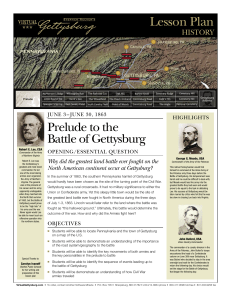
Lesson Plan - Virtual Gettysburg
... Henry Harrison Spy The identity of General James Longstreet’s famous scout, known only as “Harrison” remained a mystery for more than a century. However, in 1986 historian James O. Hall identified this elusive man. Researching the Civil War records at the National Archives, Hall found conclusive evid ...
... Henry Harrison Spy The identity of General James Longstreet’s famous scout, known only as “Harrison” remained a mystery for more than a century. However, in 1986 historian James O. Hall identified this elusive man. Researching the Civil War records at the National Archives, Hall found conclusive evid ...
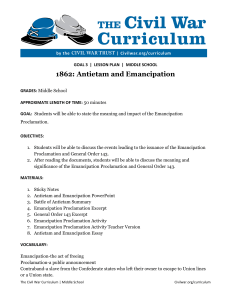
Antietam and Emancipation
... SUMMARY: In September 1862, Confederate general Robert E. Lee left the South and moved his army into Maryland. No one could be sure exactly what he planned to do, but in an incredible stroke of luck, a copy of Lee’s plans (which had been wrapped around three cigars) was discovered by Union soldiers ...
... SUMMARY: In September 1862, Confederate general Robert E. Lee left the South and moved his army into Maryland. No one could be sure exactly what he planned to do, but in an incredible stroke of luck, a copy of Lee’s plans (which had been wrapped around three cigars) was discovered by Union soldiers ...
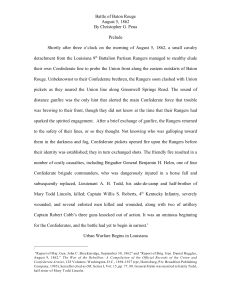
Battle of Baton Rouge - Young Sanders Center
... number of costly casualties, including Brigadier General Benjamin H. Helm, one of four Confederate brigade commanders, who was dangerously injured in a horse fall and subsequently replaced, Lieutenant A. H. Todd, his aide-de-camp and half-brother of Mary Todd Lincoln, killed; Captain Willis S. Rober ...
... number of costly casualties, including Brigadier General Benjamin H. Helm, one of four Confederate brigade commanders, who was dangerously injured in a horse fall and subsequently replaced, Lieutenant A. H. Todd, his aide-de-camp and half-brother of Mary Todd Lincoln, killed; Captain Willis S. Rober ...
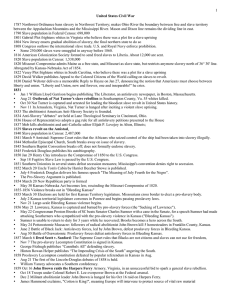
United States Civil War 1787 Northwest Ordinance bans slavery in
... (West) Feb 15 Grant attacks Fort Donelson, Tennessee and captures it the next day. (West) Feb 21 Battle of Valverde fought near Fort Craig in New Mexico Territory. Feb 22 Davis is officially inaugurated in Richmond, Virginia, to a 6-year term as president. (West) March 7 Battle of Pea Ridge: The Con ...
... (West) Feb 15 Grant attacks Fort Donelson, Tennessee and captures it the next day. (West) Feb 21 Battle of Valverde fought near Fort Craig in New Mexico Territory. Feb 22 Davis is officially inaugurated in Richmond, Virginia, to a 6-year term as president. (West) March 7 Battle of Pea Ridge: The Con ...
HISTORY Under - Cleveland Civil War Roundtable
... occupied Iuka in mid-September 1862, intent on preventing Union occupation forces in northern Mississippi and western Tennessee from reinforcing the garrison at Nashville. Alarmed that Price might be en route to strengthen Gen. Braxton Bragg’s Kentucky offensive, Maj. Gen. Ulysses Grant prepared to ...
... occupied Iuka in mid-September 1862, intent on preventing Union occupation forces in northern Mississippi and western Tennessee from reinforcing the garrison at Nashville. Alarmed that Price might be en route to strengthen Gen. Braxton Bragg’s Kentucky offensive, Maj. Gen. Ulysses Grant prepared to ...
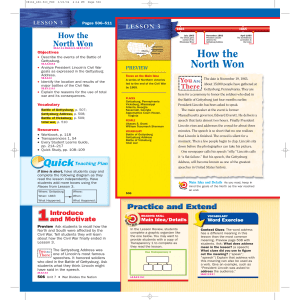
How the North Won - Mrs. McKoy`s Classroom
... One of the most important battles of the Civil War was a three-day struggle fought in Gettysburg, Pennsylvania. This was the farthest north that Confederate forces had advanced into Union territory. The Battle of Gettysburg began on July 1, 1863. The Confederates, led by Robert E. Lee, pushed the Un ...
... One of the most important battles of the Civil War was a three-day struggle fought in Gettysburg, Pennsylvania. This was the farthest north that Confederate forces had advanced into Union territory. The Battle of Gettysburg began on July 1, 1863. The Confederates, led by Robert E. Lee, pushed the Un ...
Lincoln, the Commander-in
... many more raw ones within supporting distance, all in addition to those who fought with you at Gettysburg; while it was not possible that he had received a single recruit; and yet you stood and let the flood run down, bridges be built, and the enemy move away at his leisure, without attacking him. A ...
... many more raw ones within supporting distance, all in addition to those who fought with you at Gettysburg; while it was not possible that he had received a single recruit; and yet you stood and let the flood run down, bridges be built, and the enemy move away at his leisure, without attacking him. A ...

14: The Civil War - apush-xl
... A) He did everything in his power to preserve their rights because he was devoted to individual freedom. B) He suspended the writ of habeas corpus in critical areas and applied martial law freely. C) He prohibited any free elections during the war. D) He accused newspapers that criticized his govern ...
... A) He did everything in his power to preserve their rights because he was devoted to individual freedom. B) He suspended the writ of habeas corpus in critical areas and applied martial law freely. C) He prohibited any free elections during the war. D) He accused newspapers that criticized his govern ...

October 2005 - 1st US Infantry Recreated
... The Newsletter of the 1 United States Infantry, The Regulars ...
... The Newsletter of the 1 United States Infantry, The Regulars ...
The Killer Angels by Michael Shaara
... of scouting the Union troops as he was supposed to do. Now with the information from the spy, Longstreet convinces Lee to bring his troops together and converge on Gettysburg. Lee believes that if the Union troops are really there, though he doubts they are, this could be the final battle of the war ...
... of scouting the Union troops as he was supposed to do. Now with the information from the spy, Longstreet convinces Lee to bring his troops together and converge on Gettysburg. Lee believes that if the Union troops are really there, though he doubts they are, this could be the final battle of the war ...

Waltham Watch and the Civil War
... Confederate cavalry under Jeb Stuart clash with the Union mounts of Alfred Pleasonton in an all day battle at Brandy Station, Virginia. Some 18,000 troopers—approximately nine thousand on either side—take part, making this the largest cavalry battle on American soil. In the end, Stuart will hold the ...
... Confederate cavalry under Jeb Stuart clash with the Union mounts of Alfred Pleasonton in an all day battle at Brandy Station, Virginia. Some 18,000 troopers—approximately nine thousand on either side—take part, making this the largest cavalry battle on American soil. In the end, Stuart will hold the ...
Battle of Leesburg by sfcdan
... control of the town necessitated a successful crossing of the Potomac River. This area fronted several potential crossing points; Conrad’s Ferry (north of town), Edward’s Ferry (south of town), and during times of low water a number of fording sites. The terrain near the river also offered an excell ...
... control of the town necessitated a successful crossing of the Potomac River. This area fronted several potential crossing points; Conrad’s Ferry (north of town), Edward’s Ferry (south of town), and during times of low water a number of fording sites. The terrain near the river also offered an excell ...

Civil War - Teachers.AUSD.NET
... A. Located at mouth of Charleston Harbor, Ft. Sumter was one of two last remaining federal forts in the South. 1. The day after inauguration, Lincoln notified by Major Robert Anderson that supplies to the fort would soon run out and he would be forced to surrender. 2. Lincoln faced with choices that ...
... A. Located at mouth of Charleston Harbor, Ft. Sumter was one of two last remaining federal forts in the South. 1. The day after inauguration, Lincoln notified by Major Robert Anderson that supplies to the fort would soon run out and he would be forced to surrender. 2. Lincoln faced with choices that ...
Battle of Antietam

The Battle of Antietam /ænˈtiːtəm/, also known as the Battle of Sharpsburg, particularly in the South, fought on September 17, 1862, near Sharpsburg, Maryland, and Antietam Creek as part of the Maryland Campaign, was the first major battle in the American Civil War to take place on Union soil. It is the bloodiest single-day battle in American history, with a combined tally of dead, wounded, and missing at 22,717.After pursuing Confederate General Robert E. Lee into Maryland, Union Army Maj. Gen. George B. McClellan launched attacks against Lee's army, in defensive positions behind Antietam Creek. At dawn on September 17, Maj. Gen. Joseph Hooker's corps mounted a powerful assault on Lee's left flank. Attacks and counterattacks swept across Miller's Cornfield and fighting swirled around the Dunker Church. Union assaults against the Sunken Road eventually pierced the Confederate center, but the Federal advantage was not followed up. In the afternoon, Union Maj. Gen. Ambrose Burnside's corps entered the action, capturing a stone bridge over Antietam Creek and advancing against the Confederate right. At a crucial moment, Confederate Maj. Gen. A. P. Hill's division arrived from Harpers Ferry and launched a surprise counterattack, driving back Burnside and ending the battle. Although outnumbered two-to-one, Lee committed his entire force, while McClellan sent in less than three-quarters of his army, enabling Lee to fight the Federals to a standstill. During the night, both armies consolidated their lines. In spite of crippling casualties, Lee continued to skirmish with McClellan throughout September 18, while removing his battered army south of the Potomac River.Despite having superiority of numbers, McClellan's attacks failed to achieve force concentration, allowing Lee to counter by shifting forces and moving interior lines to meet each challenge. Despite ample reserve forces that could have been deployed to exploit localized successes, McClellan failed to destroy Lee's army. McClellan had halted Lee's invasion of Maryland, but Lee was able to withdraw his army back to Virginia without interference from the cautious McClellan. Although the battle was tactically inconclusive, the Confederate troops had withdrawn first from the battlefield, making it, in military terms, a Union victory. It had significance as enough of a victory to give President Abraham Lincoln the confidence to announce his Emancipation Proclamation, which discouraged the British and French governments from potential plans for recognition of the Confederacy.