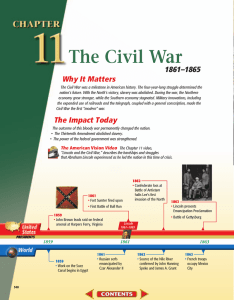
CHAPTER 11 The Civil War
... European textile factories, particularly in Britain and France, depended on Southern cotton. To pressure the British and French, many Southern planters voluntarily agreed not to sell their cotton in these markets until the Europeans recognized the Confederacy. The British and French met informally w ...
... European textile factories, particularly in Britain and France, depended on Southern cotton. To pressure the British and French, many Southern planters voluntarily agreed not to sell their cotton in these markets until the Europeans recognized the Confederacy. The British and French met informally w ...
TRANSCRIPT 7/04/12 Reflections on the Battle of Gettysburg and the Role of... Soldiers
... the time of the battle. Sitting here along the base of Bushman's Hill looking out at farm fields owned by family named slider. Judson Kilpatrick decided he should have his men attack through those fields against the southern end of the confederate line but there are Texas infantry and Alabama infant ...
... the time of the battle. Sitting here along the base of Bushman's Hill looking out at farm fields owned by family named slider. Judson Kilpatrick decided he should have his men attack through those fields against the southern end of the confederate line but there are Texas infantry and Alabama infant ...
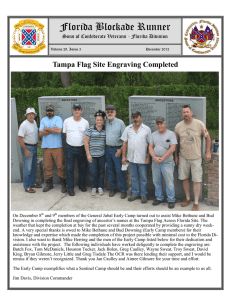
Florida Blockade Runner
... While the July 13 confrontation was little more than a skirmish, the Battle of Stone's River was a major battle of the War that also proved to be one of the bloodiest. There is too much to write about this clash to include an in-depth coverage in this article ( I will likely revisit the battle later ...
... While the July 13 confrontation was little more than a skirmish, the Battle of Stone's River was a major battle of the War that also proved to be one of the bloodiest. There is too much to write about this clash to include an in-depth coverage in this article ( I will likely revisit the battle later ...
Actions Impending - Gettysburg Civil War Roundtable
... Encampments include Confederate dismounted cavalry, Confederate & Union infantry units, loading and firing demonstrations and much more! ...
... Encampments include Confederate dismounted cavalry, Confederate & Union infantry units, loading and firing demonstrations and much more! ...
Confederate Strategy in 1863: Was a Strategic
... More ironic was the Archduke's interpretation of the secret of Napoleon's success. Archduke Charles postulated that Napoleon built his success between 1795 and 1809 on the groundwork of his predecessors in expanding France to stable or "natural" frontiers and then constructing an extensive, well-bui ...
... More ironic was the Archduke's interpretation of the secret of Napoleon's success. Archduke Charles postulated that Napoleon built his success between 1795 and 1809 on the groundwork of his predecessors in expanding France to stable or "natural" frontiers and then constructing an extensive, well-bui ...
The Camden Expedition of 1864
... ordered to advance and take positions on the right and left of the Old Military Road respectively. Company E, 2nd Missouri Light Artillery, deployed to the extreme right of the Union line and was soon engaged in an artillery duel that lasted through the afternoon and evening. The 43rd Indiana, in th ...
... ordered to advance and take positions on the right and left of the Old Military Road respectively. Company E, 2nd Missouri Light Artillery, deployed to the extreme right of the Union line and was soon engaged in an artillery duel that lasted through the afternoon and evening. The 43rd Indiana, in th ...
Alfred Surraneous Eaton 1840-1932 Life and Military History
... Freddie Helen Eaton Dies at the age of 3 In Memoriam written by Alfred S Eaton: Last Tuesday morning, at 4 o’clock just as the bright orb of day was ushering into this sad world of ours a flood of light and it came stealing over the hills into the window of her room, little Freddie Helen, daughter o ...
... Freddie Helen Eaton Dies at the age of 3 In Memoriam written by Alfred S Eaton: Last Tuesday morning, at 4 o’clock just as the bright orb of day was ushering into this sad world of ours a flood of light and it came stealing over the hills into the window of her room, little Freddie Helen, daughter o ...
Tale of the Tape: Civil War
... South Carolina sees it as aggression and fires/captures Ft. Sumter ...
... South Carolina sees it as aggression and fires/captures Ft. Sumter ...
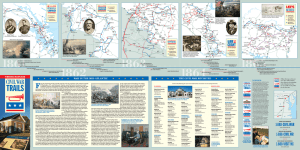
CWT Bi-State Narrative Side VA
... imprisoned Maryland Confederates. The state remained strongly Unionist in the west while southeastern Maryland became a secessionist hotbed of spies and smugglers along the Chesapeake Bay. The state did not secede. “Attack on the Massachusetts 6th at Baltimore, April 19th, 1861” Drawn by William Bom ...
... imprisoned Maryland Confederates. The state remained strongly Unionist in the west while southeastern Maryland became a secessionist hotbed of spies and smugglers along the Chesapeake Bay. The state did not secede. “Attack on the Massachusetts 6th at Baltimore, April 19th, 1861” Drawn by William Bom ...
U.S. Civil War The U.S. Civil War, also called the War between the
... Lincoln appointed General Joseph Hooker commander. Hooker proved no better. His attempt to outmaneuver Lee's forces at Chancellorsville, Virginia, in May 1863 led to defeat, retreat, and Hooker's dismissal as commander. Lee then invaded Pennsylvania, where a chance encounter of small units led to th ...
... Lincoln appointed General Joseph Hooker commander. Hooker proved no better. His attempt to outmaneuver Lee's forces at Chancellorsville, Virginia, in May 1863 led to defeat, retreat, and Hooker's dismissal as commander. Lee then invaded Pennsylvania, where a chance encounter of small units led to th ...

The Battle of Bull Run
... July 21 was quite hopeful for a Union victory. But I was anxious. I wanted to move closer to the action. I joined a few senators and newspapermen at the Warrenton Turnpike, about a mile east of Stone Bridge. It gave us the best view of the battle. We could hear the muskets being shot and see the sol ...
... July 21 was quite hopeful for a Union victory. But I was anxious. I wanted to move closer to the action. I joined a few senators and newspapermen at the Warrenton Turnpike, about a mile east of Stone Bridge. It gave us the best view of the battle. We could hear the muskets being shot and see the sol ...
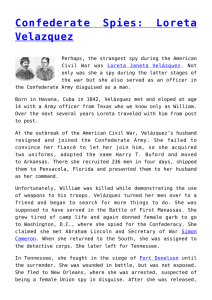
Confederate Spies: Loreta Velazquez,Union Spies: Elizabeth Van
... Stanton, mapped the unfamiliar terrain and reconnoitered its inhabitants. She later worked alongside Colonel James Montgomery, and provided him with key intelligence that aided the capture of Jacksonville, Florida. ...
... Stanton, mapped the unfamiliar terrain and reconnoitered its inhabitants. She later worked alongside Colonel James Montgomery, and provided him with key intelligence that aided the capture of Jacksonville, Florida. ...
Why was the Confederacy Defeated
... However, it is unlikely that a purely defensive strategy would have succeeded. General Joe Johnston was the Confederate exponent of defensive warfare. Refusing to stand and fight, he surrendered huge chunks of land virtually without a struggle in north Virginia in1862 and in Georgia in 1864. This di ...
... However, it is unlikely that a purely defensive strategy would have succeeded. General Joe Johnston was the Confederate exponent of defensive warfare. Refusing to stand and fight, he surrendered huge chunks of land virtually without a struggle in north Virginia in1862 and in Georgia in 1864. This di ...
Open Document - Bluegrass Heritage Museum
... John Boyd Huston (1813-1881) was born in Nelson County and came to Clark County after receiving a law degree from Transylvania University. He married Mary J. Allan, daughter of Chilton Allan, and went into practice with William S. Downey. Their office was on the site now occupied by the McEldowney B ...
... John Boyd Huston (1813-1881) was born in Nelson County and came to Clark County after receiving a law degree from Transylvania University. He married Mary J. Allan, daughter of Chilton Allan, and went into practice with William S. Downey. Their office was on the site now occupied by the McEldowney B ...
The Leadership of
... ROBERT E. LEE himself believed in the power of emulation. He believed you could study the lives of great men and learn something from them, not in the academic way but in a way that you would actually apply to your own life.... I cannot think personally of a better exemplar of mature leadership, of ...
... ROBERT E. LEE himself believed in the power of emulation. He believed you could study the lives of great men and learn something from them, not in the academic way but in a way that you would actually apply to your own life.... I cannot think personally of a better exemplar of mature leadership, of ...
confederate historical association of belgium
... one to two miles as well as short-range canister. Attacking across an open field of fire, with continuous reloading, exposed troops to murderous fire and untold slaughter. The United States military was not ignorant of the new technological developments in warfare but dismissal of long held military ...
... one to two miles as well as short-range canister. Attacking across an open field of fire, with continuous reloading, exposed troops to murderous fire and untold slaughter. The United States military was not ignorant of the new technological developments in warfare but dismissal of long held military ...
November/December 2012 - The Civil War Roundtable of Gettysburg
... the U.S., that finds such extreme focus in Lincoln, committed aspects of military triumph at all costs in men such as Sherman and Grant, and the paradoxical use of violence, against the backdrop of Christian “service and fervor”, in the surrendered South. In some ways, the entire war and its afterma ...
... the U.S., that finds such extreme focus in Lincoln, committed aspects of military triumph at all costs in men such as Sherman and Grant, and the paradoxical use of violence, against the backdrop of Christian “service and fervor”, in the surrendered South. In some ways, the entire war and its afterma ...
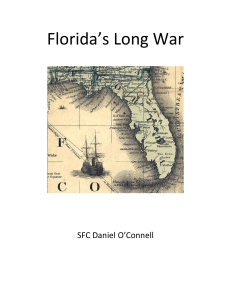
Florida`s Long War by sfcdan (Formatted Word
... extended coastline coupled with the presence of some important Federal installations made the state both a secondary strategic objective and a military flashpoint. As gigantic clashes of opposing forces rumbled through Virginia, Tennessee, and Mississippi, actions in Florida quickly became a distant ...
... extended coastline coupled with the presence of some important Federal installations made the state both a secondary strategic objective and a military flashpoint. As gigantic clashes of opposing forces rumbled through Virginia, Tennessee, and Mississippi, actions in Florida quickly became a distant ...
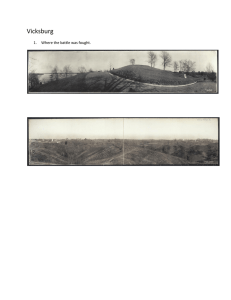
Vicksburg
... engagement at Jackson, cut off Johnston from Pemberton, and ensured the latter's isolation for the rest of the campaign. In 2 weeks Grant's force had come well over 130 mi. northeast from their Bruinsburg landing site. Ordering Sherman to destroy Jackson's heavy industry and rail facilities, Grant t ...
... engagement at Jackson, cut off Johnston from Pemberton, and ensured the latter's isolation for the rest of the campaign. In 2 weeks Grant's force had come well over 130 mi. northeast from their Bruinsburg landing site. Ordering Sherman to destroy Jackson's heavy industry and rail facilities, Grant t ...

APUSH Unit 6 Textbook Outline
... boys would be better soldiers than Yankee factory immigrants (most N soldiers were farm boys, too)-Southern believed their armies would be better led b/c of large proportion of high-ranking officers were from S and hoped for Euro help due to their reliance on southern cotton; South's plan was to mos ...
... boys would be better soldiers than Yankee factory immigrants (most N soldiers were farm boys, too)-Southern believed their armies would be better led b/c of large proportion of high-ranking officers were from S and hoped for Euro help due to their reliance on southern cotton; South's plan was to mos ...
Spring 2012 - American Civil War Society
... financial consideration and/or personal reasons. All that I and the society can ask is that you attend as many events as is feasible. With regard to the forthcoming season for those members who are ‘wavering’ about rejoining I would hope that on perusing the events calendar they would, on reflection ...
... financial consideration and/or personal reasons. All that I and the society can ask is that you attend as many events as is feasible. With regard to the forthcoming season for those members who are ‘wavering’ about rejoining I would hope that on perusing the events calendar they would, on reflection ...
Breadbasket of the Confederacy - The Northern Illinois Civil War
... mately 55,000 troops to McClellan’s division from General Braxton Joseph E. Johnston 100,000. Davis refused Johnston any Bragg’s army to General John more men to fill his ranks. After that Pemberton’s. As it was, at the time of fiasco there was Seven Pines, which saw Johnston transfer these troops w ...
... mately 55,000 troops to McClellan’s division from General Braxton Joseph E. Johnston 100,000. Davis refused Johnston any Bragg’s army to General John more men to fill his ranks. After that Pemberton’s. As it was, at the time of fiasco there was Seven Pines, which saw Johnston transfer these troops w ...

Civil War-Lincoln`s Actions
... 5/25/63-Lincoln has copperhead and future presidential opponent Clement Vallandigham arrested for disloyalty and banished to the south. Lincoln calls him an agitator who induces young boys to desert. Vallandigham gains support from Ohio democrats. 6/27/63-Licoln relieves Joseph Hooker of command and ...
... 5/25/63-Lincoln has copperhead and future presidential opponent Clement Vallandigham arrested for disloyalty and banished to the south. Lincoln calls him an agitator who induces young boys to desert. Vallandigham gains support from Ohio democrats. 6/27/63-Licoln relieves Joseph Hooker of command and ...
22 - The Civil War
... Plan was to blockade the South’s ports and cut off its trade. In 1861, the Union navy launched the blockade. By the end of the year, most ports in the South were closed to foreign ships. The South had long exported its cotton to Great Britain and France. The Confederacy looked to Great Britain to se ...
... Plan was to blockade the South’s ports and cut off its trade. In 1861, the Union navy launched the blockade. By the end of the year, most ports in the South were closed to foreign ships. The South had long exported its cotton to Great Britain and France. The Confederacy looked to Great Britain to se ...
Chapter 16: The Civil War
... fought in northern Virginia, about 5 miles from a town called Manassas Junction near Bull Run— a small river in the area. Usually called the First Battle of Bull Run, it began when about 30,000 inexperienced Union troops commanded by General Irvin McDowell attacked a slightly smaller, equally inexpe ...
... fought in northern Virginia, about 5 miles from a town called Manassas Junction near Bull Run— a small river in the area. Usually called the First Battle of Bull Run, it began when about 30,000 inexperienced Union troops commanded by General Irvin McDowell attacked a slightly smaller, equally inexpe ...
Battle of Antietam

The Battle of Antietam /ænˈtiːtəm/, also known as the Battle of Sharpsburg, particularly in the South, fought on September 17, 1862, near Sharpsburg, Maryland, and Antietam Creek as part of the Maryland Campaign, was the first major battle in the American Civil War to take place on Union soil. It is the bloodiest single-day battle in American history, with a combined tally of dead, wounded, and missing at 22,717.After pursuing Confederate General Robert E. Lee into Maryland, Union Army Maj. Gen. George B. McClellan launched attacks against Lee's army, in defensive positions behind Antietam Creek. At dawn on September 17, Maj. Gen. Joseph Hooker's corps mounted a powerful assault on Lee's left flank. Attacks and counterattacks swept across Miller's Cornfield and fighting swirled around the Dunker Church. Union assaults against the Sunken Road eventually pierced the Confederate center, but the Federal advantage was not followed up. In the afternoon, Union Maj. Gen. Ambrose Burnside's corps entered the action, capturing a stone bridge over Antietam Creek and advancing against the Confederate right. At a crucial moment, Confederate Maj. Gen. A. P. Hill's division arrived from Harpers Ferry and launched a surprise counterattack, driving back Burnside and ending the battle. Although outnumbered two-to-one, Lee committed his entire force, while McClellan sent in less than three-quarters of his army, enabling Lee to fight the Federals to a standstill. During the night, both armies consolidated their lines. In spite of crippling casualties, Lee continued to skirmish with McClellan throughout September 18, while removing his battered army south of the Potomac River.Despite having superiority of numbers, McClellan's attacks failed to achieve force concentration, allowing Lee to counter by shifting forces and moving interior lines to meet each challenge. Despite ample reserve forces that could have been deployed to exploit localized successes, McClellan failed to destroy Lee's army. McClellan had halted Lee's invasion of Maryland, but Lee was able to withdraw his army back to Virginia without interference from the cautious McClellan. Although the battle was tactically inconclusive, the Confederate troops had withdrawn first from the battlefield, making it, in military terms, a Union victory. It had significance as enough of a victory to give President Abraham Lincoln the confidence to announce his Emancipation Proclamation, which discouraged the British and French governments from potential plans for recognition of the Confederacy.