Free at Last: The Causes and Effects of the Emancipation
... The first major battle of the Civil War was Bull Run. Bull Run took place on July 21, 1861.19 Actually, many northerners thought it would be the only battle of the Civil War.20 Northerners thought that the North would overwhelm the South and that the war was going to end right there. That was not th ...
... The first major battle of the Civil War was Bull Run. Bull Run took place on July 21, 1861.19 Actually, many northerners thought it would be the only battle of the Civil War.20 Northerners thought that the North would overwhelm the South and that the war was going to end right there. That was not th ...
Civil War - Dripping Springs ISD
... and humanity would lead the North to victory. One of the main advantages of the South was the strong support its white population gave the war. Southerners also had the advantage of fighting in familiar territory—defending their land, their homes, and their way of life. The military leadership of th ...
... and humanity would lead the North to victory. One of the main advantages of the South was the strong support its white population gave the war. Southerners also had the advantage of fighting in familiar territory—defending their land, their homes, and their way of life. The military leadership of th ...
Chapter 16: The Civil War, 1861-1865
... and humanity would lead the North to victory. One of the main advantages of the South was the strong support its white population gave the war. Southerners also had the advantage of fighting in familiar territory—defending their land, their homes, and their way of life. The military leadership of th ...
... and humanity would lead the North to victory. One of the main advantages of the South was the strong support its white population gave the war. Southerners also had the advantage of fighting in familiar territory—defending their land, their homes, and their way of life. The military leadership of th ...
Chapter 16 - Your History Site
... and humanity would lead the North to victory. One of the main advantages of the South was the strong support its white population gave the war. Southerners also had the advantage of fighting in familiar territory—defending their land, their homes, and their way of life. The military leadership of th ...
... and humanity would lead the North to victory. One of the main advantages of the South was the strong support its white population gave the war. Southerners also had the advantage of fighting in familiar territory—defending their land, their homes, and their way of life. The military leadership of th ...

Gettysburg: Three Days of Glory Study Guide
... Virginia is invincible, places Longstreet in charge of a frontal assault on the Union position on Cemetery Ridge with General Pickett’s division forming the center of the assault which would go on to be known as Pickett's Charge. Longstreet, not believing the attack will be successful from the begin ...
... Virginia is invincible, places Longstreet in charge of a frontal assault on the Union position on Cemetery Ridge with General Pickett’s division forming the center of the assault which would go on to be known as Pickett's Charge. Longstreet, not believing the attack will be successful from the begin ...
This Hallowed Ground - Lewis
... who shaped their times and, uniquely, incorporates the concept that History is not neat. Catton, (in my opinion, very appropriately) begins his history of the Civil War with the critical events of May 1856--"Bleeding Sumner" and "Bleeding Kansas," two powerful symbols of the coming conflict--instead ...
... who shaped their times and, uniquely, incorporates the concept that History is not neat. Catton, (in my opinion, very appropriately) begins his history of the Civil War with the critical events of May 1856--"Bleeding Sumner" and "Bleeding Kansas," two powerful symbols of the coming conflict--instead ...
The Battle of Antietam The Battle of Antietam (September 17, 1862
... to withdraw from Maryland and return to Virginia. Abraham Lincoln saw this as the victory he needed to release the Emancipation Proclamation, thus keeping the British and French, who had abolished slavery, out of the war. One of the possible reasons for the Union victory at Antietam was “Special Ord ...
... to withdraw from Maryland and return to Virginia. Abraham Lincoln saw this as the victory he needed to release the Emancipation Proclamation, thus keeping the British and French, who had abolished slavery, out of the war. One of the possible reasons for the Union victory at Antietam was “Special Ord ...
ENCYCLOPEDIA OF CIVIL WAR BATTLES 63
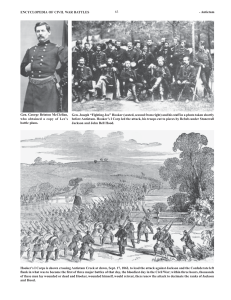
... close as the Confederates jealously guarded this crossing point. Union reserves consisted of V Corps under the command of Gen. Fitz-John Porter. McClellan’s plan was simple and methodical. He would send his strongest corps, under the commands of Hooker, Mansfield and Sumner, against Lee’s strungout ...
... close as the Confederates jealously guarded this crossing point. Union reserves consisted of V Corps under the command of Gen. Fitz-John Porter. McClellan’s plan was simple and methodical. He would send his strongest corps, under the commands of Hooker, Mansfield and Sumner, against Lee’s strungout ...
Civil War Strategy 1861-1865 Essay
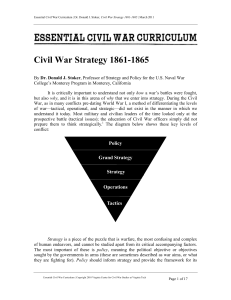
... commanders worried about the growing Union threat.xviii Strategically, the defense held sway. The Union war machine finally began to uncoil itself on February 2, 1862, when Major General Ulysses S. Grant and Flag Officer Andrew H. Foote moved to take Fort Henry, then Fort Donelson, shattering the Co ...
... commanders worried about the growing Union threat.xviii Strategically, the defense held sway. The Union war machine finally began to uncoil itself on February 2, 1862, when Major General Ulysses S. Grant and Flag Officer Andrew H. Foote moved to take Fort Henry, then Fort Donelson, shattering the Co ...
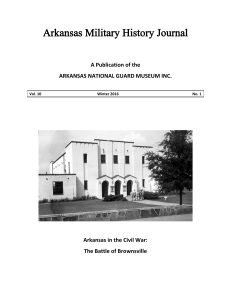
Arkansas Military History Journal
... Lt. Frederick L. Griffith was appointed superintendent of the Memphis to Little Rock Road on January 27, 1826, with instructions to make a road “at least twenty four feet wide throughout” with all timber and brush removed and stumps cut as low as possible, marshes and swamps to be “causewayed with ...
... Lt. Frederick L. Griffith was appointed superintendent of the Memphis to Little Rock Road on January 27, 1826, with instructions to make a road “at least twenty four feet wide throughout” with all timber and brush removed and stumps cut as low as possible, marshes and swamps to be “causewayed with ...
Joshua Chamberlain Lesson Plan
... bravest soldier in the unit. As the 20th Maine’s center began to break and give ground in the face of the Alabama regiments’ onslaught, Tozier stood firm, remaining upright as Southern bullets buzzed and snapped in the air around him. Tozier’s personal gallantry in defending the 20th Maine’s colors ...
... bravest soldier in the unit. As the 20th Maine’s center began to break and give ground in the face of the Alabama regiments’ onslaught, Tozier stood firm, remaining upright as Southern bullets buzzed and snapped in the air around him. Tozier’s personal gallantry in defending the 20th Maine’s colors ...
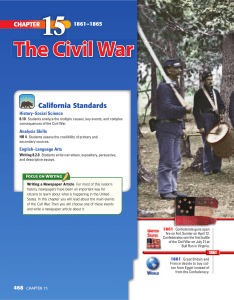
The Civil War - Chino Valley Unified School District
... national nightmare. Furious at Lincoln’s election and fearing a federal invasion, seven southern states had seceded. The new commander in chief tried desperately to save the Union. In his inaugural address, Lincoln promised not to end slavery where it existed. The federal government “will not assail ...
... national nightmare. Furious at Lincoln’s election and fearing a federal invasion, seven southern states had seceded. The new commander in chief tried desperately to save the Union. In his inaugural address, Lincoln promised not to end slavery where it existed. The federal government “will not assail ...
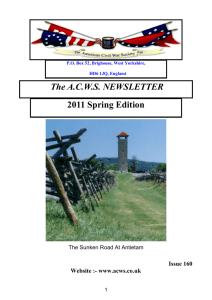
160 Spring 2011 - American Civil War Society
... including one named John Buford, Sr. That means that John Buford and his wife were third cousins. Another of Simeon's sons was the father of Brig. Gen. Abraham Buford, who commanded a division of cavalry under Forrest. Finally, another of the Bufords was married to Jubal Early's grandfather. This me ...
... including one named John Buford, Sr. That means that John Buford and his wife were third cousins. Another of Simeon's sons was the father of Brig. Gen. Abraham Buford, who commanded a division of cavalry under Forrest. Finally, another of the Bufords was married to Jubal Early's grandfather. This me ...
No Slide Title
... army. At first black troops served only as laborers, building roads and guarding supplies. By 1863, African American troops were fighting in major battles. One of the most famous African American units was the 54th Massachusetts Regiment. In 1863, this regiment led an attack on Fort Wagner near Char ...
... army. At first black troops served only as laborers, building roads and guarding supplies. By 1863, African American troops were fighting in major battles. One of the most famous African American units was the 54th Massachusetts Regiment. In 1863, this regiment led an attack on Fort Wagner near Char ...
Pocketing the Key - H-Net
... Charles A. Dana, who was sent west by Edwin Stanton to investigate Grant in early 1863 (p. 61). ...
... Charles A. Dana, who was sent west by Edwin Stanton to investigate Grant in early 1863 (p. 61). ...
USA WORLD
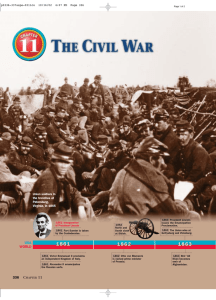
... about three months after Fort Sumter fell. An army of 30,000 inexperienced Union soldiers on its way toward the Confederate capital at Richmond, only 100 miles from Washington, D.C., came upon an equally inexperienced Confederate army encamped near the little creek of Bull Run, just 25 miles from th ...
... about three months after Fort Sumter fell. An army of 30,000 inexperienced Union soldiers on its way toward the Confederate capital at Richmond, only 100 miles from Washington, D.C., came upon an equally inexperienced Confederate army encamped near the little creek of Bull Run, just 25 miles from th ...
NC State Brochure cover-side
... U.S. rifled cannon battery firing on Fort Macon on April 25, 1862, Union batteries and gunboats bombarded Fort Macon for eleven hours. The Confederates ran up the white flag at 4:30 p.m., and formally surrendered the following morning. ...
... U.S. rifled cannon battery firing on Fort Macon on April 25, 1862, Union batteries and gunboats bombarded Fort Macon for eleven hours. The Confederates ran up the white flag at 4:30 p.m., and formally surrendered the following morning. ...
chapter 16 - apel slice
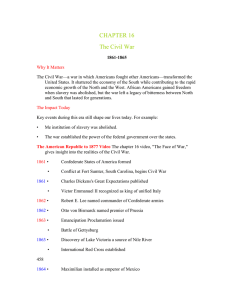
... Comparing North and South When the war began, both sides had advantages and disadvantages. How they would use those strengths and weaknesses would determine the war's outcome. The North enjoyed the advantages of a larger population, more industry, and more abundant resources than the South. It had a ...
... Comparing North and South When the war began, both sides had advantages and disadvantages. How they would use those strengths and weaknesses would determine the war's outcome. The North enjoyed the advantages of a larger population, more industry, and more abundant resources than the South. It had a ...
Union Victories in the South (cont.)
... • On July 3, Lee ordered 15,000 men under the command of General George E. Pickett and General A. P. Hill to attack the Union troops. • This became known as Pickett’s Charge. • The Confederate troops marched across open farmland toward the ridge where Union forces stood. • In less than half an ...
... • On July 3, Lee ordered 15,000 men under the command of General George E. Pickett and General A. P. Hill to attack the Union troops. • This became known as Pickett’s Charge. • The Confederate troops marched across open farmland toward the ridge where Union forces stood. • In less than half an ...
Word document
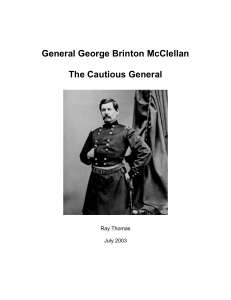
... will not serve under him – for he is an incompetent fool.” (Catton, 460) On 22nd September, Lincoln issued the Proclamation of Emancipation, to which McClellan strongly opposed. At a dinner for some of his generals and politician friends, McClellan announced that “the army was so devoted to him that ...
... will not serve under him – for he is an incompetent fool.” (Catton, 460) On 22nd September, Lincoln issued the Proclamation of Emancipation, to which McClellan strongly opposed. At a dinner for some of his generals and politician friends, McClellan announced that “the army was so devoted to him that ...
General George Brinton McClellan: The Cautious
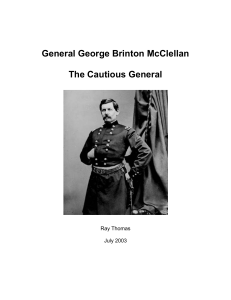
... will not serve under him – for he is an incompetent fool.” (Catton, 460) On 22nd September, Lincoln issued the Proclamation of Emancipation, to which McClellan strongly opposed. At a dinner for some of his generals and politician friends, McClellan announced that “the army was so devoted to him that ...
... will not serve under him – for he is an incompetent fool.” (Catton, 460) On 22nd September, Lincoln issued the Proclamation of Emancipation, to which McClellan strongly opposed. At a dinner for some of his generals and politician friends, McClellan announced that “the army was so devoted to him that ...
Chapter 18 - Catholic Textbook Project
... arm. He was taken to a field hospital, where the surgeon decided that he would have to amputate the general’s left arm. When Lee heard of Jackson’s misfortune, he said, “he has lost his left arm, but I have lost my right.” Yet, with or without Jackson, Lee had a battle to fight. On May 3, Sedgwick c ...
... arm. He was taken to a field hospital, where the surgeon decided that he would have to amputate the general’s left arm. When Lee heard of Jackson’s misfortune, he said, “he has lost his left arm, but I have lost my right.” Yet, with or without Jackson, Lee had a battle to fight. On May 3, Sedgwick c ...
9. Secession, the EU, and Lessons from the U.S.
... 681, n. to p 573, states that, “though the letter is signed by Stanton, it is in Lincoln’s handwriting.”] Donald interprets this instruction: “Lincoln was not just ordering the generals to follow protocol: he wanted to make sure that any negotiations led not merely to a suspension of fighting…” (pp. ...
... 681, n. to p 573, states that, “though the letter is signed by Stanton, it is in Lincoln’s handwriting.”] Donald interprets this instruction: “Lincoln was not just ordering the generals to follow protocol: he wanted to make sure that any negotiations led not merely to a suspension of fighting…” (pp. ...
May 18, 2016 - Gettysburg Battlefield Preservation Association
... (May 18, Gettysburg) -- Calling it a direct threat to the remaining hallowed ground of the Gettysburg battlefield, the Gettysburg Battlefield Preservation Association today launched a campaign against a proposed roadway extension designed to place big box stores and other commercial development on o ...
... (May 18, Gettysburg) -- Calling it a direct threat to the remaining hallowed ground of the Gettysburg battlefield, the Gettysburg Battlefield Preservation Association today launched a campaign against a proposed roadway extension designed to place big box stores and other commercial development on o ...
the emancipation proclamation
... withdrawal and marched north, defeating Pope at Second Battle of Bull Run in late August • While McClellan regrouped Army of Potomac, Lee moved north, dividing his army of 60,000 into several units – Jackson hit Harper’s Ferry and captured 11,000 prisoners – One division went as far as Hagerstown, M ...
... withdrawal and marched north, defeating Pope at Second Battle of Bull Run in late August • While McClellan regrouped Army of Potomac, Lee moved north, dividing his army of 60,000 into several units – Jackson hit Harper’s Ferry and captured 11,000 prisoners – One division went as far as Hagerstown, M ...
Battle of Antietam

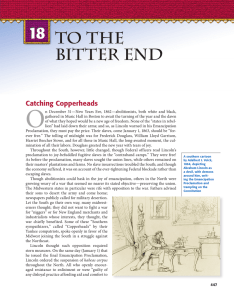
The Battle of Antietam /ænˈtiːtəm/, also known as the Battle of Sharpsburg, particularly in the South, fought on September 17, 1862, near Sharpsburg, Maryland, and Antietam Creek as part of the Maryland Campaign, was the first major battle in the American Civil War to take place on Union soil. It is the bloodiest single-day battle in American history, with a combined tally of dead, wounded, and missing at 22,717.After pursuing Confederate General Robert E. Lee into Maryland, Union Army Maj. Gen. George B. McClellan launched attacks against Lee's army, in defensive positions behind Antietam Creek. At dawn on September 17, Maj. Gen. Joseph Hooker's corps mounted a powerful assault on Lee's left flank. Attacks and counterattacks swept across Miller's Cornfield and fighting swirled around the Dunker Church. Union assaults against the Sunken Road eventually pierced the Confederate center, but the Federal advantage was not followed up. In the afternoon, Union Maj. Gen. Ambrose Burnside's corps entered the action, capturing a stone bridge over Antietam Creek and advancing against the Confederate right. At a crucial moment, Confederate Maj. Gen. A. P. Hill's division arrived from Harpers Ferry and launched a surprise counterattack, driving back Burnside and ending the battle. Although outnumbered two-to-one, Lee committed his entire force, while McClellan sent in less than three-quarters of his army, enabling Lee to fight the Federals to a standstill. During the night, both armies consolidated their lines. In spite of crippling casualties, Lee continued to skirmish with McClellan throughout September 18, while removing his battered army south of the Potomac River.Despite having superiority of numbers, McClellan's attacks failed to achieve force concentration, allowing Lee to counter by shifting forces and moving interior lines to meet each challenge. Despite ample reserve forces that could have been deployed to exploit localized successes, McClellan failed to destroy Lee's army. McClellan had halted Lee's invasion of Maryland, but Lee was able to withdraw his army back to Virginia without interference from the cautious McClellan. Although the battle was tactically inconclusive, the Confederate troops had withdrawn first from the battlefield, making it, in military terms, a Union victory. It had significance as enough of a victory to give President Abraham Lincoln the confidence to announce his Emancipation Proclamation, which discouraged the British and French governments from potential plans for recognition of the Confederacy.