
THE CIVIL WAR 1861-1865 The Civil War began over
... General Pierre G.T. Beauregard General Braxton Bragg General Simon Bolivar Buckner General Jubal Early General Nathan Bedford Forrest General Ambrose P. Hill General John Bell Hood General Thomas J. (Stonewall) Jackson General Albert Sidney Johnston General Joseph E. Johnston General James Longstree ...
... General Pierre G.T. Beauregard General Braxton Bragg General Simon Bolivar Buckner General Jubal Early General Nathan Bedford Forrest General Ambrose P. Hill General John Bell Hood General Thomas J. (Stonewall) Jackson General Albert Sidney Johnston General Joseph E. Johnston General James Longstree ...

Miracle of Missionary Ridge
... rounds of fighting, Northern troops held the town. But they were besieged by Rebel forces and, on the verge of starvation, almost gave up, which would have effectively undone the gains at Gettysburg and Vicksburg. All in all, some 150,000 men took part in the five battles. There were more than 47,00 ...
... rounds of fighting, Northern troops held the town. But they were besieged by Rebel forces and, on the verge of starvation, almost gave up, which would have effectively undone the gains at Gettysburg and Vicksburg. All in all, some 150,000 men took part in the five battles. There were more than 47,00 ...
America`s Birth At Appomattox - Jeff Littlejohn, Assistant Professor of
... that precious ethos called the “spirit of West Point.” Vindictiveness was not the order of the day for these men. They just wanted it over. Indeed, two months before, on February 25, Union Gen. Edward Ord met under a flag of truce with his former classmate, Confederate Gen. James Longstreet, and dis ...
... that precious ethos called the “spirit of West Point.” Vindictiveness was not the order of the day for these men. They just wanted it over. Indeed, two months before, on February 25, Union Gen. Edward Ord met under a flag of truce with his former classmate, Confederate Gen. James Longstreet, and dis ...

The Politics of Slavery
... • Privately, Lincoln tried to convince southern leaders they would not be interfered with • he was also committed to preserving the Union. • Outgoing president Buchanan agreed secession was illegal • He said the Constitution gave the federal government no power to stop it. ...
... • Privately, Lincoln tried to convince southern leaders they would not be interfered with • he was also committed to preserving the Union. • Outgoing president Buchanan agreed secession was illegal • He said the Constitution gave the federal government no power to stop it. ...
Touring Richmond
... hastened the Union withdrawal. Glendale (Frayser's Farm). On June 30 Union troops protected the vital crossroads near the old Frayser farm, "Glendale," while McClellan's retreating army snaked south toward Malvern Hill. Throughout the afternoon Confederate forces repeatedly assaulted the position bu ...
... hastened the Union withdrawal. Glendale (Frayser's Farm). On June 30 Union troops protected the vital crossroads near the old Frayser farm, "Glendale," while McClellan's retreating army snaked south toward Malvern Hill. Throughout the afternoon Confederate forces repeatedly assaulted the position bu ...
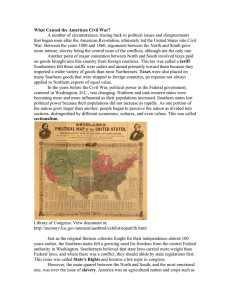
What Caused the American Civil War? A number of circumstances
... loyal to the Union, to enlist and put down what he argued was a treacherous act of rebellion (four border slave states remained in the Union and two Union states were added during the Civil War). Four more states seceded making eleven Confederate states: Alabama, Arkansas, Florida, Georgia, Louisian ...
... loyal to the Union, to enlist and put down what he argued was a treacherous act of rebellion (four border slave states remained in the Union and two Union states were added during the Civil War). Four more states seceded making eleven Confederate states: Alabama, Arkansas, Florida, Georgia, Louisian ...

The Civil War - Cloudfront.net
... Pg. 516 battle in which the Union defeated the Confederacy and enabled them to control the entire Mississippi River. The South was split in two and the tide of war turned in favor of the North. Britain gave up all thought of supporting the South. ...
... Pg. 516 battle in which the Union defeated the Confederacy and enabled them to control the entire Mississippi River. The South was split in two and the tide of war turned in favor of the North. Britain gave up all thought of supporting the South. ...
Chapter 11 Section 4 Notes
... party platform calling for an immediate end to the war. Southerners found new hope, but the Republicans tried to broaden Lincoln’s appeal by picking Tennessee’s Andrew Johnson for the ticket. Lincoln expected to lose the election. Sherman’s capture of Atlanta allowed Lincoln to easily defeat McClell ...
... party platform calling for an immediate end to the war. Southerners found new hope, but the Republicans tried to broaden Lincoln’s appeal by picking Tennessee’s Andrew Johnson for the ticket. Lincoln expected to lose the election. Sherman’s capture of Atlanta allowed Lincoln to easily defeat McClell ...
Could the South have won the War?
... everything in its power to make it useless” 11 The logic underpinning these decisions taken regarding cotton is difficult to understand and sustain! The Confederate efforts to “win” the War and, thus, gain independence focused on an essentially defensive strategy of “winning by not losing.” Througho ...
... everything in its power to make it useless” 11 The logic underpinning these decisions taken regarding cotton is difficult to understand and sustain! The Confederate efforts to “win” the War and, thus, gain independence focused on an essentially defensive strategy of “winning by not losing.” Througho ...
Unit VI Civil War Notes
... South Carolina fried on Fort Sumter arousing the north for war (April 12, 1861) Lincoln called for federal troops Drove four more states to confederacy (Virginia/Arkansas/Tenn./N.C.) Border states became the key (political battle ground) Maryland/Kentucky/Missouri/Delaware/W.V. Mostly white Recourse ...
... South Carolina fried on Fort Sumter arousing the north for war (April 12, 1861) Lincoln called for federal troops Drove four more states to confederacy (Virginia/Arkansas/Tenn./N.C.) Border states became the key (political battle ground) Maryland/Kentucky/Missouri/Delaware/W.V. Mostly white Recourse ...
LECTURE NOTES – Battle of Gettysburg
... George Meade, Commander Took over for Joseph Hooker after Chancellorsville Seven infantry corps Cavalry corps – John Buford Artillery Corps EARLY CLASHES – June 9th – first major action Brandy Station, VA Clash between Union and CSA cavalry Confederates were surprised by the Union ca ...
... George Meade, Commander Took over for Joseph Hooker after Chancellorsville Seven infantry corps Cavalry corps – John Buford Artillery Corps EARLY CLASHES – June 9th – first major action Brandy Station, VA Clash between Union and CSA cavalry Confederates were surprised by the Union ca ...
AP Civil War - Mr Powell's History Pages
... • On July 2, Lee attacked. The Union forces held their ground. On July 3, Lee ordered 15,000 men under the command of General George E. Pickett and General A. P. Hill to attack the Union troops. This became known as Pickett's Charge. ...
... • On July 2, Lee attacked. The Union forces held their ground. On July 3, Lee ordered 15,000 men under the command of General George E. Pickett and General A. P. Hill to attack the Union troops. This became known as Pickett's Charge. ...
Bull Run Essay - Essential Civil War Curriculum
... One, led by the able General Joseph Eggleston Johnston, sat about seventy miles west of Richmond in the Shenandoah River region that locals simply called the Valley. The other, far more unwieldy, force scattered throughout a region about sixty miles north of Richmond. Much of this army, which had ar ...
... One, led by the able General Joseph Eggleston Johnston, sat about seventy miles west of Richmond in the Shenandoah River region that locals simply called the Valley. The other, far more unwieldy, force scattered throughout a region about sixty miles north of Richmond. Much of this army, which had ar ...

Civil War Heritage - West Virginia Department of Commerce
... of 96 to 55. Although he had misgivings about the statehood question, President Lincoln issued a proclamation under which West Virginia entered the Union on June 20, 1863, as the 35th state. The Civil War has often been referred to as a war of brother against brother and father against son. No other ...
... of 96 to 55. Although he had misgivings about the statehood question, President Lincoln issued a proclamation under which West Virginia entered the Union on June 20, 1863, as the 35th state. The Civil War has often been referred to as a war of brother against brother and father against son. No other ...
Bull Run - Central Magnet School
... • Might lead to capture of Confederate capital at Richmond, 100 miles to south • If Richmond fell, secession would be discredited and Union could be restored without damage to economic and social system of South ...
... • Might lead to capture of Confederate capital at Richmond, 100 miles to south • If Richmond fell, secession would be discredited and Union could be restored without damage to economic and social system of South ...
File
... • Might lead to capture of Confederate capital at Richmond, 100 miles to south • If Richmond fell, secession would be discredited and Union could be restored without damage to economic and social system of South ...
... • Might lead to capture of Confederate capital at Richmond, 100 miles to south • If Richmond fell, secession would be discredited and Union could be restored without damage to economic and social system of South ...
Chapter 21 Civil War
... • Might lead to capture of Confederate capital at Richmond, 100 miles to south • If Richmond fell, secession would be discredited and Union could be restored without damage to economic and social system of South ...
... • Might lead to capture of Confederate capital at Richmond, 100 miles to south • If Richmond fell, secession would be discredited and Union could be restored without damage to economic and social system of South ...
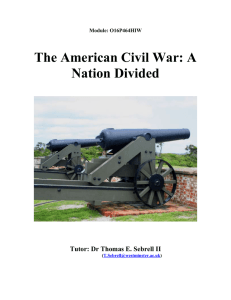
OUDCE American Civil War Syllabus
... Our focus will shift westward this week, covering the Confederate Army of Tennessee’s invasion of Kentucky, retreat after Perryville and another defeat at Stone’s River. We will then shift back to the Eastern Theater to discuss Lincoln’s new strategy of dealing with unsuccessful generals, starting w ...
... Our focus will shift westward this week, covering the Confederate Army of Tennessee’s invasion of Kentucky, retreat after Perryville and another defeat at Stone’s River. We will then shift back to the Eastern Theater to discuss Lincoln’s new strategy of dealing with unsuccessful generals, starting w ...
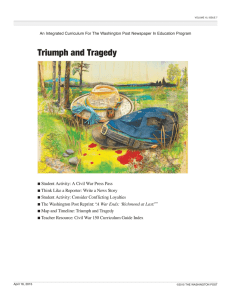
Triumph and Tragedy - Newspaper In Education
... burns, slavery ends, and Abraham Gone were its great commanders, Lincoln himself walks through the Thomas J. “Stonewall” Jackson, smoking ruins,” he said. “It doesn’t killed in 1863, J.E.B. Stuart, killed get any more dramatic than that.” in 1864, and Ambrose Powell Hill, who had just been killed on ...
... burns, slavery ends, and Abraham Gone were its great commanders, Lincoln himself walks through the Thomas J. “Stonewall” Jackson, smoking ruins,” he said. “It doesn’t killed in 1863, J.E.B. Stuart, killed get any more dramatic than that.” in 1864, and Ambrose Powell Hill, who had just been killed on ...
1 - UMW Blogs
... surfaced which lent credence to the actions taken by the commanding general of the Army of Northern Virginia (NVA), as well as his troops. It remained very interesting to view how various authors’ perspectives on the charge caused them to either praise or upbraid Lee, his subordinates, and his decis ...
... surfaced which lent credence to the actions taken by the commanding general of the Army of Northern Virginia (NVA), as well as his troops. It remained very interesting to view how various authors’ perspectives on the charge caused them to either praise or upbraid Lee, his subordinates, and his decis ...
The Battle of Lookout Mountain - Essential Civil War Curriculum
... Starting in the morning, the Federal forces advanced relentlessly. By 2:00 p.m. Hooker decided it was time for his tired troops to rest. The Union forces had advanced up the western face of the mountain and pushed the Confederate line back from the Cravens Farm on the bench and while the Confederate ...
... Starting in the morning, the Federal forces advanced relentlessly. By 2:00 p.m. Hooker decided it was time for his tired troops to rest. The Union forces had advanced up the western face of the mountain and pushed the Confederate line back from the Cravens Farm on the bench and while the Confederate ...
February 2011 - Scottsdale Civil War Round Table
... replacements for the generals. Both sides had left fifty thousand explanation of why the war with its associated horrors must dead, wounded or missing behind them. As historian Garry Wills continue, and a pledge that because of those efforts “government has recognized in his study of Lincoln at Gett ...
... replacements for the generals. Both sides had left fifty thousand explanation of why the war with its associated horrors must dead, wounded or missing behind them. As historian Garry Wills continue, and a pledge that because of those efforts “government has recognized in his study of Lincoln at Gett ...

The Civil War: A Film by Ken Burns
... Chapter 1: Introduction to The Better Angels of Our Nature: Problems Arise After the Civil War (11 min 21 sec) 1. In what ways was the Civil War a turning point and in what ways did the same problems persist after the war that had existed before the war? ...
... Chapter 1: Introduction to The Better Angels of Our Nature: Problems Arise After the Civil War (11 min 21 sec) 1. In what ways was the Civil War a turning point and in what ways did the same problems persist after the war that had existed before the war? ...
Battle of Antietam

The Battle of Antietam /ænˈtiːtəm/, also known as the Battle of Sharpsburg, particularly in the South, fought on September 17, 1862, near Sharpsburg, Maryland, and Antietam Creek as part of the Maryland Campaign, was the first major battle in the American Civil War to take place on Union soil. It is the bloodiest single-day battle in American history, with a combined tally of dead, wounded, and missing at 22,717.After pursuing Confederate General Robert E. Lee into Maryland, Union Army Maj. Gen. George B. McClellan launched attacks against Lee's army, in defensive positions behind Antietam Creek. At dawn on September 17, Maj. Gen. Joseph Hooker's corps mounted a powerful assault on Lee's left flank. Attacks and counterattacks swept across Miller's Cornfield and fighting swirled around the Dunker Church. Union assaults against the Sunken Road eventually pierced the Confederate center, but the Federal advantage was not followed up. In the afternoon, Union Maj. Gen. Ambrose Burnside's corps entered the action, capturing a stone bridge over Antietam Creek and advancing against the Confederate right. At a crucial moment, Confederate Maj. Gen. A. P. Hill's division arrived from Harpers Ferry and launched a surprise counterattack, driving back Burnside and ending the battle. Although outnumbered two-to-one, Lee committed his entire force, while McClellan sent in less than three-quarters of his army, enabling Lee to fight the Federals to a standstill. During the night, both armies consolidated their lines. In spite of crippling casualties, Lee continued to skirmish with McClellan throughout September 18, while removing his battered army south of the Potomac River.Despite having superiority of numbers, McClellan's attacks failed to achieve force concentration, allowing Lee to counter by shifting forces and moving interior lines to meet each challenge. Despite ample reserve forces that could have been deployed to exploit localized successes, McClellan failed to destroy Lee's army. McClellan had halted Lee's invasion of Maryland, but Lee was able to withdraw his army back to Virginia without interference from the cautious McClellan. Although the battle was tactically inconclusive, the Confederate troops had withdrawn first from the battlefield, making it, in military terms, a Union victory. It had significance as enough of a victory to give President Abraham Lincoln the confidence to announce his Emancipation Proclamation, which discouraged the British and French governments from potential plans for recognition of the Confederacy.