
Ch. 11 Civil War PPT.
... I have been shown in the files of the War Department a statement of the Adjutant General of Massachusetts that you are the mother of five sons who have died gloriously on the field of battle. I feel how weak and fruitless must be any word of mine which should attempt to beguile you from the grief of ...
... I have been shown in the files of the War Department a statement of the Adjutant General of Massachusetts that you are the mother of five sons who have died gloriously on the field of battle. I feel how weak and fruitless must be any word of mine which should attempt to beguile you from the grief of ...
Chapter 14
... Morrill Tariff Act, 1861: raised tariff rates to increase revenue and protect American manufacturers. Passage initiated a Republican program of high protective tariffs to help industrialists Homestead Act, 1862: promoted settlement of the Great Plains by offering parcels of 160 acres of public l ...
... Morrill Tariff Act, 1861: raised tariff rates to increase revenue and protect American manufacturers. Passage initiated a Republican program of high protective tariffs to help industrialists Homestead Act, 1862: promoted settlement of the Great Plains by offering parcels of 160 acres of public l ...

This lithograph of the Battle of Fort Donelson, Tennessee
... the bonds of a miserable and immoral institution; both of these aspects still haunt us today.3 Militarily, the war introduced or expanded two great evolutions in warfare. The Civil War was “modern,” with its technological improvements and vast new methods of not only death and destruction in advance ...
... the bonds of a miserable and immoral institution; both of these aspects still haunt us today.3 Militarily, the war introduced or expanded two great evolutions in warfare. The Civil War was “modern,” with its technological improvements and vast new methods of not only death and destruction in advance ...

video note guide - Iowa City Community School District
... abandoning Richmond? What administrative error hampered the retreat of General Lee and his troops? What was the only thing Lee and his troops left Richmond without? ...
... abandoning Richmond? What administrative error hampered the retreat of General Lee and his troops? What was the only thing Lee and his troops left Richmond without? ...

Bermuda Hundred Campaign by sfcdan
... the early morning hours numbering about 8,000 men under the command of Brigadier General William H. T. Brooks. The Confederate forces were also being hastily reinforced. Brigadier General Bushrod Johnson arrived with the remainder of his division after the previous evening’s brief engagement. In the ...
... the early morning hours numbering about 8,000 men under the command of Brigadier General William H. T. Brooks. The Confederate forces were also being hastily reinforced. Brigadier General Bushrod Johnson arrived with the remainder of his division after the previous evening’s brief engagement. In the ...

The Civil War - middletonhsapush
... Key Leaders: General George McClellan of the Union army and General Robert E. Lee of the Union army After the Second Battle of Bull Run, Lee thrust in Maryland to encourage foreign intervention and attempt to induce the border states into joining the Confederacy. Two Union soldiers found a copy of L ...
... Key Leaders: General George McClellan of the Union army and General Robert E. Lee of the Union army After the Second Battle of Bull Run, Lee thrust in Maryland to encourage foreign intervention and attempt to induce the border states into joining the Confederacy. Two Union soldiers found a copy of L ...
The Civil War - Leon County Schools
... In a final attack, Gen. Lee ordered “Pickett’s Charge” in a failed attack on the Union center (named for Confederate Gen. George Pickett) Gen. Lee retreated back to Virginia and took blame for the failed battle (first battle that Gen. Lee fought “blind” (without Gen. Stuart or Gen. Jackson to give h ...
... In a final attack, Gen. Lee ordered “Pickett’s Charge” in a failed attack on the Union center (named for Confederate Gen. George Pickett) Gen. Lee retreated back to Virginia and took blame for the failed battle (first battle that Gen. Lee fought “blind” (without Gen. Stuart or Gen. Jackson to give h ...

Study Guide for Unit Test #4 (Part 1) What were the three main
... 3) What is popular sovereignty? Who was one of its main supporters? (Hint: he wrote it in as part of the Kansas-Nebraska Act) 4) What were the three main provisions of the Compromise of 1850? There were five total, but I told you in class that you only needed to know three. Why was it significant? W ...
... 3) What is popular sovereignty? Who was one of its main supporters? (Hint: he wrote it in as part of the Kansas-Nebraska Act) 4) What were the three main provisions of the Compromise of 1850? There were five total, but I told you in class that you only needed to know three. Why was it significant? W ...

civil war cause and effect study guide
... CSA bombards Union held Fort Sumter in South Carolina which had seceded from the Union ...
... CSA bombards Union held Fort Sumter in South Carolina which had seceded from the Union ...
APUSH Keys to Unit 5 Civil War
... Robert E Lee: Commander of Confederate Army of Northern Virginia Shenandoah Valley (Virginia): Attacks by Jackson’s Confederates diverted attention from Richmond; General John Pope was replaced by McClellan after losing second battle of Bull Run to Lee The West: General Ulysses S. Grant drove the Co ...
... Robert E Lee: Commander of Confederate Army of Northern Virginia Shenandoah Valley (Virginia): Attacks by Jackson’s Confederates diverted attention from Richmond; General John Pope was replaced by McClellan after losing second battle of Bull Run to Lee The West: General Ulysses S. Grant drove the Co ...
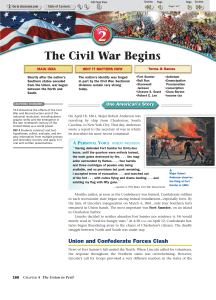
The Civil War Begins
... had marched off to war thinking it would be a glorious affair. They were soon disillusioned, not just by heavy battlefield casualties but also by such unhealthy conditions as filthy surroundings, a limited diet, and inadequate medical care. In the 1860s, the technology of killing had outrun the tech ...
... had marched off to war thinking it would be a glorious affair. They were soon disillusioned, not just by heavy battlefield casualties but also by such unhealthy conditions as filthy surroundings, a limited diet, and inadequate medical care. In the 1860s, the technology of killing had outrun the tech ...

October - 4th Texas
... Chattanooga, Tennessee, on October 28, 1863, the Fourth was routed by the enemy for the only time during the war. Upon the unit's return to Virginia in April 1864 with the rest of Longstreet's corps, the Texans once again acquitted themselves admirably, by plugging a gap torn in the Confederate line ...
... Chattanooga, Tennessee, on October 28, 1863, the Fourth was routed by the enemy for the only time during the war. Upon the unit's return to Virginia in April 1864 with the rest of Longstreet's corps, the Texans once again acquitted themselves admirably, by plugging a gap torn in the Confederate line ...

Unit 9 ~ The Civil War
... victory, because General Lee and his Confederate army retreated into Virginia. Union military success at the Battle of Antietam allowed President Lincoln to issue the Emancipation Proclamation. Because of this relationship to the Emancipation Proclamation, historians consider Antietam one of the war ...
... victory, because General Lee and his Confederate army retreated into Virginia. Union military success at the Battle of Antietam allowed President Lincoln to issue the Emancipation Proclamation. Because of this relationship to the Emancipation Proclamation, historians consider Antietam one of the war ...

The Thirteenth Amendment
... On April 8, Lee replied that he was willing to talk with Grant, but not to surrender his army, which continued to move toward Appomattox In the early morning of April 9 Lee's men made a final attempt to break away from the Union. The attack failed, finally convincing Lee that the end had come. H ...
... On April 8, Lee replied that he was willing to talk with Grant, but not to surrender his army, which continued to move toward Appomattox In the early morning of April 9 Lee's men made a final attempt to break away from the Union. The attack failed, finally convincing Lee that the end had come. H ...
Civil War PowerPoint
... • One of the most important battles of the Civil War for the North • Confederate General Robert E. Lee invaded the North trying to defeat them once and for all • Union Army held and sent Lee retreating • Battle lasted three days ...
... • One of the most important battles of the Civil War for the North • Confederate General Robert E. Lee invaded the North trying to defeat them once and for all • Union Army held and sent Lee retreating • Battle lasted three days ...
The Civil War - thomas.k12.ga.us
... Goal was to restrict Southern commerce and weaken south. ●Days later, Union soldiers landed on Tybee Island and captured Ft. Pulaski protecting Savannah ●Savannah is one of the MOST IMPORTANT cities to the Southern states and Confederate Government ...
... Goal was to restrict Southern commerce and weaken south. ●Days later, Union soldiers landed on Tybee Island and captured Ft. Pulaski protecting Savannah ●Savannah is one of the MOST IMPORTANT cities to the Southern states and Confederate Government ...
THE CIVIL WAR
... • One of the most important battles of the Civil War for the North • Confederate General Robert E. Lee invaded the North trying to defeat them once and for all • Union Army held and sent Lee retreating • Battle lasted three days ...
... • One of the most important battles of the Civil War for the North • Confederate General Robert E. Lee invaded the North trying to defeat them once and for all • Union Army held and sent Lee retreating • Battle lasted three days ...

userfiles/605/my files/ch. 16 pp civil war?id=2958
... many planters were unwilling to buy them. Inflation (when prices of goods and services increase) occurred as Confederate money lost its value. Union blockade of the South’s ports caused shortages. Bread riots occurred in some Georgia towns. Great Britain had to buy cotton from India and Egypt ...
... many planters were unwilling to buy them. Inflation (when prices of goods and services increase) occurred as Confederate money lost its value. Union blockade of the South’s ports caused shortages. Bread riots occurred in some Georgia towns. Great Britain had to buy cotton from India and Egypt ...
the civil war - Tipp City Exempted Village Schools
... ► People thought this would end quickly ► This battle proves it will not ...
... ► People thought this would end quickly ► This battle proves it will not ...

CJ. CNM 2011-01-28 5307
... • The United States, in turn, later threatened war if Britain refused to stop building warships—such as the CSS Alabama —for the Confederacy. This time, Britain conceded. • War between Britain and the U.S. almost broke out a third time in 1864, when Canada harbored Confederate fugitives. Britain sen ...
... • The United States, in turn, later threatened war if Britain refused to stop building warships—such as the CSS Alabama —for the Confederacy. This time, Britain conceded. • War between Britain and the U.S. almost broke out a third time in 1864, when Canada harbored Confederate fugitives. Britain sen ...

The Civil War - Dream History
... “Four score and seven years ago our fathers brought forth on this continent a new nation, conceived in Liberty, and dedicated to the proposition that all men are created equal. “Now we are engaged in a great civil war, testing whether that nation, or any nation, so conceived and so dedicated, can lo ...
... “Four score and seven years ago our fathers brought forth on this continent a new nation, conceived in Liberty, and dedicated to the proposition that all men are created equal. “Now we are engaged in a great civil war, testing whether that nation, or any nation, so conceived and so dedicated, can lo ...

Gettysburg, Vicksburg, and Chattanooga
... • Purpose: To honor the men who died in the battle of Gettysburg and also to take advantage of the emotion of his audience and use it to further their support of the war cause. • Value: It is a show of how much raw emotion the nation was feeling at the time and the tragedy of the war. • Limit ...
... • Purpose: To honor the men who died in the battle of Gettysburg and also to take advantage of the emotion of his audience and use it to further their support of the war cause. • Value: It is a show of how much raw emotion the nation was feeling at the time and the tragedy of the war. • Limit ...

1863 in Virginia - Civil War Travel
... New Union commander Gen. Joseph Hooker thought he could get around Lee’s army instead of attacking it head-on. That didn’t work either. After desperate fighting near Chancellorsville, the Union army was sent packing… again. Lee’s masterful victory set the stage for another Confederate march north. B ...
... New Union commander Gen. Joseph Hooker thought he could get around Lee’s army instead of attacking it head-on. That didn’t work either. After desperate fighting near Chancellorsville, the Union army was sent packing… again. Lee’s masterful victory set the stage for another Confederate march north. B ...

8.4-The_Civil_War-Historysage
... Potomac and replaced by Gen. John Pope. 4. Casualties: Confederates 20,141; Union 15,849 B. Second Battle of Bull Run (14 July to 30 August) 1. General Pope put in charge of the Union army near Washington. 2. Combined forces of Lee, Jackson, & James Longstreet forced the Union army to retreat again. ...
... Potomac and replaced by Gen. John Pope. 4. Casualties: Confederates 20,141; Union 15,849 B. Second Battle of Bull Run (14 July to 30 August) 1. General Pope put in charge of the Union army near Washington. 2. Combined forces of Lee, Jackson, & James Longstreet forced the Union army to retreat again. ...
Battle of Antietam

The Battle of Antietam /ænˈtiːtəm/, also known as the Battle of Sharpsburg, particularly in the South, fought on September 17, 1862, near Sharpsburg, Maryland, and Antietam Creek as part of the Maryland Campaign, was the first major battle in the American Civil War to take place on Union soil. It is the bloodiest single-day battle in American history, with a combined tally of dead, wounded, and missing at 22,717.After pursuing Confederate General Robert E. Lee into Maryland, Union Army Maj. Gen. George B. McClellan launched attacks against Lee's army, in defensive positions behind Antietam Creek. At dawn on September 17, Maj. Gen. Joseph Hooker's corps mounted a powerful assault on Lee's left flank. Attacks and counterattacks swept across Miller's Cornfield and fighting swirled around the Dunker Church. Union assaults against the Sunken Road eventually pierced the Confederate center, but the Federal advantage was not followed up. In the afternoon, Union Maj. Gen. Ambrose Burnside's corps entered the action, capturing a stone bridge over Antietam Creek and advancing against the Confederate right. At a crucial moment, Confederate Maj. Gen. A. P. Hill's division arrived from Harpers Ferry and launched a surprise counterattack, driving back Burnside and ending the battle. Although outnumbered two-to-one, Lee committed his entire force, while McClellan sent in less than three-quarters of his army, enabling Lee to fight the Federals to a standstill. During the night, both armies consolidated their lines. In spite of crippling casualties, Lee continued to skirmish with McClellan throughout September 18, while removing his battered army south of the Potomac River.Despite having superiority of numbers, McClellan's attacks failed to achieve force concentration, allowing Lee to counter by shifting forces and moving interior lines to meet each challenge. Despite ample reserve forces that could have been deployed to exploit localized successes, McClellan failed to destroy Lee's army. McClellan had halted Lee's invasion of Maryland, but Lee was able to withdraw his army back to Virginia without interference from the cautious McClellan. Although the battle was tactically inconclusive, the Confederate troops had withdrawn first from the battlefield, making it, in military terms, a Union victory. It had significance as enough of a victory to give President Abraham Lincoln the confidence to announce his Emancipation Proclamation, which discouraged the British and French governments from potential plans for recognition of the Confederacy.