
Civil War Battles
... and TN; boosted northern morale; took New Orleans but not Mississippi River ...
... and TN; boosted northern morale; took New Orleans but not Mississippi River ...

Sumter to Appomattox - American Civil War Roundtable of Australia
... Lincoln – The Army of the Potomac” is the first authoritative single volume history of the Army of the Potomac for many years. The hard-cover edition of the book was released this year and is published by Simon and Schuster. It is available through “Amazon.com” for a heavily discounted price of $US ...
... Lincoln – The Army of the Potomac” is the first authoritative single volume history of the Army of the Potomac for many years. The hard-cover edition of the book was released this year and is published by Simon and Schuster. It is available through “Amazon.com” for a heavily discounted price of $US ...
SOL 9d: Key Individuals of the Civil War
... 1) Was leader of the Army of Northern VIRGINIA 2) Was offered command of the UNION forces at the beginning of the war, but chose not to fight against Virginia. 3) Opposed SECESSION, but did not believe that the Union should be held together by FORCE 4) Urged Southerners to accept DEFEAT at the end o ...
... 1) Was leader of the Army of Northern VIRGINIA 2) Was offered command of the UNION forces at the beginning of the war, but chose not to fight against Virginia. 3) Opposed SECESSION, but did not believe that the Union should be held together by FORCE 4) Urged Southerners to accept DEFEAT at the end o ...

Antietam Map side - Civil War Traveler
... the likely site where the famous Lost Order (Special Orders No. 191) was found, containing Gen. Robert E. Lee’s campaign strategy. ...
... the likely site where the famous Lost Order (Special Orders No. 191) was found, containing Gen. Robert E. Lee’s campaign strategy. ...

Turning Points of the Civil War
... Lincoln replaced Hooker with Meade Lee moved North – some of his troops forged into Gettysburg When they arrived the CSA ran into Union troops under the command of John Buford 1st day – Union troops were pushed out of the town into hills directly south ...
... Lincoln replaced Hooker with Meade Lee moved North – some of his troops forged into Gettysburg When they arrived the CSA ran into Union troops under the command of John Buford 1st day – Union troops were pushed out of the town into hills directly south ...

A.P. U.S. History Notes Chapter 16: The Civil War Summary: In 1860
... The south tried to get Europe to help them, but Europe failed to recognize The Confederate States of America as an independent nation and did not believe they could win. For a while it seemed the South would win but thing took a turn for the worst after the Battle of Gettysburg .After 5 years of fig ...
... The south tried to get Europe to help them, but Europe failed to recognize The Confederate States of America as an independent nation and did not believe they could win. For a while it seemed the South would win but thing took a turn for the worst after the Battle of Gettysburg .After 5 years of fig ...

The Civil War
... Both sides eventually moved away from volunteer armies, and towards conscription The Confederates drafted all able-bodied white men between 18 and 35 The Union drafted white men between 20 and ...
... Both sides eventually moved away from volunteer armies, and towards conscription The Confederates drafted all able-bodied white men between 18 and 35 The Union drafted white men between 20 and ...

Chapter Twenty-One: The Furnace of Civil War
... B. George G. Meade at Gettysburg 1) Fortified a Union position at Gettysburg with 92,000 troops 2) Attacked by Lee’s 76,000 troops July 1-3, 1863 3) Failed after Pickett’s charge was turned back 4) Lincoln turned back Jefferson’s delegation at the Union line, which had been sent to negotiate peace i ...
... B. George G. Meade at Gettysburg 1) Fortified a Union position at Gettysburg with 92,000 troops 2) Attacked by Lee’s 76,000 troops July 1-3, 1863 3) Failed after Pickett’s charge was turned back 4) Lincoln turned back Jefferson’s delegation at the Union line, which had been sent to negotiate peace i ...

Civil War - West Point High School
... But, in a larger sense, we can not dedicate -- we can not consecrate -- we can not hallow -this ground. The brave men, living and dead, who struggled here, have consecrated it, far above our poor power to add or detract. The world will little note, nor long remember what we say here, but it can neve ...
... But, in a larger sense, we can not dedicate -- we can not consecrate -- we can not hallow -this ground. The brave men, living and dead, who struggled here, have consecrated it, far above our poor power to add or detract. The world will little note, nor long remember what we say here, but it can neve ...

THE CIVIL WAR
... – 1. Capture Richmond by outflanking Confederate defenses from the Atlantic coast.---110,000 men vs. Gen J. Johnston’s 40,000 – Results: – 1. McClellan wins Battle of 7 Pines—Union army 25 miles east of Richmond. Gen. Johnston wounded. – 2. Pres. Davis replaces him with Gen. Robert E. Lee. 3. June 1 ...
... – 1. Capture Richmond by outflanking Confederate defenses from the Atlantic coast.---110,000 men vs. Gen J. Johnston’s 40,000 – Results: – 1. McClellan wins Battle of 7 Pines—Union army 25 miles east of Richmond. Gen. Johnston wounded. – 2. Pres. Davis replaces him with Gen. Robert E. Lee. 3. June 1 ...

16-3 No End in Sight
... Union fleet led by David Farragut captured New Orleans, the largest city in the South. Rebel gunboats tried to ram the Union warships and succeeded in sinking one. Farragut's ships had to run through cannon fire and then dodge burning rafts in order to reach the city. Residents stood on the docks an ...
... Union fleet led by David Farragut captured New Orleans, the largest city in the South. Rebel gunboats tried to ram the Union warships and succeeded in sinking one. Farragut's ships had to run through cannon fire and then dodge burning rafts in order to reach the city. Residents stood on the docks an ...

- Hesston Middle School
... Union fleet led by David Farragut captured New Orleans, the largest city in the South. Rebel gunboats tried to ram the Union warships and succeeded in sinking one. Farragut's ships had to run through cannon fire and then dodge burning rafts in order to reach the city. Residents stood on the docks an ...
... Union fleet led by David Farragut captured New Orleans, the largest city in the South. Rebel gunboats tried to ram the Union warships and succeeded in sinking one. Farragut's ships had to run through cannon fire and then dodge burning rafts in order to reach the city. Residents stood on the docks an ...

17 - Coppell ISD
... Stopped ALL cargo from reaching the Confederate Army ¿¿ How did the battle between the Virginia and the Monitor change warfare at sea ? 1.________________________________________________________________________ 2.________________________________________________________________________ 3.__________ ...
... Stopped ALL cargo from reaching the Confederate Army ¿¿ How did the battle between the Virginia and the Monitor change warfare at sea ? 1.________________________________________________________________________ 2.________________________________________________________________________ 3.__________ ...

Chapter Eleven, Section One
... o Union seemed to have the advantage early, but it was General Thomas Jackson of the Confederacy who held firm and inspired/rallied the rest of ...
... o Union seemed to have the advantage early, but it was General Thomas Jackson of the Confederacy who held firm and inspired/rallied the rest of ...
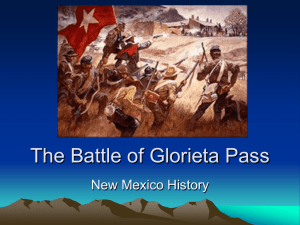
The Battle of Glorieta Pass
... ranch, Pyron sent for reinforcements from Lt. Col. William R, Scurry at Galisteo, 15 miles south of La Glorieta. Scurry arrived on the morning of March 27, bringing the Confederate force to 1,100 men. They waited 24 hours at Johnson's ranch, expecting Chivington to renew the attack. When the Federal ...
... ranch, Pyron sent for reinforcements from Lt. Col. William R, Scurry at Galisteo, 15 miles south of La Glorieta. Scurry arrived on the morning of March 27, bringing the Confederate force to 1,100 men. They waited 24 hours at Johnson's ranch, expecting Chivington to renew the attack. When the Federal ...
What was NC`s role in the Civil War efforts?
... What is meant by "It is . North - could pay $300 to the gov’t or pay someone to a rich man's war but a fight in his place and therefore not have to fight poor man's fight"? South - people who owned 20+ slaves were not required to join. Many slaves joined their owners to fight or take care of their m ...
... What is meant by "It is . North - could pay $300 to the gov’t or pay someone to a rich man's war but a fight in his place and therefore not have to fight poor man's fight"? South - people who owned 20+ slaves were not required to join. Many slaves joined their owners to fight or take care of their m ...

From Bull Run to Antietam
... Peninsular Campaign In March of 1862 Union General McClellan order his army out of the Potomac under orders of President Lincoln and moved them along the coast to a place south east of the Confederate capital of Virginia. A fight ensued, after a period of delay by McClellan, at Seven Pines. 53. What ...
... Peninsular Campaign In March of 1862 Union General McClellan order his army out of the Potomac under orders of President Lincoln and moved them along the coast to a place south east of the Confederate capital of Virginia. A fight ensued, after a period of delay by McClellan, at Seven Pines. 53. What ...
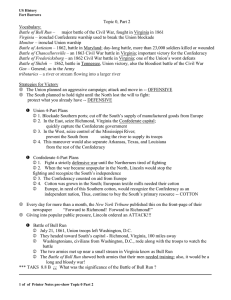
17 - Coppell ISD
... 1.________________________________________________________________________ 2.________________________________________________________________________ 3.________________________________________________________________________ 4.________________________________________________________________________. ...
... 1.________________________________________________________________________ 2.________________________________________________________________________ 3.________________________________________________________________________ 4.________________________________________________________________________. ...

12.3 The tide of war turns
... I Can explain how the Battles of Gettysburg and Vicksburg turn the tide of the war. ...
... I Can explain how the Battles of Gettysburg and Vicksburg turn the tide of the war. ...

THE CIVIL WAR
... - First major fighting centered around the two capitals o Washington DC o Richmond VA o June 1, 18661 Union army invades Virginia to capture Richmond 30 miles from DC 30,000 Union troops meet a smaller Confederate troop at a stream called Bull Run North expects a quick and easy victory Membe ...
... - First major fighting centered around the two capitals o Washington DC o Richmond VA o June 1, 18661 Union army invades Virginia to capture Richmond 30 miles from DC 30,000 Union troops meet a smaller Confederate troop at a stream called Bull Run North expects a quick and easy victory Membe ...

1 - Madison Public Schools
... * The Union had set up a blockade cutting the South off from supplies * The South responded with the C.S.S. Virginia (an iron ship) to attack the three Union ships * The Union used their own iron ship to battle the Virginia. Neither ship was victorious but a new age of Naval war was born ...
... * The Union had set up a blockade cutting the South off from supplies * The South responded with the C.S.S. Virginia (an iron ship) to attack the three Union ships * The Union used their own iron ship to battle the Virginia. Neither ship was victorious but a new age of Naval war was born ...

Document
... smaller Confederate unit. i. The atmosphere was like that of a sporting event, as Congressmen gathered in picnics. ii. However, after initial success by the Union, Confederate reinforcements arrived and, coupled with Stonewall Jackson’s line holding, sent the Union soldiers into disarray. 3. The Bat ...
... smaller Confederate unit. i. The atmosphere was like that of a sporting event, as Congressmen gathered in picnics. ii. However, after initial success by the Union, Confederate reinforcements arrived and, coupled with Stonewall Jackson’s line holding, sent the Union soldiers into disarray. 3. The Bat ...

Civil War Vocab - Moore Public Schools
... Just after 10pm on April 14, 1865 Lincoln is shot in the back of the head by John Wilkes Booth. He dies the next morning. This occurs at a play at Ford’s Theater. ...
... Just after 10pm on April 14, 1865 Lincoln is shot in the back of the head by John Wilkes Booth. He dies the next morning. This occurs at a play at Ford’s Theater. ...

War Begins – Major Battles & Events
... Sept 4, 1862 – Lee and 40,000 Confederate Soldiers arrive in Maryland. Lee issues a Proclamation urging people in MD to join the Confederates They don’t. Union Soldiers find Lee’s battle plans wrapped around his cigar Soldiers take plans to McClellan. He does nothing for 4 days (too timi ...
... Sept 4, 1862 – Lee and 40,000 Confederate Soldiers arrive in Maryland. Lee issues a Proclamation urging people in MD to join the Confederates They don’t. Union Soldiers find Lee’s battle plans wrapped around his cigar Soldiers take plans to McClellan. He does nothing for 4 days (too timi ...

A - Humble ISD
... smaller Confederate unit. i. The atmosphere was like that of a sporting event, as Congressmen gathered in picnics. ii. However, after initial success by the Union, Confederate reinforcements arrived and, coupled with Stonewall Jackson’s line holding, sent the Union soldiers into disarray. 3. The Bat ...
... smaller Confederate unit. i. The atmosphere was like that of a sporting event, as Congressmen gathered in picnics. ii. However, after initial success by the Union, Confederate reinforcements arrived and, coupled with Stonewall Jackson’s line holding, sent the Union soldiers into disarray. 3. The Bat ...
Battle of Antietam

The Battle of Antietam /ænˈtiːtəm/, also known as the Battle of Sharpsburg, particularly in the South, fought on September 17, 1862, near Sharpsburg, Maryland, and Antietam Creek as part of the Maryland Campaign, was the first major battle in the American Civil War to take place on Union soil. It is the bloodiest single-day battle in American history, with a combined tally of dead, wounded, and missing at 22,717.After pursuing Confederate General Robert E. Lee into Maryland, Union Army Maj. Gen. George B. McClellan launched attacks against Lee's army, in defensive positions behind Antietam Creek. At dawn on September 17, Maj. Gen. Joseph Hooker's corps mounted a powerful assault on Lee's left flank. Attacks and counterattacks swept across Miller's Cornfield and fighting swirled around the Dunker Church. Union assaults against the Sunken Road eventually pierced the Confederate center, but the Federal advantage was not followed up. In the afternoon, Union Maj. Gen. Ambrose Burnside's corps entered the action, capturing a stone bridge over Antietam Creek and advancing against the Confederate right. At a crucial moment, Confederate Maj. Gen. A. P. Hill's division arrived from Harpers Ferry and launched a surprise counterattack, driving back Burnside and ending the battle. Although outnumbered two-to-one, Lee committed his entire force, while McClellan sent in less than three-quarters of his army, enabling Lee to fight the Federals to a standstill. During the night, both armies consolidated their lines. In spite of crippling casualties, Lee continued to skirmish with McClellan throughout September 18, while removing his battered army south of the Potomac River.Despite having superiority of numbers, McClellan's attacks failed to achieve force concentration, allowing Lee to counter by shifting forces and moving interior lines to meet each challenge. Despite ample reserve forces that could have been deployed to exploit localized successes, McClellan failed to destroy Lee's army. McClellan had halted Lee's invasion of Maryland, but Lee was able to withdraw his army back to Virginia without interference from the cautious McClellan. Although the battle was tactically inconclusive, the Confederate troops had withdrawn first from the battlefield, making it, in military terms, a Union victory. It had significance as enough of a victory to give President Abraham Lincoln the confidence to announce his Emancipation Proclamation, which discouraged the British and French governments from potential plans for recognition of the Confederacy.