
Civil War Quiz
... 5. Which of the following was not part of the Anaconda Plan? A. blockade Southern ports B. invade California C. control the Mississippi River D. capture the Confederate capital of Richmond, VA 6. What was the first major battle of the War (it occurred only 25 miles from D.C.)? A. Antietam C. Shiloh ...
... 5. Which of the following was not part of the Anaconda Plan? A. blockade Southern ports B. invade California C. control the Mississippi River D. capture the Confederate capital of Richmond, VA 6. What was the first major battle of the War (it occurred only 25 miles from D.C.)? A. Antietam C. Shiloh ...
US History 1 - Final Exam - Review - Day 4
... howlings, explosions. It is a new, strange, unanticipated experience to the soldiers of both armies, far different from what they thought it would be." —Charles Coffin, My Days and Nights on the Battlefield ...
... howlings, explosions. It is a new, strange, unanticipated experience to the soldiers of both armies, far different from what they thought it would be." —Charles Coffin, My Days and Nights on the Battlefield ...

The American Civil War 1861-1865
... • He was a rash fighter. He performed well in subordinate roles, not as an army commander. ...
... • He was a rash fighter. He performed well in subordinate roles, not as an army commander. ...

The American Civil War 1861-1865
... • He was a rash fighter. He performed well in subordinate roles, not as an army commander. ...
... • He was a rash fighter. He performed well in subordinate roles, not as an army commander. ...

The war becomes a struggle
... Confederate leaders believed a victory would damage Union morale. They believed a Confederate victory would force the Union to make peace. In Antietam, MD, Lee’s forces were attacked by a much larger Union army. In a few hours 23,000 soldiers were killed or wounded. Lee was forced to retreat back in ...
... Confederate leaders believed a victory would damage Union morale. They believed a Confederate victory would force the Union to make peace. In Antietam, MD, Lee’s forces were attacked by a much larger Union army. In a few hours 23,000 soldiers were killed or wounded. Lee was forced to retreat back in ...
Name:
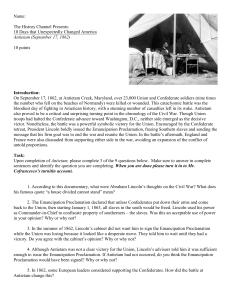
... On September 17, 1862, at Antietam Creek, Maryland, over 23,000 Union and Confederate soldiers (nine times the number who fell on the beaches of Normandy) were killed or wounded. This cataclysmic battle was the bloodiest day of fighting in American history, with a stunning number of casualties left ...
... On September 17, 1862, at Antietam Creek, Maryland, over 23,000 Union and Confederate soldiers (nine times the number who fell on the beaches of Normandy) were killed or wounded. This cataclysmic battle was the bloodiest day of fighting in American history, with a stunning number of casualties left ...
CW Basics
... The sides……… • Blue- North Union Army – United States of America, Federal Army, Yankee Army, Northern Army, or Army of the “river” (Potomac, Cumberland, ...
... The sides……… • Blue- North Union Army – United States of America, Federal Army, Yankee Army, Northern Army, or Army of the “river” (Potomac, Cumberland, ...
Chapter 21
... ridge. Burnside orders repeated frontal charges. Union troops are slaughtered. More than 10,000 casualties. 12,700 Union Cas. to 5,300 Confed. Casualties. Biggest disparity of casualties of any Major Civil War battle. Lincoln replaces Burnside with Hooker. Winter of 62-63 is low point for the ...
... ridge. Burnside orders repeated frontal charges. Union troops are slaughtered. More than 10,000 casualties. 12,700 Union Cas. to 5,300 Confed. Casualties. Biggest disparity of casualties of any Major Civil War battle. Lincoln replaces Burnside with Hooker. Winter of 62-63 is low point for the ...

Battle of Bull Run
... The biggest Confederate threat to the Union came in the form of an old U.S. warship reconditioned and plated with iron railroad rails: the Virginia (formerly called the Merrimack), which threatened to break the Union blockade, but fortunately, the Monitor arrived just in time to fight the Merrimack ...
... The biggest Confederate threat to the Union came in the form of an old U.S. warship reconditioned and plated with iron railroad rails: the Virginia (formerly called the Merrimack), which threatened to break the Union blockade, but fortunately, the Monitor arrived just in time to fight the Merrimack ...

13/13 THE CIVIL WAR IS FROM 1861-1865…
... -Identify the years of the Civil War and the major events of those years. -Describe the causes of the Civil War -Explain the advantages of each side -Analyze the importance of the following events: The First Battle of bull Run, Chancellorsville, Gettysburg, Emancipation Proclamation, Sherman’s March ...
... -Identify the years of the Civil War and the major events of those years. -Describe the causes of the Civil War -Explain the advantages of each side -Analyze the importance of the following events: The First Battle of bull Run, Chancellorsville, Gettysburg, Emancipation Proclamation, Sherman’s March ...


Name
... D) to help in the attack on Gettysburg. E) in recognition that the idea of slavery was wrong. What were Robert E. Lee’s purposes for launching his invasion North through Pennsylvania? (pg. 464) _________________________________________________________________________________________________ ________ ...
... D) to help in the attack on Gettysburg. E) in recognition that the idea of slavery was wrong. What were Robert E. Lee’s purposes for launching his invasion North through Pennsylvania? (pg. 464) _________________________________________________________________________________________________ ________ ...

Chapter 15
... Miss. River. • Grant had started his siege in May, and the Confederates only surrendered when they were totally out of supplies. No more food. • Union controlled the ocean, Miss. River and land. The Anaconda plan was successful ...
... Miss. River. • Grant had started his siege in May, and the Confederates only surrendered when they were totally out of supplies. No more food. • Union controlled the ocean, Miss. River and land. The Anaconda plan was successful ...
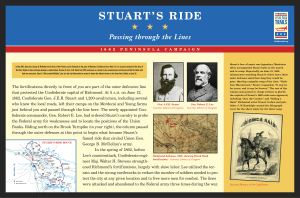
stuart`s ride - Richmond Discoveries
... STUART’S RIDE ROUTE George B. McClellan’s army. In the spring of 1862, before Lee’s counterattack, Confederate engi- Richmond defenses, 1862, showing Brook Road fortification – Courtesy Library of Congress neer Maj. Walter H. Stevens strengthened Richmond’s fortifications, largely with slave labor. ...
... STUART’S RIDE ROUTE George B. McClellan’s army. In the spring of 1862, before Lee’s counterattack, Confederate engi- Richmond defenses, 1862, showing Brook Road fortification – Courtesy Library of Congress neer Maj. Walter H. Stevens strengthened Richmond’s fortifications, largely with slave labor. ...
Small and interesting facts about the Civil War
... Old Henry Clay's grandsons were soldiers, three for the Union, and four for the Confederacy. ...
... Old Henry Clay's grandsons were soldiers, three for the Union, and four for the Confederacy. ...

The Civil War - Los Angeles Center for Enriched Studies
... Sherman’s March to the Sea Union Gen. Sherman adopted the concept of total war in Georgia - started to destroy farms, crops, free slaves. This affected the ability of the Confederacy to supply the military, and the psyche of Southerners - did they want to continue fighting. ...
... Sherman’s March to the Sea Union Gen. Sherman adopted the concept of total war in Georgia - started to destroy farms, crops, free slaves. This affected the ability of the Confederacy to supply the military, and the psyche of Southerners - did they want to continue fighting. ...
Civil War and Reconstruction
... Name_______________________________________ Period_______________ Date ______________ ...
... Name_______________________________________ Period_______________ Date ______________ ...

File - American History I with Ms. Byrne
... – Pope thought that because of his superior numbers, he could out maneuver the Confederates; he failed – Jackson, Longstreet, and Lee all successfully defended Manassas ...
... – Pope thought that because of his superior numbers, he could out maneuver the Confederates; he failed – Jackson, Longstreet, and Lee all successfully defended Manassas ...


Ch 21 Questions and VocabEXEMPLAR answers
... expectations, and inflated the Confederate’s over confidence. Antietam – Union victory because the battle plans were discovered and thwarted. Gettysburg – Union victory after the failure of Pickett’s Charge. Vicksburg – Union victory under Grant Shiloh – Confederate victory and bloody battle demonst ...
... expectations, and inflated the Confederate’s over confidence. Antietam – Union victory because the battle plans were discovered and thwarted. Gettysburg – Union victory after the failure of Pickett’s Charge. Vicksburg – Union victory under Grant Shiloh – Confederate victory and bloody battle demonst ...

Civil War Sesquicentennial 2011-2015
... If you have never visited a Civil War battlefield, it was years ago, or you just want to be there for the anniversary, the following is a good start – Harpers Ferry, West Virgnia, 1859 – long simmering tensions explode as abolitionist John Brown and his followers raid the Federal Arsenal in hopes ...
... If you have never visited a Civil War battlefield, it was years ago, or you just want to be there for the anniversary, the following is a good start – Harpers Ferry, West Virgnia, 1859 – long simmering tensions explode as abolitionist John Brown and his followers raid the Federal Arsenal in hopes ...
Fort Sumter: The Confederates attack Fort Sumter (Union property
... Fort Sumter: The Confederates attack Fort Sumter (Union property) in South Carolina, and Lincoln decides to go to war. 3 events that led to war: The issue of slavery, election of Lincoln (1860), the arguments over states’ rights. Secession: To withdraw from a group, in this case, from the Union. Fir ...
... Fort Sumter: The Confederates attack Fort Sumter (Union property) in South Carolina, and Lincoln decides to go to war. 3 events that led to war: The issue of slavery, election of Lincoln (1860), the arguments over states’ rights. Secession: To withdraw from a group, in this case, from the Union. Fir ...

Civil War Battles
... 1. Why did Grant’s “total war” policy meet with resistance even in the North? Do you think the policy was a good idea? Why? 2. How did Grant and Sherman’s military campaigns help Lincoln win reelection in 1864? ...
... 1. Why did Grant’s “total war” policy meet with resistance even in the North? Do you think the policy was a good idea? Why? 2. How did Grant and Sherman’s military campaigns help Lincoln win reelection in 1864? ...
The Civil War
... C. Lee ordered his troops back into Virginia. D. North claimed victory. Bloodiest single day in American History with 23,000 casualties. ...
... C. Lee ordered his troops back into Virginia. D. North claimed victory. Bloodiest single day in American History with 23,000 casualties. ...

Chapter 16
... Antietam was the bloodiest single-day battle in American history, with about 23,000 casualties. This was a two to one battle with Robert E. Lee’s Army of Northern Virginia having approximately 45,00 troops to Union Army Maj. Gen. George B. McClellan’s 90,000 troops. General Lee’s battle plans were k ...
... Antietam was the bloodiest single-day battle in American history, with about 23,000 casualties. This was a two to one battle with Robert E. Lee’s Army of Northern Virginia having approximately 45,00 troops to Union Army Maj. Gen. George B. McClellan’s 90,000 troops. General Lee’s battle plans were k ...
Battle of Antietam

The Battle of Antietam /ænˈtiːtəm/, also known as the Battle of Sharpsburg, particularly in the South, fought on September 17, 1862, near Sharpsburg, Maryland, and Antietam Creek as part of the Maryland Campaign, was the first major battle in the American Civil War to take place on Union soil. It is the bloodiest single-day battle in American history, with a combined tally of dead, wounded, and missing at 22,717.After pursuing Confederate General Robert E. Lee into Maryland, Union Army Maj. Gen. George B. McClellan launched attacks against Lee's army, in defensive positions behind Antietam Creek. At dawn on September 17, Maj. Gen. Joseph Hooker's corps mounted a powerful assault on Lee's left flank. Attacks and counterattacks swept across Miller's Cornfield and fighting swirled around the Dunker Church. Union assaults against the Sunken Road eventually pierced the Confederate center, but the Federal advantage was not followed up. In the afternoon, Union Maj. Gen. Ambrose Burnside's corps entered the action, capturing a stone bridge over Antietam Creek and advancing against the Confederate right. At a crucial moment, Confederate Maj. Gen. A. P. Hill's division arrived from Harpers Ferry and launched a surprise counterattack, driving back Burnside and ending the battle. Although outnumbered two-to-one, Lee committed his entire force, while McClellan sent in less than three-quarters of his army, enabling Lee to fight the Federals to a standstill. During the night, both armies consolidated their lines. In spite of crippling casualties, Lee continued to skirmish with McClellan throughout September 18, while removing his battered army south of the Potomac River.Despite having superiority of numbers, McClellan's attacks failed to achieve force concentration, allowing Lee to counter by shifting forces and moving interior lines to meet each challenge. Despite ample reserve forces that could have been deployed to exploit localized successes, McClellan failed to destroy Lee's army. McClellan had halted Lee's invasion of Maryland, but Lee was able to withdraw his army back to Virginia without interference from the cautious McClellan. Although the battle was tactically inconclusive, the Confederate troops had withdrawn first from the battlefield, making it, in military terms, a Union victory. It had significance as enough of a victory to give President Abraham Lincoln the confidence to announce his Emancipation Proclamation, which discouraged the British and French governments from potential plans for recognition of the Confederacy.