
Unit 8 - Mr. O`Sullivan`s World of History
... Union cavalry. Soon both sides called for reinforcements and the war’s greatest battle began. The Battle of Gettysburg would last for three days and culminate with a massive Confederate infantry charge led by Major General George Pickett. The Rebel charge was wiped out by the deadly effective fire f ...
... Union cavalry. Soon both sides called for reinforcements and the war’s greatest battle began. The Battle of Gettysburg would last for three days and culminate with a massive Confederate infantry charge led by Major General George Pickett. The Rebel charge was wiped out by the deadly effective fire f ...

The Civil War
... Civil War broke out, he quickly volunteered to serve in the Union army. Lincoln quickly made him a general. ...
... Civil War broke out, he quickly volunteered to serve in the Union army. Lincoln quickly made him a general. ...

Copy of The Civil War: Guided Reading Lesson 2: Early Years of the
... 11. The Confederates had a series of victories in the East, while in the West the Union was making gains. 12. Seven Days' Battle, Second Battle of Bull Run, Fredericksburg, Chancellorsville 13. knowledge of the terrain; ability to move troops quickly; ability to inspire troops 14. He wanted to bring ...
... 11. The Confederates had a series of victories in the East, while in the West the Union was making gains. 12. Seven Days' Battle, Second Battle of Bull Run, Fredericksburg, Chancellorsville 13. knowledge of the terrain; ability to move troops quickly; ability to inspire troops 14. He wanted to bring ...
Civil War Battles - United States History
... downfall,” he wrote. “The war [was] over. There rebels [were] our countrymen again.” Lee’s Army of North Virginia stacked arms and surrendered its battle flags on April 12, 1865 and by late June, all Confederate forces had laid down their arms. ...
... downfall,” he wrote. “The war [was] over. There rebels [were] our countrymen again.” Lee’s Army of North Virginia stacked arms and surrendered its battle flags on April 12, 1865 and by late June, all Confederate forces had laid down their arms. ...

The war in the East and in the West
... Farragut tried to quickly sneak his ships past New Orleans Forces and were met with heavy gunfire from southern Troops even using burning rafts to burn Farragut’s wooden ships ...
... Farragut tried to quickly sneak his ships past New Orleans Forces and were met with heavy gunfire from southern Troops even using burning rafts to burn Farragut’s wooden ships ...

The Civil War - Cloudfront.net
... General John Pope ordered to make a second run at Richmond. Union Army at 63,000 strong. Pope’s headquarters are raided by a Confederate cavalry. ...
... General John Pope ordered to make a second run at Richmond. Union Army at 63,000 strong. Pope’s headquarters are raided by a Confederate cavalry. ...
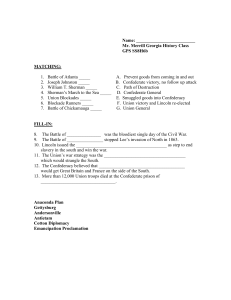
Civil War test
... 9. The Battle of ________________ stopped Lee’s invasion of North in 1863. 10. Lincoln issued the ________________________________________ as step to end slavery in the south and win the war. 11. The Union’s war strategy was the ____________________________________ which would strangle the South. 12 ...
... 9. The Battle of ________________ stopped Lee’s invasion of North in 1863. 10. Lincoln issued the ________________________________________ as step to end slavery in the south and win the war. 11. The Union’s war strategy was the ____________________________________ which would strangle the South. 12 ...

Ch. 16, Section 5: The Way to Victory pg. 485
... 1. The Civil War was the most devastating in American history. More than 600,000 soldiers died. It caused billions of dollars worth of damage, mostly in the South. 2. Bitter feelings between Southerners and Northerners lasted for ...
... 1. The Civil War was the most devastating in American history. More than 600,000 soldiers died. It caused billions of dollars worth of damage, mostly in the South. 2. Bitter feelings between Southerners and Northerners lasted for ...
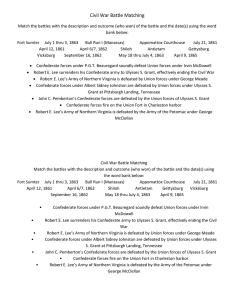
Civil War Battle Matching
... Confederate forces under P.G.T. Beauregard soundly defeat Union forces under Irvin McDowell Robert E. Lee surrenders his Confederate army to Ulysses S. Grant, effectively ending the Civil War Robert E. Lee’s Army of Northern Virginia is defeated by Union forces under George Meade Confederate forces ...
... Confederate forces under P.G.T. Beauregard soundly defeat Union forces under Irvin McDowell Robert E. Lee surrenders his Confederate army to Ulysses S. Grant, effectively ending the Civil War Robert E. Lee’s Army of Northern Virginia is defeated by Union forces under George Meade Confederate forces ...

Civil War Leaders (12-7-16) File
... forces. McDowell was a graduate of West Point, a veteran of the Mexican War, and an instructor at West Point when the war ended. He lost his command, however, at the first major battle of the war – Bull Run. McDowell had told the President that when the Confederate soldiers saw the Union army, and i ...
... forces. McDowell was a graduate of West Point, a veteran of the Mexican War, and an instructor at West Point when the war ended. He lost his command, however, at the first major battle of the war – Bull Run. McDowell had told the President that when the Confederate soldiers saw the Union army, and i ...

Advantage & Disadvantage
... The deciding moment can reasonable called the turning point of the war, Lee, realizing the strategic importance for the south of capturing Little Round Top, as it would have allowed southern artillery fire to hit every section of the Union army, ordered a massive attack at the center of the Union ar ...
... The deciding moment can reasonable called the turning point of the war, Lee, realizing the strategic importance for the south of capturing Little Round Top, as it would have allowed southern artillery fire to hit every section of the Union army, ordered a massive attack at the center of the Union ar ...

Chapter 16 The Civil War (1861-1865)
... • The under General George Pickett, 1000s of Confederates attacked the Union’s center position • They advanced across open land • At first, it seemed Pickett’s Charge might work- the Confederates broke the Union’s first line • In the end 75% of those that charged were dead or wounded ...
... • The under General George Pickett, 1000s of Confederates attacked the Union’s center position • They advanced across open land • At first, it seemed Pickett’s Charge might work- the Confederates broke the Union’s first line • In the end 75% of those that charged were dead or wounded ...

Chapter 22
... we say here, but it can never forget what they did here. It is for us the living, rather, to be dedicated here to the unfinished work which they who fought here have thus far so nobly advanced. It is rather for us to be here dedicated to the great task remaining before us -- that from these honored ...
... we say here, but it can never forget what they did here. It is for us the living, rather, to be dedicated here to the unfinished work which they who fought here have thus far so nobly advanced. It is rather for us to be here dedicated to the great task remaining before us -- that from these honored ...
Chapter 12 Review
... 31. What did Lincoln suspend during the Civil War? __________________________________________ 32. What did Lincoln issue on New Year’s Day in 1863? __________________________________________ 33. Who devised a legal argument that allowed the Union Army to free enslaved Africans? ____________________ ...
... 31. What did Lincoln suspend during the Civil War? __________________________________________ 32. What did Lincoln issue on New Year’s Day in 1863? __________________________________________ 33. Who devised a legal argument that allowed the Union Army to free enslaved Africans? ____________________ ...
End of the Civil War
... Gettysburg, the spirit of the Union was further boosted when Ulysses S. Grant was given command of the Union armies. His bravery and expertise in battle soon led to more Union victories. One of his most important victories was at Vicksburg, Mississippi. After two long months of fighting and laying s ...
... Gettysburg, the spirit of the Union was further boosted when Ulysses S. Grant was given command of the Union armies. His bravery and expertise in battle soon led to more Union victories. One of his most important victories was at Vicksburg, Mississippi. After two long months of fighting and laying s ...

Part One: - HASANAPUSH
... the Civil War The initial Northern strategy for subduing the South, the so-called Anaconda Plan, entailed strangling it by a blockade at sea and obtaining control of the Mississippi River. But at the end of 1862, it was clear that the South’s defensive strategy could only be broken by the invasion o ...
... the Civil War The initial Northern strategy for subduing the South, the so-called Anaconda Plan, entailed strangling it by a blockade at sea and obtaining control of the Mississippi River. But at the end of 1862, it was clear that the South’s defensive strategy could only be broken by the invasion o ...

Civil War Battles
... • No casualties during the battle • 4 Union casualties during the surrender ceremony 1 killed and 3 Wounded • Starts the Civil War ...
... • No casualties during the battle • 4 Union casualties during the surrender ceremony 1 killed and 3 Wounded • Starts the Civil War ...

Junior High History Chapter 16 1. Seven southern states seceded as
... General George B. McClellan was placed in charge of 100,000 soldiers, called the Army of the Potomac. Confederate army in Virginia was under the command of General Robert E. Lee. Lee forced Union army to retreat in June 1862. Lincoln ordered General John Pope to march to Richmond. Jackson’s troops s ...
... General George B. McClellan was placed in charge of 100,000 soldiers, called the Army of the Potomac. Confederate army in Virginia was under the command of General Robert E. Lee. Lee forced Union army to retreat in June 1862. Lincoln ordered General John Pope to march to Richmond. Jackson’s troops s ...
Causes and Beginning of the Civil War
... which is ready to pay its way out of USA. Attack on Fort Sumter on April 12-13 on the order of Jefferson Davies begins the Civil War (War of the Secession). Fort Sumter is forced to surrender. Lincoln calls for 75000 soldiers and next additional 42000. Four states of Upper South join the Confederacy ...
... which is ready to pay its way out of USA. Attack on Fort Sumter on April 12-13 on the order of Jefferson Davies begins the Civil War (War of the Secession). Fort Sumter is forced to surrender. Lincoln calls for 75000 soldiers and next additional 42000. Four states of Upper South join the Confederacy ...

Civil War Section 3 “Fighting the War” The War in the West
... All slaves living in areas still rebelling against the United States would be free. ...
... All slaves living in areas still rebelling against the United States would be free. ...

File
... In the late afternoon, Beauregard counterattacked, bolstered with reinforcements, ordered his men to charge, yelling like “furies” at the Union line. Terrified, the Union army fell to pieces. Afraid the picnicking spectators and panicked soldiers ran from the bloody field—the scene ...
... In the late afternoon, Beauregard counterattacked, bolstered with reinforcements, ordered his men to charge, yelling like “furies” at the Union line. Terrified, the Union army fell to pieces. Afraid the picnicking spectators and panicked soldiers ran from the bloody field—the scene ...

Slide 1
... After Petersburg, Davis’s government leaves Richmond, sets it afire • Lee surrenders April 1865 at village of ...
... After Petersburg, Davis’s government leaves Richmond, sets it afire • Lee surrenders April 1865 at village of ...
Battle of Antietam

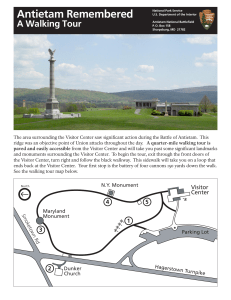
The Battle of Antietam /ænˈtiːtəm/, also known as the Battle of Sharpsburg, particularly in the South, fought on September 17, 1862, near Sharpsburg, Maryland, and Antietam Creek as part of the Maryland Campaign, was the first major battle in the American Civil War to take place on Union soil. It is the bloodiest single-day battle in American history, with a combined tally of dead, wounded, and missing at 22,717.After pursuing Confederate General Robert E. Lee into Maryland, Union Army Maj. Gen. George B. McClellan launched attacks against Lee's army, in defensive positions behind Antietam Creek. At dawn on September 17, Maj. Gen. Joseph Hooker's corps mounted a powerful assault on Lee's left flank. Attacks and counterattacks swept across Miller's Cornfield and fighting swirled around the Dunker Church. Union assaults against the Sunken Road eventually pierced the Confederate center, but the Federal advantage was not followed up. In the afternoon, Union Maj. Gen. Ambrose Burnside's corps entered the action, capturing a stone bridge over Antietam Creek and advancing against the Confederate right. At a crucial moment, Confederate Maj. Gen. A. P. Hill's division arrived from Harpers Ferry and launched a surprise counterattack, driving back Burnside and ending the battle. Although outnumbered two-to-one, Lee committed his entire force, while McClellan sent in less than three-quarters of his army, enabling Lee to fight the Federals to a standstill. During the night, both armies consolidated their lines. In spite of crippling casualties, Lee continued to skirmish with McClellan throughout September 18, while removing his battered army south of the Potomac River.Despite having superiority of numbers, McClellan's attacks failed to achieve force concentration, allowing Lee to counter by shifting forces and moving interior lines to meet each challenge. Despite ample reserve forces that could have been deployed to exploit localized successes, McClellan failed to destroy Lee's army. McClellan had halted Lee's invasion of Maryland, but Lee was able to withdraw his army back to Virginia without interference from the cautious McClellan. Although the battle was tactically inconclusive, the Confederate troops had withdrawn first from the battlefield, making it, in military terms, a Union victory. It had significance as enough of a victory to give President Abraham Lincoln the confidence to announce his Emancipation Proclamation, which discouraged the British and French governments from potential plans for recognition of the Confederacy.