File
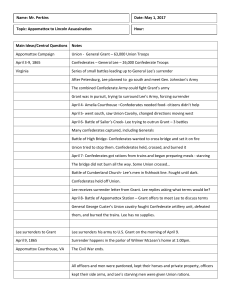
... Series of small battles leading up to General Lee’s surrender After Petersburg, Lee planned to go south and meet Gen. Johnston’s Army The combined Confederate Army could fight Grant’s army Grant was in pursuit, trying to surround Lee’s Army, forcing surrender April 4- Amelia Courthouse –Confederates ...
... Series of small battles leading up to General Lee’s surrender After Petersburg, Lee planned to go south and meet Gen. Johnston’s Army The combined Confederate Army could fight Grant’s army Grant was in pursuit, trying to surround Lee’s Army, forcing surrender April 4- Amelia Courthouse –Confederates ...

Chapter 18 PowerPoint Notes
... • Gen. Lee was looking to gain a ____________________ in the North to bring in European support • Sept. 1862 Lee entered Maryland and split his forces. He sent Stonewall Jackson to capture _________________________________________. • His plans were _________________________________ and told to Union ...
... • Gen. Lee was looking to gain a ____________________ in the North to bring in European support • Sept. 1862 Lee entered Maryland and split his forces. He sent Stonewall Jackson to capture _________________________________________. • His plans were _________________________________ and told to Union ...

chapter 18 notes - Biloxi Public Schools
... • Gen. Lee was looking to gain a ____________________ in the North to bring in European support • Sept. 1862 Lee entered Maryland and split his forces. He sent Stonewall Jackson to capture _________________________________________. • His plans were _________________________________ and told to Union ...
... • Gen. Lee was looking to gain a ____________________ in the North to bring in European support • Sept. 1862 Lee entered Maryland and split his forces. He sent Stonewall Jackson to capture _________________________________________. • His plans were _________________________________ and told to Union ...

17 - Coppell ISD
... Gen – Army General Setting the Scene: At first the armies of the North and the South marched proudly off to war. Each side expected a quick and painless victory. The reality of war soon shattered this expectation. Over and over, soldiers wrote home describing the awful face of battle: “I never saw s ...
... Gen – Army General Setting the Scene: At first the armies of the North and the South marched proudly off to war. Each side expected a quick and painless victory. The reality of war soon shattered this expectation. Over and over, soldiers wrote home describing the awful face of battle: “I never saw s ...

Battle Notes
... 23,000 casualties (25%); Union wins; wake up call to the country that war is going to be very deadly and not easy ...
... 23,000 casualties (25%); Union wins; wake up call to the country that war is going to be very deadly and not easy ...


Chapter 16 Study Guide/Notes
... Appomattox Courthouse - The Virginia town where General Robert E. Lee was forced to surrender, thus ending the Civil War Battle of Antietam - A union victory in the Civil War that marked the bloodiest single-day battle in U.S. military history border states - Four slave states that lay between the N ...
... Appomattox Courthouse - The Virginia town where General Robert E. Lee was forced to surrender, thus ending the Civil War Battle of Antietam - A union victory in the Civil War that marked the bloodiest single-day battle in U.S. military history border states - Four slave states that lay between the N ...
Chapter 16 Civil War Review Questions
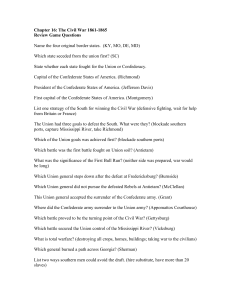
... Capital of the Confederate States of America. (Richmond) President of the Confederate States of America. (Jefferson Davis) First capital of the Confederate States of America. (Montgomery) List one strategy of the South for winning the Civil War (defensive fighting, wait for help from Britain or Fran ...
... Capital of the Confederate States of America. (Richmond) President of the Confederate States of America. (Jefferson Davis) First capital of the Confederate States of America. (Montgomery) List one strategy of the South for winning the Civil War (defensive fighting, wait for help from Britain or Fran ...


Chapter 16 history notes
... and Chancellorsville ~ Stonewall Jackson was shot by his own men at Chancellorsville-he died a week later The South failed in an invasion of the North- The turning point of the war Grant laid siege to the town ~it surrendered on July 4 1863 ~gave Union control of MS River 2 minute speech at cemetery ...
... and Chancellorsville ~ Stonewall Jackson was shot by his own men at Chancellorsville-he died a week later The South failed in an invasion of the North- The turning point of the war Grant laid siege to the town ~it surrendered on July 4 1863 ~gave Union control of MS River 2 minute speech at cemetery ...
File - Scottsdale Civil War Round Table
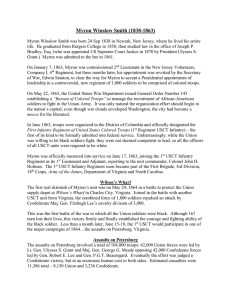
... Bradley, Esq. (who was appointed US Supreme Court Justice in 1870 by President Ulysses S. Grant.) Myron was admitted to the bar in 1861. On January 7, 1863, Myron was commissioned 2nd Lieutenant in the New Jersey Volunteers, Company I, 4th Regiment, but three months later, his appointment was revoke ...
... Bradley, Esq. (who was appointed US Supreme Court Justice in 1870 by President Ulysses S. Grant.) Myron was admitted to the bar in 1861. On January 7, 1863, Myron was commissioned 2nd Lieutenant in the New Jersey Volunteers, Company I, 4th Regiment, but three months later, his appointment was revoke ...

Historical Notes to accompany letter dated: 07/04/62: 028 Historical
... raged over an extended territory and consisted of several battles including Oak Grove, Mechanicsville, Gaines' Mill, Savage Station, and Malvern Hill. As one might expect of a participant in such a chaotic event, Hardaway's descriptions do not utilize a modern historical analysis. We can discern fro ...
... raged over an extended territory and consisted of several battles including Oak Grove, Mechanicsville, Gaines' Mill, Savage Station, and Malvern Hill. As one might expect of a participant in such a chaotic event, Hardaway's descriptions do not utilize a modern historical analysis. We can discern fro ...
Leaders of the Civil War
... Brilliant Southern general Earned his nickname because he stood like a stone wall at the Battle of Bull Run (first major Civil War Battle) Good tactics (attack from behind the enemy, destroy Northern regiments one at a time by disrupting them, march long distances and still fight) Accidentally shot ...
... Brilliant Southern general Earned his nickname because he stood like a stone wall at the Battle of Bull Run (first major Civil War Battle) Good tactics (attack from behind the enemy, destroy Northern regiments one at a time by disrupting them, march long distances and still fight) Accidentally shot ...

File
... On the second day, Pope found Jackson’s soldiers along an unfinished railroad grade. Pope hurled his men against the Confederates. But the attacks were pushed back with heavy casualties on both sides. ...
... On the second day, Pope found Jackson’s soldiers along an unfinished railroad grade. Pope hurled his men against the Confederates. But the attacks were pushed back with heavy casualties on both sides. ...
Civil War
... Civil War Begins Abraham Lincoln wins presidential election South Carolina Secedes (leaves U.S.) Confederate States of America formed Jefferson Davis becomes president of Confederate States ...
... Civil War Begins Abraham Lincoln wins presidential election South Carolina Secedes (leaves U.S.) Confederate States of America formed Jefferson Davis becomes president of Confederate States ...

Modern World History Chapter 16-2: Japan`s Pacific
... The North Takes Charge Armies Clash at Gettysburg: 1) The Battle of Gettysburg was significant because it _____________________________ the South so badly that they would never again have enough troops to invade a _____________________________. 2) The South won the Battle of Chancellorsville, howeve ...
... The North Takes Charge Armies Clash at Gettysburg: 1) The Battle of Gettysburg was significant because it _____________________________ the South so badly that they would never again have enough troops to invade a _____________________________. 2) The South won the Battle of Chancellorsville, howeve ...

Chapter 22 Outline - Mr. Wilkinson`s APUSh Class
... Explain the role of the proclamation in the formation of Northern strategy and war goals. 4. Describe the failure of the North to gain its expected early victory in 1861. 5. Describe the role of African-Americans, both Northern and Southern, free and slave. 6. Describe the political struggle between ...
... Explain the role of the proclamation in the formation of Northern strategy and war goals. 4. Describe the failure of the North to gain its expected early victory in 1861. 5. Describe the role of African-Americans, both Northern and Southern, free and slave. 6. Describe the political struggle between ...

old civil war test
... Name: _______________________ Core: _____ Place the names of the proper leaders on the lines next to the battle. (2pts. Each) Union ...
... Name: _______________________ Core: _____ Place the names of the proper leaders on the lines next to the battle. (2pts. Each) Union ...

Caleb - Strouse House Of History
... General Grant was the main Union general and General James Longstreet and General Hill for the Confederacy The fighting was intense as the battered and beaten Confederate forces tried to hold off the overwhelming Union Army The battle was a tactical draw with both sides but Grant did not retreat he ...
... General Grant was the main Union general and General James Longstreet and General Hill for the Confederacy The fighting was intense as the battered and beaten Confederate forces tried to hold off the overwhelming Union Army The battle was a tactical draw with both sides but Grant did not retreat he ...

Civil War
... I. Robert E. Lee takes over Johnston’s troops and began attacking McClellan in the “Seven Day’s Battle”. – Lee took no mercy and forced the northern troops back to Washington, DC J. As they retreated Lee started after Washington – Second Battle of Bull Run – CSA army got within 20 miles of DC K. Lee ...
... I. Robert E. Lee takes over Johnston’s troops and began attacking McClellan in the “Seven Day’s Battle”. – Lee took no mercy and forced the northern troops back to Washington, DC J. As they retreated Lee started after Washington – Second Battle of Bull Run – CSA army got within 20 miles of DC K. Lee ...

Civil War
... With the reinforcements of Federal General Buell’s division fighting began anew. General Beauregard rallied his men, but when all seemed hopeless he ordered a retreat. As a result of the Battle of Shiloh, both sides realized this would be a very long war. ...
... With the reinforcements of Federal General Buell’s division fighting began anew. General Beauregard rallied his men, but when all seemed hopeless he ordered a retreat. As a result of the Battle of Shiloh, both sides realized this would be a very long war. ...

Thai Dumas-Watts Vietnam War The Vietnam War took place in
... Poland. Britain and France responded by declaring war on Germany but took little action over the following months. In1940, Germany launched its next initiative by attacking Denmark and Norway, followed shortly thereafter by attacks on Belgium, the Netherlands, and France. All of these nations were ...
... Poland. Britain and France responded by declaring war on Germany but took little action over the following months. In1940, Germany launched its next initiative by attacking Denmark and Norway, followed shortly thereafter by attacks on Belgium, the Netherlands, and France. All of these nations were ...

Civil War Battles
... Antietam + Emancipation Proclamation Rather than wait around for the enemy to attack him, Lee made an aggressive push into the border states to try to defeat the Union on its own turf. He also hoped that a Confederate victory in Maryland would convince the state legislature to secede. In September 1 ...
... Antietam + Emancipation Proclamation Rather than wait around for the enemy to attack him, Lee made an aggressive push into the border states to try to defeat the Union on its own turf. He also hoped that a Confederate victory in Maryland would convince the state legislature to secede. In September 1 ...

THE AMERICAN CIVIL WAR
... Shiloh is in Western Tennessee 23,000 Northern casualties Bloodiest single battle at that time ...
... Shiloh is in Western Tennessee 23,000 Northern casualties Bloodiest single battle at that time ...

Chapter 21 - Mr. Carnazzo`s US History Wiki
... Confederated hoped to take advantage of momentum, convince Maryland to secede, persuade European counties to help, and relieve pressure coming down on them from the North. McClellan’s men found a copy of Lee’s plans and were able to stop the Southerners at Antietam on September 17, 1862 in one of th ...
... Confederated hoped to take advantage of momentum, convince Maryland to secede, persuade European counties to help, and relieve pressure coming down on them from the North. McClellan’s men found a copy of Lee’s plans and were able to stop the Southerners at Antietam on September 17, 1862 in one of th ...
Battle of Antietam

The Battle of Antietam /ænˈtiːtəm/, also known as the Battle of Sharpsburg, particularly in the South, fought on September 17, 1862, near Sharpsburg, Maryland, and Antietam Creek as part of the Maryland Campaign, was the first major battle in the American Civil War to take place on Union soil. It is the bloodiest single-day battle in American history, with a combined tally of dead, wounded, and missing at 22,717.After pursuing Confederate General Robert E. Lee into Maryland, Union Army Maj. Gen. George B. McClellan launched attacks against Lee's army, in defensive positions behind Antietam Creek. At dawn on September 17, Maj. Gen. Joseph Hooker's corps mounted a powerful assault on Lee's left flank. Attacks and counterattacks swept across Miller's Cornfield and fighting swirled around the Dunker Church. Union assaults against the Sunken Road eventually pierced the Confederate center, but the Federal advantage was not followed up. In the afternoon, Union Maj. Gen. Ambrose Burnside's corps entered the action, capturing a stone bridge over Antietam Creek and advancing against the Confederate right. At a crucial moment, Confederate Maj. Gen. A. P. Hill's division arrived from Harpers Ferry and launched a surprise counterattack, driving back Burnside and ending the battle. Although outnumbered two-to-one, Lee committed his entire force, while McClellan sent in less than three-quarters of his army, enabling Lee to fight the Federals to a standstill. During the night, both armies consolidated their lines. In spite of crippling casualties, Lee continued to skirmish with McClellan throughout September 18, while removing his battered army south of the Potomac River.Despite having superiority of numbers, McClellan's attacks failed to achieve force concentration, allowing Lee to counter by shifting forces and moving interior lines to meet each challenge. Despite ample reserve forces that could have been deployed to exploit localized successes, McClellan failed to destroy Lee's army. McClellan had halted Lee's invasion of Maryland, but Lee was able to withdraw his army back to Virginia without interference from the cautious McClellan. Although the battle was tactically inconclusive, the Confederate troops had withdrawn first from the battlefield, making it, in military terms, a Union victory. It had significance as enough of a victory to give President Abraham Lincoln the confidence to announce his Emancipation Proclamation, which discouraged the British and French governments from potential plans for recognition of the Confederacy.