
THE CIVIL WAR : YEAR BY YEAR
... • The battle of Antietam is the bloodiest day on American Soil. More people died on Sept. 17, 1862 than any other single day in America. ...
... • The battle of Antietam is the bloodiest day on American Soil. More people died on Sept. 17, 1862 than any other single day in America. ...

Battle of Gettysburg PPT
... 1. His army needed supplies like weapons and clothing. 2. General Lee’s men were hungry and needed food. 3. General Lee hoped to take attention away from the Union victory at Fredericksburg. 4. The confederacy also thought that a victory over the Union on northern soil may cause Great Britain and Fr ...
... 1. His army needed supplies like weapons and clothing. 2. General Lee’s men were hungry and needed food. 3. General Lee hoped to take attention away from the Union victory at Fredericksburg. 4. The confederacy also thought that a victory over the Union on northern soil may cause Great Britain and Fr ...

Prelude to War
... decided to suspend habeas corpus. If someone opposed the war, they could be detained without a trial Lincoln suspended these common rights in an effort to stop anyone from resisting the Union’s cause ...
... decided to suspend habeas corpus. If someone opposed the war, they could be detained without a trial Lincoln suspended these common rights in an effort to stop anyone from resisting the Union’s cause ...

US Civil War - Cloudfront.net
... First Battle of Bull Run • Known as the First Battle of Manassas in the South • July 21, 1861 – First major land engagement of the Civil War – General Irvin McDowell (U) – 35,000 troops • Hounded by Washington politicians & Lincoln to rush into battle, get to Richmond and end the war quickly • Troo ...
... First Battle of Bull Run • Known as the First Battle of Manassas in the South • July 21, 1861 – First major land engagement of the Civil War – General Irvin McDowell (U) – 35,000 troops • Hounded by Washington politicians & Lincoln to rush into battle, get to Richmond and end the war quickly • Troo ...
battle of jenkins` ferry
... Confederate Army was under the command of General E. Kirby Smith. General Steele and 5000 Union troops were attempting to get back to Little Rock while retreating from Camden, Arkansas after having been mauled at Mark's Mill and Poison Springs. On the afternoon of April 29 Union forces reached Jenki ...
... Confederate Army was under the command of General E. Kirby Smith. General Steele and 5000 Union troops were attempting to get back to Little Rock while retreating from Camden, Arkansas after having been mauled at Mark's Mill and Poison Springs. On the afternoon of April 29 Union forces reached Jenki ...

Chapter 21 Focus Questions: Essay question: What was the relative
... How was the South’s victory at the First Bull Run harmful to its cause and helpful to the northern cause? Describe George B. McClellan – what was his major fault? After assuming command of the Army of Potomac, General McClellan made the mistake of consistently believing what about the enemy? How did ...
... How was the South’s victory at the First Bull Run harmful to its cause and helpful to the northern cause? Describe George B. McClellan – what was his major fault? After assuming command of the Army of Potomac, General McClellan made the mistake of consistently believing what about the enemy? How did ...

Fight a defensive war - Ms. Scott`s US History
... Spectators from Washington came out to picnic and watch the battle. Union General – Irvin McDowell Confederate General – P.G.T. Beauregard Southern troops stationed at Manassas Junction engaged Northern troops along a creek called Bull Run. The Union seemed assured of victory until Thomas J. (Stonew ...
... Spectators from Washington came out to picnic and watch the battle. Union General – Irvin McDowell Confederate General – P.G.T. Beauregard Southern troops stationed at Manassas Junction engaged Northern troops along a creek called Bull Run. The Union seemed assured of victory until Thomas J. (Stonew ...
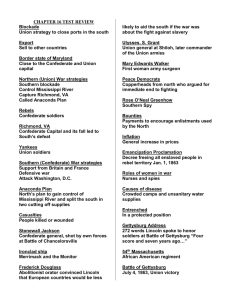
ch16reviewwithanswer..
... Richmond, VA Confederate Capital and its fall led to South’s defeat Yankees Union soldiers Southern (Confederate) War strategies Support from Britain and France Defensive war Attack Washington, D.C. Anaconda Plan North’s plan to gain control of Mississippi River and split the south in two cutting of ...
... Richmond, VA Confederate Capital and its fall led to South’s defeat Yankees Union soldiers Southern (Confederate) War strategies Support from Britain and France Defensive war Attack Washington, D.C. Anaconda Plan North’s plan to gain control of Mississippi River and split the south in two cutting of ...


Lincoln - drurban.info
... 1. Confiscation Acts (1861, 1862) – slaves would be freed if they fell into Union hands 2. Lincoln supported gradual emancipation and colonization 3. Emancipation would undermine Confederate diplomacy 4. Battle of Antietam served as springboard for Emancipation Proclamation ...
... 1. Confiscation Acts (1861, 1862) – slaves would be freed if they fell into Union hands 2. Lincoln supported gradual emancipation and colonization 3. Emancipation would undermine Confederate diplomacy 4. Battle of Antietam served as springboard for Emancipation Proclamation ...


What was the first battle of the Civil War? - Ms. Sims
... • Union took control of the Mississippi • Split the Confederacy in two (east, west) • Viewed as Turning Point of Civil War ...
... • Union took control of the Mississippi • Split the Confederacy in two (east, west) • Viewed as Turning Point of Civil War ...

Civil War Facts
... Confederate General Nathan Bedford Forrest had 30 horses shot from under him and personally killed 31 men in hand-to-hand combat. "I was a horse ahead at the end," he said. ...
... Confederate General Nathan Bedford Forrest had 30 horses shot from under him and personally killed 31 men in hand-to-hand combat. "I was a horse ahead at the end," he said. ...
A Brothers* War: The Upper South
... E. Lyon was shot and his men ran out of ammunition, they retreated F. Confederates won G. Fremont (Commander of the Union’s Western Department) issued an order that would put the whole state under martial law H. Lincoln tells Fremont to modify his proclamation I. Civil War 1. 80,000 whit ...
... E. Lyon was shot and his men ran out of ammunition, they retreated F. Confederates won G. Fremont (Commander of the Union’s Western Department) issued an order that would put the whole state under martial law H. Lincoln tells Fremont to modify his proclamation I. Civil War 1. 80,000 whit ...
The Battle Of Chickamauga - ushistory
... In late morning, Rosecrans was misinformed that he had a gap in his line. In moving units to shore up the supposed gap, Rosecrans accidentally created an actual gap, directly in the path of an eight-brigade assault on a narrow front by Confederate Lt. Gen. James Longstreet. Longstreet's attack drove ...
... In late morning, Rosecrans was misinformed that he had a gap in his line. In moving units to shore up the supposed gap, Rosecrans accidentally created an actual gap, directly in the path of an eight-brigade assault on a narrow front by Confederate Lt. Gen. James Longstreet. Longstreet's attack drove ...
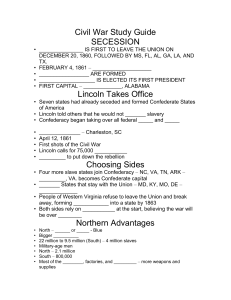
Civil War Study Guide
... • _________________ – believed that _______ and ________ would help them to get Southern cotton ...
... • _________________ – believed that _______ and ________ would help them to get Southern cotton ...
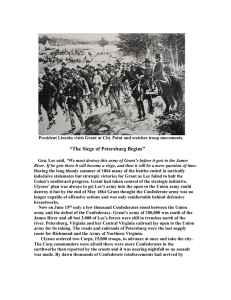
“The Siege of Petersburg Begins”
... “The Siege of Petersburg Begins” Gen. Lee said, “We must destroy this army of Grant’s before it gets to the James River. If he gets there it will become a siege, and then it will be a mere question of time. During the long bloody summer of 1864 many of the battles ended in tactically indecisive stal ...
... “The Siege of Petersburg Begins” Gen. Lee said, “We must destroy this army of Grant’s before it gets to the James River. If he gets there it will become a siege, and then it will be a mere question of time. During the long bloody summer of 1864 many of the battles ended in tactically indecisive stal ...

4-D
... actor and Southern sympathizer—then leaped down from the presidential box. Pg. 184. 43. Reconstruction, the period during which the United States began to Civil War, lasted from 1865 to 1877. ...
... actor and Southern sympathizer—then leaped down from the presidential box. Pg. 184. 43. Reconstruction, the period during which the United States began to Civil War, lasted from 1865 to 1877. ...

The 1940s 14-C 10 points NAME
... actor and Southern sympathizer—then leaped down from the presidential box. Pg. 184. 43. Reconstruction, the period during which the United States began to Civil War, lasted from 1865 to 1877. ...
... actor and Southern sympathizer—then leaped down from the presidential box. Pg. 184. 43. Reconstruction, the period during which the United States began to Civil War, lasted from 1865 to 1877. ...

The War Begins - Civil War Trust
... 12. The Confederate victory at _________ was aided by the inaction of Union General McClellan after his troops discovered Robert E. Lee’s battle plans. McClellan decided to wait instead of acting immediately, giving Confederate troops ample time to revise their plans 14. Of her work on the battlefie ...
... 12. The Confederate victory at _________ was aided by the inaction of Union General McClellan after his troops discovered Robert E. Lee’s battle plans. McClellan decided to wait instead of acting immediately, giving Confederate troops ample time to revise their plans 14. Of her work on the battlefie ...

his 201 class 14
... Valley and in 1862, General U.S. Grant took Fort Henry on the Tennessee River and Fort Donelson on the Cumberland ...
... Valley and in 1862, General U.S. Grant took Fort Henry on the Tennessee River and Fort Donelson on the Cumberland ...
AMERICAN CIVIL WAR TRIVIA QUIZ
... d. Battle of Gettysburg 6> The battle of Gettysburg occurred in which year? a. July 1-3, 1861 b. July 1-3, 1863 c. July 1-3, 1864 d. July 1-3, 1862 7> Who commanded the Confederate Army in Virginia immediately before Robert E. Lee? a. Joseph E. Johnston b. James Goff c. Stonewall Jackson d. Braxton ...
... d. Battle of Gettysburg 6> The battle of Gettysburg occurred in which year? a. July 1-3, 1861 b. July 1-3, 1863 c. July 1-3, 1864 d. July 1-3, 1862 7> Who commanded the Confederate Army in Virginia immediately before Robert E. Lee? a. Joseph E. Johnston b. James Goff c. Stonewall Jackson d. Braxton ...

Civil War Battles - WAQT You Gotta Know
... breach defenses of New Orleans ● Confederate General Lovell withdraws his 3,000 troops without a fight ● On May 1, 15,000 Union troops take control of the city (for the remainder of the war) ● Considered one of the worst Confederate losses in the western theater of the war ...
... breach defenses of New Orleans ● Confederate General Lovell withdraws his 3,000 troops without a fight ● On May 1, 15,000 Union troops take control of the city (for the remainder of the war) ● Considered one of the worst Confederate losses in the western theater of the war ...

Civil War Part 2
... Virginia in early 1862. He soon turned into one of the greatest armies the world has ever seen. • Always outnumbered, the army fought brilliantly and won battles with excellent leadership from Lee, and his subordinate generals like Stonewall Jackson, James Longstreet, A.P. Hill, and John Bell Hood. ...
... Virginia in early 1862. He soon turned into one of the greatest armies the world has ever seen. • Always outnumbered, the army fought brilliantly and won battles with excellent leadership from Lee, and his subordinate generals like Stonewall Jackson, James Longstreet, A.P. Hill, and John Bell Hood. ...

civ war test review.xlsx
... The Civil War began when Confederate artillery fired on this fort in South Carolina ...
... The Civil War began when Confederate artillery fired on this fort in South Carolina ...
Battle of Antietam

The Battle of Antietam /ænˈtiːtəm/, also known as the Battle of Sharpsburg, particularly in the South, fought on September 17, 1862, near Sharpsburg, Maryland, and Antietam Creek as part of the Maryland Campaign, was the first major battle in the American Civil War to take place on Union soil. It is the bloodiest single-day battle in American history, with a combined tally of dead, wounded, and missing at 22,717.After pursuing Confederate General Robert E. Lee into Maryland, Union Army Maj. Gen. George B. McClellan launched attacks against Lee's army, in defensive positions behind Antietam Creek. At dawn on September 17, Maj. Gen. Joseph Hooker's corps mounted a powerful assault on Lee's left flank. Attacks and counterattacks swept across Miller's Cornfield and fighting swirled around the Dunker Church. Union assaults against the Sunken Road eventually pierced the Confederate center, but the Federal advantage was not followed up. In the afternoon, Union Maj. Gen. Ambrose Burnside's corps entered the action, capturing a stone bridge over Antietam Creek and advancing against the Confederate right. At a crucial moment, Confederate Maj. Gen. A. P. Hill's division arrived from Harpers Ferry and launched a surprise counterattack, driving back Burnside and ending the battle. Although outnumbered two-to-one, Lee committed his entire force, while McClellan sent in less than three-quarters of his army, enabling Lee to fight the Federals to a standstill. During the night, both armies consolidated their lines. In spite of crippling casualties, Lee continued to skirmish with McClellan throughout September 18, while removing his battered army south of the Potomac River.Despite having superiority of numbers, McClellan's attacks failed to achieve force concentration, allowing Lee to counter by shifting forces and moving interior lines to meet each challenge. Despite ample reserve forces that could have been deployed to exploit localized successes, McClellan failed to destroy Lee's army. McClellan had halted Lee's invasion of Maryland, but Lee was able to withdraw his army back to Virginia without interference from the cautious McClellan. Although the battle was tactically inconclusive, the Confederate troops had withdrawn first from the battlefield, making it, in military terms, a Union victory. It had significance as enough of a victory to give President Abraham Lincoln the confidence to announce his Emancipation Proclamation, which discouraged the British and French governments from potential plans for recognition of the Confederacy.