
Chapter 11 section 4
... capturing Jackson and foraging as they go Traveled 150 miles in 17 days and fought 5 battles along the way Reaches Vicksburg in May 1863 and attacks the city twice, but fails. Decides that a siege is the only way he will be able to take the city Siege: cut off the food and supplies that can enter an ...
... capturing Jackson and foraging as they go Traveled 150 miles in 17 days and fought 5 battles along the way Reaches Vicksburg in May 1863 and attacks the city twice, but fails. Decides that a siege is the only way he will be able to take the city Siege: cut off the food and supplies that can enter an ...
The Civil War - Cobb Learning
... The Civil War transformed the U.S. It devastated the economy of the South while contributing to the rapid economic growth of the North & West. While African Americans gained their freedom, a legacy of bitterness between the North & South was left behind that lasted for generations. The war also esta ...
... The Civil War transformed the U.S. It devastated the economy of the South while contributing to the rapid economic growth of the North & West. While African Americans gained their freedom, a legacy of bitterness between the North & South was left behind that lasted for generations. The war also esta ...

Slide 1 - SCHOOLinSITES
... a) restriction of slavery--not abolition b) "A house divided against itself cannot stand..." the country cannot remain half-slave and halffree—it must become all one thing or another J) South Carolina secedes from the Union 1) “...too small for a republic and too large for an insane asylum...” ...
... a) restriction of slavery--not abolition b) "A house divided against itself cannot stand..." the country cannot remain half-slave and halffree—it must become all one thing or another J) South Carolina secedes from the Union 1) “...too small for a republic and too large for an insane asylum...” ...
The Battle of Shiloh
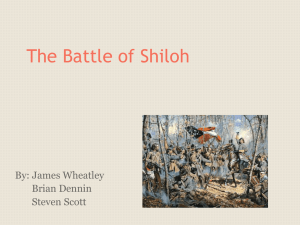
... • April 6, 1862, 40,000 Confederate soldiers under the command of Gen. Albert Sidney Johnston poured out of the nearby woods and struck a line of Union soldiers occupying ground near Pittsburg Landing on the Tennessee River • Repeated Rebel attacks failed to carry the Hornet's Nest, but massed artil ...
... • April 6, 1862, 40,000 Confederate soldiers under the command of Gen. Albert Sidney Johnston poured out of the nearby woods and struck a line of Union soldiers occupying ground near Pittsburg Landing on the Tennessee River • Repeated Rebel attacks failed to carry the Hornet's Nest, but massed artil ...
Name - cloudfront.net
... 29. The most famous African American regiment was the ______________________________. 30. ________________________________ founded the American _______________________. ...
... 29. The most famous African American regiment was the ______________________________. 30. ________________________________ founded the American _______________________. ...
CW Study Guide Ans.
... 23. Southern troops became increasingly younger and more poorly clothed. 24. Women were left to run the businesses in the North and the farms and plantations in the South. 25. The collapse of the Confederacy made Confederate money worthless 26. Robert Smalls was honored for his heroism and bravery. ...
... 23. Southern troops became increasingly younger and more poorly clothed. 24. Women were left to run the businesses in the North and the farms and plantations in the South. 25. The collapse of the Confederacy made Confederate money worthless 26. Robert Smalls was honored for his heroism and bravery. ...

the regimental dispatch - SOUTHERN PIEDMONT HISTORICAL
... army a dual purpose: preserve the Union, and free any slaves in bondage. With this document, Lincoln stated that all slaves in the Confederacy were to be free on January 1 st, 1863. This not only robbed the Confederates of their labor force, but also helped to keep European countries, which had alre ...
... army a dual purpose: preserve the Union, and free any slaves in bondage. With this document, Lincoln stated that all slaves in the Confederacy were to be free on January 1 st, 1863. This not only robbed the Confederates of their labor force, but also helped to keep European countries, which had alre ...
How do personalities begin to mold the outcome of the war?
... • A place on the battlefield that experienced the deadliest fighting • It is the bloodiest battle of the Civil War to date result’s of tHe Battle of sHiloH: • 24,000 casualties (killed or wounded) • A Union victory ...
... • A place on the battlefield that experienced the deadliest fighting • It is the bloodiest battle of the Civil War to date result’s of tHe Battle of sHiloH: • 24,000 casualties (killed or wounded) • A Union victory ...

civil war 1 - OCPS TeacherPress
... VA (near Washington, D.C.) • South led by Lee & Jackson • North led by Pope (McClellan demoted after 7 Days Battles attempting to take Richmond but gets command again after Pope loses Bull Run II) • SOUTH WON again • Significance: Gen. Lee is now ...
... VA (near Washington, D.C.) • South led by Lee & Jackson • North led by Pope (McClellan demoted after 7 Days Battles attempting to take Richmond but gets command again after Pope loses Bull Run II) • SOUTH WON again • Significance: Gen. Lee is now ...

Civil War
... • Bull Run Ends the "Ninety-Day War" • President Abraham Lincoln concluded that an attack on a smaller Confederate force at Bull Run would be worth trying. If successful, the victory would show the superiority of Union arms and might eventually lead to the capture of Richmond. • On July 21, 1861, th ...
... • Bull Run Ends the "Ninety-Day War" • President Abraham Lincoln concluded that an attack on a smaller Confederate force at Bull Run would be worth trying. If successful, the victory would show the superiority of Union arms and might eventually lead to the capture of Richmond. • On July 21, 1861, th ...
Chapter 16.2- Lecture Station - Waverly
... • Fought in Mexican-American War • Lincoln asked Lee to lead Union army at start of Civil War. • Lee declined and resigned from the Union Army to become a Confederate general. ...
... • Fought in Mexican-American War • Lincoln asked Lee to lead Union army at start of Civil War. • Lee declined and resigned from the Union Army to become a Confederate general. ...
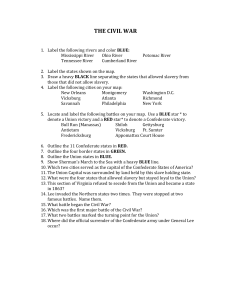
THE CIVIL WAR
... 9. Show Sherman’s March to the Sea with a heavy BLUE line. 10. Which two cities served as the capital of the Confederate States of America? 11. The Union Capital was surrounded by land held by th ...
... 9. Show Sherman’s March to the Sea with a heavy BLUE line. 10. Which two cities served as the capital of the Confederate States of America? 11. The Union Capital was surrounded by land held by th ...

Ch. 21 – The Furnace of War
... When captured many black soldiers were put to death. At Fort Pillow several back soldiers were massacred after they had surrendered. ...
... When captured many black soldiers were put to death. At Fort Pillow several back soldiers were massacred after they had surrendered. ...

ch16s4sgcompleted
... •Union Troops under General Meade held their positions •That night Meade made the decision not to retreat •The next day Lee order an attack designed to “create a panic and virtually destroy the [Union] army” Results of Gettysburg •The Confederates started by firing nearly 140 cannons at Union lines ...
... •Union Troops under General Meade held their positions •That night Meade made the decision not to retreat •The next day Lee order an attack designed to “create a panic and virtually destroy the [Union] army” Results of Gettysburg •The Confederates started by firing nearly 140 cannons at Union lines ...

Ch. 21 – The Furnace of War
... provided shelter to war prisoners. • At end of war: half million slaves fled from the plantations. • Many who stayed negotiated new working conditions in factories or on farms. ...
... provided shelter to war prisoners. • At end of war: half million slaves fled from the plantations. • Many who stayed negotiated new working conditions in factories or on farms. ...
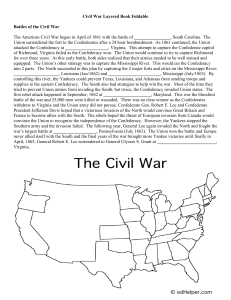
Civil War Layered Book Foldable
... The American Civil War began in April of 1861 with the battle of ________________, South Carolina. The Union surrendered the fort to the Confederates after a 24 hour bombardment. As 1861 continued, the Union attacked the Confederacy at ___________________, Virginia. This attempt to capture the Confe ...
... The American Civil War began in April of 1861 with the battle of ________________, South Carolina. The Union surrendered the fort to the Confederates after a 24 hour bombardment. As 1861 continued, the Union attacked the Confederacy at ___________________, Virginia. This attempt to capture the Confe ...

File - Mrs. Hess Honor`s US History and Regular
... The first major battle of the Civil War was called the First Battle of Bull Run. It was fought in northern Virginia near a river called Bull Run. The Confederates were victorious. – Union troops attacked Confederate forces led by General P.G.T. Beauregard. – Rebels rallied under General Thomas “Ston ...
... The first major battle of the Civil War was called the First Battle of Bull Run. It was fought in northern Virginia near a river called Bull Run. The Confederates were victorious. – Union troops attacked Confederate forces led by General P.G.T. Beauregard. – Rebels rallied under General Thomas “Ston ...


ABC Book of a New Nation - Ms. Veal
... “Hornet's Nest.” Repeated Rebel attacks failed to carry the Hornet's Nest, but massed artillery helped to turn the tide as Confederates surrounded the Union troops and captured, killed, or wounded most. During the first day’s attacks, Gen. Johnston was mortally wounded and was replaced by P.G.T. Bea ...
... “Hornet's Nest.” Repeated Rebel attacks failed to carry the Hornet's Nest, but massed artillery helped to turn the tide as Confederates surrounded the Union troops and captured, killed, or wounded most. During the first day’s attacks, Gen. Johnston was mortally wounded and was replaced by P.G.T. Bea ...

“A Great Civil War”
... • Union Commander Irwin McDowell • Southern Commanders Joseph Johnston, P. G. T. Beauregard • “Stonewall” Jackson • Confederacy was disorganized by victory as much as the Union was disorganized by victory. ...
... • Union Commander Irwin McDowell • Southern Commanders Joseph Johnston, P. G. T. Beauregard • “Stonewall” Jackson • Confederacy was disorganized by victory as much as the Union was disorganized by victory. ...
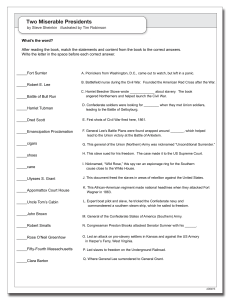
290677 Gr6NF TwoMiserablePres pg1
... A. Picnickers from Washington, D.C., came out to watch, but left in a panic. B. Battlefield nurse during the Civil War. Founded the American Red Cross after the War. C. Harriet Beecher Stowe wrote _____________ about slavery. The book angered Northerners and helped launch the Civil War. ...
... A. Picnickers from Washington, D.C., came out to watch, but left in a panic. B. Battlefield nurse during the Civil War. Founded the American Red Cross after the War. C. Harriet Beecher Stowe wrote _____________ about slavery. The book angered Northerners and helped launch the Civil War. ...
Ch. 21
... McClellan’s slow creep down the Chesapeake Seven Day’s Battle Robert E. Lee McClellan’s Retreat ...
... McClellan’s slow creep down the Chesapeake Seven Day’s Battle Robert E. Lee McClellan’s Retreat ...

Chapter 11 Section 2
... the union army in the east after Gen. McDowell’s defeat at the first Battle of Bull Run. Goal is to capture the CSA capital. McClellan develops the peninsula campaign: a plan to assemble troops near Yorktown, VA and march them up a peninsula where the James and York rivers meet up to Richmond. Thi ...
... the union army in the east after Gen. McDowell’s defeat at the first Battle of Bull Run. Goal is to capture the CSA capital. McClellan develops the peninsula campaign: a plan to assemble troops near Yorktown, VA and march them up a peninsula where the James and York rivers meet up to Richmond. Thi ...
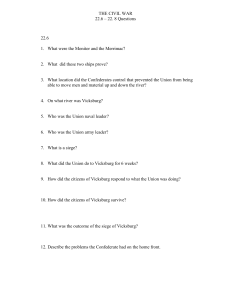
22 - cloudfront.net
... 18. What did Lincoln’s opponent want done immediately? 19. What two military victories help lead to Lincoln’s reelection? ...
... 18. What did Lincoln’s opponent want done immediately? 19. What two military victories help lead to Lincoln’s reelection? ...

The Civil War
... The Battle of Gettysburg-July 3, 1863 After the failure of the attacks on the second day of battle, Longstreet again begged Lee to move South towards Washington, but Lee planned an all out frontal assault on the Union lines. The attack would begin with a concentrated artillery attack on the center ...
... The Battle of Gettysburg-July 3, 1863 After the failure of the attacks on the second day of battle, Longstreet again begged Lee to move South towards Washington, but Lee planned an all out frontal assault on the Union lines. The attack would begin with a concentrated artillery attack on the center ...
Battle of Antietam

The Battle of Antietam /ænˈtiːtəm/, also known as the Battle of Sharpsburg, particularly in the South, fought on September 17, 1862, near Sharpsburg, Maryland, and Antietam Creek as part of the Maryland Campaign, was the first major battle in the American Civil War to take place on Union soil. It is the bloodiest single-day battle in American history, with a combined tally of dead, wounded, and missing at 22,717.After pursuing Confederate General Robert E. Lee into Maryland, Union Army Maj. Gen. George B. McClellan launched attacks against Lee's army, in defensive positions behind Antietam Creek. At dawn on September 17, Maj. Gen. Joseph Hooker's corps mounted a powerful assault on Lee's left flank. Attacks and counterattacks swept across Miller's Cornfield and fighting swirled around the Dunker Church. Union assaults against the Sunken Road eventually pierced the Confederate center, but the Federal advantage was not followed up. In the afternoon, Union Maj. Gen. Ambrose Burnside's corps entered the action, capturing a stone bridge over Antietam Creek and advancing against the Confederate right. At a crucial moment, Confederate Maj. Gen. A. P. Hill's division arrived from Harpers Ferry and launched a surprise counterattack, driving back Burnside and ending the battle. Although outnumbered two-to-one, Lee committed his entire force, while McClellan sent in less than three-quarters of his army, enabling Lee to fight the Federals to a standstill. During the night, both armies consolidated their lines. In spite of crippling casualties, Lee continued to skirmish with McClellan throughout September 18, while removing his battered army south of the Potomac River.Despite having superiority of numbers, McClellan's attacks failed to achieve force concentration, allowing Lee to counter by shifting forces and moving interior lines to meet each challenge. Despite ample reserve forces that could have been deployed to exploit localized successes, McClellan failed to destroy Lee's army. McClellan had halted Lee's invasion of Maryland, but Lee was able to withdraw his army back to Virginia without interference from the cautious McClellan. Although the battle was tactically inconclusive, the Confederate troops had withdrawn first from the battlefield, making it, in military terms, a Union victory. It had significance as enough of a victory to give President Abraham Lincoln the confidence to announce his Emancipation Proclamation, which discouraged the British and French governments from potential plans for recognition of the Confederacy.