
To Bull Run
... In the Election of 1862, Africans and slavery was the hot issue. Lincoln, and many others, advocated “colonization”. But efforts to organize colonization failed. ...
... In the Election of 1862, Africans and slavery was the hot issue. Lincoln, and many others, advocated “colonization”. But efforts to organize colonization failed. ...
Civil War Study Guide KEY
... Alexander Stephens – Georgia congressman who opposed secession, but was made vice president of the Confederacy after secession. John Bell Hood – Confederate general during the Battle of Atlanta, which he lost. Braxton Bragg – Confederate general who defeated the Union forces at the Battle of Chickam ...
... Alexander Stephens – Georgia congressman who opposed secession, but was made vice president of the Confederacy after secession. John Bell Hood – Confederate general during the Battle of Atlanta, which he lost. Braxton Bragg – Confederate general who defeated the Union forces at the Battle of Chickam ...

Thru Gettysburg
... a. The Gettysburg Address b. The Emancipation Proclamation c. The Constitution d. The letter of Recognition _____18) Who did the Emancipation Proclamation emancipate? a. All slaves b. Only slaves in the Union c. Only slaves in Washington DC d. Slaves in the states that were in rebellion _____19) How ...
... a. The Gettysburg Address b. The Emancipation Proclamation c. The Constitution d. The letter of Recognition _____18) Who did the Emancipation Proclamation emancipate? a. All slaves b. Only slaves in the Union c. Only slaves in Washington DC d. Slaves in the states that were in rebellion _____19) How ...
NORTHERN ADVANTAGES
... Delaware between South and North All slave states and contained 5 million ...
... Delaware between South and North All slave states and contained 5 million ...

Antietam
... On September 17, 1862, at Antietam Creek, Maryland, over 23,000 Union and Confederate soldiers (nine times the number who fell on the beaches of Normandy) were killed or wounded. This cataclysmic battle was the bloodiest day of fighting in American history, with a stunning number of casualties left ...
... On September 17, 1862, at Antietam Creek, Maryland, over 23,000 Union and Confederate soldiers (nine times the number who fell on the beaches of Normandy) were killed or wounded. This cataclysmic battle was the bloodiest day of fighting in American history, with a stunning number of casualties left ...

INTO THE FURNACE OF THE AMERICAN CIVIL WAR
... Attack up the James River Peninsula. McClellan was overcautious, indecisive. Stalled in Front of Richmond, Confederates, led by Robert E. Lee launched “Seven Days” counter attack June 26th to July 2, 1862. McClellan retreats off the peninsula. (Fired) Lee follows with victory at 2nd Bull R ...
... Attack up the James River Peninsula. McClellan was overcautious, indecisive. Stalled in Front of Richmond, Confederates, led by Robert E. Lee launched “Seven Days” counter attack June 26th to July 2, 1862. McClellan retreats off the peninsula. (Fired) Lee follows with victory at 2nd Bull R ...

Defining Battles of the Civil War
... Assumption on both sides that it would be a short war. Small Forces for both sides. Major Battles First Battle of Bull Run – Confederacy wins, shows that war will be ...
... Assumption on both sides that it would be a short war. Small Forces for both sides. Major Battles First Battle of Bull Run – Confederacy wins, shows that war will be ...

The Battle of Gettysburg
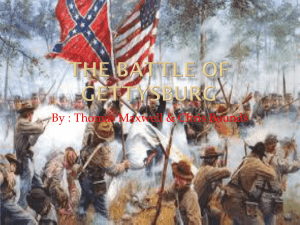
... 12,000 Rebels formed an orderly line that stretched a mile from flank to flank. In deliberate silence and with military pageantry from days gone by, they slowly headed toward the Union Army a mile away on Cemetery Ridge as the Federals gazed in silent wonder at this spectacular sight. ...
... 12,000 Rebels formed an orderly line that stretched a mile from flank to flank. In deliberate silence and with military pageantry from days gone by, they slowly headed toward the Union Army a mile away on Cemetery Ridge as the Federals gazed in silent wonder at this spectacular sight. ...

preparing for war - HousteauSocialStudies
... Bloody battle in Maryland resulted in a tie and Robert E. Lee’s army has to retreat back into Virginia. Lee attacked the north because he needed a victory on northern soil. ...
... Bloody battle in Maryland resulted in a tie and Robert E. Lee’s army has to retreat back into Virginia. Lee attacked the north because he needed a victory on northern soil. ...

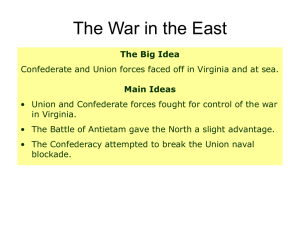

The Battle of Antietam: A Turning Point in the Civil War
... Shenandoah Valley in Virginia. Knowledge of these orders gave McClellan an opportunity to catch parts of Lee’s army separated from each other and defeat them in detail. McClellan moved too slowly to take full advantage of this opportunity, but his soldiers did push their way through three passes in ...
... Shenandoah Valley in Virginia. Knowledge of these orders gave McClellan an opportunity to catch parts of Lee’s army separated from each other and defeat them in detail. McClellan moved too slowly to take full advantage of this opportunity, but his soldiers did push their way through three passes in ...
Civil War - cloudfront.net
... the Union North and the Confederate South. Abraham Lincoln was inaugurated as president on March 1861 and stated that he was okay with where slavery was. South Carolina was the first state to succeed out of the Union on December 20, 1860. Mississippi, Florida, Alabama, Georgia, Louisiana, Texas, Vir ...
... the Union North and the Confederate South. Abraham Lincoln was inaugurated as president on March 1861 and stated that he was okay with where slavery was. South Carolina was the first state to succeed out of the Union on December 20, 1860. Mississippi, Florida, Alabama, Georgia, Louisiana, Texas, Vir ...
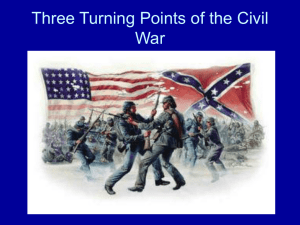
Three Turning Points of the Civil War
... • After the Battle of Antietam, Lincoln replaced McClellan with Gen. Burnside. • Burnside has his army almost destroyed by Lee at the Battle of Fredericksburg. • Next, Lincoln places Gen. Joseph Hooker in charge of the Army of the Potomac. • Hooker has a very good plan to defeat Lee, but Lee turns ...
... • After the Battle of Antietam, Lincoln replaced McClellan with Gen. Burnside. • Burnside has his army almost destroyed by Lee at the Battle of Fredericksburg. • Next, Lincoln places Gen. Joseph Hooker in charge of the Army of the Potomac. • Hooker has a very good plan to defeat Lee, but Lee turns ...

Early Civil War
... LEADERS • President • Abraham Lincoln – Union • Jefferson Davis – Confederate ...
... LEADERS • President • Abraham Lincoln – Union • Jefferson Davis – Confederate ...

9.4 PowerPoint
... July 2, 1863- Lee attacked- Union held their ground Lee ordered 15,000 men under the command of general George E. Pickett and A.P. Hill to undertake a massive assault- Pickett’s Charge 7,000 casualties in less than half an hour of fighting ...
... July 2, 1863- Lee attacked- Union held their ground Lee ordered 15,000 men under the command of general George E. Pickett and A.P. Hill to undertake a massive assault- Pickett’s Charge 7,000 casualties in less than half an hour of fighting ...

The Civil War
... luck-finding a copy of Lee’s army orders 10. The plan revealed that Lee’s and Stonewall Jackson’s armies were separated for the moment 11. For once, McClellan acted aggressively 12. The two armies fought on September 17 beside a sluggish creek called the Antietam a. the clash proved to be the bloodi ...
... luck-finding a copy of Lee’s army orders 10. The plan revealed that Lee’s and Stonewall Jackson’s armies were separated for the moment 11. For once, McClellan acted aggressively 12. The two armies fought on September 17 beside a sluggish creek called the Antietam a. the clash proved to be the bloodi ...
Power Point
... (the South’s capital). Called the Peninsula Campaign, it took him about a month to capture Yorktown before finally making it to Richmond. •At just this time, President Lincoln diverted McClellan’s expected reinforcements and sent them chasing Stonewall Jackson (right) who was seemingly threatening a ...
... (the South’s capital). Called the Peninsula Campaign, it took him about a month to capture Yorktown before finally making it to Richmond. •At just this time, President Lincoln diverted McClellan’s expected reinforcements and sent them chasing Stonewall Jackson (right) who was seemingly threatening a ...

Chapter Seventeen Structured Notes
... The Union planned a blockade of southern ports by the navy The Confederacy planned a defensive war until the North was tired of the fighting The Battle of Bull Run was the first major encounter between the North and South, no side won the battle The Merrimack and Monitor, two ironclad ships, ...
... The Union planned a blockade of southern ports by the navy The Confederacy planned a defensive war until the North was tired of the fighting The Battle of Bull Run was the first major encounter between the North and South, no side won the battle The Merrimack and Monitor, two ironclad ships, ...

The Civil War - Valhalla High School
... Confederate Capital established in Richmond Richmond Became the Union Army’s Primary Objective ...
... Confederate Capital established in Richmond Richmond Became the Union Army’s Primary Objective ...
Substitutes were often recent immigrants to the US, but even before
... The civil war the first American war in which soldiers were drafted. The South was first to employ the draft, followed by the North. In March of 1863, the National conscription act was passed. Draftees would be called by lottery. Once called, a draftee had the opportunity to either pay a commutatio ...
... The civil war the first American war in which soldiers were drafted. The South was first to employ the draft, followed by the North. In March of 1863, the National conscription act was passed. Draftees would be called by lottery. Once called, a draftee had the opportunity to either pay a commutatio ...
End of the Civil War
... Union defends at _________________________, stopping Confed. assault. Day 3 – Lee attacks the Center of the Union line on _______________. Has 12,500 men march ¾ of a mile into the Union lines over open fields. Known as __________________. Total Casualties for Gettysburg – ...
... Union defends at _________________________, stopping Confed. assault. Day 3 – Lee attacks the Center of the Union line on _______________. Has 12,500 men march ¾ of a mile into the Union lines over open fields. Known as __________________. Total Casualties for Gettysburg – ...
Battle of Antietam

The Battle of Antietam /ænˈtiːtəm/, also known as the Battle of Sharpsburg, particularly in the South, fought on September 17, 1862, near Sharpsburg, Maryland, and Antietam Creek as part of the Maryland Campaign, was the first major battle in the American Civil War to take place on Union soil. It is the bloodiest single-day battle in American history, with a combined tally of dead, wounded, and missing at 22,717.After pursuing Confederate General Robert E. Lee into Maryland, Union Army Maj. Gen. George B. McClellan launched attacks against Lee's army, in defensive positions behind Antietam Creek. At dawn on September 17, Maj. Gen. Joseph Hooker's corps mounted a powerful assault on Lee's left flank. Attacks and counterattacks swept across Miller's Cornfield and fighting swirled around the Dunker Church. Union assaults against the Sunken Road eventually pierced the Confederate center, but the Federal advantage was not followed up. In the afternoon, Union Maj. Gen. Ambrose Burnside's corps entered the action, capturing a stone bridge over Antietam Creek and advancing against the Confederate right. At a crucial moment, Confederate Maj. Gen. A. P. Hill's division arrived from Harpers Ferry and launched a surprise counterattack, driving back Burnside and ending the battle. Although outnumbered two-to-one, Lee committed his entire force, while McClellan sent in less than three-quarters of his army, enabling Lee to fight the Federals to a standstill. During the night, both armies consolidated their lines. In spite of crippling casualties, Lee continued to skirmish with McClellan throughout September 18, while removing his battered army south of the Potomac River.Despite having superiority of numbers, McClellan's attacks failed to achieve force concentration, allowing Lee to counter by shifting forces and moving interior lines to meet each challenge. Despite ample reserve forces that could have been deployed to exploit localized successes, McClellan failed to destroy Lee's army. McClellan had halted Lee's invasion of Maryland, but Lee was able to withdraw his army back to Virginia without interference from the cautious McClellan. Although the battle was tactically inconclusive, the Confederate troops had withdrawn first from the battlefield, making it, in military terms, a Union victory. It had significance as enough of a victory to give President Abraham Lincoln the confidence to announce his Emancipation Proclamation, which discouraged the British and French governments from potential plans for recognition of the Confederacy.