Chapter 10 Higher Level Multiple Choice Questions
... B. The belief that the Union had very little chance to win the war in the wake of recent losses to Confederate forces. C. Distress over job losses caused by the economic depression that accompanied the war. D. The newly passed law by Congress that increased the draft age to 40. 5. Which of the follo ...
... B. The belief that the Union had very little chance to win the war in the wake of recent losses to Confederate forces. C. Distress over job losses caused by the economic depression that accompanied the war. D. The newly passed law by Congress that increased the draft age to 40. 5. Which of the follo ...
The Civil War - Guided Viewing
... 22. How did Union General Benjamin Butler justify ignoring the Fugitive Slave Act? Manassas 23. What was the goal of the Union Army in Virginia on July 16, 1861? 24. How close was Bull Run creek to Washington D.C.? 25. What Virginian held a hill in the center of the Confederate line, even as the Uni ...
... 22. How did Union General Benjamin Butler justify ignoring the Fugitive Slave Act? Manassas 23. What was the goal of the Union Army in Virginia on July 16, 1861? 24. How close was Bull Run creek to Washington D.C.? 25. What Virginian held a hill in the center of the Confederate line, even as the Uni ...

File - Miss Diaz`s Class
... devotion to that cause for which they gave the last full measure of devotion -- that we here highly resolve that these dead shall not have died in vain -that this nation, under God, shall have a new birth of freedom -- and that government of the people, by the people, for the people, shall not peris ...
... devotion to that cause for which they gave the last full measure of devotion -- that we here highly resolve that these dead shall not have died in vain -that this nation, under God, shall have a new birth of freedom -- and that government of the people, by the people, for the people, shall not peris ...


FIRST YEARS OF A LONG WAR
... - Following up his victory at Bull Run, Lee led his army across the Potomac into enemy territory in Maryland - Lee hoped a big Confederate victory in the North would convince Britain to give official recognition & support to the South - By this time in September 1862, Lincoln had restored McClellan ...
... - Following up his victory at Bull Run, Lee led his army across the Potomac into enemy territory in Maryland - Lee hoped a big Confederate victory in the North would convince Britain to give official recognition & support to the South - By this time in September 1862, Lincoln had restored McClellan ...

Talmadge Wood
... The soldiers of the 12th Corps,1st division, 2nd Brigade, 150th NY Company C were positioned on Culp's hill and faced relentless fighting. This was a unit which had never ...
... The soldiers of the 12th Corps,1st division, 2nd Brigade, 150th NY Company C were positioned on Culp's hill and faced relentless fighting. This was a unit which had never ...

Document
... who proceeded to chase Lee’s army around northern Virginia. Lee and his brilliant lieutenant “Stonewall” _______________ were then encouraged by a stunning victory at _____________________ to advance into the North again in the hope of breaking the Union will to fight. For three days in July 18____, ...
... who proceeded to chase Lee’s army around northern Virginia. Lee and his brilliant lieutenant “Stonewall” _______________ were then encouraged by a stunning victory at _____________________ to advance into the North again in the hope of breaking the Union will to fight. For three days in July 18____, ...

The Civil War
... but ultimately released, due to the outrage from the British over Americans seizing one of their ships • Alabama-built in Britain for the Confederates, which captured 60 Union ships, destroyed off the coast of France in 1864 • -1872-British paid damages of 15.5 million for problems caused by Alabama ...
... but ultimately released, due to the outrage from the British over Americans seizing one of their ships • Alabama-built in Britain for the Confederates, which captured 60 Union ships, destroyed off the coast of France in 1864 • -1872-British paid damages of 15.5 million for problems caused by Alabama ...
Fort Sumter, April 12
... No need for CS cotton Turn to Egypt and India to meet demand Major southern bargaining tool undermined • No foreign recognition – never proves its close enough ...
... No need for CS cotton Turn to Egypt and India to meet demand Major southern bargaining tool undermined • No foreign recognition – never proves its close enough ...

Chapter 21 Focus Questions: Essay question: List the three most
... At the beginning of the Civil War, President Lincoln favored what kind of military action? What did Lincoln hope the Union would capture after a victory at Bull Run? How was the South’s victory at the First Bull Run harmful to its cause and helpful to the northern cause? After assuming command, Gene ...
... At the beginning of the Civil War, President Lincoln favored what kind of military action? What did Lincoln hope the Union would capture after a victory at Bull Run? How was the South’s victory at the First Bull Run harmful to its cause and helpful to the northern cause? After assuming command, Gene ...
The Signal Flag - Brandywine Valley Civil War Round Table
... Dave Booz is an adjunct professor at Gettysburg College in the Civil War Era Studies Department. He has 36 years experience in education, teaching students in grades 7 through the graduate level. At Gettysburg College he has taught Introduction To The Civil War Era, Gender In The Civil War, Gettysbu ...
... Dave Booz is an adjunct professor at Gettysburg College in the Civil War Era Studies Department. He has 36 years experience in education, teaching students in grades 7 through the graduate level. At Gettysburg College he has taught Introduction To The Civil War Era, Gender In The Civil War, Gettysbu ...
File
... wanted to attack the North in Gettysburg, Pennsylvania Lee sent wave after wave of soldiers at the Union, but kept getting shot down 52,000 men were killed over 3 days “The beginning of the end” for the Confederacy: they lost their best and brightest in Vicksburg and Gettysburg, and would never agai ...
... wanted to attack the North in Gettysburg, Pennsylvania Lee sent wave after wave of soldiers at the Union, but kept getting shot down 52,000 men were killed over 3 days “The beginning of the end” for the Confederacy: they lost their best and brightest in Vicksburg and Gettysburg, and would never agai ...

Civil War: Beginning To End
... • In June 1861 West Virginia is born a state. • July 21st,1861, the first battle of the Civil War had begun by a river named the Bull Run. This battle was later renamed as the Battle of Bull Run. • The Union blockade on the Confederacy made a huge impact. ...
... • In June 1861 West Virginia is born a state. • July 21st,1861, the first battle of the Civil War had begun by a river named the Bull Run. This battle was later renamed as the Battle of Bull Run. • The Union blockade on the Confederacy made a huge impact. ...

4 - Civil War Part 1
... The Second and Third parts to the Anaconda Plan (Union’s Plan) were going well, but Part 1 was not (moving on land to capture the southern capital of Richmond). General McClellan was too cautious and refused to move, even though he had an army of 120,000 men! ...
... The Second and Third parts to the Anaconda Plan (Union’s Plan) were going well, but Part 1 was not (moving on land to capture the southern capital of Richmond). General McClellan was too cautious and refused to move, even though he had an army of 120,000 men! ...

The Battle of Antietam Page 1- Battle name, date, links to web pages
... The Battle of Antietam started about 5:30 am with Union Major General Hooker’s Corps I and Confederate leader Jeb Stuart’s horse artillery batteries and Col. Stephen D. Lee on high ground. This battle took place in Miller’s cornfield. The Union’s returned fire was from 9 batteries on a ridge behind ...
... The Battle of Antietam started about 5:30 am with Union Major General Hooker’s Corps I and Confederate leader Jeb Stuart’s horse artillery batteries and Col. Stephen D. Lee on high ground. This battle took place in Miller’s cornfield. The Union’s returned fire was from 9 batteries on a ridge behind ...

over 23000 soldiers were killed that day. While the Battle of Antietam
... killed—totaling nearly as many lives lost than all American wars combined—the Civil War finally ended. One out of every four Confederate soldiers died or suffered debilitating injuries while one in ten Union troops lost their lives. The year following the surrender, Mississippi allocated onefifth of ...
... killed—totaling nearly as many lives lost than all American wars combined—the Civil War finally ended. One out of every four Confederate soldiers died or suffered debilitating injuries while one in ten Union troops lost their lives. The year following the surrender, Mississippi allocated onefifth of ...

Key Civil War Battles
... • Goal of the West is to gain control of the Miss River • What/How: Confederates launch surprise attack • Day 1: Grant driven back • Day 2: Union recovers, defeat Confederates ...
... • Goal of the West is to gain control of the Miss River • What/How: Confederates launch surprise attack • Day 1: Grant driven back • Day 2: Union recovers, defeat Confederates ...


Review for Chapter 11 Section 1 Quiz
... F. First battle-Bull Run-Confederate victory 1. Stonewall Jackson G. George McClellan-Union army in the East H. Ulysses S. Grant-Union victory at Shiloh I. War for capitals J. Robert E. Lee-victory at Second Battle of Bull Run K. Antietam, MD 1. bloodiest battle 2. Lee forced to retreat ...
... F. First battle-Bull Run-Confederate victory 1. Stonewall Jackson G. George McClellan-Union army in the East H. Ulysses S. Grant-Union victory at Shiloh I. War for capitals J. Robert E. Lee-victory at Second Battle of Bull Run K. Antietam, MD 1. bloodiest battle 2. Lee forced to retreat ...

Objective 3.03
... One of the most famous Generals in the Southern Army, known for riding his horse with his hand raised, favorite fruit was lemons, gained his nickname during the Battle of Bull Run, When he died Robert E. Lee said that he had lost his right arm ...
... One of the most famous Generals in the Southern Army, known for riding his horse with his hand raised, favorite fruit was lemons, gained his nickname during the Battle of Bull Run, When he died Robert E. Lee said that he had lost his right arm ...

Major Events of the Civil War
... It was the bloodiest of battle of the Civil War. 23,000 soldiers were killed in one day. It was fought on Northern soil in Maryland. Lee took his army into Maryland after a victory at the 2nd Battle of Bull Run. He wanted to seek new supplies and recruits. General Lee positioned behind Antieta ...
... It was the bloodiest of battle of the Civil War. 23,000 soldiers were killed in one day. It was fought on Northern soil in Maryland. Lee took his army into Maryland after a victory at the 2nd Battle of Bull Run. He wanted to seek new supplies and recruits. General Lee positioned behind Antieta ...

The Battle of Antietam was the bloodiest day of the Civil War for both
... battle plan for the battle of Antietam in Maryland Sergeant John Bloss and Corporal Barton W. Mitchell found a piece of paper wrapped around three cigars, it became evident it was Lee’s battle plan! McClellan now knew that Lee's forces were split into five parts and scattered over a 30-mile stretch ...
... battle plan for the battle of Antietam in Maryland Sergeant John Bloss and Corporal Barton W. Mitchell found a piece of paper wrapped around three cigars, it became evident it was Lee’s battle plan! McClellan now knew that Lee's forces were split into five parts and scattered over a 30-mile stretch ...

The Civil War - Cloudfront.net
... Both sides thought the war would be very short Bull Run July 21, 1861 • Raw Union recruits unprepared for battle ran into Stonewall Jackson who held until Confederate forces arrived • Union troops fled all the way back to D.C. • Psychological and political consequences—South was over confident, many ...
... Both sides thought the war would be very short Bull Run July 21, 1861 • Raw Union recruits unprepared for battle ran into Stonewall Jackson who held until Confederate forces arrived • Union troops fled all the way back to D.C. • Psychological and political consequences—South was over confident, many ...

The Civil War
... The Naval War Lincoln proclaimed a blockade of all Confederate ports in an effort to cut the South’s trade with the world. The Union blockade became increasingly effective as the war went on. The Union navy, however, could not stop all of the blockade runners. A fleet of Union ships, led by David G ...
... The Naval War Lincoln proclaimed a blockade of all Confederate ports in an effort to cut the South’s trade with the world. The Union blockade became increasingly effective as the war went on. The Union navy, however, could not stop all of the blockade runners. A fleet of Union ships, led by David G ...

Battles of Civil War Start
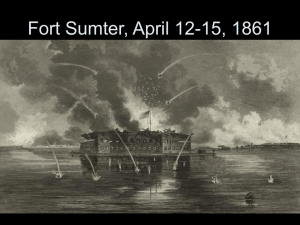
... The first shots of the Civil War were fired at Fort Sumter. Major Robert Anderson of the United States Army had moved his troops to the base because he feared a Confederate attack. In the early morning of April 12, 1861, the Confederates launched an attack. Northern troops under Anderson’s command r ...
... The first shots of the Civil War were fired at Fort Sumter. Major Robert Anderson of the United States Army had moved his troops to the base because he feared a Confederate attack. In the early morning of April 12, 1861, the Confederates launched an attack. Northern troops under Anderson’s command r ...
Battle of Antietam

The Battle of Antietam /ænˈtiːtəm/, also known as the Battle of Sharpsburg, particularly in the South, fought on September 17, 1862, near Sharpsburg, Maryland, and Antietam Creek as part of the Maryland Campaign, was the first major battle in the American Civil War to take place on Union soil. It is the bloodiest single-day battle in American history, with a combined tally of dead, wounded, and missing at 22,717.After pursuing Confederate General Robert E. Lee into Maryland, Union Army Maj. Gen. George B. McClellan launched attacks against Lee's army, in defensive positions behind Antietam Creek. At dawn on September 17, Maj. Gen. Joseph Hooker's corps mounted a powerful assault on Lee's left flank. Attacks and counterattacks swept across Miller's Cornfield and fighting swirled around the Dunker Church. Union assaults against the Sunken Road eventually pierced the Confederate center, but the Federal advantage was not followed up. In the afternoon, Union Maj. Gen. Ambrose Burnside's corps entered the action, capturing a stone bridge over Antietam Creek and advancing against the Confederate right. At a crucial moment, Confederate Maj. Gen. A. P. Hill's division arrived from Harpers Ferry and launched a surprise counterattack, driving back Burnside and ending the battle. Although outnumbered two-to-one, Lee committed his entire force, while McClellan sent in less than three-quarters of his army, enabling Lee to fight the Federals to a standstill. During the night, both armies consolidated their lines. In spite of crippling casualties, Lee continued to skirmish with McClellan throughout September 18, while removing his battered army south of the Potomac River.Despite having superiority of numbers, McClellan's attacks failed to achieve force concentration, allowing Lee to counter by shifting forces and moving interior lines to meet each challenge. Despite ample reserve forces that could have been deployed to exploit localized successes, McClellan failed to destroy Lee's army. McClellan had halted Lee's invasion of Maryland, but Lee was able to withdraw his army back to Virginia without interference from the cautious McClellan. Although the battle was tactically inconclusive, the Confederate troops had withdrawn first from the battlefield, making it, in military terms, a Union victory. It had significance as enough of a victory to give President Abraham Lincoln the confidence to announce his Emancipation Proclamation, which discouraged the British and French governments from potential plans for recognition of the Confederacy.