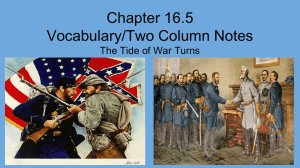
Chapter 16.5 Vocabulary Two Column Notes
... ● The next battle would take place at Gettysburg, Pennsylvania ● Lee hoped to receive international recognition by winning this battle Battle of Gettysburg: (July 1-3, 1863) key battle that finally turned the tide against the Confederates - George G. Meade vs. Robert E. Lee Day 1: Union establishes ...
... ● The next battle would take place at Gettysburg, Pennsylvania ● Lee hoped to receive international recognition by winning this battle Battle of Gettysburg: (July 1-3, 1863) key battle that finally turned the tide against the Confederates - George G. Meade vs. Robert E. Lee Day 1: Union establishes ...

EVENT - jhernandez
... 3. When the frontier was finally pacified and the Indians subdued, more than 1500 Sioux were captured. 4. After trials in military courts, nearly 300 were hanged. Result: EVENT – Bloody Antietam gives Union victory Sept. 17, 1862 Supporting details: 1. The Union achieved its first major victory at A ...
... 3. When the frontier was finally pacified and the Indians subdued, more than 1500 Sioux were captured. 4. After trials in military courts, nearly 300 were hanged. Result: EVENT – Bloody Antietam gives Union victory Sept. 17, 1862 Supporting details: 1. The Union achieved its first major victory at A ...

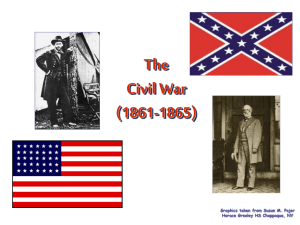
The Civil War
... Battle of Antietam was the first battle of the Civil War to take place on Northern soil in Sharpsburg, Maryland. 3 major assaults by the Union driving the Confederates over the stone bridge at Antietam Creek. Help arrives for the Confederates. The battle ends with a Union victory when Lee retreats t ...
... Battle of Antietam was the first battle of the Civil War to take place on Northern soil in Sharpsburg, Maryland. 3 major assaults by the Union driving the Confederates over the stone bridge at Antietam Creek. Help arrives for the Confederates. The battle ends with a Union victory when Lee retreats t ...

The American Civil War
... • Served as U.S. Senator, Secretary of War, and President of the Confederacy. • Served as a P.O.W. for two years, U.S. dropped its case against him in 1868. ...
... • Served as U.S. Senator, Secretary of War, and President of the Confederacy. • Served as a P.O.W. for two years, U.S. dropped its case against him in 1868. ...

File
... ordered Lee to launch offensive attack of Maryland – Hoped another win would bring aid from England/France – Davis also urged people of Maryland to join Confederacy ...
... ordered Lee to launch offensive attack of Maryland – Hoped another win would bring aid from England/France – Davis also urged people of Maryland to join Confederacy ...

The Civil War Begins Objectives
... Main Idea: Shortly after the nations Southern states seceded from the Union, war began between the north and the South. Why It Matter Now: The nation’s identity was forged in part by the Civil War. Sectional divisions remain very strong today. Union and Confederate Forces Clash ...
... Main Idea: Shortly after the nations Southern states seceded from the Union, war began between the north and the South. Why It Matter Now: The nation’s identity was forged in part by the Civil War. Sectional divisions remain very strong today. Union and Confederate Forces Clash ...

1861-1865 Chapter 11
... As the Civil War began, President Lincoln's goal was to __________ even if it meant allowing slavery to continue. With few ______________and little ________, the South suffered more inflation and critical shortages during the Civil War than did the North. New types of warships known as ___________ d ...
... As the Civil War began, President Lincoln's goal was to __________ even if it meant allowing slavery to continue. With few ______________and little ________, the South suffered more inflation and critical shortages during the Civil War than did the North. New types of warships known as ___________ d ...

Lecture Notes – BATTLE OF ANTIETAM
... Set up along a low ridge Began on September 15th Effective, but not impregnable Benefits o Rail and stone fences o Limestone outcroppings o Antietam Creek to the front of them Possible problems o Potomac River to the rear could make retreat a major problem Only one place to retreat (Bote ...
... Set up along a low ridge Began on September 15th Effective, but not impregnable Benefits o Rail and stone fences o Limestone outcroppings o Antietam Creek to the front of them Possible problems o Potomac River to the rear could make retreat a major problem Only one place to retreat (Bote ...
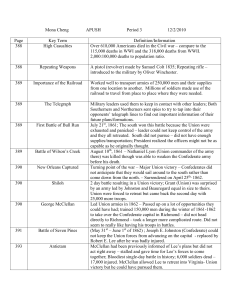
Key Terms Ch 14 Pages 388-399
... directly to Richmond – took a longer more complicated route. Did not seem to really like having his troops in battles. (May 31st – June 1st of 1862) ; Joseph E. Johnston (Confederate) could not keep the Union forces from advancing on the capital - replaced by Robert E. Lee after he was badly injured ...
... directly to Richmond – took a longer more complicated route. Did not seem to really like having his troops in battles. (May 31st – June 1st of 1862) ; Joseph E. Johnston (Confederate) could not keep the Union forces from advancing on the capital - replaced by Robert E. Lee after he was badly injured ...

Ch - Dickinson ISD
... 3. War at Midpoint (pp. 462–468) After Antietam, Lincoln tried a variety of new generals, who proceeded to chase Lee’s army around northern Virginia. Lee and his brilliant lieutenant “Stonewall” ____________ were then encouraged by a stunning victory at C_________________ to advance into the North ...
... 3. War at Midpoint (pp. 462–468) After Antietam, Lincoln tried a variety of new generals, who proceeded to chase Lee’s army around northern Virginia. Lee and his brilliant lieutenant “Stonewall” ____________ were then encouraged by a stunning victory at C_________________ to advance into the North ...
Key Figures of the Civil War
... • General in the Union Army • Won the battle of Vicksburg (splitting the Confederacy in two at the Mississippi River) • Named as the commander of the Army of the Potomac • Strategy was total war • Changed the Union Army from a weak one into a strong one • Accepted the surrender of Confederate troops ...
... • General in the Union Army • Won the battle of Vicksburg (splitting the Confederacy in two at the Mississippi River) • Named as the commander of the Army of the Potomac • Strategy was total war • Changed the Union Army from a weak one into a strong one • Accepted the surrender of Confederate troops ...

(21)
... 3. War at Midpoint (pp. 462–468) After Antietam, Lincoln tried a variety of new generals, who proceeded to chase Lee’s army around northern Virginia. Lee and his brilliant lieutenant “Stonewall” ____________ were then encouraged by a stunning victory at C_________________ to advance into the North a ...
... 3. War at Midpoint (pp. 462–468) After Antietam, Lincoln tried a variety of new generals, who proceeded to chase Lee’s army around northern Virginia. Lee and his brilliant lieutenant “Stonewall” ____________ were then encouraged by a stunning victory at C_________________ to advance into the North a ...

The War in Virginia and The West, 1862-1863
... victory, but massed artillery broke up the assault”. v Although the battle to that point had been a tactical draw, the arrival of Union reinforcements made Bragg’s position untenable. v He retreated on January 3, granting the North a valuable strategic victory. ...
... victory, but massed artillery broke up the assault”. v Although the battle to that point had been a tactical draw, the arrival of Union reinforcements made Bragg’s position untenable. v He retreated on January 3, granting the North a valuable strategic victory. ...

AHON Chapter 15 Section 2 Lecture Notes
... Confederates used ironclads against Union blockades, while Union ironclads helped gain control of the Mississippi. ...
... Confederates used ironclads against Union blockades, while Union ironclads helped gain control of the Mississippi. ...
Civil War Battles and the End of the War
... great task remaining before us -- that, from these honored dead we take increased devotion to that cause for which they here, gave the last full measure of devotion -- that we here highly resolve these dead shall not have died in vain; that the nation, shall have a new birth of freedom, and that gov ...
... great task remaining before us -- that, from these honored dead we take increased devotion to that cause for which they here, gave the last full measure of devotion -- that we here highly resolve these dead shall not have died in vain; that the nation, shall have a new birth of freedom, and that gov ...

The Civil War 1861-1865
... • Lincoln toured the city soon after The remains of buildings after the Union invasion, April 1865 ...
... • Lincoln toured the city soon after The remains of buildings after the Union invasion, April 1865 ...
“The War Ends
... • Robert E Lee again went on the offensive. He planned to attack Pennsylvania and then Washington DC. On his way to Pennsylvania, he met a northern army at the town of Gettysburg. Even though the south made several aggressive charges, they were not able to break through the union position. The sou ...
... • Robert E Lee again went on the offensive. He planned to attack Pennsylvania and then Washington DC. On his way to Pennsylvania, he met a northern army at the town of Gettysburg. Even though the south made several aggressive charges, they were not able to break through the union position. The sou ...
Civil War Fill in the Blank
... After Union forces failed to capture the capital, the South went on the offensive behind General Robert E. __________. After crossing the Potomac River, General _______ forces clashed with Union troops at ___________________, just outside of Sharpsburg, Maryland. This battle became the bloodiest one ...
... After Union forces failed to capture the capital, the South went on the offensive behind General Robert E. __________. After crossing the Potomac River, General _______ forces clashed with Union troops at ___________________, just outside of Sharpsburg, Maryland. This battle became the bloodiest one ...
SSchapter11 - Mrs. Henriksson iClassroom Wikispace
... • The battle turned in favor of the Confederates, and the poorly trained Union troops began to panic. • They fled back to Washington.The Confederates were too exhausted to pursue them. ...
... • The battle turned in favor of the Confederates, and the poorly trained Union troops began to panic. • They fled back to Washington.The Confederates were too exhausted to pursue them. ...

1862 - PP - Mr. Cvelbar`s US History Page
... Finally, the Merrimack retreated Neither ship destroyed, but Union blockade remained – The Merrimack became trapped two months later between the shallow waters of the James River and the Union blockade – It was run aground and blown up by the Confederate Army May 11 ...
... Finally, the Merrimack retreated Neither ship destroyed, but Union blockade remained – The Merrimack became trapped two months later between the shallow waters of the James River and the Union blockade – It was run aground and blown up by the Confederate Army May 11 ...
Civil War Battles
... Proved the war would not be quick or bloodless North would need a large, well-trained army to defeat the South http://cdn.dipity.com/uploads/events/305 54fa9b47a1fc95fa2dd6517edab3e_1M.png ...
... Proved the war would not be quick or bloodless North would need a large, well-trained army to defeat the South http://cdn.dipity.com/uploads/events/305 54fa9b47a1fc95fa2dd6517edab3e_1M.png ...
Chapter 10 Higher Level Multiple Choice Questions
... B. The belief that the Union had very little chance to win the war in the wake of recent losses to Confederate forces. C. Distress over job losses caused by the economic depression that accompanied the war. D. The newly passed law by Congress that increased the draft age to 40. 5. Which of the follo ...
... B. The belief that the Union had very little chance to win the war in the wake of recent losses to Confederate forces. C. Distress over job losses caused by the economic depression that accompanied the war. D. The newly passed law by Congress that increased the draft age to 40. 5. Which of the follo ...
Battle of Antietam

The Battle of Antietam /ænˈtiːtəm/, also known as the Battle of Sharpsburg, particularly in the South, fought on September 17, 1862, near Sharpsburg, Maryland, and Antietam Creek as part of the Maryland Campaign, was the first major battle in the American Civil War to take place on Union soil. It is the bloodiest single-day battle in American history, with a combined tally of dead, wounded, and missing at 22,717.After pursuing Confederate General Robert E. Lee into Maryland, Union Army Maj. Gen. George B. McClellan launched attacks against Lee's army, in defensive positions behind Antietam Creek. At dawn on September 17, Maj. Gen. Joseph Hooker's corps mounted a powerful assault on Lee's left flank. Attacks and counterattacks swept across Miller's Cornfield and fighting swirled around the Dunker Church. Union assaults against the Sunken Road eventually pierced the Confederate center, but the Federal advantage was not followed up. In the afternoon, Union Maj. Gen. Ambrose Burnside's corps entered the action, capturing a stone bridge over Antietam Creek and advancing against the Confederate right. At a crucial moment, Confederate Maj. Gen. A. P. Hill's division arrived from Harpers Ferry and launched a surprise counterattack, driving back Burnside and ending the battle. Although outnumbered two-to-one, Lee committed his entire force, while McClellan sent in less than three-quarters of his army, enabling Lee to fight the Federals to a standstill. During the night, both armies consolidated their lines. In spite of crippling casualties, Lee continued to skirmish with McClellan throughout September 18, while removing his battered army south of the Potomac River.Despite having superiority of numbers, McClellan's attacks failed to achieve force concentration, allowing Lee to counter by shifting forces and moving interior lines to meet each challenge. Despite ample reserve forces that could have been deployed to exploit localized successes, McClellan failed to destroy Lee's army. McClellan had halted Lee's invasion of Maryland, but Lee was able to withdraw his army back to Virginia without interference from the cautious McClellan. Although the battle was tactically inconclusive, the Confederate troops had withdrawn first from the battlefield, making it, in military terms, a Union victory. It had significance as enough of a victory to give President Abraham Lincoln the confidence to announce his Emancipation Proclamation, which discouraged the British and French governments from potential plans for recognition of the Confederacy.