
Civil_War_Battles - billieblalock
... •During this battle, General Thomas J. Jackson earned the name, “Stonewall” by inspiring his troops to stand firm under the Union attack. ...
... •During this battle, General Thomas J. Jackson earned the name, “Stonewall” by inspiring his troops to stand firm under the Union attack. ...
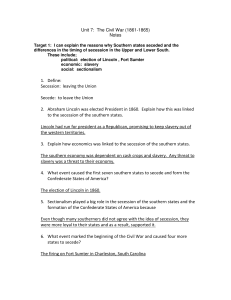
1. Define: Secession: leaving the Union Secede: to leave
... 12. The Battle of Bull Run was fought in July of 1861 and was the first major battle of the war. It was a Confederate victory. Why was this battle important? The battle was a Confederate victory. It showed both sides that the war would be long and the casualties high. 13. The Battle of Antietam was ...
... 12. The Battle of Bull Run was fought in July of 1861 and was the first major battle of the war. It was a Confederate victory. Why was this battle important? The battle was a Confederate victory. It showed both sides that the war would be long and the casualties high. 13. The Battle of Antietam was ...

Chapter 10 Notes
... B. Lincoln thought that the slaves would stop working for the farms that grew food for the Confederate Army. C. He also thought that Northerners would then understand why the War was so important African Americans in the Union Army A. After the Emancipation Proclamation, Lincoln decided to allow Afr ...
... B. Lincoln thought that the slaves would stop working for the farms that grew food for the Confederate Army. C. He also thought that Northerners would then understand why the War was so important African Americans in the Union Army A. After the Emancipation Proclamation, Lincoln decided to allow Afr ...

the american civil war
... It freed the slaves only in states that have seceded from the Union. It did not free slaves in border ...
... It freed the slaves only in states that have seceded from the Union. It did not free slaves in border ...

End of the War study guide Key
... on September 17, 1862, than on any other single day of the Civil War. Federal losses were 12,410, Confederate losses 10,700. Although neither side gained a decisive victory, Lee's failure to carry the war effort effectively into the North caused Great Britain to postpone recognition of the Confeder ...
... on September 17, 1862, than on any other single day of the Civil War. Federal losses were 12,410, Confederate losses 10,700. Although neither side gained a decisive victory, Lee's failure to carry the war effort effectively into the North caused Great Britain to postpone recognition of the Confeder ...

THE CIVIL WAR by Ken Burns – Video Guide Questions
... 15. In what year did Congress pass an act that allowed Kansas & Nebraska to decide for themselves whether or not to permit slavery?______________ 16. Who said, “A house divided against itself cannot stand”?_______________________________ THE METEOR 17. Who led the raid on Harper’s Ferry armory & eng ...
... 15. In what year did Congress pass an act that allowed Kansas & Nebraska to decide for themselves whether or not to permit slavery?______________ 16. Who said, “A house divided against itself cannot stand”?_______________________________ THE METEOR 17. Who led the raid on Harper’s Ferry armory & eng ...
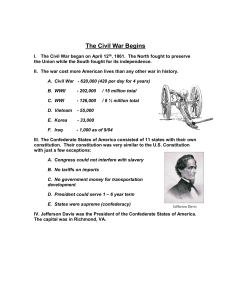
The Civil War Begins
... Grant attacks the fort that controlled the Mississippi River between New Orleans and Memphis. It took six weeks to get the soldiers at Vicksburg to ...
... Grant attacks the fort that controlled the Mississippi River between New Orleans and Memphis. It took six weeks to get the soldiers at Vicksburg to ...
Secession and the Civil War
... Goal was not equality, but the reversal of roles for the races. Economic-policies of a Republican president-protective tariffs, free homesteads in the west, etc.--will prevent the South from ...
... Goal was not equality, but the reversal of roles for the races. Economic-policies of a Republican president-protective tariffs, free homesteads in the west, etc.--will prevent the South from ...

Mr. Bailey
... George McClellan took command of northern forces. He had considerable organizational ability but no desire to be daring on the battlefield. McClellan transformed the Army of the Potomac into a fighting force- the short term militia went home. He believed he would win the war by maneuvering rather th ...
... George McClellan took command of northern forces. He had considerable organizational ability but no desire to be daring on the battlefield. McClellan transformed the Army of the Potomac into a fighting force- the short term militia went home. He believed he would win the war by maneuvering rather th ...
civil war - TeacherWeb
... however had told the British that if they did intervene then they would go to war with the north. This scared the British enough to keep them out of the war. The most involvement that was allowed by the British was to keep the flow of cotton going and aid the south economically. ...
... however had told the British that if they did intervene then they would go to war with the north. This scared the British enough to keep them out of the war. The most involvement that was allowed by the British was to keep the flow of cotton going and aid the south economically. ...

Notes key events blog
... Hardly any Confederate ship could make it in or out of Georgia. Antietam: Confederate General Robert E. Lee wanted to bring the war to the North. The Battle of Antietam took place on September 17, 1862, between Antietam Creek and Sharpsburg, Maryland. It was the bloodiest one-day battle of the Civil ...
... Hardly any Confederate ship could make it in or out of Georgia. Antietam: Confederate General Robert E. Lee wanted to bring the war to the North. The Battle of Antietam took place on September 17, 1862, between Antietam Creek and Sharpsburg, Maryland. It was the bloodiest one-day battle of the Civil ...

The Civil War In Texas and Beyond
... • 24,000 Union troops moved across ________________________, along the Red River. • Planned to attack _______________________________________________ • They were pushed back at ________________________, by a smaller Confederate army from Texas, Louisiana, Mississippi, and Arkansas. Battle of Atlanta ...
... • 24,000 Union troops moved across ________________________, along the Red River. • Planned to attack _______________________________________________ • They were pushed back at ________________________, by a smaller Confederate army from Texas, Louisiana, Mississippi, and Arkansas. Battle of Atlanta ...


CWF
... _____ 26) Where were the battles of Bull Run I & II fought? a. Sharpsburg, Md. b. Gettysburg, Pa. c. Vicksburg, Ms. d. Manassas, Va. _____ 27) Who took over the Union Army after the battle of Bull Run I? a. McClellan b. Burnside c. Hood d. Lee _____ 28) What was the name of the Union Army in Washin ...
... _____ 26) Where were the battles of Bull Run I & II fought? a. Sharpsburg, Md. b. Gettysburg, Pa. c. Vicksburg, Ms. d. Manassas, Va. _____ 27) Who took over the Union Army after the battle of Bull Run I? a. McClellan b. Burnside c. Hood d. Lee _____ 28) What was the name of the Union Army in Washin ...
Research Paper The Seven Days Battles
... General Joe Johnson, was wounded, and Lee was handed the command of the Confederate army in Virginia. The second was that the Confederates found that by simply parading their men continuously, McClellan would believe that he was vastly outnumbered. The third was the disposition of the Union forces ...
... General Joe Johnson, was wounded, and Lee was handed the command of the Confederate army in Virginia. The second was that the Confederates found that by simply parading their men continuously, McClellan would believe that he was vastly outnumbered. The third was the disposition of the Union forces ...
CIVIL WAR
... Lee divides Stonewall Jackson's corps, catches Pope between Lee and Jackson; September 1, 1862--McClellan back in command of Army of Potomac ANTIETAM (SHARPSBURG) MD. (SEPTEMBER 17, 1862) McClellan moves!!! "I thought I knew McClellan, but this movement of his puzzles me." Stonewall Jackson CSA--10, ...
... Lee divides Stonewall Jackson's corps, catches Pope between Lee and Jackson; September 1, 1862--McClellan back in command of Army of Potomac ANTIETAM (SHARPSBURG) MD. (SEPTEMBER 17, 1862) McClellan moves!!! "I thought I knew McClellan, but this movement of his puzzles me." Stonewall Jackson CSA--10, ...

american history Military Strategy of the Civil War
... C. Battle of Gettysburg (July 1-3, 1863) 1. Lee decided to invade the North again, this time through PA in hopes of strengthening peace movement in North and getting direct foreign support. 2. Bloodiest battle of the Civil War: 53,000 casualties. 3. Day 1 -- July 1 – Confederates took Gettysburg bu ...
... C. Battle of Gettysburg (July 1-3, 1863) 1. Lee decided to invade the North again, this time through PA in hopes of strengthening peace movement in North and getting direct foreign support. 2. Bloodiest battle of the Civil War: 53,000 casualties. 3. Day 1 -- July 1 – Confederates took Gettysburg bu ...

Battles of the Civil War - Immaculateheartacademy.org
... general's tent near the Antietam battlefield, October 3, 1862. ...
... general's tent near the Antietam battlefield, October 3, 1862. ...
Manassas or the Battle of Bull Run
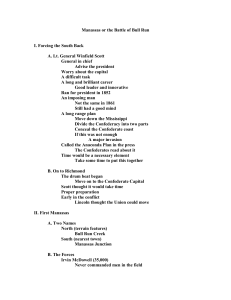
... Still had a good mind A long range plan Move down the Mississippi Divide the Confederacy into two parts Conceal the Confederate coast If this was not enough A major invasion Called the Anaconda Plan in the press The Confederates read about it Time would be a necessary element Take some time to put t ...
... Still had a good mind A long range plan Move down the Mississippi Divide the Confederacy into two parts Conceal the Confederate coast If this was not enough A major invasion Called the Anaconda Plan in the press The Confederates read about it Time would be a necessary element Take some time to put t ...
The Road To Appomattox (Filled Out)
... The Road to the Confederate Surrender at Appomattox Court House, VA Sunday, April 9, 1865 ...
... The Road to the Confederate Surrender at Appomattox Court House, VA Sunday, April 9, 1865 ...
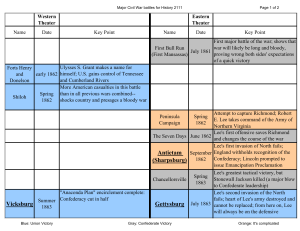
Major Civil War Battles
... Lee's first invasion of North fails; Antietam September England withholds recognition of the (Sharpsburg) 1862 Confederacy; Lincoln prompted to issue Emancipation Proclamation Peninsula Campaign ...
... Lee's first invasion of North fails; Antietam September England withholds recognition of the (Sharpsburg) 1862 Confederacy; Lincoln prompted to issue Emancipation Proclamation Peninsula Campaign ...
Battle of Shiloh
... was unaware of Buell’s arrival. Therefore, when William Nelson’s division of Buell’s army launched an attack at 6:00 am on April 7, Beauregard immediately ordered a counterattack. Though Beauregard's counter thrust was initially successful, Union resistance stiffened and the Confederates were compel ...
... was unaware of Buell’s arrival. Therefore, when William Nelson’s division of Buell’s army launched an attack at 6:00 am on April 7, Beauregard immediately ordered a counterattack. Though Beauregard's counter thrust was initially successful, Union resistance stiffened and the Confederates were compel ...
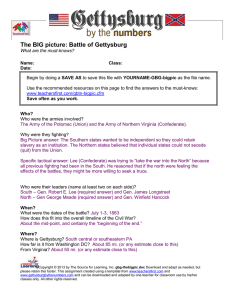
The Big Picture Answer Key
... Big Picture answer: The Southern states wanted to be independent so they could retain slavery as an institution. The Northern states believed that individual states could not secede (quit) from the Union. Specific tactical answer: Lee (Confederate) was trying to “take the war into the North” because ...
... Big Picture answer: The Southern states wanted to be independent so they could retain slavery as an institution. The Northern states believed that individual states could not secede (quit) from the Union. Specific tactical answer: Lee (Confederate) was trying to “take the war into the North” because ...

The Civil War - Mr. Howard`s Social Studies
... • Many people watch the battle from a distance, expecting an easy victory. • Confederacy rally’s behind General Thomas “Stonewall” Jackson and defeat the Union. • Shows that the war will not end quickly. ...
... • Many people watch the battle from a distance, expecting an easy victory. • Confederacy rally’s behind General Thomas “Stonewall” Jackson and defeat the Union. • Shows that the war will not end quickly. ...
LEQ: How will the north and south prepare for war?
... Confederate troops began to take forts Symbol of rebellion Confederate troops won the fort ...
... Confederate troops began to take forts Symbol of rebellion Confederate troops won the fort ...
Battle of Antietam

The Battle of Antietam /ænˈtiːtəm/, also known as the Battle of Sharpsburg, particularly in the South, fought on September 17, 1862, near Sharpsburg, Maryland, and Antietam Creek as part of the Maryland Campaign, was the first major battle in the American Civil War to take place on Union soil. It is the bloodiest single-day battle in American history, with a combined tally of dead, wounded, and missing at 22,717.After pursuing Confederate General Robert E. Lee into Maryland, Union Army Maj. Gen. George B. McClellan launched attacks against Lee's army, in defensive positions behind Antietam Creek. At dawn on September 17, Maj. Gen. Joseph Hooker's corps mounted a powerful assault on Lee's left flank. Attacks and counterattacks swept across Miller's Cornfield and fighting swirled around the Dunker Church. Union assaults against the Sunken Road eventually pierced the Confederate center, but the Federal advantage was not followed up. In the afternoon, Union Maj. Gen. Ambrose Burnside's corps entered the action, capturing a stone bridge over Antietam Creek and advancing against the Confederate right. At a crucial moment, Confederate Maj. Gen. A. P. Hill's division arrived from Harpers Ferry and launched a surprise counterattack, driving back Burnside and ending the battle. Although outnumbered two-to-one, Lee committed his entire force, while McClellan sent in less than three-quarters of his army, enabling Lee to fight the Federals to a standstill. During the night, both armies consolidated their lines. In spite of crippling casualties, Lee continued to skirmish with McClellan throughout September 18, while removing his battered army south of the Potomac River.Despite having superiority of numbers, McClellan's attacks failed to achieve force concentration, allowing Lee to counter by shifting forces and moving interior lines to meet each challenge. Despite ample reserve forces that could have been deployed to exploit localized successes, McClellan failed to destroy Lee's army. McClellan had halted Lee's invasion of Maryland, but Lee was able to withdraw his army back to Virginia without interference from the cautious McClellan. Although the battle was tactically inconclusive, the Confederate troops had withdrawn first from the battlefield, making it, in military terms, a Union victory. It had significance as enough of a victory to give President Abraham Lincoln the confidence to announce his Emancipation Proclamation, which discouraged the British and French governments from potential plans for recognition of the Confederacy.