
jlenz.file18.1460811221.ures
... South and that the war was going to take more time. Lincoln called for 500,000 volunteers. ** After losing the Battle of Bull Run, Lincoln replaced General McDowell with General George B. McClellan as the leader of the Union Army in the East. -McClellan put together a force of 100,000 and worked to ...
... South and that the war was going to take more time. Lincoln called for 500,000 volunteers. ** After losing the Battle of Bull Run, Lincoln replaced General McDowell with General George B. McClellan as the leader of the Union Army in the East. -McClellan put together a force of 100,000 and worked to ...

File
... Each of these battles was hard fought in searing heat with appalling casualties on both sides. At the final engagement - Malvern Hill - General Lee ordered his Confederate infantry to assault the entrenched Union troops. In reply, well-placed Union artillery cut the advancing Southern forces to shre ...
... Each of these battles was hard fought in searing heat with appalling casualties on both sides. At the final engagement - Malvern Hill - General Lee ordered his Confederate infantry to assault the entrenched Union troops. In reply, well-placed Union artillery cut the advancing Southern forces to shre ...
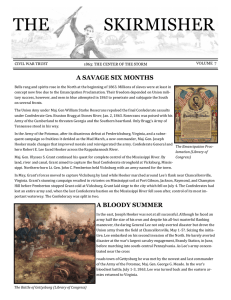
the print issue here!
... land, river and canal, Grant aimed to capture the final Confederate stronghold at Vicksburg, Mississippi. Northern-born Lt. Gen. John C. Pemberton held Vicksburg with an army named for the town. In May, Grant’s forces moved to capture Vicksburg by land while Hooker marched around Lee’s flank near Ch ...
... land, river and canal, Grant aimed to capture the final Confederate stronghold at Vicksburg, Mississippi. Northern-born Lt. Gen. John C. Pemberton held Vicksburg with an army named for the town. In May, Grant’s forces moved to capture Vicksburg by land while Hooker marched around Lee’s flank near Ch ...
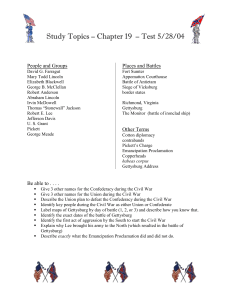

Battles of the Civil War
... • Surgeons did not wash their hands between patients • Far more soldiers died of disease and infection than from battle ...
... • Surgeons did not wash their hands between patients • Far more soldiers died of disease and infection than from battle ...


Chapter 16 Notes
... women in both North and South took over family farms and businesses • Others became nurses to help the wounded, both in hospitals and on battlefields • Clara Barton: ...
... women in both North and South took over family farms and businesses • Others became nurses to help the wounded, both in hospitals and on battlefields • Clara Barton: ...

Slavery and Civil War
... General Ulysses S Grant and the Army of the Mississippi (Union’s main western force) accepted the fortress city’s surrender the same day Lee retreated from ...
... General Ulysses S Grant and the Army of the Mississippi (Union’s main western force) accepted the fortress city’s surrender the same day Lee retreated from ...


Chapter 15-5 Notes: Decisive Battles
... Burnside used traditional tactics and sent wave after wave of troops charging Union lost 13,000 men while Confederates lost only 5,000 o Lincoln replaced Burnside with General Joseph Hooker May 1863, Hooker’s army battled a Confederate army half the size at Chancellorsville – leading to a Unio ...
... Burnside used traditional tactics and sent wave after wave of troops charging Union lost 13,000 men while Confederates lost only 5,000 o Lincoln replaced Burnside with General Joseph Hooker May 1863, Hooker’s army battled a Confederate army half the size at Chancellorsville – leading to a Unio ...

The Civil War
... 2. May ’63 south wins at Chancellorsville, VA (Stonewall Jackson dies) 3. Lee goes on the offensive into Maryland and up into PA – Gen. Meade (union) follows north, they meet at Gettysburg, PA ...
... 2. May ’63 south wins at Chancellorsville, VA (Stonewall Jackson dies) 3. Lee goes on the offensive into Maryland and up into PA – Gen. Meade (union) follows north, they meet at Gettysburg, PA ...
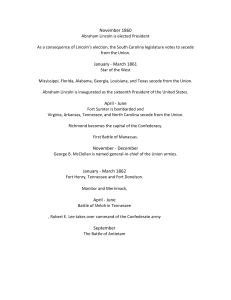
November 1860 - Georgetown ISD
... Star of the West Mississippi, Florida, Alabama, Georgia, Louisiana, and Texas secede from the Union. Abraham Lincoln is inaugurated as the sixteenth President of the United States. ...
... Star of the West Mississippi, Florida, Alabama, Georgia, Louisiana, and Texas secede from the Union. Abraham Lincoln is inaugurated as the sixteenth President of the United States. ...

Civil War Turning Points (1863)
... Lee divided force again, sending 28,000 men with Stonewall Jackson on 14-mile march through dense Wilderness and around Union right flank Hooker was convinced Jackson was retreating and did not attack Lee’s tiny remaining force Stonewall attacks Hooker’s unsuspecting army from rear ...
... Lee divided force again, sending 28,000 men with Stonewall Jackson on 14-mile march through dense Wilderness and around Union right flank Hooker was convinced Jackson was retreating and did not attack Lee’s tiny remaining force Stonewall attacks Hooker’s unsuspecting army from rear ...
Civil War Jeopardy Review
... being the single deadliest battle in American history. It also provided the victory needed for Lincoln to issue his Emancipation Proclamation. ...
... being the single deadliest battle in American history. It also provided the victory needed for Lincoln to issue his Emancipation Proclamation. ...


The Civil War - Petal School District
... “I cannot raise my hand against my relatives, my children, my home.” 40. Robert E. Lee ...
... “I cannot raise my hand against my relatives, my children, my home.” 40. Robert E. Lee ...
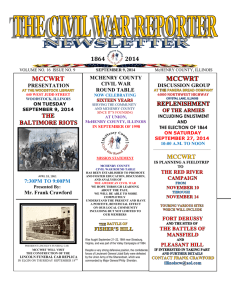
September - McHenry County Civil War Round Table
... would be carried out by the Army of the James under Maj. Gen. Benjamin Butler against the Confederate works at Chaffin's Farm. The western attack was to be carried out by the Union V Corps under Maj. Gen. Gouverneur K. Warren and a cavalry division under Brig. Gen. David . Gregg with units from the ...
... would be carried out by the Army of the James under Maj. Gen. Benjamin Butler against the Confederate works at Chaffin's Farm. The western attack was to be carried out by the Union V Corps under Maj. Gen. Gouverneur K. Warren and a cavalry division under Brig. Gen. David . Gregg with units from the ...

Copyright, USHistoryTeachers.com All Rights Reserved. Name: Date:_
... The South Loses a General - In December of 1862, Robert E. Lee defeated Union forces in Fredericksburg, Virginia. The South achieved another victory in Chancellorsville, Virginia in the Spring of 1863. - It seemed as if the South was gaining the upper hand. - However, at Chancellorsville, Thomas “St ...
... The South Loses a General - In December of 1862, Robert E. Lee defeated Union forces in Fredericksburg, Virginia. The South achieved another victory in Chancellorsville, Virginia in the Spring of 1863. - It seemed as if the South was gaining the upper hand. - However, at Chancellorsville, Thomas “St ...


Civil War to Gettyburg - Sign in to Westminster School
... • Wait for, then resist and wear down invasion • Seek alliances with Europe • Take the war to the North when possible, to shock the public out of their enthusiasm for war’s human, social, and financial costs ...
... • Wait for, then resist and wear down invasion • Seek alliances with Europe • Take the war to the North when possible, to shock the public out of their enthusiasm for war’s human, social, and financial costs ...
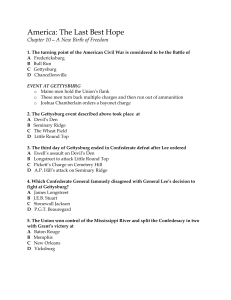
Chapter 10 Multiple Choice in WORD
... B Seminary Ridge C The Wheat Field D Little Round Top 3. The third day of Gettysburg ended in Confederate defeat after Lee ordered A Ewell’s assault on Devil’s Den B Longstreet to attack Little Round Top C Pickett’s Charge on Cemetery Hill D A.P. Hill’s attack on Seminary Ridge 4. Which Confederate ...
... B Seminary Ridge C The Wheat Field D Little Round Top 3. The third day of Gettysburg ended in Confederate defeat after Lee ordered A Ewell’s assault on Devil’s Den B Longstreet to attack Little Round Top C Pickett’s Charge on Cemetery Hill D A.P. Hill’s attack on Seminary Ridge 4. Which Confederate ...

Chapter 11.1
... troops toward Washington, D.C. In August, Lee’s troops won a resounding victory at the second Battle of Bull Run. A few days later, they crossed the Potomac River into the Union State of Maryland. At this point McClellan had a tremendous stroke of luck. His troops found a plan that revealed that Lee ...
... troops toward Washington, D.C. In August, Lee’s troops won a resounding victory at the second Battle of Bull Run. A few days later, they crossed the Potomac River into the Union State of Maryland. At this point McClellan had a tremendous stroke of luck. His troops found a plan that revealed that Lee ...
Battle of Antietam

The Battle of Antietam /ænˈtiːtəm/, also known as the Battle of Sharpsburg, particularly in the South, fought on September 17, 1862, near Sharpsburg, Maryland, and Antietam Creek as part of the Maryland Campaign, was the first major battle in the American Civil War to take place on Union soil. It is the bloodiest single-day battle in American history, with a combined tally of dead, wounded, and missing at 22,717.After pursuing Confederate General Robert E. Lee into Maryland, Union Army Maj. Gen. George B. McClellan launched attacks against Lee's army, in defensive positions behind Antietam Creek. At dawn on September 17, Maj. Gen. Joseph Hooker's corps mounted a powerful assault on Lee's left flank. Attacks and counterattacks swept across Miller's Cornfield and fighting swirled around the Dunker Church. Union assaults against the Sunken Road eventually pierced the Confederate center, but the Federal advantage was not followed up. In the afternoon, Union Maj. Gen. Ambrose Burnside's corps entered the action, capturing a stone bridge over Antietam Creek and advancing against the Confederate right. At a crucial moment, Confederate Maj. Gen. A. P. Hill's division arrived from Harpers Ferry and launched a surprise counterattack, driving back Burnside and ending the battle. Although outnumbered two-to-one, Lee committed his entire force, while McClellan sent in less than three-quarters of his army, enabling Lee to fight the Federals to a standstill. During the night, both armies consolidated their lines. In spite of crippling casualties, Lee continued to skirmish with McClellan throughout September 18, while removing his battered army south of the Potomac River.Despite having superiority of numbers, McClellan's attacks failed to achieve force concentration, allowing Lee to counter by shifting forces and moving interior lines to meet each challenge. Despite ample reserve forces that could have been deployed to exploit localized successes, McClellan failed to destroy Lee's army. McClellan had halted Lee's invasion of Maryland, but Lee was able to withdraw his army back to Virginia without interference from the cautious McClellan. Although the battle was tactically inconclusive, the Confederate troops had withdrawn first from the battlefield, making it, in military terms, a Union victory. It had significance as enough of a victory to give President Abraham Lincoln the confidence to announce his Emancipation Proclamation, which discouraged the British and French governments from potential plans for recognition of the Confederacy.